
The Sprite
BUILDING A SPRITE — *a finished sprite is not one trick. it is pixels placed, colors ramped, light chosen, edges outlined, and jaggies smoothed — each craft laid over the last, in order.*
Press play to listen along. The line being read lights up as you go.
Show full transcript
Loading transcript…
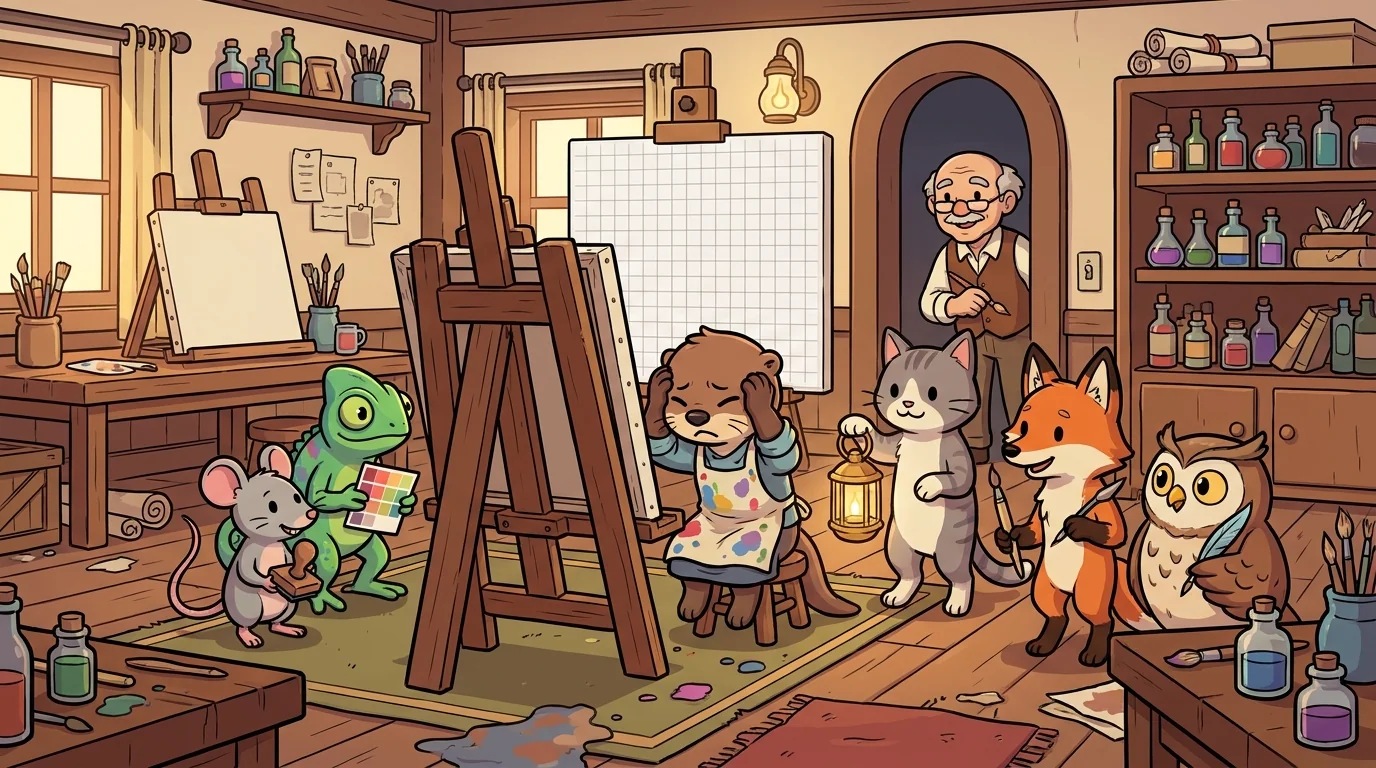
Sumi wanted to make one perfect sprite, and she wanted to make it all at once.
The otter-kit sat in the PixelForge studio, staring at a blank 32-by-32 grid, paralyzed. "I want to make a little hero character," she said. "A finished one, that looks real and round and clean. But every time I start I try to do everything at the same time — the shape and the colors and the shading and the outline — and it turns into a muddy mess and I give up." She slumped. "How do you make a whole sprite? It's too many things at once."
Palette, the studio's kind old teacher, smiled from the doorway. "Ah. You've found the secret nobody tells beginners: you don't do it all at once. A sprite is built in layers — one craft laid over the last, in order. Each of my artists holds one layer. Watch them build your little hero together, and you'll see there's no such thing as 'all at once.' There's only 'one patient layer at a time.'"
Five artists gathered around the blank grid: Speck the mouse with her pixel-stamp, Shade the chameleon with her color-ramp, Sheen the cat with her brass lantern, Rim the fox with his reed-pen, and Feather the owl with his smoothing-quill.
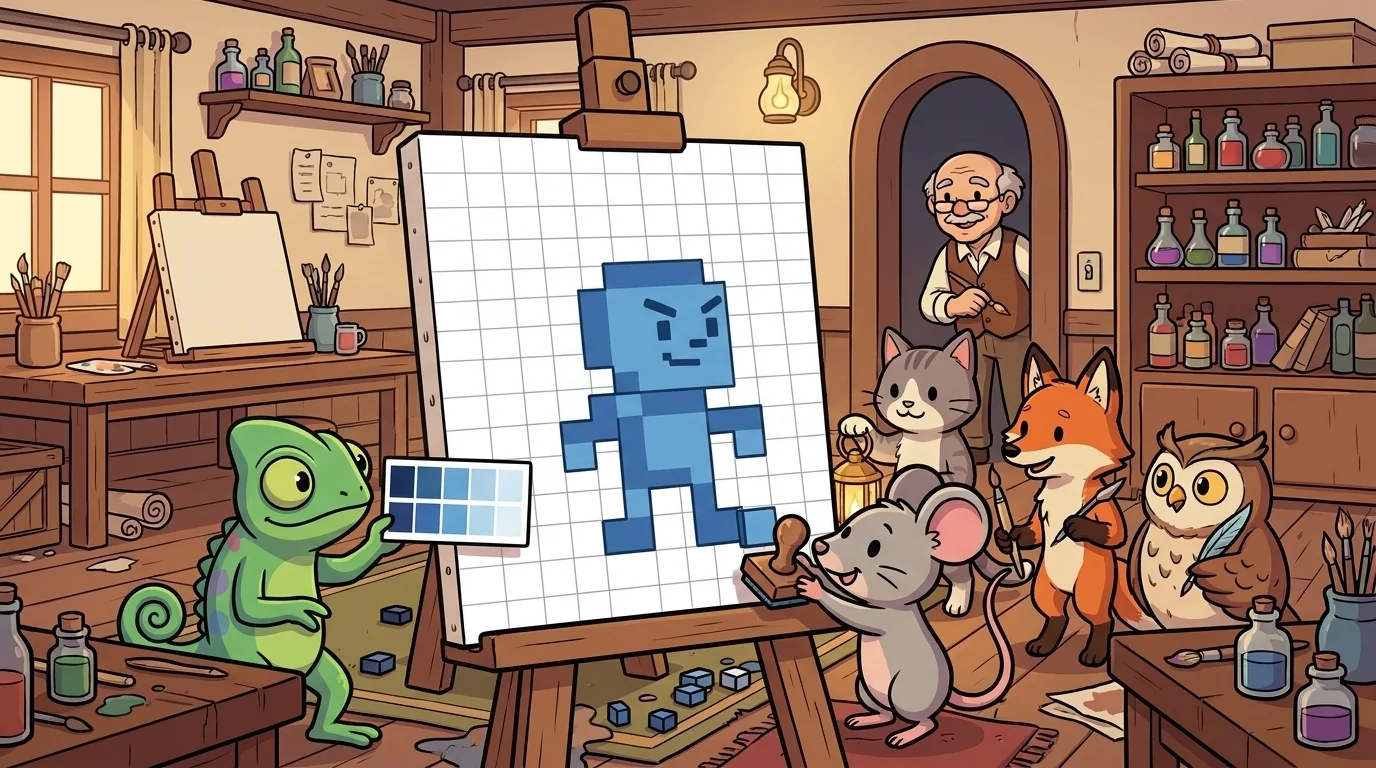
Speck went first, because everything in pixel art starts with her. With her pixel-stamp she placed the shape — one careful square at a time — a little round hero, arms and legs and a determined face, in flat single-color blocks. "Just the shape first," she said, nudging a pixel left, then right. "Don't worry about color or light yet. Get the form readable in flat blocks. If the shape doesn't read now, no amount of shading will save it later." She stepped back. It was blocky and plain — but you could tell, unmistakably, it was a little hero.
Then Shade the chameleon slid in with her palette-ramp — a row of colors from darkest to lightest. "Now the flat blocks get a range," she said. She replaced Speck's single flat colors with her ramps: not one blue, but five blues from deep navy to pale sky, ready to shape roundness. "One flat color looks like a sticker. A ramp — dark to light — is what lets a shape look like it has form. I don't decide where the light goes yet. I just lay out the ladder of colors so someone else can." Speck's pixels and Shade's palette — Pixels and Palette, the two of them a pair — turned a flat blocky hero into one ready to come alive.
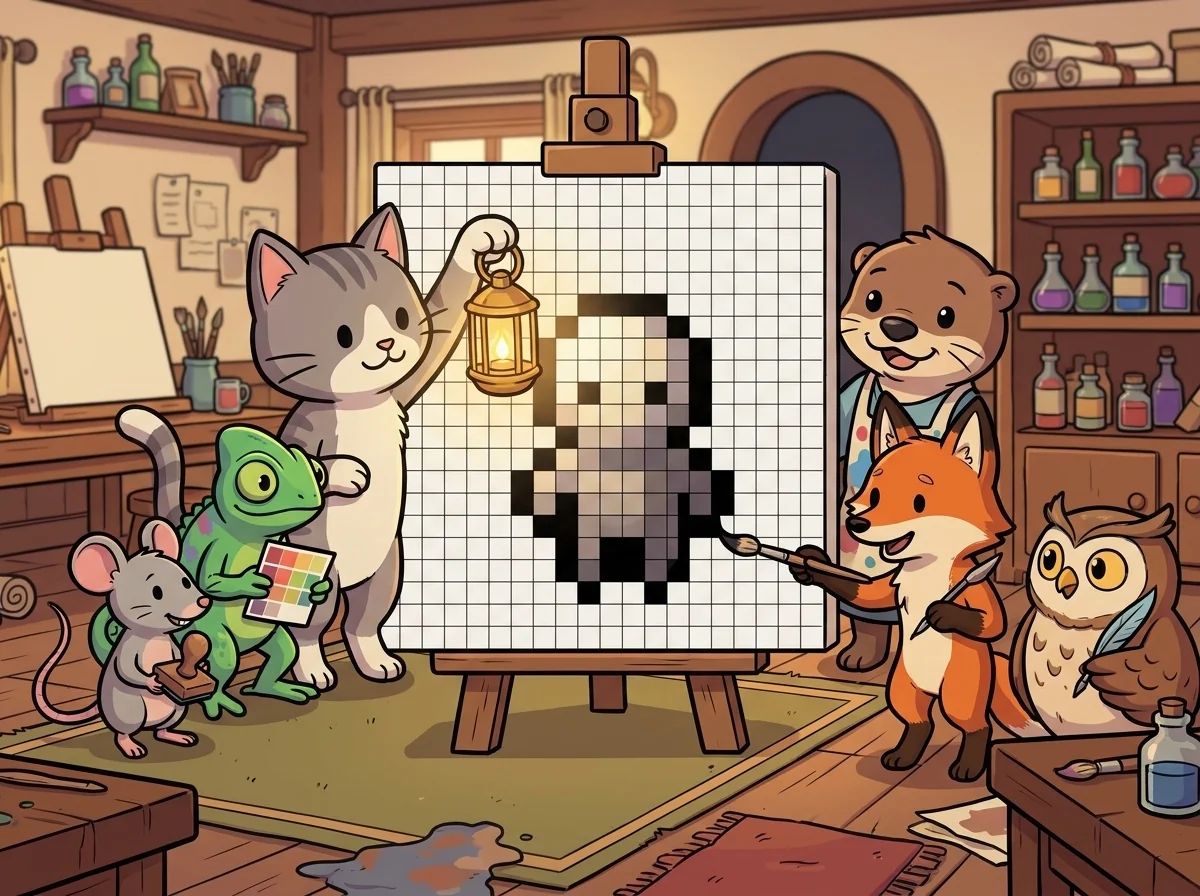
That someone was Sheen the cat, who raised her little brass lantern and aimed it at the top-left of the grid. "The light lives there," she announced. And she went to work with Shade's ramp: the pale colors on the top-left where the light struck, the deep colors on the bottom-right where it couldn't reach, the mid-tones curving around between. Suddenly Sumi's flat hero bulged — round arms, a rounded head, a solid little body catching the light. "One light, chosen and kept," Sheen said. "I put the bright end of Shade's ramp where the sun hits and the dark end where it doesn't. That's all 'round' is — a shape plus a decision about the light."
But against the busy studio background, the little hero's edges were starting to blur into the scene. Rim the fox stepped up with his reed-pen. "He's getting lost at the edges," he said, and laid a firm dark outline — but only along the shadow side, where the hero met the background, leaving the lit side open to breathe. "Selective outline. I separate him from the background where he'd otherwise vanish, but I don't wall him in on every side — that would make him look like a sticker again." Sheen's light and Rim's edge — Light and Edge, the two of them a pair — gave the hero both roundness and a clean place to stand in the world.
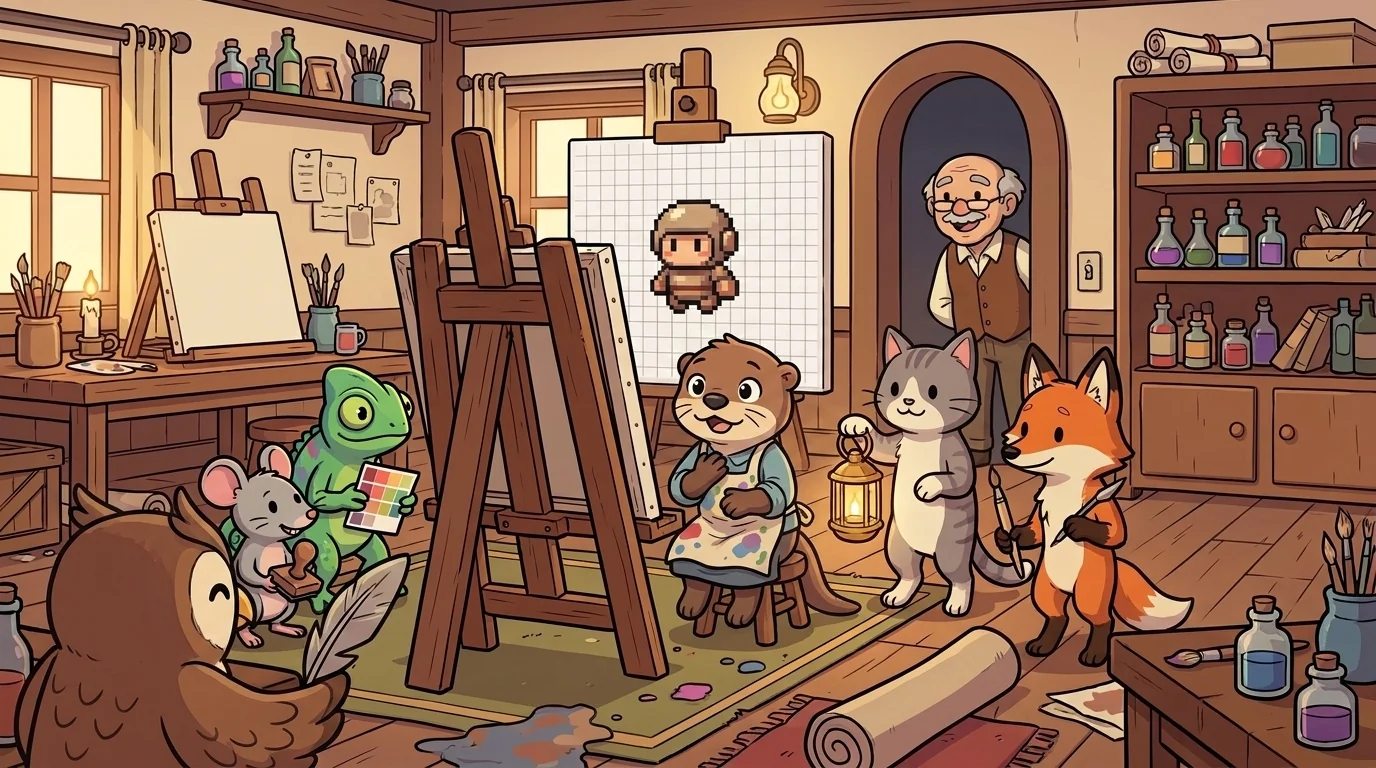
Only one thing was left. Up close, the hero's curves — his rounded helmet, his arm — climbed in little jagged stair-steps. Feather the owl drifted over with his smoothing-quill. "Almost done," he murmured. "Just the jaggies." At each corner where the curves stair-stepped, he tucked a single in-between-colored pixel — softening only the elbows, leaving the straight runs alone. He touched maybe a dozen pixels in all. "Not a lot. Just where the eye stumbles."
"Now — everyone step back," said Palette.
They all stepped back from the grid. And there, where a blank square had been, stood a finished sprite: a little round hero, solid and lit, cleanly separated from the world, his curves smooth, his colors ranged — alive. Not one of the five had done everything. Each had laid one patient layer over the last: shape, then palette, then light, then edge, then smoothing. And together, in order, they'd made a whole character.
"He's real," Sumi breathed. "He looks like he could walk off the grid."
"Because he was built the way every good sprite is built," said Palette. "In layers. In order. Each craft trusting the one before it and setting up the one after. Speck's shape held Shade's ramp; Shade's ramp gave Sheen a light to place; Sheen's roundness told Rim where to outline; Rim's clean edges gave Feather something worth smoothing. No layer skipped. No layer rushed. No layer alone."
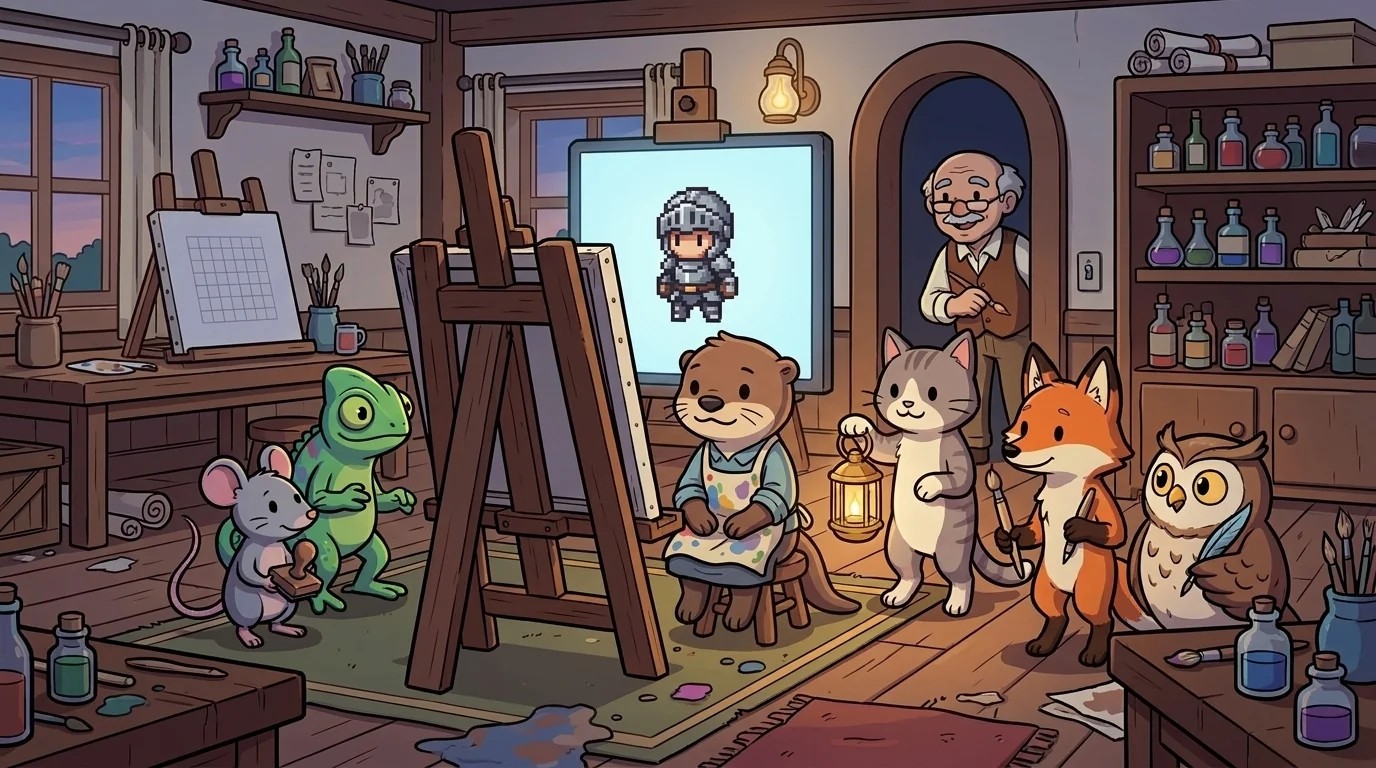
That evening, as the studio screens dimmed to a glow, Sumi lingered by her little hero, turning him this way and that.
"I always tried to do the whole thing at once," she admitted, "and it always turned to mud, and I felt like I just wasn't good enough to make a real sprite."
Palette sat beside the otter-kit as the five artists gathered close. "You were plenty good enough. You were just trying to hold five crafts in your paws at the same time — nobody can do that. The trick isn't being brilliant enough to do it all at once. It's being patient enough to do one layer at a time, and to trust that the next layer will fix what this one leaves rough." She nodded at the little hero. "Speck's shape looked plain, and that was fine — Shade was coming. Shade's flat ramp looked lifeless, and that was fine — Sheen was coming. Every layer was allowed to be unfinished, because it wasn't alone. Neither are you."
Sumi looked at her finished hero — shape and color and light and edge and smoothing, five layers, five friends, one whole little character — and felt the overwhelmed, not-good-enough knot in her chest loosen into a warm, patient calm: the quiet joy of watching something become whole, one trusting layer at a time.
"One patient layer at a time," she said softly. "None of it alone."
Palette rested a paw on the otter-kit's shoulder, and Sumi felt the last of the overwhelmed feeling settle into a calm, glad warmth — the happy pride of having watched a blank grid, and a room full of friends, become one small living hero together. It was, she decided, the best feeling in the whole studio.
The PixelForge ensemble
The Sprite is part of PixelForge's distributed-narrative cast. Each character embodies a different curricular primitive; together they teach the full subject.
-

Speck
The single pixel — the atomic unit of pixel art; every image is a grid of these
-

Shade
The palette ramp — a small set of colors arranged from darkest to lightest (the foundation of pixel-art shading and form)
-
Grid
The tilemap grid — pixels snapped to repeating units that form tiles, tilesets, and game maps
-
Tween
The in-between frame — the animation frame that sits between two keyframes, giving motion its smoothness
-
Banner
The impact pose — the heroic / dramatic silhouette that reads instantly at thumbnail size (the principle that good character art is recognizable from its outline alone)
-
Stipple
Dithering — scattering two colors in a checker pattern so your eye blends them into a third; how pixel artists fake a smooth gradient with a tiny palette
-
Feather
Anti-aliasing — tucking a few in-between pixels along a jagged edge so a curve reads smooth instead of like a staircase
-
Sheen
Light source and form shading — choosing where the light comes from, then placing highlights and shadows so a flat shape turns round
-
Rim
Selective outlining — drawing the edge only where a sprite would get lost, so it pops from the background without looking boxed-in
-

Cycle
Color-cycling animation — making water and fire flow by shifting which colors sit in the palette slots, without moving a single pixel