
Cycle
COLOR-CYCLING ANIMATION — *making a picture move without moving a single pixel, by shifting which colors sit in the palette slots. how classic pixel water, fire, and waterfalls flow.*
Press play to listen along. The line being read lights up as you go.
Show full transcript
Loading transcript…
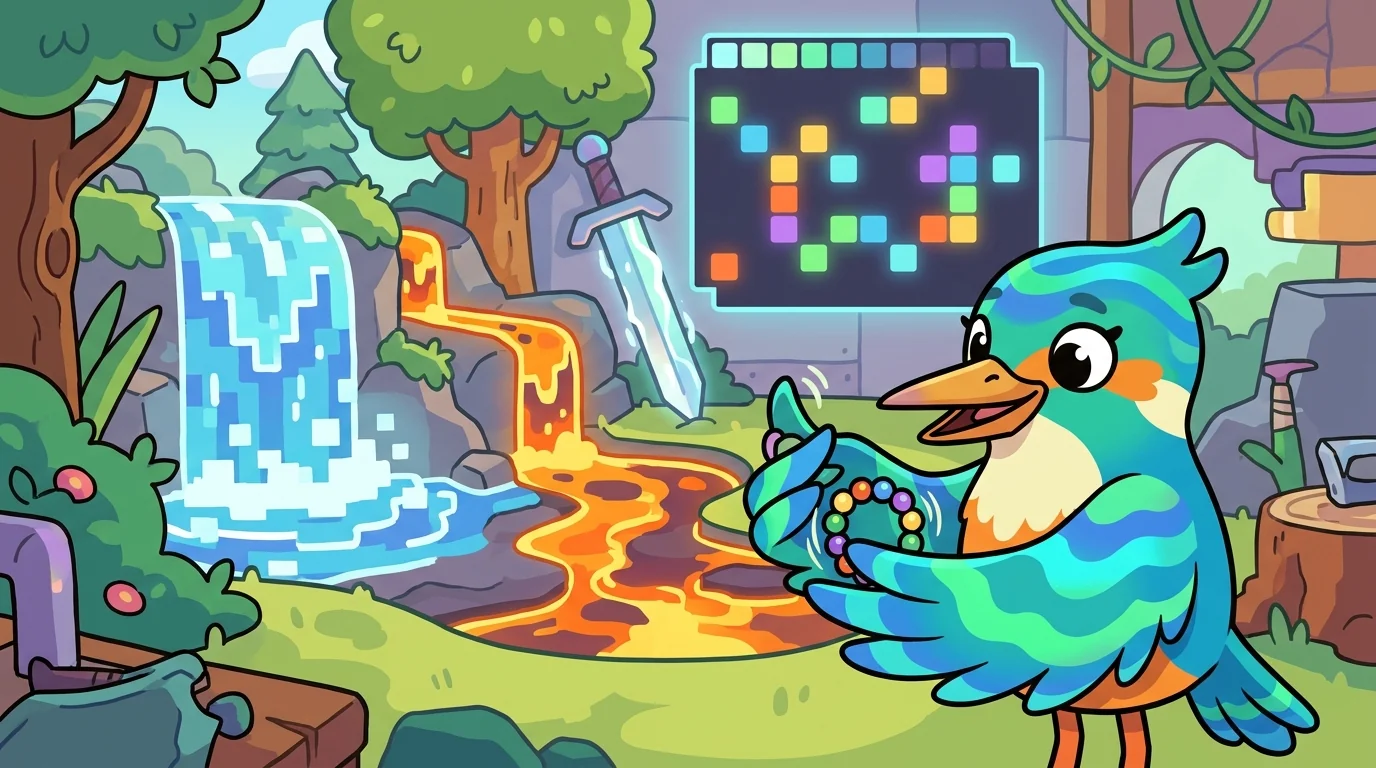
Cycle was a kingfisher-tween, bright as a struck match, and she was almost impossible to look at without feeling like she was in motion — even perfectly still, the bands of blue-green along her wings seemed to travel, shimmering from tail to tip, though her feathers never stirred. It was an illusion she wore on purpose. In her claw she carried a little wheel of colored beads on a ring, and she'd spin it slowly, click by click, so the same beads kept passing the same spot in a smooth endless flow. "Nothing's moving," she'd say, spinning it. "The beads just take turns being here. But your eye swears it's a river."
She worked on everything that needed to flow — waterfalls, lava, rippling ponds, the glow crawling along a magic sword. "Most animation moves the pixels," Cycle explained. "You draw the thing in a new spot, frame after frame. Tween's the master of that. But some things flow so smoothly that moving pixels would take a thousand frames. So I cheat, beautifully. I leave every pixel exactly where it is, and I only change which color sits in which palette slot. I shift the colors down the line — slot one to slot two, two to three, and the last one loops back to the front. The pixels never budge. The colors just march. And the water flows forever, out of almost nothing."
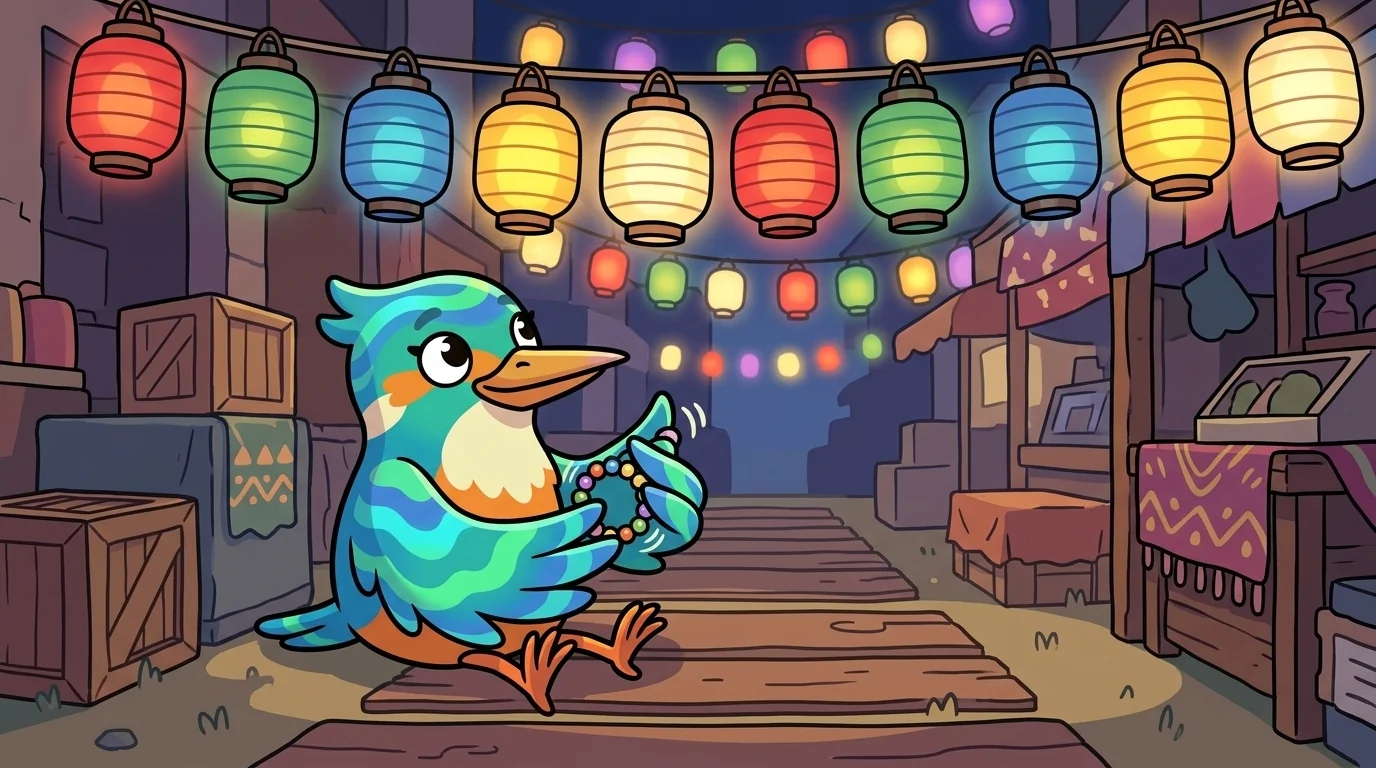
Cycle grew up beside the mill-race, where her family were lamplighters for the night-market. The market couldn't afford moving decorations — no spinning signs, no clockwork. What it had was a long row of colored paper lanterns strung over the lane, fixed in place, never moving an inch. But Cycle's mother had a trick that made the whole lane seem to ripple with light. Each night she'd change which lantern was lit brightest, one at a time down the row — this one, then the next, then the next — and loop back to the start. The lanterns hung dead still. Yet the brightness traveled along them like a wave running down a rope, and shoppers swore the lane was shimmering.
Little Cycle would lie under the lanterns for hours, checking. Are they moving? No. Are they moving? No. And yet the wave of light rolled on and on. "You don't need to move a thing to make it come alive," her mother said, relighting the row. "You just need to change one small thing in order, over and over, and let the eye do the traveling." Cycle fell in love with that — motion made out of patience and taking-turns, out of almost nothing at all. She strung her bead-wheel that same week and never stopped spinning it.
At twelve Cycle followed the road to PixelForge, bead-wheel clicking at her side. Palette met her at the door.
"What is color-cycling animation?"
Cycle spun her wheel one slow click. "It's making a picture move without moving any pixels," she said. "You set up a little group of colors in the palette — say the blues of a river. Then, over and over, you shift which color sits in which slot: each color steps to the next slot, and the last one loops back to the front. Every pixel stays exactly where it is. But the colors march along the line, and the eye reads it as flowing water. Motion out of taking-turns. It costs almost nothing and it never stops."
Palette watched the kingfisher whose still wings already seemed to travel. "You shimmer standing still," she said.
"I grew up under lanterns that never moved and shimmered all night," said Cycle.
"You're the one," Palette said, and the studio's warm light seemed, just for a moment, to ripple.
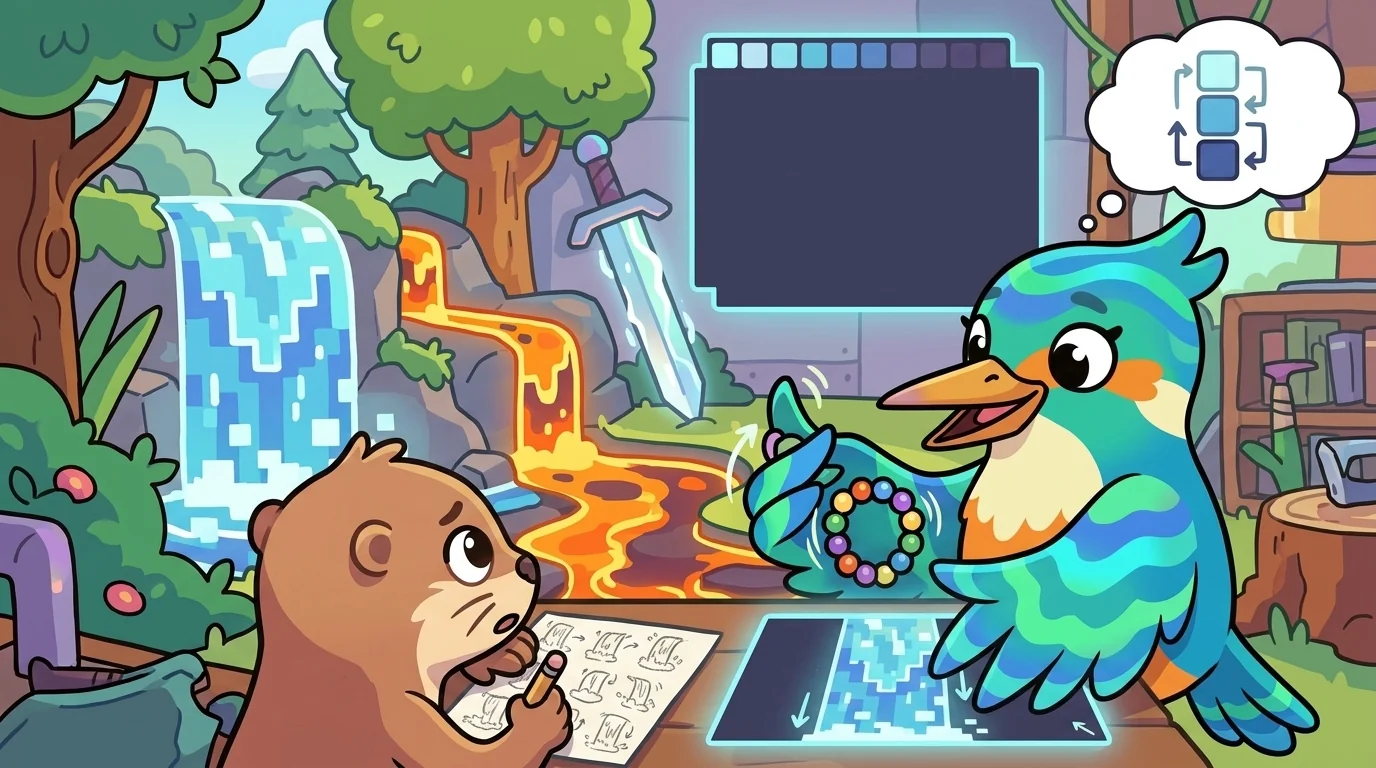
Cycle's workshop hummed with quiet, endless motion — still pictures on every wall, all of them somehow flowing. On her table sat the bead-wheel and a glowing canvas, and today Sumi the otter-kit was slumped beside a picture of a waterfall that would not fall.
"I want it to flow," Sumi said, "so I started drawing every frame of the water moving down, and I did nine frames and I'm exhausted and it's barely started and it looks jumpy."
"Oh, you poor thing, you've been moving all the pixels by hand," Cycle said, half-laughing, half-kind. "Put the pencil down. We're going to make this waterfall flow and you're not going to move one single pixel." She took the falling water — a set of pale-and-deep blue streaks — and grouped their colors into a little run of palette slots, lightest to darkest. Then she showed Sumi the shift: click, and every color hopped one slot down the line, the last looping back to the top. Click. Click. The pixels sat frozen. But the bands of light and dark began to travel down the waterfall — flowing, endless, smooth.
Sumi shot upright. "It's FALLING. But you didn't— the pixels didn't—"
"Not one of them moved," Cycle grinned. "The colors are just taking turns down the slots, and looping. That's the whole waterfall." She spun her bead-wheel alongside so Sumi could see the two flows match. Then she gave the little rules, click by click. Group your flowing colors together in the palette so you can march them as a set. Shift them in one steady direction and always loop the last back to the first, or the flow will stutter and die. Keep the run short — four or five colors usually flow better than twelve. And don't cycle colors that belong to still things, or your character's eyeballs will start swimming.
"A small change, in order, over and over," Cycle said. "That's all a river is."
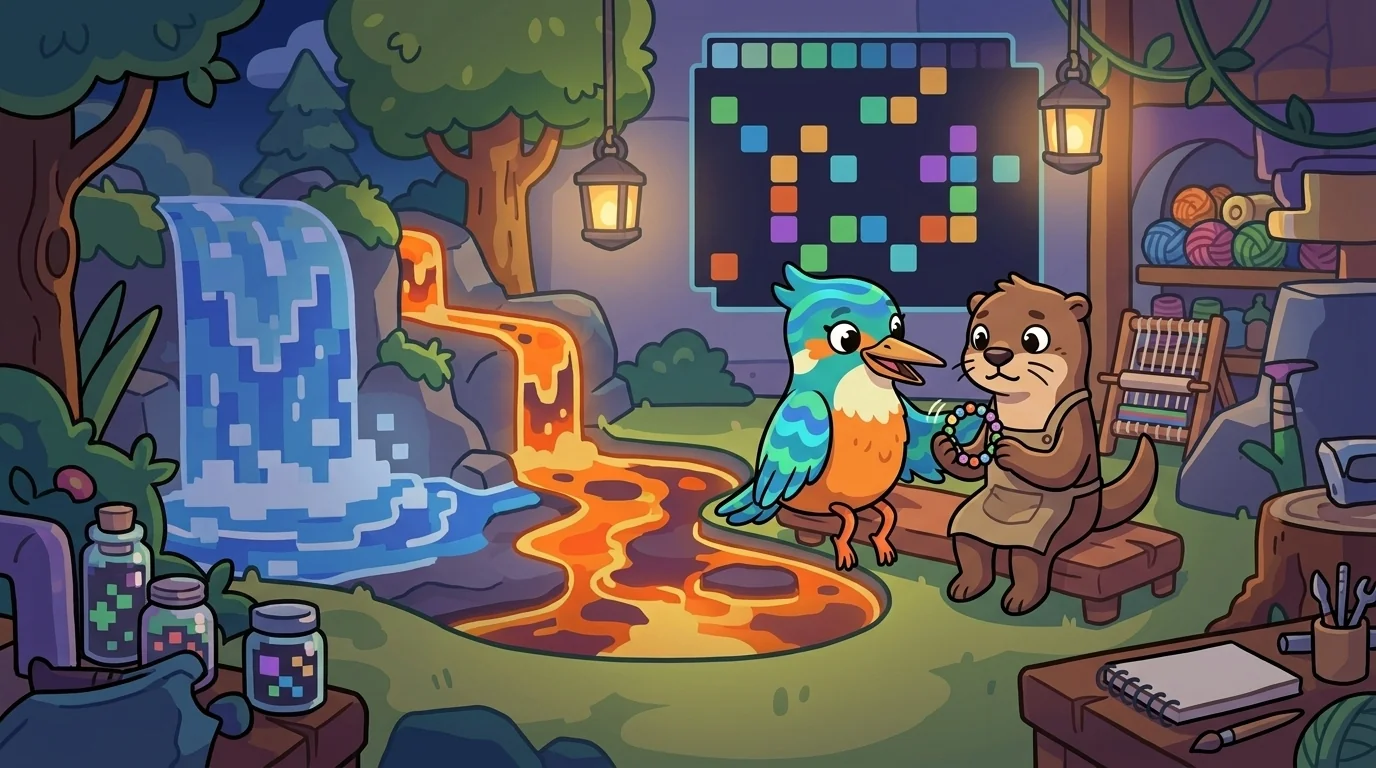
When the workshop lights dimmed — though the pictures kept flowing — Sumi stayed to watch the waterfall fall and fall.
"I feel kind of dumb," Sumi said. "I was drawing nine exhausting frames and you made it flow forever by changing which color's in which slot."
"Not dumb. You were doing it the hard, honest way, moving everything yourself." Cycle sat beside the otter and pressed the still-clicking bead-wheel into Sumi's paws. "Here's the secret my mother gave me under the lanterns: you almost never have to move everything to make something come alive. You just have to change one small thing, in order, over and over, and be patient enough to let it loop. The picture does the rest. The eye does the traveling."
Sumi held the spinning wheel, watching the beads take their endless turns, and felt the exhausted, jumpy frustration melt into something calm and almost hypnotized — the quiet wonder of watching a still thing come alive from almost nothing.
"Nothing moves," Cycle said softly, as the frozen waterfall poured on. "The colors just take turns. Isn't it a lovely feeling — watching it come alive like that?"
The PixelForge ensemble
Cycle is part of PixelForge's distributed-narrative cast. Each character embodies a different curricular primitive; together they teach the full subject.
-

Speck
The single pixel — the atomic unit of pixel art; every image is a grid of these
-

Shade
The palette ramp — a small set of colors arranged from darkest to lightest (the foundation of pixel-art shading and form)
-
Grid
The tilemap grid — pixels snapped to repeating units that form tiles, tilesets, and game maps
-
Tween
The in-between frame — the animation frame that sits between two keyframes, giving motion its smoothness
-

Banner
The impact pose — the heroic / dramatic silhouette that reads instantly at thumbnail size (the principle that good character art is recognizable from its outline alone)
-

Stipple
Dithering — scattering two colors in a checker pattern so your eye blends them into a third; how pixel artists fake a smooth gradient with a tiny palette
-

Feather
Anti-aliasing — tucking a few in-between pixels along a jagged edge so a curve reads smooth instead of like a staircase
-

Sheen
Light source and form shading — choosing where the light comes from, then placing highlights and shadows so a flat shape turns round
-

Rim
Selective outlining — drawing the edge only where a sprite would get lost, so it pops from the background without looking boxed-in
-

The Sprite
A finished character sprite coming to life — how placed pixels, a color ramp, chosen light, a clean outline, and smoothed edges layer together into one whole little hero