Grid
TILEMAP GRID — *pixels snapped to repeating tiles. tiles repeat; tilesets compose; maps emerge.*
Press play to listen along. The line being read lights up as you go.
Show full transcript
Loading transcript…
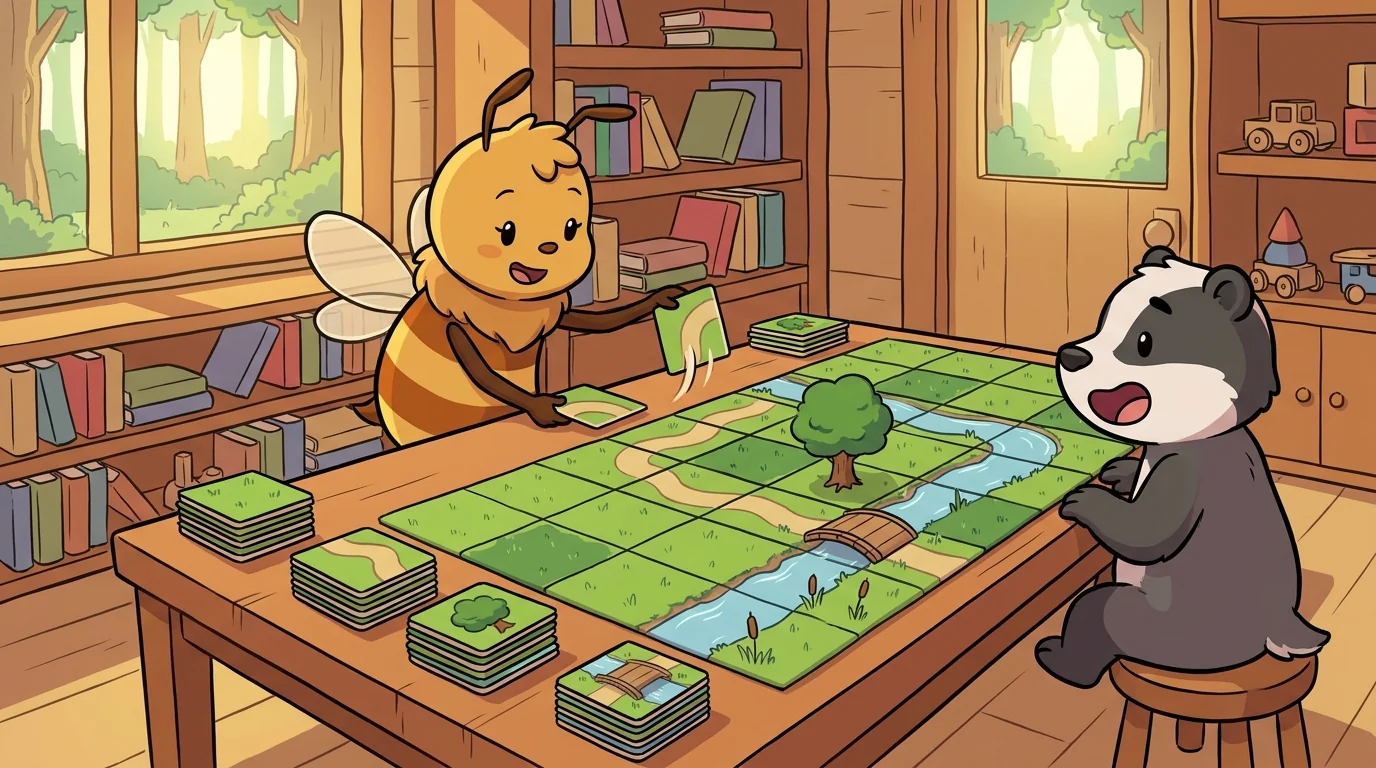
The forest grew across Grid's table one card at a time.
Flip. Tap. Click. A grass tile. Flip, tap, click. Another grass tile beside it. A bee-tween with soft amber stripes and no stinger at all, Grid worked her little deck like a card sharp — grass, grass, a winding path, grass, a single tree — until a whole slice of woodland sat there in the sunlight, complete.
A badger-cub named Rue watched with her mouth open. "You drew all that? That fast?"
"I didn't draw any of it," Grid said, and grinned. "I only had sixteen little pictures the whole time. Watch me do it again."
She swept the forest away and started over. Same sixteen cards. This time a river appeared, banked with reeds, crossed by a bridge. "Sixteen tiles," Grid said. "Endless worlds. That's the trick I want to show you."
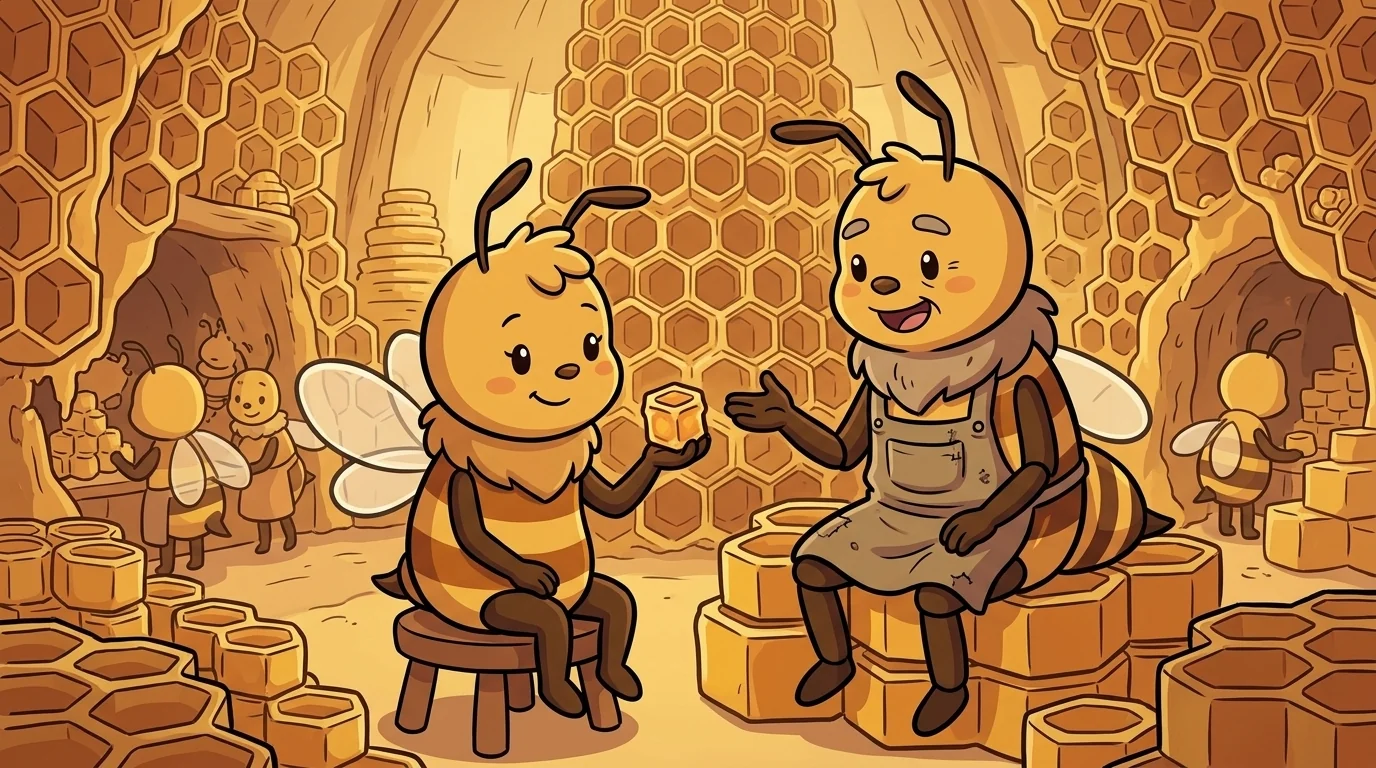
She'd learned it in the hive-village, where her family were honeycomb-builders. They never carved a hall out of one enormous slab. They made cells — small, identical, six-sided cells — and stacked them, and the stacking became the hall.
Little Grid had once asked her uncle why they didn't just build the whole warehouse at once, in one piece, and be done.
Her uncle had set a single wax cell in her palm. "This is boring alone," he agreed. "One cell. But a thousand of these" — he waved at the towering, humming hive around them — "and you have a village. Small pieces, made well, become big things. You do a little work a thousand times instead of a thousand pieces of work once."
Grid had turned the little cell over and over, feeling the odd, cozy pride of it: the huge hive was really just this, again and again.
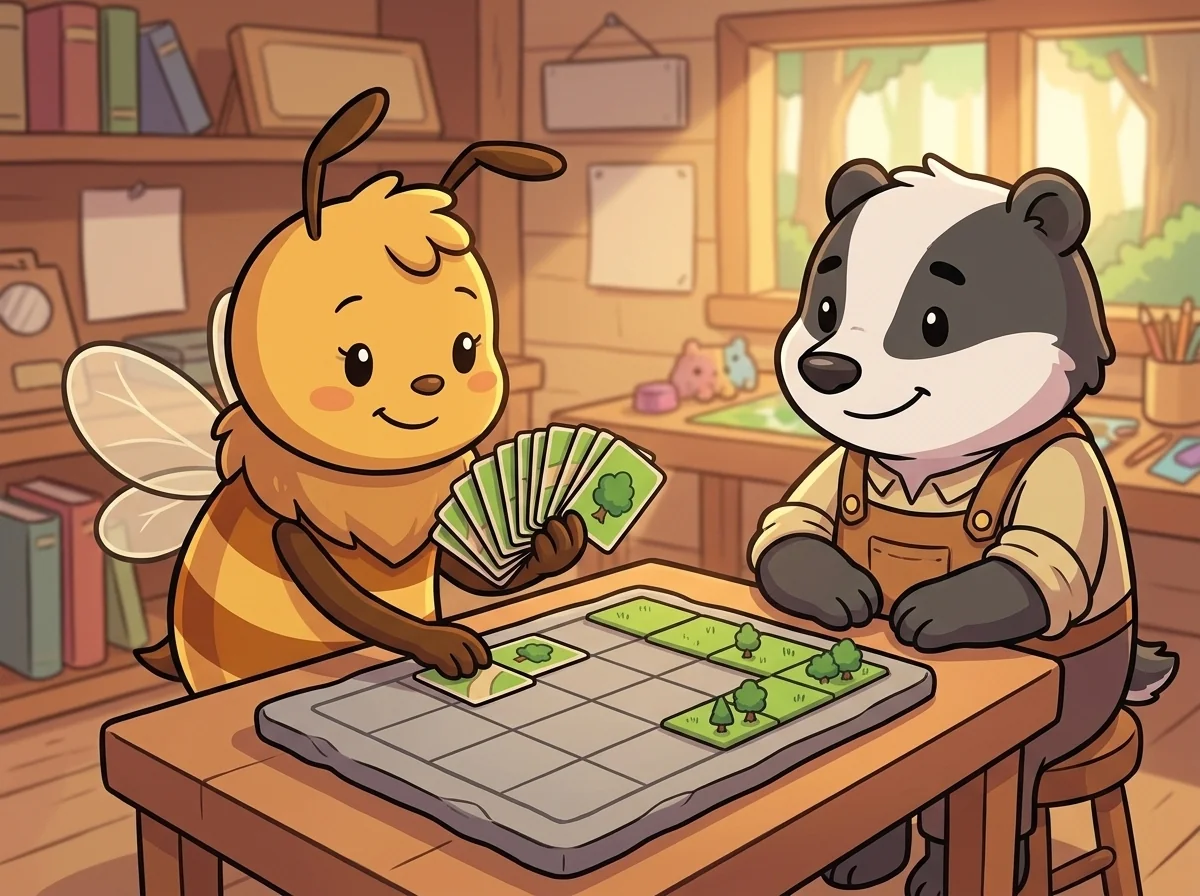
She walked down to PixelForge when she was twelve, carrying her deck of sixteen tiles, and her mentor Palette met her with an empty grid drawn on a slate.
"There's a whole overworld to build," Palette said. "Rivers, roads, forests, a mountain pass. How long, do you think, to draw every blade of grass by hand?"
"You wouldn't," Grid said. She fanned her deck. "You'd make a small set of good tiles — grass, water, path, rock, tree, some edge pieces for where they meet — and arrange them. The map comes from the arranging." She laid four cards down on Palette's grid and a corner of forest bloomed.
Palette looked at it a long moment. "Show the others how you think," she said. "That's what this place is for."
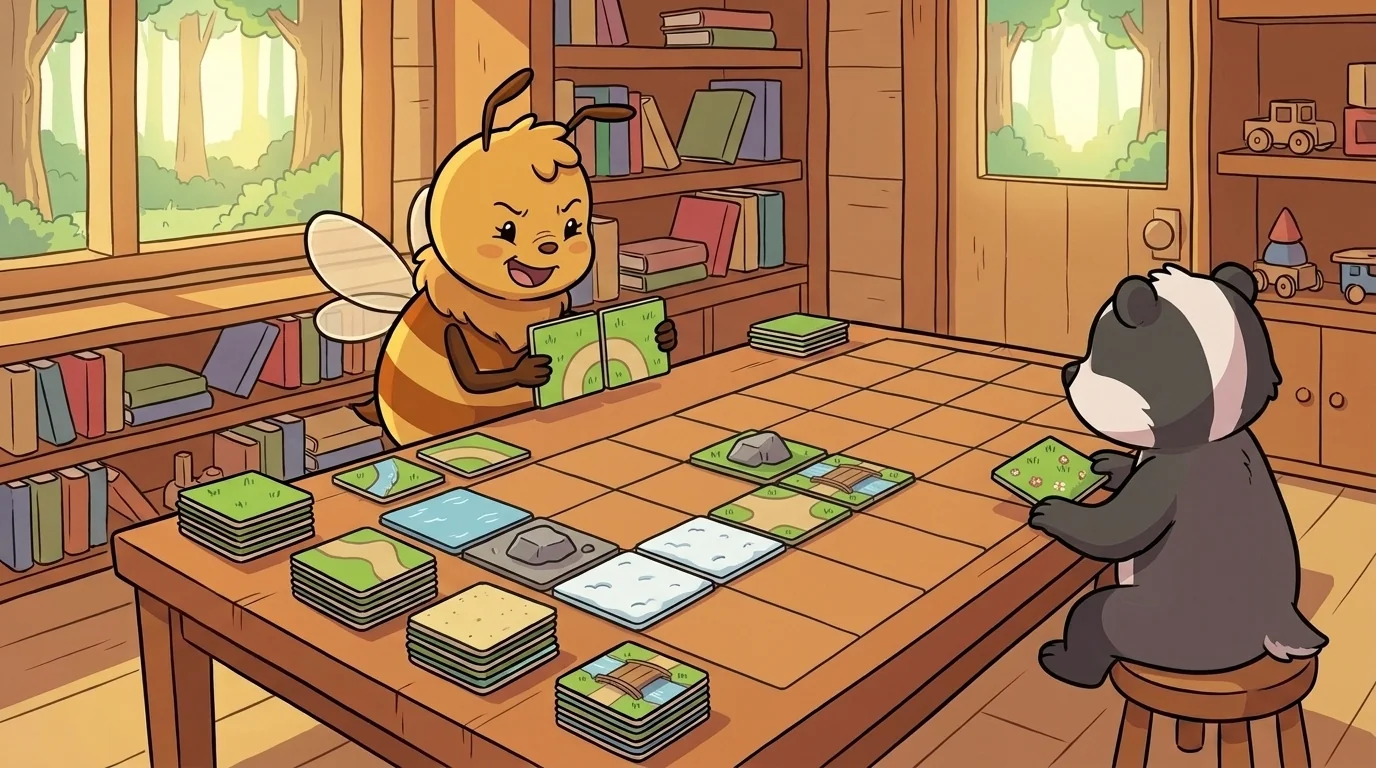
Now, in her own workshop, Grid pulled Rue close to the table and dealt out her full deck.
"Sixteen," she said. "Grass. Water. Path. Rock. Tree. Sand. Snow. Bridge — and a special edge piece for each place where one thing meets another." She held up two grass tiles side by side, then slid a third one against them so the green ran on seamlessly. "See how the edges kiss? A grass edge has to meet a grass edge exactly, or you get an ugly seam." She wrinkled her nose. "Nobody wants a world with cracks in the grass."
Rue picked up a tile. "But won't it get boring? Same grass everywhere?"
"Good question — that's the real danger," Grid said. She turned the grass tile over. On the back was almost-the-same grass, with a tiny flower, a slightly different clump. "So you make a few grass tiles that are almost alike. Sprinkle them in. The eye stops noticing the repeat." She tapped a rock tile. "And some tiles do more than sit pretty. Grass, you can walk on. Water might stop you. That big rock, too. What a tile is decides what happens in the game — not just how it looks."
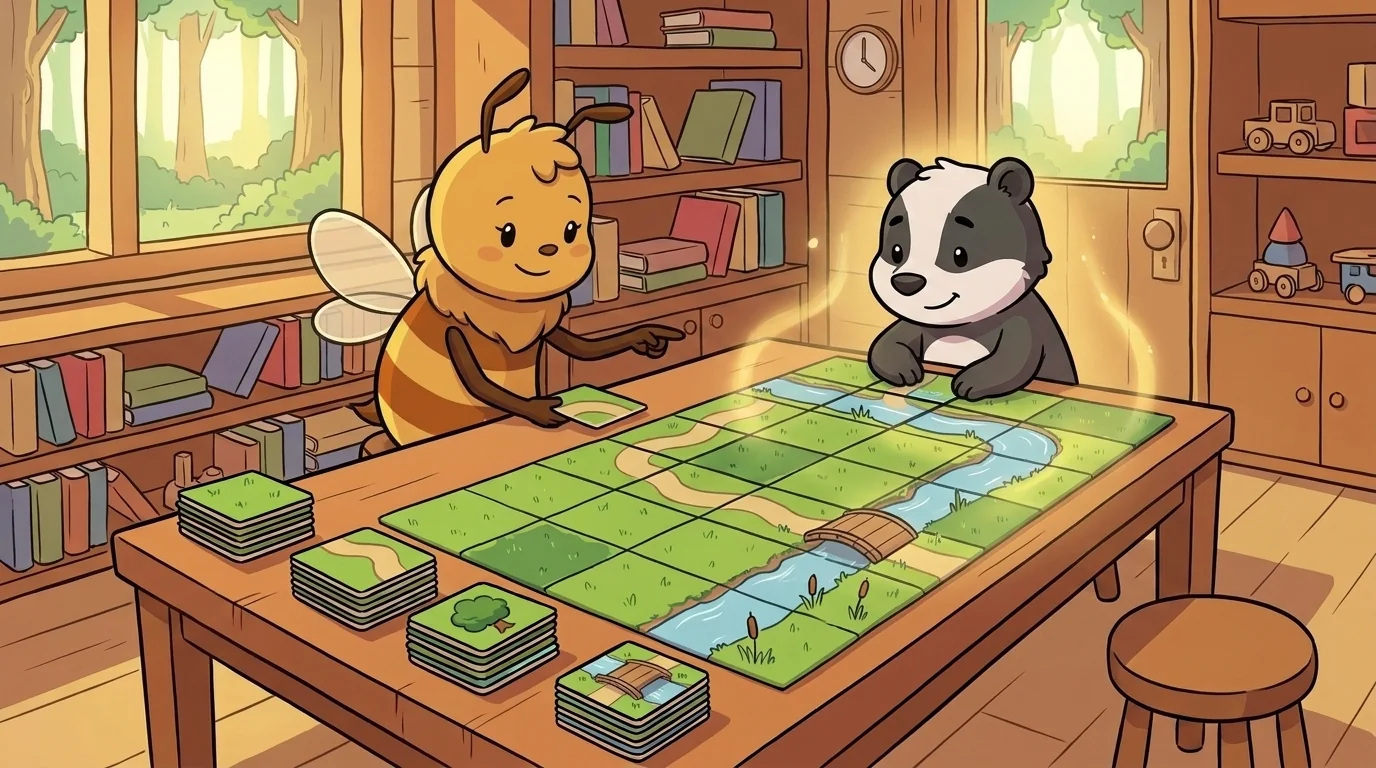
Rue tried it herself, clumsy at first — she jammed a water tile against a mountain and the river ran straight up a cliff.
Grid didn't fix it for her. "Slide the edge tile in between," she said, pointing. "The one that's half-water, half-shore."
Rue found it. Placed it. The river suddenly made sense, curving down to meet the land. She sat back, and something in her face relaxed all at once.
"There it is," Grid said softly.
"There's what?"
"That feeling. The big scary thing — a whole world — getting small and friendly in your hands." Grid rested her hand on her little deck of cards, and a warm, content feeling settled over her, the same cozy pride her family felt watching a hive grow from tiny cells. "That's what makes me happiest. Not the finished map. The moment you realize you don't have to draw the whole world — you just have to arrange it."
Rue looked down at the river she'd made from pieces, and Grid saw the exact moment the tiredness left her — that heavy, before-you-start dread melting into a light, curious, I-can-do-this hum.
"Can I keep going?" Rue asked, and she was already smiling.
"That happy feeling you've got right now," Grid said gently, pushing the deck toward her, "the one that says a big thing just turned small and friendly — hold onto it. That's the whole reason I love this."
The PixelForge ensemble
Grid is part of PixelForge's distributed-narrative cast. Each character embodies a different curricular primitive; together they teach the full subject.
-

Speck
The single pixel — the atomic unit of pixel art; every image is a grid of these
-

Shade
The palette ramp — a small set of colors arranged from darkest to lightest (the foundation of pixel-art shading and form)
-
Tween
The in-between frame — the animation frame that sits between two keyframes, giving motion its smoothness
-

Banner
The impact pose — the heroic / dramatic silhouette that reads instantly at thumbnail size (the principle that good character art is recognizable from its outline alone)
-
Stipple
Dithering — scattering two colors in a checker pattern so your eye blends them into a third; how pixel artists fake a smooth gradient with a tiny palette
-
Feather
Anti-aliasing — tucking a few in-between pixels along a jagged edge so a curve reads smooth instead of like a staircase
-
Sheen
Light source and form shading — choosing where the light comes from, then placing highlights and shadows so a flat shape turns round
-
Rim
Selective outlining — drawing the edge only where a sprite would get lost, so it pops from the background without looking boxed-in
-

Cycle
Color-cycling animation — making water and fire flow by shifting which colors sit in the palette slots, without moving a single pixel
-

The Sprite
A finished character sprite coming to life — how placed pixels, a color ramp, chosen light, a clean outline, and smoothed edges layer together into one whole little hero