
Stipple
DITHERING — *two colors, scattered in a pattern, that your eye blends into a third. how pixel artists fake a smooth gradient when the palette is tiny.*
Press play to listen along. The line being read lights up as you go.
Show full transcript
Loading transcript…
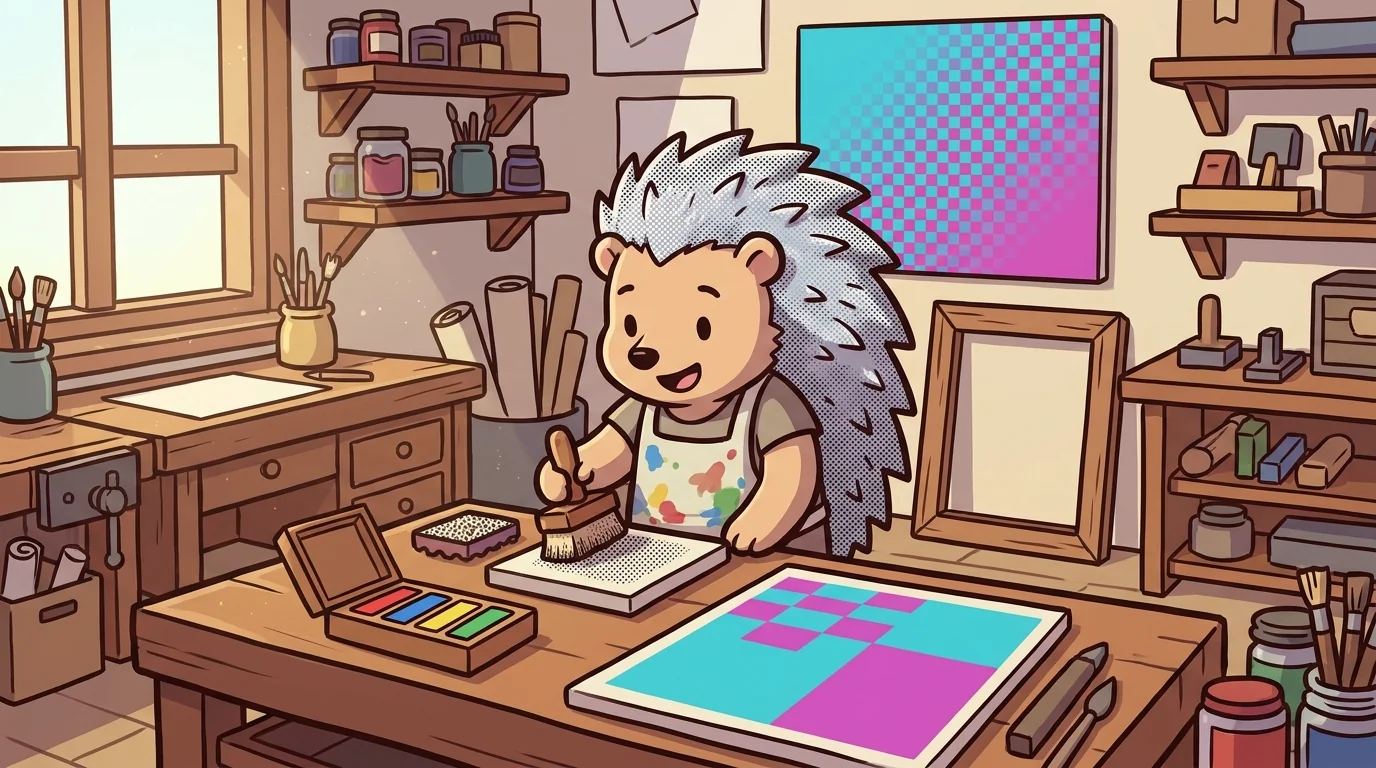
Stipple was a hedgehog-tween with a coat of short, blunt quills, each one tipped a slightly different shade of grey. When she got excited her quills lifted a little, and up close you could see they weren't really grey at all — they were tiny flecks of black and white, packed so close together that from across the room they read as one soft silver. That was Stipple's whole secret, worn right on her back. In her paw she carried a stippling-brush: a fat little tool that stamped not one pixel but a scattered handful, always in a careful checker.
She worked in the corner of the PixelForge studio where the palettes were smallest. Other artists had big glowing boxes of color. Stipple had a box with four colors in it, sometimes fewer, and she loved it that way. "Watch," she would say, and she'd tap two flat colors down side by side in a checker — one square of this, one square of that, this, that, this, that. Then she'd step you back three paces. The checker melted. Where there had been two colors, your eye now saw a third, hovering between them like a color that wasn't quite in the box at all.
"That's dithering," Stipple said, pleased. "Two colors, scattered on purpose. Your eye does the blending. I never actually make the in-between color. I just arrange the ones I have so you believe in it."
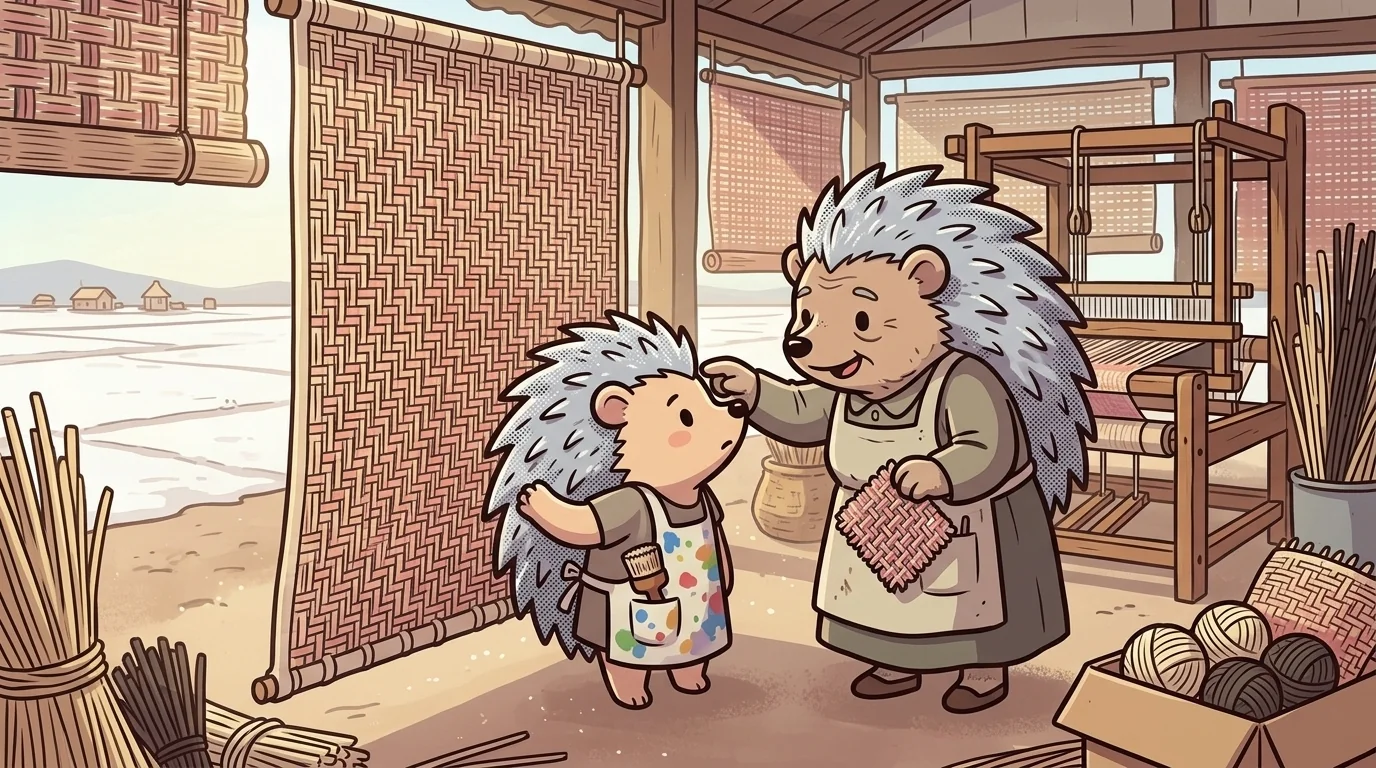
Stipple grew up in the salt-flats past the village, where her family were weavers. Not cloth-weavers — light-weavers. They made sunshades for the market stalls out of two threads only: a pale reed and a dark reed, no dyes, because dye was dear and reeds were free. A single pale reed looked pale. A single dark reed looked dark. But her grandmother could cross them in a pattern so tight that a finished shade glowed a warm dusty rose you couldn't find in either thread.
Little Stipple used to press her nose right up to the weave, hunting for the rose thread. There wasn't one. "There's no rose in here, Nan," she'd complain. "There's rose in your eye," her grandmother said, tapping Stipple gently between the eyebrows. "I only gave it a reason to happen. Two honest colors, crossed close. That's all a third color ever is when you're poor in thread and rich in patience."
Stipple never forgot the feeling of that — hunting for a color that wasn't there and slowly understanding it was there anyway, made out of nothing but arrangement. She started carrying a scrap of the sunshade everywhere. When people said her palette was too small to make anything beautiful, she'd hold up the scrap and smile.
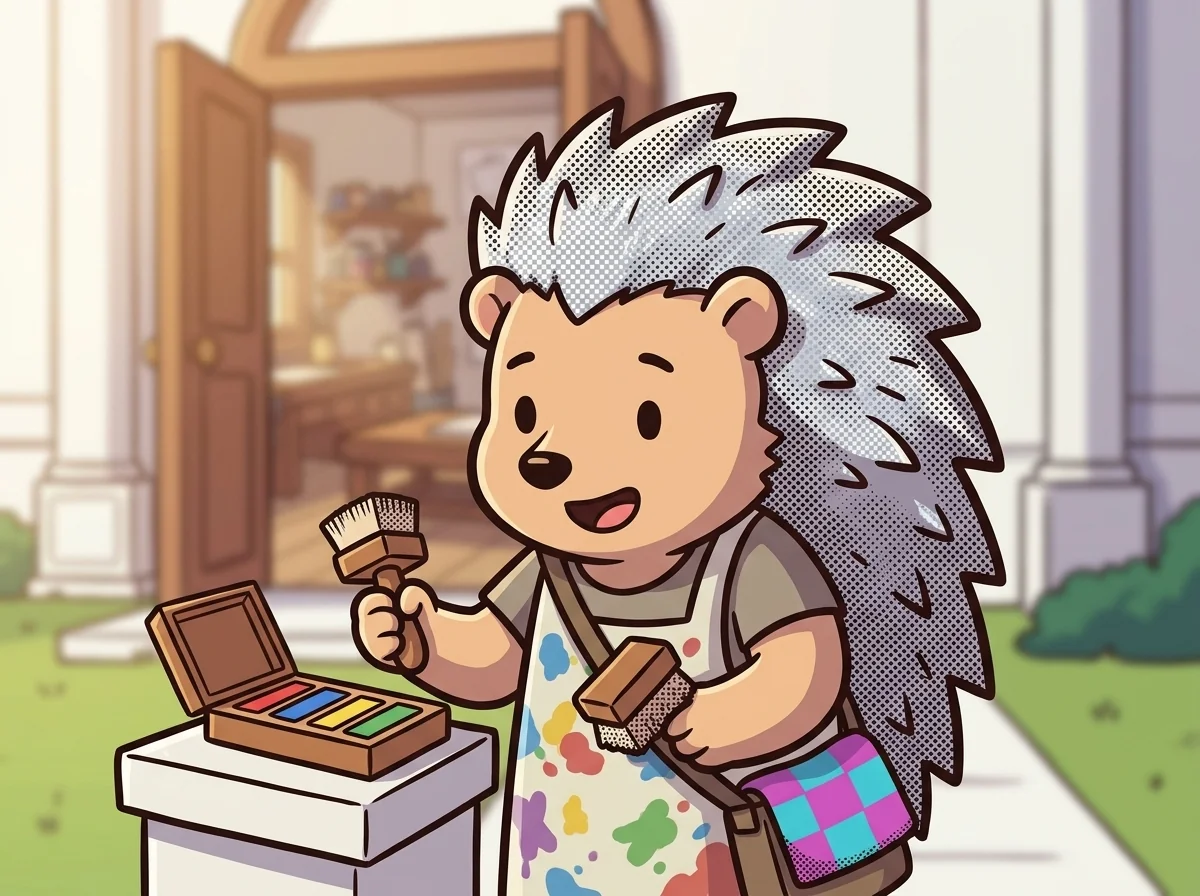
When Stipple was twelve she walked the long white road to PixelForge with her stippling-brush and one small box of four colors. Palette met her at the door, the way Palette met everyone, and asked the question she always asked.
"What is dithering?"
Stipple set her tiny box on the step. "It's a trick that isn't a trick," she said. "You take two colors you already have and you scatter them in a pattern, close together. My eye stops seeing two colors and starts seeing one that's in between. I never make the new color. I just arrange the old ones so it appears."
Palette looked at the four-color box, then at the pale-and-dark scrap of sunshade pinned to Stipple's satchel. "Most artists come here begging me for more colors," Palette said. "You came to show me you need fewer than you'd think."
"Fewer, arranged better," Stipple agreed.
Palette's whole face warmed. "You're the one," she said, and held the door.
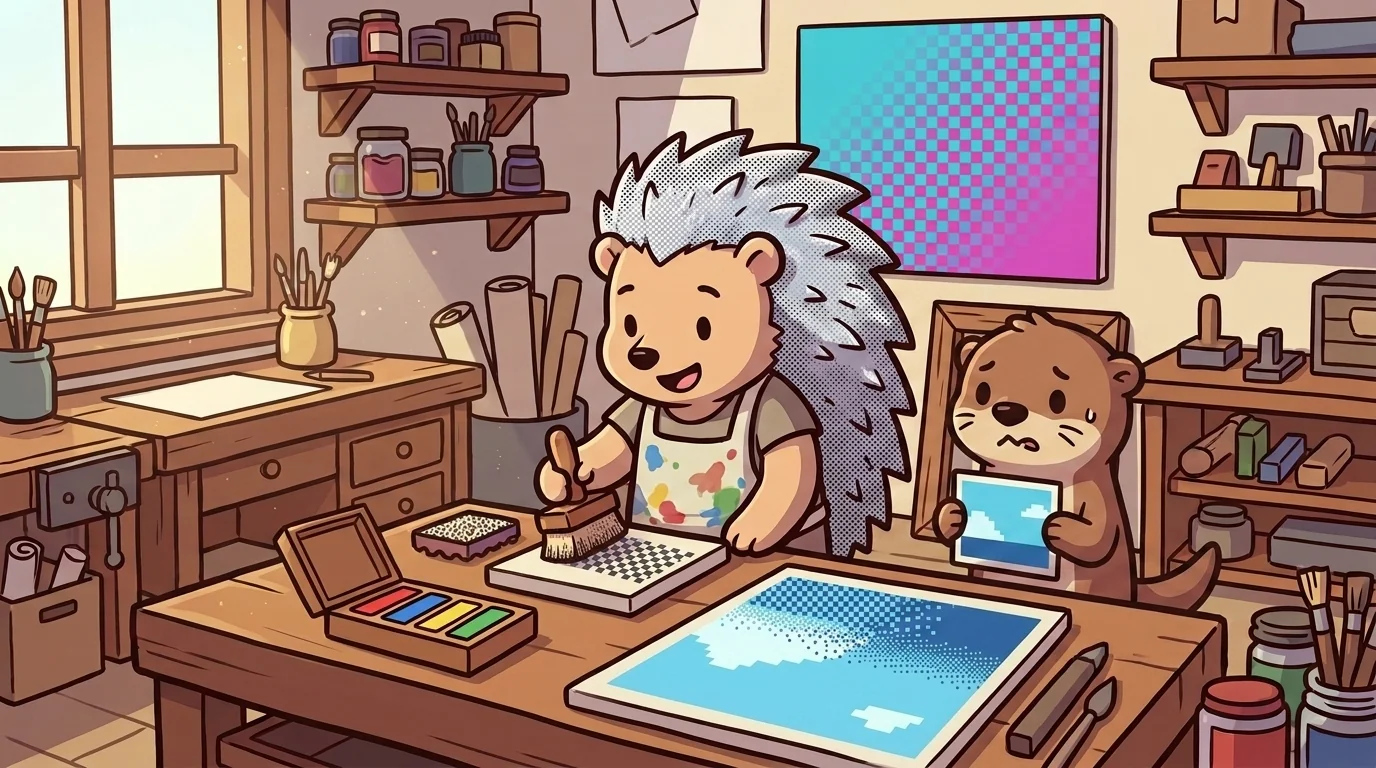
Stipple's workshop was the smallest in the studio and the one people crowded into most. On her worktable sat her four-color box and a big glowing canvas, and today a nervous otter-kit named Sumi stood beside her holding a picture of a sky. The sky was a problem. Sumi had only a light blue and a dark blue, and where they met the sky broke in a hard, ugly stripe — light on top, dark below, a seam like a crack.
"I want it to fade," Sumi said. "Soft. But I don't have the middle blues. I don't have enough."
"Let's find out how much enough is," Stipple said. She took the stippling-brush and worked right along the seam. Where light met dark she didn't add a new blue — she couldn't — she checkered the two she had. One light, one dark, one light, one dark, thick at the top, thinning as it went down. Up close it looked like a mess of dots. "Trust it," Stipple murmured. "Now step back with me."
They stepped back together. The seam was gone. The sky slid from light to dark through a soft speckled band that read, from three paces, as every blue in between.
Sumi's mouth fell open. "Where did the middle come from?"
"From your eyes, and from the two blues you already had." Stipple tapped Sumi gently between the eyebrows, the way her grandmother once had. "You weren't short on colors. You were short on arrangement. That's a much easier thing to be short on — you can fix it with patience instead of a bigger box."
She showed Sumi the small rules, one at a time. Keep the pattern even, so it reads as a smooth band and not a rash. Let the checker get denser where you want the color to lean one way, thinner where you want it to lean the other. Zoom out often, because dithering is a promise you make to a faraway eye, and you have to keep checking the eye still believes you. And don't panic when it looks wrong up close — up close it's supposed to look like scattered dots. The magic is a stepping-back magic.
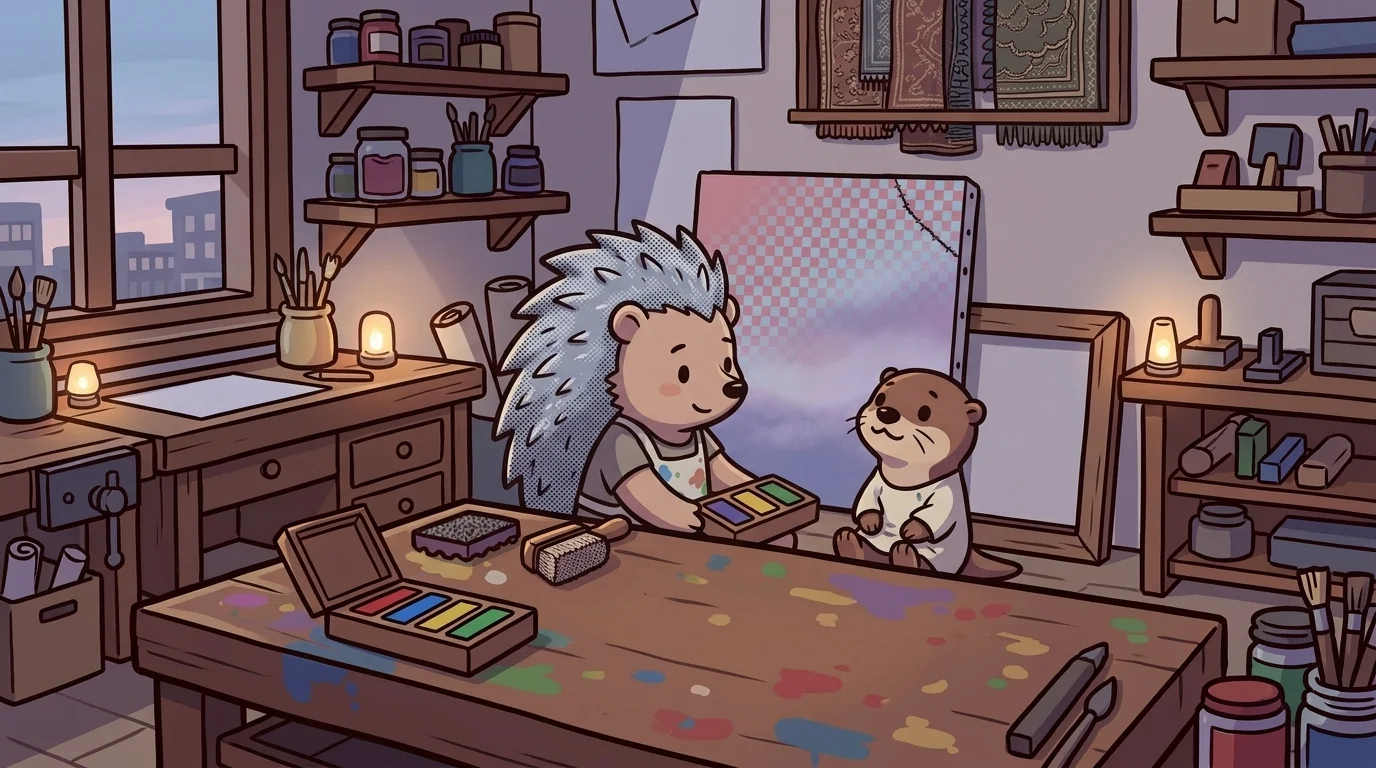
Later, when the studio had gone quiet and the canvases dimmed, Sumi lingered by Stipple's table, looking at the mended sky.
"I almost gave up," Sumi admitted. "I thought I couldn't make it soft because I didn't have the right colors. I felt kind of small about it."
Stipple sat down beside the little otter so they were the same height. "That small feeling — I know it well. I felt it my whole childhood, hunting for a rose thread that didn't exist." She nudged the four-color box toward Sumi. "Here's the thing nobody tells you: almost nobody has all the colors. Not really. What they have is two honest colors and the patience to cross them close. You did that today. You made a whole sky out of not enough, and it turned out enough was hiding in the arrangement the whole time."
Sumi looked at the box, then at the soft speckled sky, and something in the little shoulders came unclenched — the quiet relief of finding out you had been enough all along.
"Two colors, scattered on purpose," Stipple said softly, and her quills settled. "Your eye makes the third. Isn't it a good feeling — making more out of less?"
The PixelForge ensemble
Stipple is part of PixelForge's distributed-narrative cast. Each character embodies a different curricular primitive; together they teach the full subject.
-

Speck
The single pixel — the atomic unit of pixel art; every image is a grid of these
-

Shade
The palette ramp — a small set of colors arranged from darkest to lightest (the foundation of pixel-art shading and form)
-
Grid
The tilemap grid — pixels snapped to repeating units that form tiles, tilesets, and game maps
-
Tween
The in-between frame — the animation frame that sits between two keyframes, giving motion its smoothness
-

Banner
The impact pose — the heroic / dramatic silhouette that reads instantly at thumbnail size (the principle that good character art is recognizable from its outline alone)
-
Feather
Anti-aliasing — tucking a few in-between pixels along a jagged edge so a curve reads smooth instead of like a staircase
-

Sheen
Light source and form shading — choosing where the light comes from, then placing highlights and shadows so a flat shape turns round
-
Rim
Selective outlining — drawing the edge only where a sprite would get lost, so it pops from the background without looking boxed-in
-

Cycle
Color-cycling animation — making water and fire flow by shifting which colors sit in the palette slots, without moving a single pixel
-

The Sprite
A finished character sprite coming to life — how placed pixels, a color ramp, chosen light, a clean outline, and smoothed edges layer together into one whole little hero