
Feather
ANTI-ALIASING — *placing a few in-between pixels along a jagged edge so a curve or diagonal reads smooth instead of staircase-sharp. softening the stair-steps so the shape reads clearly.*
Press play to listen along. The line being read lights up as you go.
Show full transcript
Loading transcript…
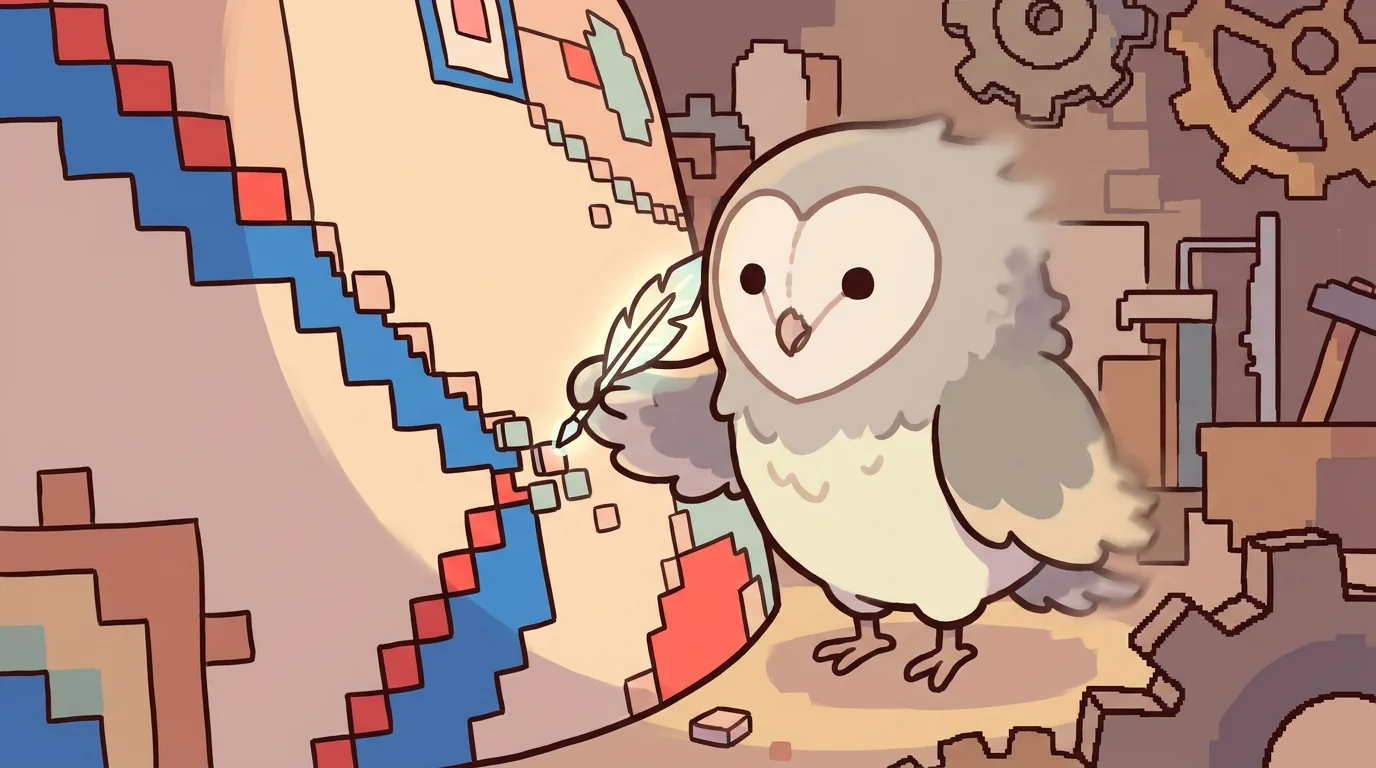
Feather was a barn-owl-tween, round and soft-edged, with a face like a pale heart and feathers so downy that his outline seemed to melt gently into the air around him. That melting was the point. When Feather stood in a doorway you couldn't say exactly where he ended and the light began — there was a hush of grey between him and everything else. In his wing he carried a fine, soft-tipped tool he called his smoothing-quill, and he used it to lay down single pale pixels along the edges of other people's art, in the exact spots where a shape went jagged.
He worked wherever curves and diagonals lived, because those were the shapes that suffered most on a grid. "A grid only knows squares," Feather liked to say, "and a curve is not a square. So when you draw a round thing on a grid, the edge climbs like a tiny staircase — step, step, step. Nothing's wrong with the staircase. It's just doing its honest square best. My job is to help the eye read past it."
He'd take a harsh diagonal line — the kind that looked like stacked bricks — and tuck a few softer, in-between-colored pixels into the corners of each step. Suddenly the bricks stopped shouting staircase and started whispering smooth line. "See?" Feather would murmur. "I didn't straighten it. I can't. I just softened the corners so your eye slides along instead of tripping."

Feather grew up in the bell-tower, where his family were the village criers — not loud ones. Soft ones. Their job was to carry news between two feuding hill-farms whose shouting had long ago stopped working; the words came across too hard, all sharp edges, and people just heard the sharpness and not the meaning.
Feather's mother had a gift. She'd take a jagged, bristling message — your goats broke my fence again — and she wouldn't change what it meant, not one bit. She'd only soften the corners of how it landed: a warm word tucked in front, a gentle pause set behind. The farmers still heard the truth about the goats. But now they could hear it without flinching, because the sharp stair-steps of it had been eased just enough for the ear to slide across.
"You never lie the edge away," she taught him. "The fence is still broken. You just stop the sharpness from being the only thing they feel." Feather practiced on everything — harsh notes, hard corners, blunt goodbyes — laying soft grey pixels of kindness into the jagged spots so the true shape could finally be read. He came to love that quiet work: not changing what a thing was, only helping it be understood.
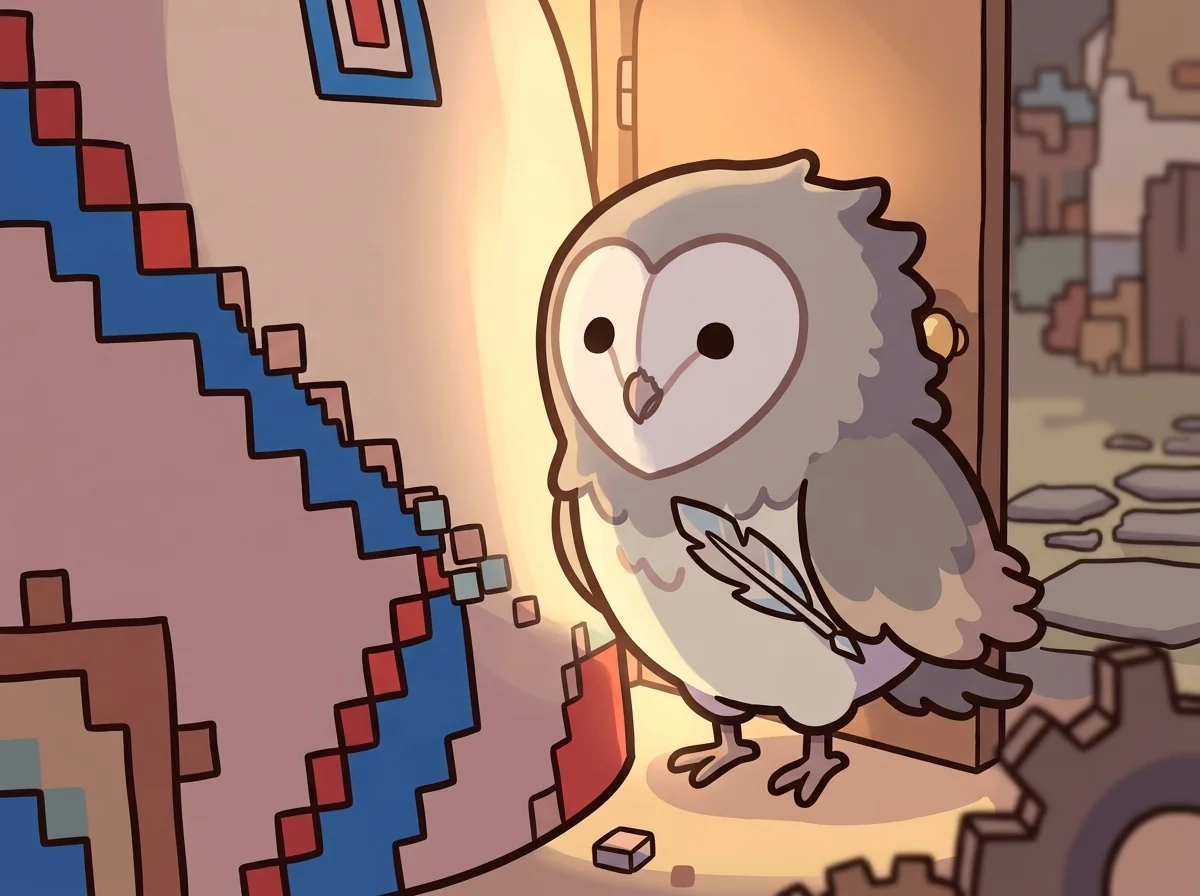
At twelve, Feather flew and walked the long road to PixelForge, his smoothing-quill tucked under one wing. Palette met him at the door with her one question.
"What is anti-aliasing?"
Feather blinked his big soft eyes. "It's helping a jagged edge read as smooth," he said, "without pretending it's not made of squares. A curve on a grid climbs in little stair-steps. I lay a few in-between-colored pixels into the corners of the steps — not too many, only where the eye stumbles — and the eye stops seeing stairs and starts seeing a line. I don't straighten anything. I soften the corners so the true shape comes through."
Palette studied the downy owl whose own edges melted gently into the air. "You are the lesson, aren't you," she said. "You come with your own soft edge already worn."
"I come from a family that softened hard things for a living," Feather said.
"You're the one," said Palette, and opened the door into the warm light.

Feather's workshop had walls the color of morning fog. On his table sat his smoothing-quill and a glowing canvas, and today the otter-kit Sumi was back, frowning at a picture of a curved sword. The blade was supposed to sweep in a graceful arc. Instead it climbed the screen in hard, blocky stair-steps — step, step, step — and it looked less like a sword and more like a broken staircase.
"It's so jaggy," Sumi groaned. "I zoomed in and tried to fix every single square and it just got worse. Now it's a mess AND it's jaggy."
"Ah. You tried to do a lot," Feather said kindly. "This is a little job. Watch where I put my pixels — and watch where I don't." He leaned close. At each corner where one stair-step met the next, he tucked a single pixel in a color halfway between the blade and the background. One here. One there. He skipped the long straight runs entirely — "those already read fine; leave them be" — and touched only the elbows where the eye tripped.
He set the quill down. "Now step back."
Sumi stepped back. The staircase was gone. The blade curved — a clean, smooth arc sweeping across the screen. Sumi hadn't seen Feather change the shape at all, yet the shape was suddenly readable.
"You barely did anything," Sumi breathed.
"I did exactly enough, in exactly the spots that needed it, and nothing anywhere else," Feather said. "That's the whole discipline. Too few in-between pixels and the stairs still shout. Too many and you get a blurry smudge — you can over-soften until the shape goes mushy and no one can read it at all. The skill isn't adding a lot. It's knowing where the eye stumbles, easing only there, and then having the courage to stop."
He showed Sumi the small rules. Only soften the corners of the stair-steps, never the flat runs. Pick your in-between pixel from between the two colors that actually meet at that edge — borrow from both sides. Keep it thin; one pixel of softening usually beats three. And always, always step back, because anti-aliasing is a favor you do for a faraway eye, and only the faraway eye can tell you if it worked.
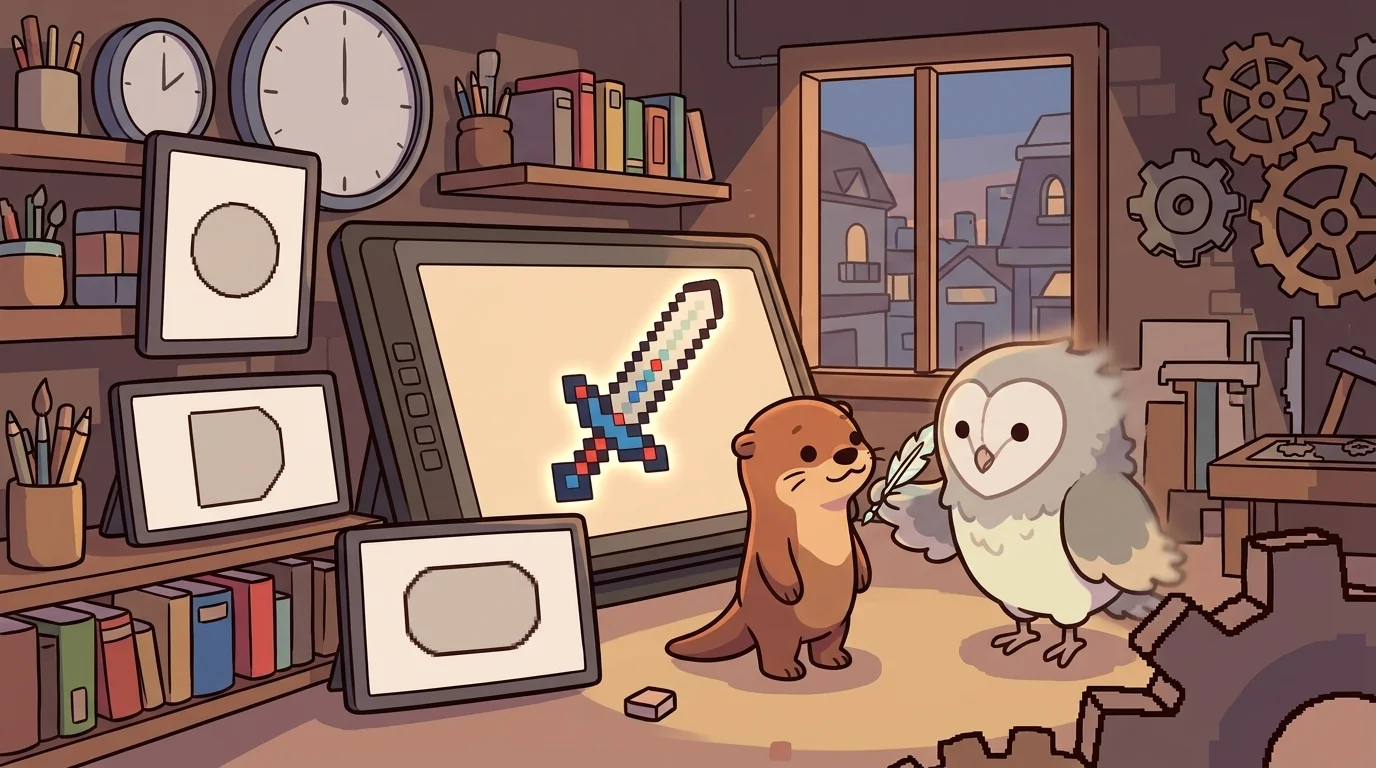
When the studio dimmed for the evening, Sumi stayed to look at the smooth sword.
"I feel a little silly," Sumi said. "I spent an hour zooming in and adding tons of pixels and making it worse. You fixed it in a minute by adding, like, six."
"Don't feel silly. Feel it in your shoulders instead — feel them come down." Feather settled beside the otter-kit, his soft edges catching the last light. "Everyone starts by trying to do a lot, because doing a lot feels like caring. But the kindest thing you can do to a jagged edge — and to yourself — is figure out the few spots that actually need help, help exactly those, and then let the rest be. You don't have to touch every square to make something clear. You just have to touch the right ones and know when you're done."
Sumi's shoulders came down. There was a small, clean relief in it — the calm of doing just enough and being allowed to stop.
"Soften only where the eye stumbles," Feather said gently, his outline blurring into the warm dark. "Then trust it. Doesn't it feel good to stop before you've overdone it?"
The PixelForge ensemble
Feather is part of PixelForge's distributed-narrative cast. Each character embodies a different curricular primitive; together they teach the full subject.
-

Speck
The single pixel — the atomic unit of pixel art; every image is a grid of these
-

Shade
The palette ramp — a small set of colors arranged from darkest to lightest (the foundation of pixel-art shading and form)
-
Grid
The tilemap grid — pixels snapped to repeating units that form tiles, tilesets, and game maps
-
Tween
The in-between frame — the animation frame that sits between two keyframes, giving motion its smoothness
-

Banner
The impact pose — the heroic / dramatic silhouette that reads instantly at thumbnail size (the principle that good character art is recognizable from its outline alone)
-

Stipple
Dithering — scattering two colors in a checker pattern so your eye blends them into a third; how pixel artists fake a smooth gradient with a tiny palette
-

Sheen
Light source and form shading — choosing where the light comes from, then placing highlights and shadows so a flat shape turns round
-
Rim
Selective outlining — drawing the edge only where a sprite would get lost, so it pops from the background without looking boxed-in
-

Cycle
Color-cycling animation — making water and fire flow by shifting which colors sit in the palette slots, without moving a single pixel
-

The Sprite
A finished character sprite coming to life — how placed pixels, a color ramp, chosen light, a clean outline, and smoothed edges layer together into one whole little hero