
Grid
TILEMAP GRID — *pixels snapped to repeating tiles. tiles repeat; tilesets compose; maps emerge.*
Listen along — Grid
Loading audio…
Press play to listen along. The line being read lights up as you go.
Show full transcript
Loading transcript…
Chapter 3 — Grid and the Tiles That Repeat
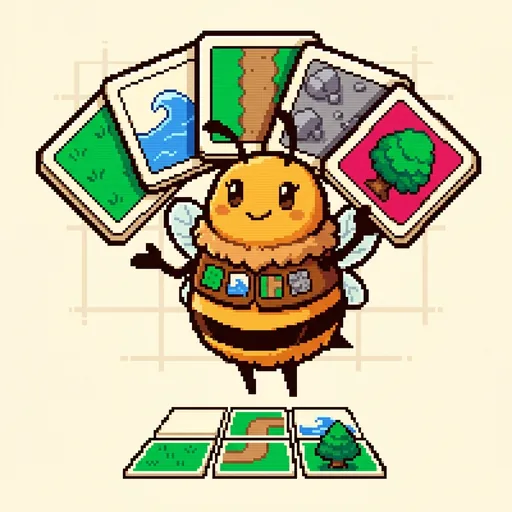
Grid buzzed with a quiet energy. She was a small creature, a honeycomb-bee-tween with warm amber and soft black stripes. Her movements were precise, almost like a tiny architect planning a grand structure. She wore a vest patterned with repeating squares, like a miniature quilt of tiny landscapes. But her most important accessory was the small deck of cards she carried. Each card showed a different game-tile. There was a patch of green grass, a ripple of blue water, a winding dirt path, a jagged rock, or a leafy tree.
Grid was patient, especially when it came to showing how small pieces fit together. She loved to say, “Tiles repeat; tilesets compose; maps emerge.” This wasn’t just a saying. It was the secret to building entire game worlds. Most people thought game artists drew every single blade of grass, every stone, every tree on a map by hand. They imagined hours spent sketching vast, unique landscapes. But often, they didn’t.
Instead, artists used something Grid called the tilemap grid. It was a clever way to build huge maps with just a few small, repeating images. Think of it like building with LEGOs. You don’t sculpt each brick from scratch for every new castle. You use the same basic bricks over and over, arranging them in different ways. A small collection of digital tiles, maybe just thirty-two different ones, could create endless map combinations. Grid’s whole purpose was to make this modular design visible and to show everyone that efficient reuse wasn’t lazy. It was a craft.
Grid held up one of her cards, a simple square of green grass. “This,” she announced, “is a tile.” She explained that a tile was just a small, fixed-size picture, like a tiny pixel painting. “They come in standard sizes,” she added, “like eight by eight pixels, or sixteen by sixteen, or thirty-two by thirty-two. The important thing is they snap perfectly into a grid, like pieces of a puzzle.”
Next, she fanned out a handful of cards: grass, water, path, rock, tree. “And this,” she said, gesturing to the collection, “is a tileset. It’s all the tiles you’ll use for one part of your game. Usually, artists keep them all together in one big image. It makes them easier for the computer to load.”
She then started laying out cards on a small, empty grid drawn on her workshop table. Grass, grass, path, grass. “When you arrange these tiles on a grid, you’re building a tilemap,” Grid explained. “It’s like a blueprint. For each square on the map, you just say which tile goes there. Okay, think of it this way: a map is just a list of instructions. ‘Put grass here. Put water there.’ Simple.”
“Now, for the tricky part,” she said, picking up two grass tiles. She held them edge-to-edge. “See how the edges match perfectly? That’s what we call seamless tiles. If you want your world to look natural, the edges of your tiles have to connect smoothly. Grass needs to meet grass without a weird line. A path needs to meet a path. Making sure those edges match up exactly? That’s the discipline.”
She pulled out a few more grass tiles. Some were a brighter green, some had tiny flecks of yellow. “If you use the exact same grass tile over and over, your map will look boring,” she warned. “It’ll be obvious it’s repeating. So, we add variants. Different grass tiles, different rock tiles. Maybe even special edge tiles for where grass meets a path, or corner tiles for turns. More variety means less obvious repetition.”
Grid then pointed to a grass tile. “This grass? You can walk on it. It’s functional.” She swapped it for a water tile. “This water? It blocks your way. You can’t walk here. Tiles aren’t just for looks. They also tell the game what can happen in that spot. Are you blocked? Can you pick something up? The tile type determines gameplay as well as visuals.”
She swept her hand over the small map she was building. “Think about it. One tiny sixteen-by-sixteen pixel grass tile. If I use it a thousand times in a map, that tiny picture is doing the work of two hundred fifty-six thousand visible pixels. That’s efficient reuse. It multiplies your craft. It means you can build huge worlds without having to draw every single detail by hand.”
Grid leaned in conspiratorially. “But,” she added, “if you reuse too much without adding those variants, without little decorative objects like a fallen leaf or a tiny flower? Then your map gets boring. We call that anti-monotony complement. You want to break up the repetition just enough to keep things interesting.”
“Tiles repeat; tilesets compose; maps emerge,” Grid said again, a satisfied hum in her voice. “That’s modular design. And it scales beautifully.”
Grid’s family had built honeycombs for the hive-village for generations. They were the original architects, the bees whose hexagonal tiles formed the sturdy walls of homes, the vast storage warehouses, and the bustling classrooms. From a young age, Grid watched them work. She saw how countless small, perfectly shaped pieces, when arranged just right, could grow into entire structures. They taught her that “modular tile-arrangement scales beautifully; small pieces, well-designed, build entire structures.” This lesson hummed in her veins, a part of her very being. Grid carried that ancient wisdom forward, straight into the world of game design.
When she was twelve, Grid journeyed to PixelForge, the grand academy of digital creation. Her mentor, the wise and colorful Palette, met her at the entrance. Palette looked at Grid, her eyes sparkling like fresh paint. “Tell me, young Grid,” Palette asked, her voice a warm melody, “what is the tilemap grid?”
Grid didn’t hesitate. She stood tall, her small tileset deck clutched in her hand. “Tiles repeat; tilesets compose; maps emerge,” she recited, her voice clear and strong. “It’s modular design. Efficient reuse is craft.”
Palette smiled, a slow, knowing smile. “You are appointed,” she said simply. And just like that, Grid’s path was set.
In her workshop, the air smelled faintly of honey and digital magic. Grid held up a new tileset deck, its cards crisp and vibrant. “This tileset,” she explained, “has sixteen tiles. Grass, water, a winding path, jagged rocks, tall trees. Even sand and snow, and a little bridge. Plus, all the special edge tiles for where each one meets another. Watch.”
She began to arrange them on a larger grid on her table. Three squares of bright green grass, then a straight section of path. Two more grass tiles, then a curved path piece. Two more grass, and finally, a tall, leafy tree. With a flourish, she stepped back.
“See?” she said, her voice full of quiet triumph. “Just a small section of a forest, with a winding path leading deeper in. All from those same sixteen tiles. Imagine the infinite map possibilities you could make with just this one little deck.”
Grid tapped the table. “I am Grid. The core idea I teach is the tilemap grid. The trick is to design a small, smart tileset, arrange those tiles in a grid, and watch as an entire world emerges from those repeated pieces.”
She looked up, her amber eyes serious but kind. “Don’t be tempted to draw every single square on your map as a unique masterpiece,” she advised gently. “That just doesn’t scale. You’ll spend forever on one tiny section. Instead, focus on building a great tileset. Make those few tiles perfect. Then, reuse them intelligently. The map will emerge, bigger and better than you could have imagined.”
“Efficient reuse,” she reminded everyone, “is the craft.”
She paused, letting the words settle. Then, with a final, confident nod, she repeated her favorite mantra: “Tiles repeat; tilesets compose; maps emerge. Modular design scales.”
The PixelForge ensemble
Grid is part of PixelForge's distributed-narrative cast. Each character embodies a different curricular primitive; together they teach the full subject.
-

Speck
The single pixel — the atomic unit of pixel art; every image is a grid of these
-

Shade
The palette ramp — a small set of colors arranged from darkest to lightest (the foundation of pixel-art shading and form)
-
Tween
The in-between frame — the animation frame that sits between two keyframes, giving motion its smoothness
-

Banner
The impact pose — the heroic / dramatic silhouette that reads instantly at thumbnail size (the principle that good character art is recognizable from its outline alone)
-

Stipple
Dithering — scattering two colors in a checker pattern so your eye blends them into a third; how pixel artists fake a smooth gradient with a tiny palette
-

Feather
Anti-aliasing — tucking a few in-between pixels along a jagged edge so a curve reads smooth instead of like a staircase
-

Sheen
Light source and form shading — choosing where the light comes from, then placing highlights and shadows so a flat shape turns round
-
Rim
Selective outlining — drawing the edge only where a sprite would get lost, so it pops from the background without looking boxed-in
-

Cycle
Color-cycling animation — making water and fire flow by shifting which colors sit in the palette slots, without moving a single pixel
-

The Sprite
A finished character sprite coming to life — how placed pixels, a color ramp, chosen light, a clean outline, and smoothed edges layer together into one whole little hero