
Wanderer
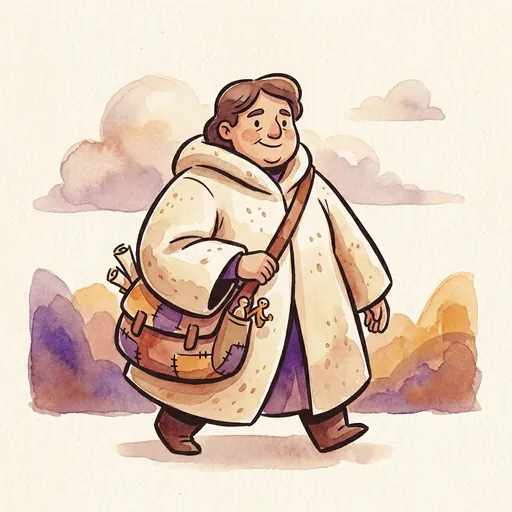
WANDERER — *the journeyer without fixed home. carries stories between cultures.*
Listen along — Wanderer
Loading audio…
Press play to listen along. The line being read lights up as you go.
Show full transcript
Loading transcript…
Chapter 8 — Wanderer and the Story Carried Between Worlds
The Wanderer wasn’t a person you’d see on a school bus. They were more like a living idea, a pattern walking right out of an old map. Their cloak, the color of warm cream and streaked with road dust, swirled around them. They carried only a single, well-worn bag. This was the journeyer + story-carrier, come to life in the MythForge workshop.
“Welcome, young myth-weavers,” the Wanderer said, their voice like wind through dry leaves. “I am the Wanderer pattern. I teach about journeys, and the tales carried between worlds.”
They weren’t just one person. They embodied a recurring pattern, a figure found in stories across time and cultures. Think of someone always traveling, never quite settling. They might be searching, or fleeing, or simply observing. The Wanderer was an adult-sized figure, but their posture, a bit hunched forward, suggested constant motion. They seemed ready to walk on at any moment.
“The journeyer without fixed home,” the Wanderer continued, stepping toward a large, round table. “They carry stories between cultures.”
They unlatched their bag, a patchwork of fabrics from every corner of the world. It wasn’t just empty space inside. It held a universe of objects, each one whispering a tale. There was a smooth, grey stone, a faded piece of embroidered cloth, a tiny, intricately carved wooden bird. These were the Wanderer’s signature features: the story-carrier-bag and its cross-tradition-display.
“Stories,” the Wanderer explained, picking up the stone. “They move. They travel with people, like seeds on the wind.”
A student named Maya leaned forward. “Like how a story from one country ends up in another?”
“Exactly,” the Wanderer affirmed. “Think of Odysseus. After he finally returned home to Ithaca, he found it too small. He was restless, still a journeyer at heart. His stories, and the stories he gathered, kept moving.”
They set down the stone and picked up the embroidered cloth. “But not all journeys are chosen. Many people move because they have no choice. Their homes are lost to war, or famine, or injustice.” The Wanderer’s expression grew serious. “When a group of people is forced to leave their homeland and spread out across the world, but they keep their culture and memories alive, that’s called a diaspora.”
Leo, another student, raised his hand. “So, like, people from different places, but they still share their culture?”
“Precisely, Leo. They become diaspora-keepers. They preserve cultural knowledge, their traditions, their language, even when they are geographically dispersed. They carry their identity with them, like treasures in a hidden pocket.” The Wanderer’s gaze swept over the students. “This is a essential truth: migration stories matter. They show us how cultures survive and change.”
Maya frowned. “My history teacher mentioned something about ‘the wandering Jew’ once,” she said slowly. “It sounded…bad.”
The Wanderer nodded, their expression serious. “It was bad, Maya. That phrase comes from centuries of prejudice. It was used to hurt people, to make them seem rootless and unwelcome.” They picked up the small, intricately carved wooden bird. “But the real story is different. For many Jewish people, and for many other groups who have been displaced, carrying their stories and traditions is an act of strength. It’s how they keep their culture alive, no matter where they are. They are cultural-keepers-during-displacement.”
“We must be careful,” the Wanderer stressed. “Many wandering-figure traditions have been mis-framed. Some have been used antisemitically, others colonially. We reject those rootless-savage tropes. We honor specific traditions’ wanderer-figures, like the Roma, the African diaspora, Armenians, and Indigenous peoples. Their stories are theirs to tell.”
The Wanderer placed the wooden bird back into the bag. “The primitive I teach is journeyer + story-carrier. The move is cultural-keeper-during-displacement. We reject rootless-tropes. We honor specific traditions.”
They pulled out a small, brightly colored ceramic shard. “This piece, for example, tells of a trader who traveled the Silk Road. He carried not just goods, but also tales, songs, and even recipes. He helped stories diffuse, recombine, and root in new places.”
“So, stories are like plants?” Leo asked, a small smile appearing. “They grow in new soil?”
“A good comparison, Leo,” the Wanderer agreed. “But remember, displacement was usually forced. It came from slavery, colonialism, war, or exile. We must honor that structural reality. Don’t romanticize displacement. Don’t deploy antisemitic or colonial tropes.”
The Wanderer closed their bag, the patchwork of fabrics a silent testament to countless journeys. “Honor the carriers. Tell their stories with care.”
“The journeyer without fixed home. Carries stories between cultures.”
The MythForge ensemble
Wanderer is part of MythForge's distributed-narrative cast. Each character embodies a different curricular primitive; together they teach the full subject.
-

Trickster
The boundary-crosser who teaches through inversion. Recurs across nearly all traditions (Anansi, Coyote, Loki, Hermes, Maui, Ijapa).
-

Hero-King
The reluctant ruler called to a journey (Campbell's central figure: Gilgamesh, Odysseus, Arjuna, Beowulf, Cuchulain).
-
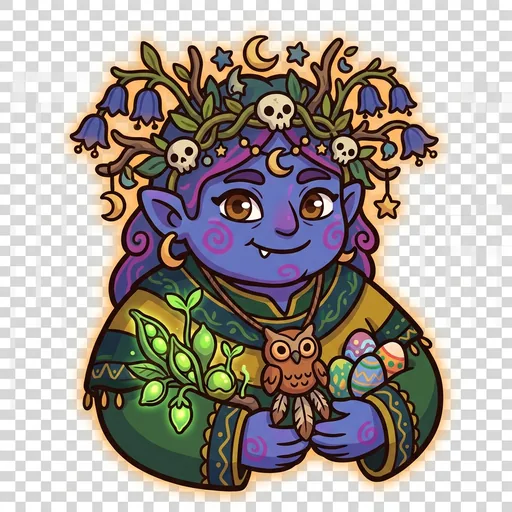
Devouring-Mother
The dark-creator / death-and-renewal force (post-Jungian; surfaces as Kali-aspect / Hel / Coatlicue / Hecate). **High trauma load.**
-

Wise-Elder
The mentor-figure who knows the path but cannot walk it for the hero (Athena, Odin-as-wanderer, Krishna-as-advisor).
-

Threshold-Guardian
The figure that tests whether the hero is ready to cross (Sphinx, Cerberus, the dragon at the gate, the riddling stranger).
-

Shadow
The repressed-self / dark-mirror (Jungian core archetype; surfaces as the hero's nemesis-who-is-also-them: Loki/Baldr, Set/Osiris, Cain/Abel framings).
-

Anima/Animus (paired)
The complementary-other-self (Jungian); represented as a pair-character that always appears together, embodying the inner-other-gendered-self pattern that surfaces across many t...
-

Child-Divinity
The newborn-with-power archetype (infant Krishna, baby Hermes, child Horus, divine-child motif).
-

Sacrificial-Lamb
The figure whose loss enables renewal (cross-traditional: dying-and-rising deities, scapegoat figures, voluntary-sacrifice motif).
-

Warrior
The conflict-pattern-bearer (Ares, Tyr, Sekhmet-aspect, the warrior-figure across many traditions).
-

Lover
The relational-bond-bearer (Aphrodite-aspect, the romantic-mythic pair, the bond-that-shapes-the-world archetype).
-

Sovereign
The cosmic-order-keeper archetype (Zeus-aspect, Odin-as-ruler, Ra-as-cosmic-king, Quetzalcoatl-aspect).
-

Magician
The transformation-bearer (Hermes-Trismegistus, Tezcatlipoca-aspect, Merlin, the alchemist-figure, the shape-shifter pattern).