
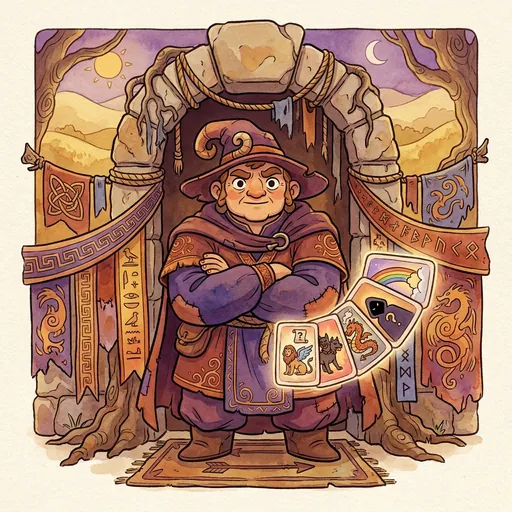
Threshold-Guardian
THRESHOLD-GUARDIAN — *the figure that tests whether the hero is ready to cross.*
Listen along — Threshold-Guardian
Loading audio…
Press play to listen along. The line being read lights up as you go.
Show full transcript
Loading transcript…
Chapter 5 — Threshold-Guardian and the Test at Every Door
At the far end of the MythForge hall stood a door of dark, ancient wood with no handle at all — just a smooth, worn surface — and in front of it stood a tall, quiet figure in a robe the color of twilight. This was the Threshold-Guardian. Not a person, exactly. More like a job that shows up in stories everywhere, wearing a hundred different faces. Today it wore this one: hands clasped, eyes calm and steady, watching everyone who came near the door.
A group of young storytellers edged into the hall. One of them, a bold kid named Rell, marched straight up to the door and pushed. It didn’t budge.
“You can’t just walk through,” the Guardian said, in a voice low and warm as a deep bell. “First there is a question.”
Rell frowned. “Why? Are you trying to keep me out?”
“No,” said the Guardian. “I’m trying to find out if you’re ready. Those are not the same thing.” A shimmer of light bloomed in the air beside the door, like a window opening onto other stories. “Watch. You are not the first to reach a locked door. Every hero, in every land, has stood where you’re standing now.”
In the shimmer, a shape appeared: a stern creature with a lion’s body and a human face, sitting on a rocky path, blocking the way. “In one old Greek tale,” the Guardian said, “a traveler met the Sphinx. She wouldn’t let anyone pass unless they answered her riddle. And her riddle wasn’t cruelty. It was a check — did this traveler understand something true about being alive?”
Rell leaned in despite himself. “What was the riddle?”
The Guardian had not always stood at a door. Long ago — so long that the story is more feeling than fact — it had simply been the pause a hero feels at the edge of something new. The held breath before the leap. Storytellers noticed that pause, and gave it a shape, and the shape became a figure standing guard.
That was the Guardian’s whole beginning: someone realized that the scariest part of any journey isn’t the monster in the middle. It’s the doorway at the start — the moment you have to decide whether you’re truly ready to go in.
So the figure appeared, over and over, in tale after tale, always at the crossing point. Never at the comfortable part. Always at the edge, where a child becomes something older, where a traveler leaves home, where a learner steps into a way of thinking they’ve never tried before.
And here is the thing the Guardian understood better than anyone: the test at the edge was never a punishment. It was a mirror. It didn’t ask are you good enough. It asked have you gotten ready. Those two questions feel the same when you’re nervous, but they are worlds apart, and the whole craft of the Guardian was to help a hero tell them apart.
The Guardian came to the MythForge the way all the archetypes did — not walking, exactly, but arriving, the way a familiar feeling arrives when you need it. Lyra, the mentor of the hall, had been asking a question aloud: what is it that waits for a hero at every doorway?
The Guardian answered by simply being there, at the door, hands folded, patient.
Lyra studied the tall twilight figure for a long moment. “You test them,” she said. “But you’re not the enemy.”
“I test whether they’re ready,” the Guardian agreed. “And when they are, I open the door myself.”
Lyra nodded slowly. “Then this door in my hall is yours to keep,” she said. “Stand here. Ask the question that helps them find out what they already know. And when a young one is truly prepared — let them through, and let them feel it.”
Now the Guardian turned back to Rell and the others, and the shimmer showed a new figure: a huge dog with three heads, snarling silently at the gate of a dark underworld.
“This guardian couldn’t be snuck past either,” the Guardian said. “In the old tales, a hero who wanted to cross had to come prepared — knowing a song to calm the great dog, or carrying a honey-cake to lull it to sleep. Not tricks. Preparation. You had to show you respected the rules of the place you were entering.”
The shimmer shifted again — a dragon coiled on a hoard of treasure, one eye gleaming. “And this one guards not a door but a prize,” the Guardian said. “It doesn’t yield to the sneaky or the strong-armed. It yields to the one who is ready in heart and mind.”
Rell crossed his arms, but his voice had gone quieter. “So how do I pass your test? What’s the riddle?”
“You already answered it,” the Guardian said gently. “You asked how do I get ready instead of how do I get around. That’s the whole difference. The heroes who try to slip past a guardian, in almost every story, end up worse off — lost, or trapped, or changed into something they didn’t want to be. But the one who stops, and prepares, and steps forward only when they’re truly ready—”
The Guardian laid one hand flat against the ancient wood. Slowly, without a sound, the door swung inward.
Rell stared at the open doorway. He didn’t run through. He found, to his surprise, that he didn’t want to yet — he wanted to earn the step.
“It’s not locked to keep you out,” the Guardian said, watching him. “It was locked to give you something to become ready for. The door and the getting-ready are the same gift.”
Rell felt the nervousness in his stomach that had been there since he walked in — and felt, underneath it now, something new and steadier. Not the jittery what if I’m not enough. Something more like I did the work; I can trust my own feet. His shoulders, which had been up near his ears, came down.
The Guardian saw it, and though the twilight robe never moved and the voice stayed low and calm, there was a warmth behind those watchful eyes — the quiet gladness of someone who wants nothing more than for you to feel that exact mix, the nervous and the proud all braided together, the moment you finally step through your own door, ready.
Rell took a breath, and stepped through, and the warm, sure feeling went with him.
The MythForge ensemble
Threshold-Guardian is part of MythForge's distributed-narrative cast. Each character embodies a different curricular primitive; together they teach the full subject.
-

Trickster
The boundary-crosser who teaches through inversion. Recurs across nearly all traditions (Anansi, Coyote, Loki, Hermes, Maui, Ijapa).
-

Hero-King
The reluctant ruler called to a journey (Campbell's central figure: Gilgamesh, Odysseus, Arjuna, Beowulf, Cuchulain).
-
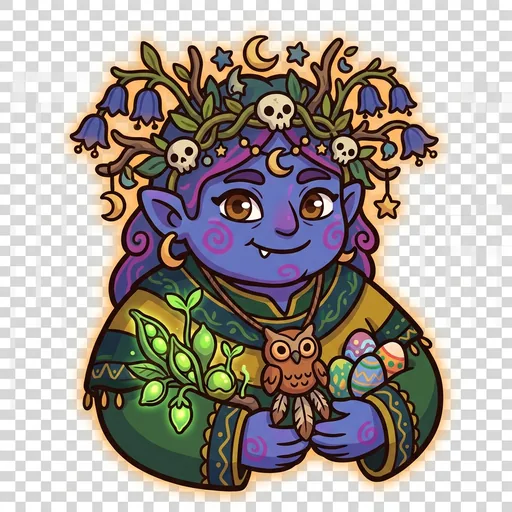
Devouring-Mother
The dark-creator / death-and-renewal force (post-Jungian; surfaces as Kali-aspect / Hel / Coatlicue / Hecate). **High trauma load.**
-

Wise-Elder
The mentor-figure who knows the path but cannot walk it for the hero (Athena, Odin-as-wanderer, Krishna-as-advisor).
-

Shadow
The repressed-self / dark-mirror (Jungian core archetype; surfaces as the hero's nemesis-who-is-also-them: Loki/Baldr, Set/Osiris, Cain/Abel framings).
-

Anima/Animus (paired)
The complementary-other-self (Jungian); represented as a pair-character that always appears together, embodying the inner-other-gendered-self pattern that surfaces across many t...
-
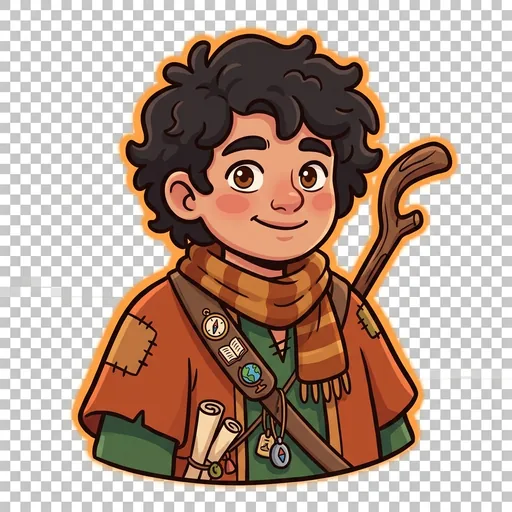
Wanderer
The journeyer-without-fixed-home who carries stories between cultures (Odysseus-after-Ithaca, the wandering Jew, the diaspora-keeper figure).
-
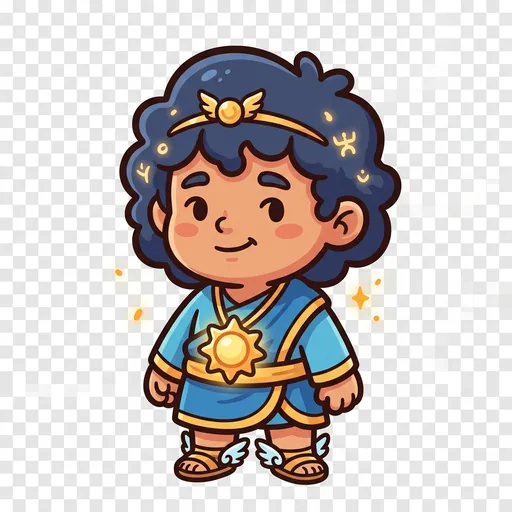
Child-Divinity
The newborn-with-power archetype (infant Krishna, baby Hermes, child Horus, divine-child motif).
-
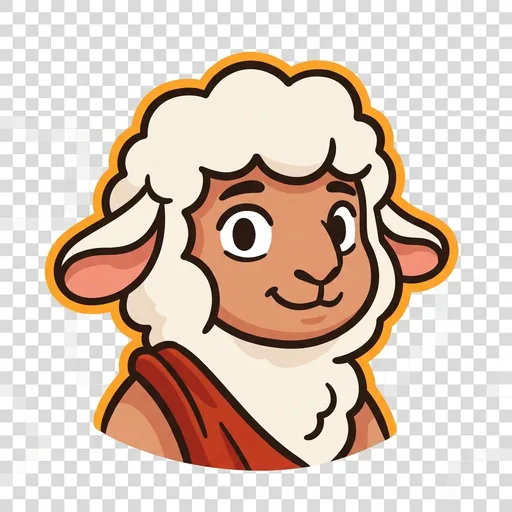
Sacrificial-Lamb
The figure whose loss enables renewal (cross-traditional: dying-and-rising deities, scapegoat figures, voluntary-sacrifice motif).
-
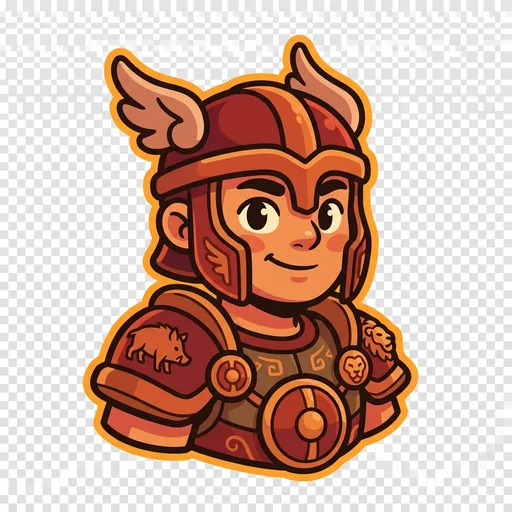
Warrior
The conflict-pattern-bearer (Ares, Tyr, Sekhmet-aspect, the warrior-figure across many traditions).
-
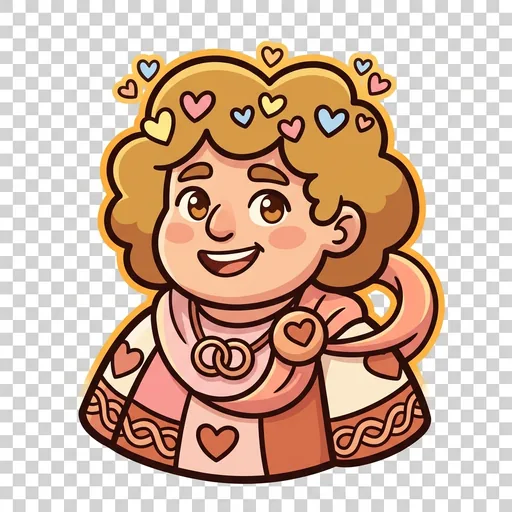
Lover
The relational-bond-bearer (Aphrodite-aspect, the romantic-mythic pair, the bond-that-shapes-the-world archetype).
-

Sovereign
The cosmic-order-keeper archetype (Zeus-aspect, Odin-as-ruler, Ra-as-cosmic-king, Quetzalcoatl-aspect).
-

Magician
The transformation-bearer (Hermes-Trismegistus, Tezcatlipoca-aspect, Merlin, the alchemist-figure, the shape-shifter pattern).