
Reggie and Stella
THE TWO DODGES — two ways an argument runs from the real point instead of facing it: the red herring (Reggie) drags the talk off to an unrelated topic, and the strawman (Stella) knocks down a twisted fake version of what you actually said — spot both, and steer back to the real point
A story read by Reggie and Stella
Loading audio…
Press play to listen along. The line being read lights up as you go.
Show full transcript
Loading transcript…
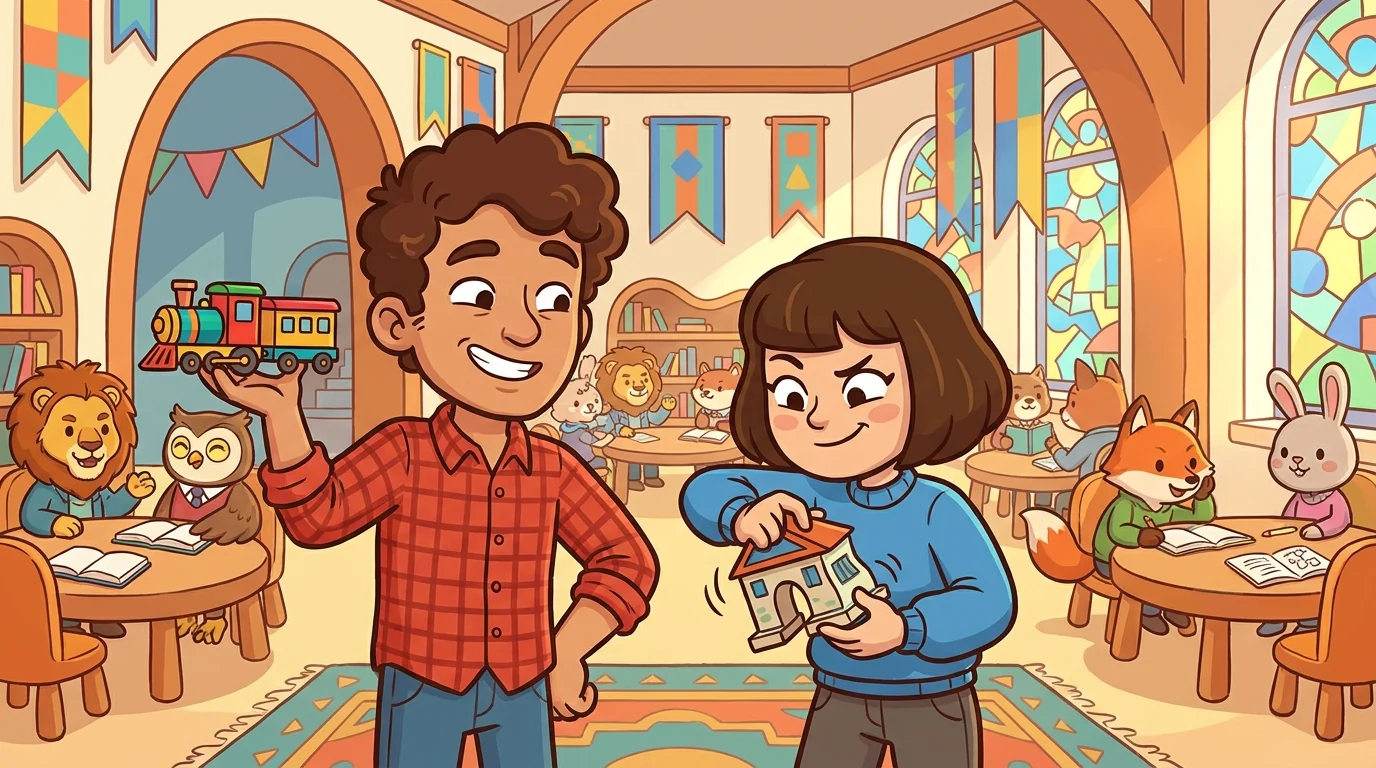
They were charming. That was the trouble with them. Reggie and Stella were the two most likable dodgers in the whole Logic Hall, and if you weren't watching closely, you'd walk away from a talk with either one feeling like something had been settled — when really, the actual point had never been touched at all.
"They're not lying, exactly," a young student once said, confused. "So why does talking to them feel so slippery?"
"Because neither of them ever answers the point you made," said Mo, passing by. "Reggie runs off to a different point. Stella swaps your point for an easier one. Watch. You'll start to see the moves."
And once you saw them, you could never un-see them.
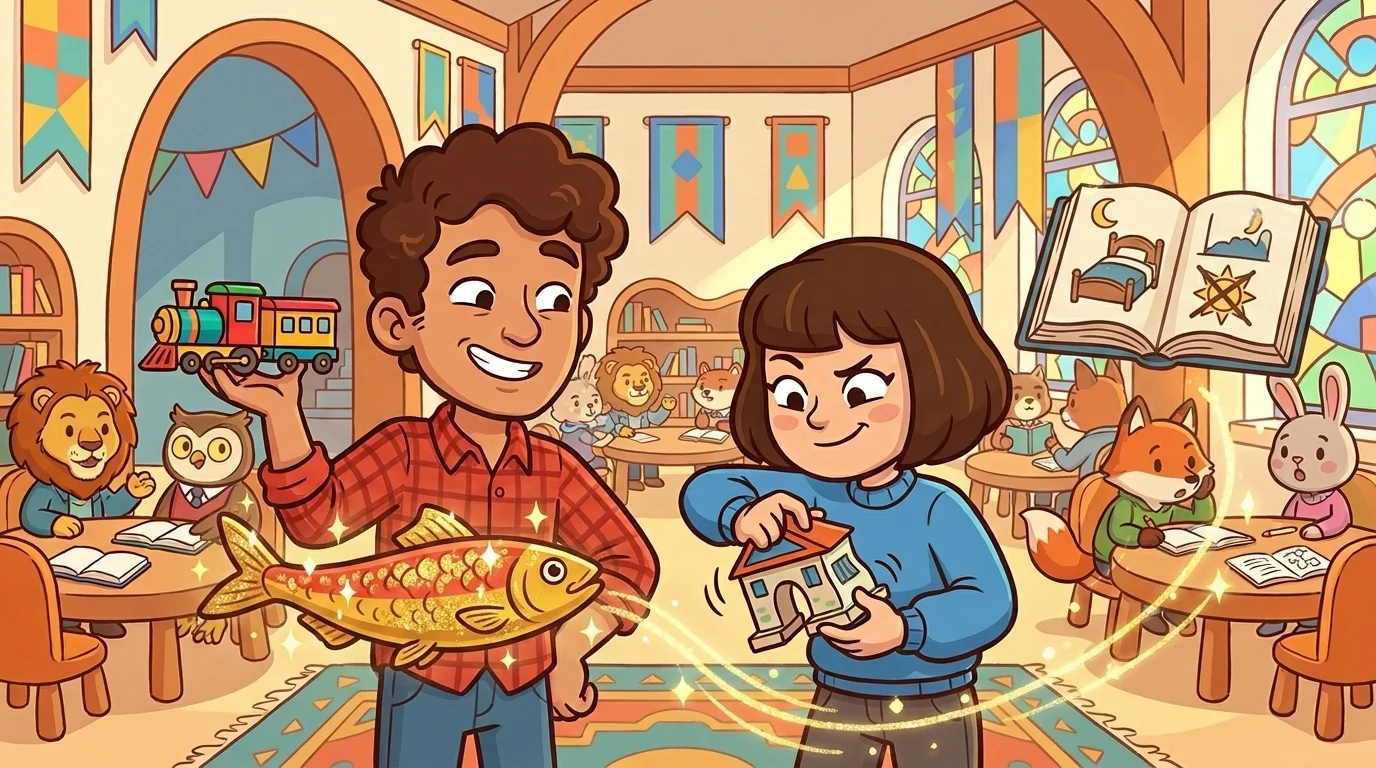
Reggie went first, because Reggie's dodge was the friendlier-looking one: change the subject.
The question on the table was simple. "Should we have earlier bedtimes on school nights?" And Reggie, who did not want an earlier bedtime and had no good reason against it, did the thing Reggie always did: reached for something completely different, and shiny, and off to the side.
"Bedtimes? Well — you know what the real problem is? The cafeteria food. Have you tasted the cafeteria food lately? It's a disgrace! Somebody should do something about that." And off the whole room went, suddenly arguing about tater tots, while the bedtime question sat forgotten in the corner, exactly as Reggie wanted.
"That's the red herring," said Reggie, cheerfully, when it was pointed out. "A shiny thing dragged across the trail so everyone chases it instead of the real question. I didn't say bedtimes are good. I didn't say they're bad. I just made sure we'd never get around to talking about them at all." He grinned. "Notice how you never got an answer? That was the whole point."
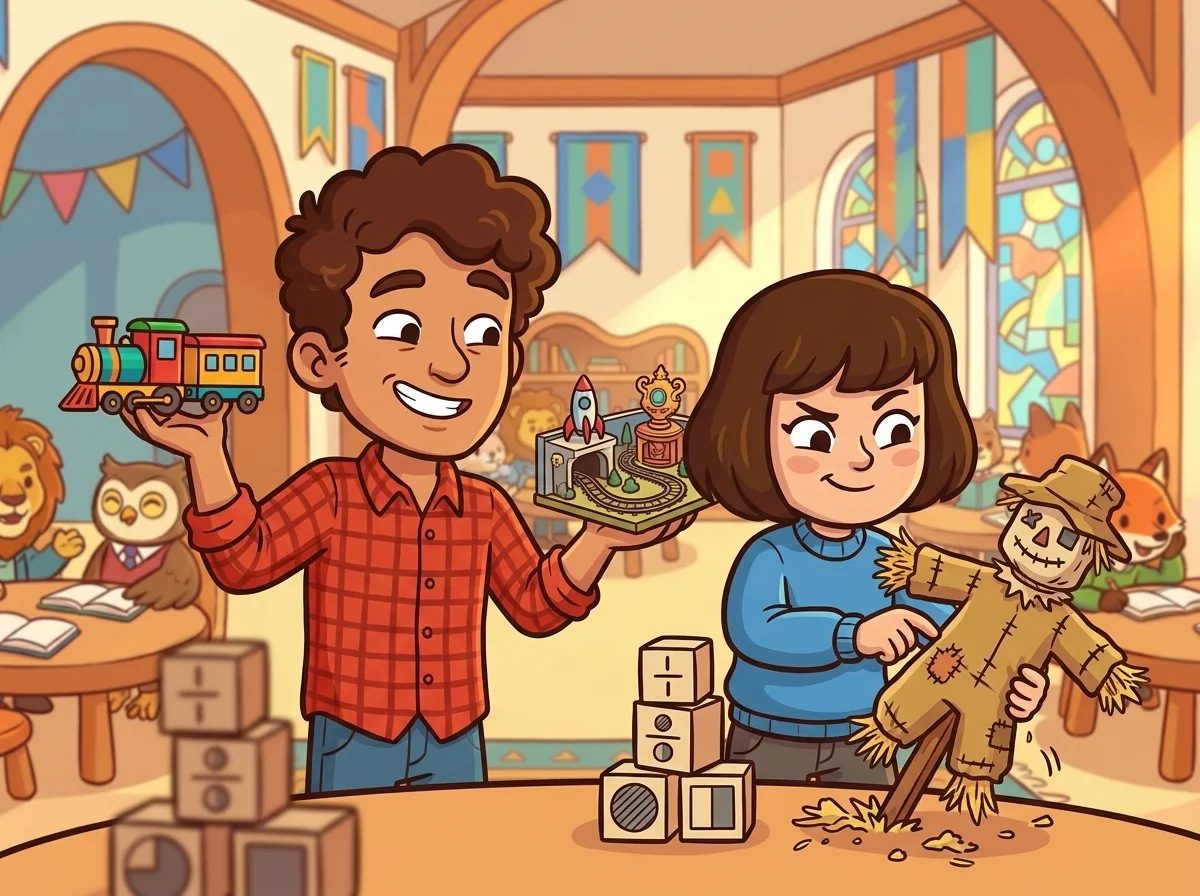
Stella's dodge was quieter, and in its way more unfair, because Stella did seem to argue the point — she just argued a fake one.
The point someone had actually made was careful: "I think we should have a little more homework in math, because we're a bit behind on fractions." A modest, reasonable point. But Stella did not argue against that point. Stella built a twisted, easier, floppy version of it — a scarecrow, stuffed with straw — and then knocked that down instead.
"Oh, so you want us buried in homework every single night!" Stella cried. "You want us doing math until midnight, no free time, no fun, just endless worksheets forever! What a cruel idea!" And she tore that terrible version to shreds, to great applause — while the real point, the small reasonable one about fractions, stood off to the side untouched, never actually answered at all.
"But I never said that," the first student protested, and that protest is the exact feeling a strawman leaves behind.
"I know you didn't," said Stella, almost kindly. "That's the trick. Your real point — a little more math homework — is hard to argue against, because it's reasonable. So I don't argue against it. I quietly swap it for a monster version — homework until midnight forever — and argue against that. The monster's easy to beat. And if nobody notices the swap, it looks like I beat you." She shrugged. "But I didn't. I beat a scarecrow I built myself. Your actual point is still standing right there, waiting for a real answer."
That was the sting of it — the feeling of being answered for something you never said, of watching a twisted echo of yourself get knocked down while the real you went unheard.
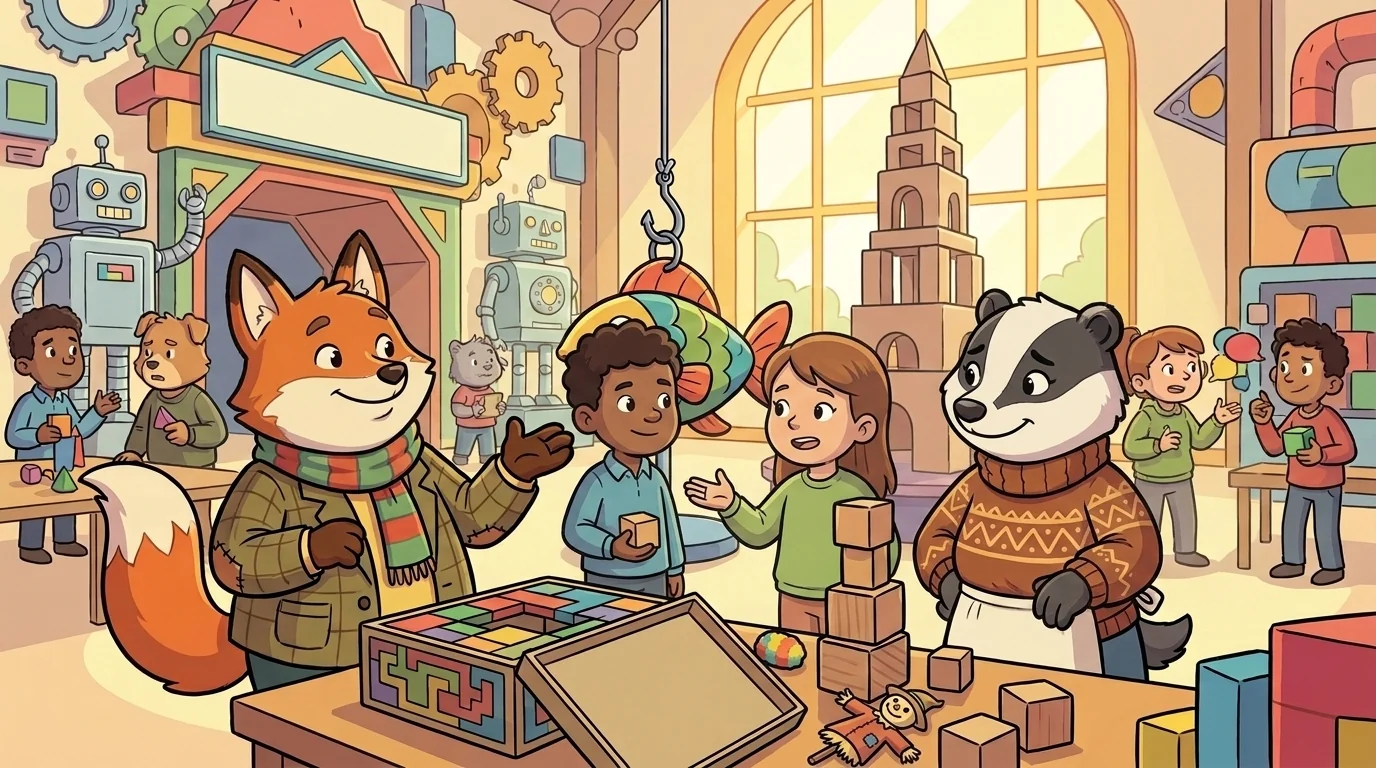
And here was the wonderful thing the students learned: the way to handle both dodges was the very same calm move.
You didn't have to shout. You didn't have to win the tater-tot fight or defend the midnight-homework scarecrow. You just had to notice the dodge, name it — gently, without meanness — and steer back to the real point. "That's interesting, Reggie, but we were talking about bedtimes — let's finish that first." "That's not quite what I said, Stella — my point was just a little more math. Can we talk about that one?" Calm. Steady. Back to the trail.
"Good spotting," said Stella, a little rueful, when a student caught her clean.
"Good steering," said Reggie, who secretly respected it.
There is a quiet strength in being un-dodge-able — in staying warm and unbothered while someone tries to pull you off the trail, and simply, kindly, walking back to what actually matters. You don't have to catch every clever move to feel it slip past you. But once you can name the two dodges, they lose their charm, and you get to keep the thing they were trying to take: the real conversation, still standing, still yours to have.
The LogicQuest ensemble
Reggie and Stella is part of LogicQuest's distributed-narrative cast. Each character embodies a different curricular primitive; together they teach the full subject.
-

Ad Hominem Hannibal
Attacking the arguer, not the argument
-

Strawman Stella
Misrepresenting the opponent's argument
-

Slippery-Slope Sam
Chaining dire consequences from a small first step
-

Appeal-to-Authority Auntie
Citing irrelevant / unqualified authority as proof
-

Red-Herring Reggie
Deflecting to an irrelevant topic
-

Circular-Reasoning Cici
Assuming the conclusion in the premise
-

False-Dichotomy Fia
Presenting only two options when more exist
-

Bandwagon Bran
Truth-by-popularity
-

Sunk-Cost Cyril
Refusing to change course because of past investment
-

Whataboutism Wanda
Deflecting criticism via someone else's wrongdoing
-

Equivocator Eva
Sliding a word's meaning mid-argument
-

Tu-Quoque Tessa
"You too!" — dismissing criticism by accusing the critic of the same thing
-

Modus-Ponens Mo
If P then Q; P; ∴ Q
-

Modus-Tollens Tara
If P then Q; ¬Q; ∴ ¬P
-

Syllogism Solon
All M are P; all S are M; ∴ all S are P
-

Disjunctive-Syllogism Dior
P ∨ Q; ¬P; ∴ Q

