
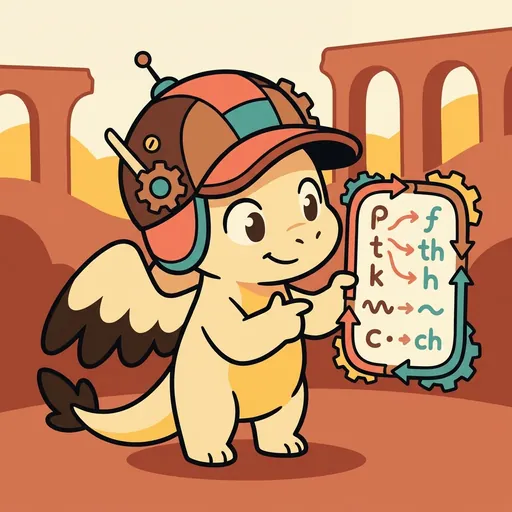
Drift
SOUND CHANGE — *sounds shift slowly across generations. systematic patterns; predictable directions.*
Listen along — Drift
Loading audio…
Press play to listen along. The line being read lights up as you go.
Show full transcript
Loading transcript…
Chapter 2 — Drift and the Slow Slide of Sounds
Drift stood at the front of his workshop, a small swift-tween with a cap that looked like it had traveled through time. It was chunky and cartoonish, made of soft, worn leather. His wings, the color of warm cream with brown tips, were tucked neatly behind him. He held a small, intricate chart, covered in swirling lines and ancient-looking symbols. This was his sound change chart, and it was his favorite thing in the world.
He was a creature of deep patience. He understood gradual change. He often said, “Sounds shift slowly across generations. Systematic patterns; predictable directions.” He believed this with his whole being.
His workshop smelled faintly of old paper and something like dry grass. Sunlight streamed through a high window, illuminating dust motes dancing in the air. A few students sat on wooden benches, looking curious, or maybe a little bored.
“Welcome,” Drift chirped, his voice soft but clear. “I am Drift. The primitive I teach is sound change.” He held up his chart. “Most people think language just… changes. Like a messy room, getting sloppier over time. But it’s not like that at all.”
A girl named Lena, with bright, skeptical eyes, raised a hand. “So, like, when my little brother says ‘aks’ instead of ‘ask’? Is that sound change, or is he just being lazy?”
Drift smiled, a gentle, knowing expression. “An excellent question, Lena. And a common one. Many novices think language change is random. Or, as you put it, ‘sloppy’ or ‘lazy.’ But it isn’t. Not really.” He paused, letting that sink in. “Sound change follows patterns. Always.”
He unrolled his chart, a scroll of parchment covered in tiny, precise script and colorful arrows. “Imagine a river,” he began. “It doesn’t just flood everywhere at once. It carves a path, slowly, over time. Language is like that river. It follows certain rules. Which sounds shift before others. In which positions. It’s like linguistic archaeology.”
He pointed to a section of the chart. “Take something called Grimm’s Law.” He saw a few blank stares. “It’s a famous set of sound changes. It happened thousands of years ago, when an ancient language we call Proto-Indo-European, or PIE, started to split into different branches. One of those branches became Germanic, which is where English comes from.”
Drift traced a line with a slender, cream-colored finger. “In PIE, they had a sound like ‘p.’ Like in the word pater, which meant ‘father.’” He looked at the students. “What do you think happened to that ‘p’ sound in Germanic languages, like early English?”
A boy named Finn, who usually looked like he’d rather be anywhere else, mumbled, “It changed to an ‘f’?”
“Exactly!” Drift beamed. “The ‘p’ sound systematically shifted to an ‘f’ sound. So pater became ‘father.’ Not just in that one word, mind you. It happened to all ‘p’ sounds at the beginning of words in that specific branch of the language.”
He moved his finger to another symbol. “The ‘t’ sound in PIE, like in trēs, meaning ‘three,’ shifted to a ‘th’ sound. And the ‘k’ sound, as in kṃtom, meaning ‘hundred,’ became an ‘h’ sound. So, kṃtom became ‘hundred.’”
“Wait,” Lena said, leaning forward. “So, like, every single ‘p’ changed to an ‘f’?”
“Within that specific linguistic community, yes,” Drift confirmed. “That’s the key. Sound shifts are regular. They apply to all instances of a sound in a given position. Not just some words, but all words. This regularity is how linguists can reconstruct ancestor-languages they’ve never heard. We can trace these systematic shifts and figure out what the original sounds must have been.”
He scrolled the chart further. “Another famous shift: the Great Vowel Shift.” He tapped a section with looping arrows. “This one happened much more recently, between Middle English and Modern English. Our vowels actually raised up in our mouths, and some turned into diphthongs.”
“A what-thong?” Finn asked, wrinkling his nose.
“A diphthong,” Drift clarified patiently. “It’s when your tongue moves from one vowel sound to another within the same syllable. Think of the ‘i’ sound in ‘bite.’ It used to sound more like the ‘ee’ in ‘beet.’ And ‘boot’ used to rhyme with ‘boat.’ Shakespeare’s English sounded very different from ours, because of this shift.”
He then showed them palatalization. “When ‘k’ or ‘g’ sounds appeared before certain front vowels, they often shifted. For example, the Latin ‘k’ in centum became the ‘ch’ sound in the Italian cento. It’s a precise, rule-governed change.”
Drift looked around at their faces. “These changes aren’t just ancient history. Change continues today. English vowels are still shifting. Different regions shift differently, which is how dialects form.”
Lena piped up again. “So, my brother saying ‘aks’ isn’t ‘wrong’?”
“Ah,” Drift said, his eyes twinkling. “That brings us to a very important point. Never call any pronunciation ‘wrong.’ It’s simply a different stage of change. Or a different regional shift. What you hear today might be tomorrow’s standard, drifting in. English has always changed. It will keep changing. Drift is the way of all living languages.”
He paused, letting his words hang in the air. “My family, back in the cliffside village, were generation-watchers. We tracked how our own dialect shifted over decades. We learned that the youngsters always speak slightly differently from the elders. That’s not corruption. That’s the wave of change. It’s natural.”
He remembered his own appointment, years ago. Mira, his mentor, had asked him, “What is sound change?” He had answered, “Sounds shift slowly across generations. Systematic patterns; predictable directions. Grimm’s Law isn’t random; it’s a rule. The Great Vowel Shift isn’t sloppiness; it’s a regular shift across the entire Middle-to-Modern-English transition.” Mira had simply nodded. “You are appointed.”
Now, he looked at his own students. “Sounds shift. Patterns are visible. Reconstruction is possible. The drift never stops.” He rolled up his chart, a small, knowing smile on his face. “And that, young linguists, is the beauty of sound change.”
The LinguaQuest ensemble
Drift is part of LinguaQuest's distributed-narrative cast. Each character embodies a different curricular primitive; together they teach the full subject.
-

Bough
Language families (genetic descent — Indo-European / Sino-Tibetan / Afro-Asiatic / Niger-Congo / Austronesian)
-

Glyph
Writing systems (alphabetic / abjad / abugida / syllabic / logographic — and how each captures speech)
-
Bridge
Cognates and loanwords (shared roots across languages; trade-route borrowings)
-

Cant
Sociolinguistics — dialect, register, code-switching, formal/informal speech
-
Sign
Signed languages — full natural languages spoken with hands, face, and space; each Deaf community's own, never 'just gestures'
-
Swoop
Tone — pitch that changes a word's meaning (tonal languages); precise and sophisticated, never 'sing-song' or 'exotic'
-
Weft
Word order / syntax — languages arrange words differently (SVO/SOV/verb-first); no order is 'backwards,' each is complete
-

Lex
Untranslatable words — words no other language has in one breath; not a gap in your language but a gift another can offer
-

Nook
Endangered languages + revitalization — keeping fading languages safe; decline is from histories of harm, never the speakers' fault; communities lead the revival