
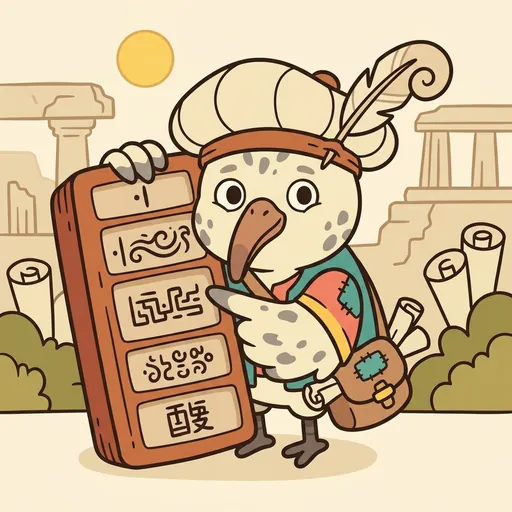
Glyph
WRITING SYSTEMS — *alphabet, abjad, abugida, syllabary, logograph — each captures speech differently.*
Listen along — Glyph
Loading audio…
Press play to listen along. The line being read lights up as you go.
Show full transcript
Loading transcript…
Chapter 3 — Glyph and the Five Ways to Write Down Speech
In the scriptorium, Glyph the ibis-tween had the same two words written five different ways down her tablet, and she was daring a visitor to call any of them wrong.
“Hello, world,” she said, tilting the tablet toward the boy who’d wandered in. “Watch.” She pointed to the top line — neat separated letters. “Here it is with an alphabet, one letter for about one sound.” Her feather slid down. “Here, an abjad — the consonants written strong, the vowels tucked into little marks.” Down again, to a row where each mark carried a built-in hum. “Abugida. Then a syllabary, one symbol per whole beat. Then—” her feather stopped on a pair of dense, beautiful shapes — “a logograph, where the symbol holds a whole word at once.” She looked up, eyes bright. “Five roads. Same destination. Go on — pick the ‘best’ one. I’ll wait.”
The boy opened his mouth, then closed it. He couldn’t.
“Exactly,” Glyph said, delighted.
Glyph came from a family of scriptorium-elders, ibises who had kept the village’s writing for as long as anyone could remember, in more scripts than most people knew existed.
When she was young, she made a mistake she never forgot. A traveler had shown her a page of Arabic, and she’d wrinkled her beak and said, “Where are all the vowels? That looks broken.”
Her great-aunt, who was patching an old scroll, set down her needle very slowly. “Broken,” she repeated, not angry, just quiet. “Child. That script has carried poetry and law and prayer for a thousand years. It isn’t missing anything. It’s built for a language where the meaning lives in the consonants — so that’s what it writes, clear as a bell.” She looked at Glyph over her spectacles. “The only thing broken here is a young bird who called a stranger’s home ugly because it wasn’t hers.” Glyph’s ears burned. She never forgot the lesson underneath the sting: new to me is not the same as strange, and familiar to me is not the same as simple.
She was twelve when she walked into LinguaQuest, tablet under one wing, and Mira met her with a test disguised as a question.
“Some folks say the alphabet is the cleverest way to write,” Mira said. “The most advanced. What do you say?”
Glyph could have argued. Instead she set her tablet down and lit up the five lines. “I say look,” she said. She pointed to the logograph. “Chinese has whole crowds of words that sound the same. This script tells them apart at a glance — the alphabet would blur them together.” She pointed to the abjad. “This one packs a whole word’s meaning into a handful of consonants, because that’s how the language is built.” She sat back. “Each one grew up to fit its own language, like a shoe fits a foot. ‘Advanced’ is the wrong question. The right question is fitted.”
Mira studied the glowing rows a long moment. “You didn’t rank them for me,” she said. “You showed me why ranking them is the mistake.” She stepped back from the doorway. “The workshop with the wide windows is yours. Good light for reading.”
Glyph’s workshop was full of side-by-side scrolls, and the day a group of students crowded in, she had the same phrase waiting on her tablet, glowing in all five scripts.
“Same meaning, five ways of catching it,” she said, and walked them along the row. “Latin letters — five of them, one per sound. Arabic — the consonants strong, marks for the vowels if you want them. Devanagari — consonants with the vowel built right in. Japanese hiragana — one symbol for each whole syllable. Chinese — two characters, each holding a whole word.” She turned the tablet so the light rippled across all five. “Every one says hello. Not one of them is trying to be the others.”
A girl frowned at the Chinese characters. “But those look so much harder.”
“Harder to you,” Glyph said gently, “because they’re new to you. To a child in Beijing, your alphabet looks like a fence full of little sticks.” She smiled. “New isn’t hard. Familiar isn’t simple. If you ever hear someone say a script is ‘too slow’ or ‘skips the vowels like it forgot them’ — that’s just somebody who’s only ever seen one road, mistaking it for the only road.” She tapped the tablet. “There are five. At least. And each one is exactly right for the mouth that made it.”
After the lesson, the girl stayed, running her feather-light finger over a script that wasn’t the alphabet.
“My family writes in one of these,” she said quietly. “Not the letters everyone at school uses. Someone said it looked ‘weird.’”
Glyph came and sat beside her, and looked at the script the way you look at something precious. “It isn’t weird,” she said. “It’s a whole way of holding your language on a page — clever, complete, worked out over lifetimes by people who loved it.” She let her gaze rest on the five glowing rows. “Your script has a seat right here, next to all the others. Not below them. Beside them.” Her voice went soft and warm. “Every one of these is somebody’s home. Yours too.”
The girl traced her family’s script again — slower this time, almost proud. And a happy warmth spread across Glyph’s face, the kind that comes from watching someone stop shrinking and start belonging.
“Doesn’t that feel good?” Glyph murmured, looking down at all five scripts side by side. “Knowing there’s room on the page for every last one of us. There always was.”
The LinguaQuest ensemble
Glyph is part of LinguaQuest's distributed-narrative cast. Each character embodies a different curricular primitive; together they teach the full subject.
-
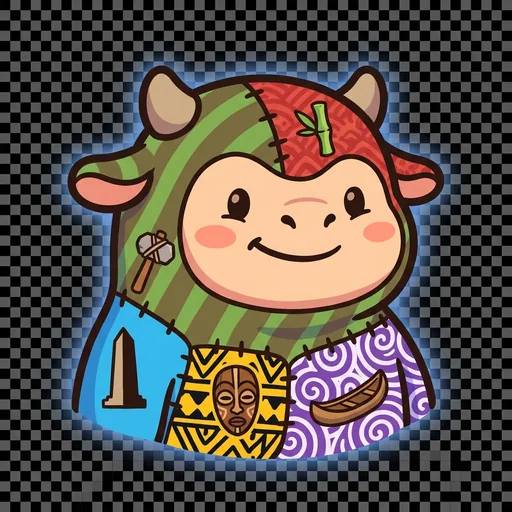
Bough
Language families (genetic descent — Indo-European / Sino-Tibetan / Afro-Asiatic / Niger-Congo / Austronesian)
-
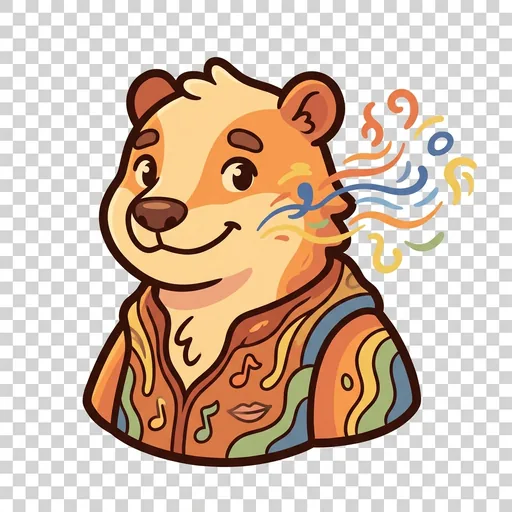
Drift
Sound change (phonological evolution — Grimm's Law, vowel shifts, palatalization)
-
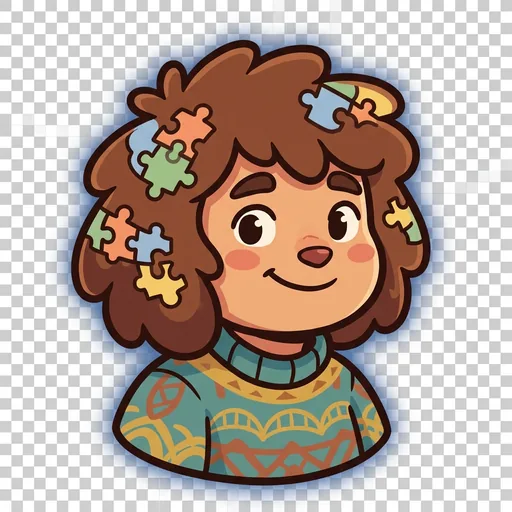
Bridge
Cognates and loanwords (shared roots across languages; trade-route borrowings)
-
Cant
Sociolinguistics — dialect, register, code-switching, formal/informal speech
-
Sign
Signed languages — full natural languages spoken with hands, face, and space; each Deaf community's own, never 'just gestures'
-
Swoop
Tone — pitch that changes a word's meaning (tonal languages); precise and sophisticated, never 'sing-song' or 'exotic'
-
Weft
Word order / syntax — languages arrange words differently (SVO/SOV/verb-first); no order is 'backwards,' each is complete
-
Lex
Untranslatable words — words no other language has in one breath; not a gap in your language but a gift another can offer
-

Nook
Endangered languages + revitalization — keeping fading languages safe; decline is from histories of harm, never the speakers' fault; communities lead the revival