
Bough
LANGUAGE FAMILIES — languages have ancestors. tree-of-tongues; family resemblance.
Listen along — Bough
Loading audio…
Press play to listen along. The line being read lights up as you go.
Show full transcript
Loading transcript…
Chapter 1 — Bough and the Tree of Tongues
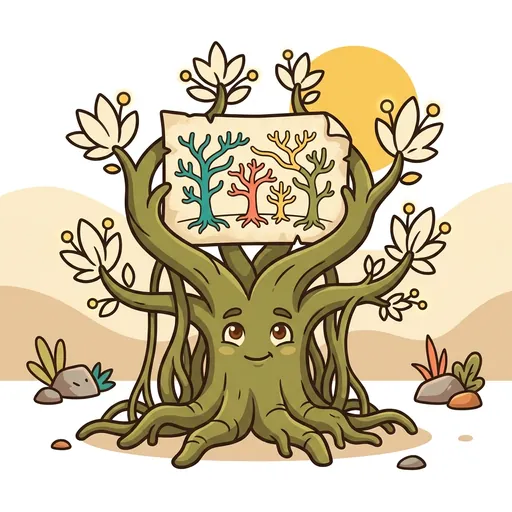
Bough sat in the middle of the courtyard with four words written on four scraps of parchment, and she was refusing to line them up in a straight row.
“Mother,” she read off the first scrap. Then the others, slow and careful: “Mātṛ. Māter. Mutter.” She laid them out on the stone — not in a line, but in a little fan, like fingers spreading from one palm.
A boy watched her from the bench, arms crossed. “They’re just different words for the same thing,” he said. “So what?”
“So listen to them,” Bough said. She was a small, chunky banyan-tween, her roots curling patient across the courtyard tiles, a folded scrap of parchment tucked in her branches. She read the four words again, and this time she leaned on the sounds. Muh. Muh. Muh. Every one of them started the same soft way.
“They rhyme,” the boy admitted.
“They don’t rhyme. They remember.” Bough drew a little line back from all four scraps until the lines met at one empty spot on the stone. “There was a word here. A very old one. Nobody wrote it down, because nobody was writing anything down yet. But four grandchildren-words all point back to it — English mother, Hindi mātṛ, Latin māter, German Mutter. Four cousins who never met, all with their great-great-grandmother’s chin.”
She sat back. The boy uncrossed his arms and leaned over the little fan of words, and Bough watched his face do the thing she loved most — the small startled softening when someone realizes that words have families, and that the families are real.
Bough had learned to look for that resemblance a long way from any classroom.
She grew up in an old banyan grove where her family were the tree-walkers — the ones whose roots reached quietly under the ground from village to village. When she was small, she thought every grove was supposed to grow the same way. Then one summer she stretched her roots into a far village and felt, for the first time, a tree shaped completely differently from her own — trunks where she had branches, a canopy that spread instead of climbing.
Her first feeling was a hot little flush of wrong. This tree was doing it wrong. Hers was the right shape.
Her grandmother felt her flinch through the shared roots and came slow and warm across the grove. “You met a tree that isn’t like ours,” she said. It wasn’t a question.
Bough nodded, embarrassed, not sure why.
“And some small part of you decided ours was the better one.” Her grandmother didn’t scold. She just pressed a root gently against the strange far tree. “Feel how deep this one goes. Older than ours, maybe. Fuller. It’s not a worse tree because it grew a different shape. There’s no right shape for a family, little one. There’s only how deep it goes and how long it’s been growing.” She paused. “Anyone who tells you one family is better than another — they’ve just never put their roots down far enough to feel the others.”
Bough sat with that a long time. The hot wrong feeling drained out of her and left something quieter behind: a kind of hungry respect. She took it with her when she left the grove.
At twelve she walked to LinguaQuest, because a place that studied how people talk ought to understand that people talk in more than one kind of tree.
Her mentor, Mira, met her at the gate and asked only one thing. “What are language families?”
Bough didn’t rush to explain. She unfolded her little parchment on the ground and pointed — not to the top of it, but all across it. “These,” she said. “So many trees. This tall one is Indo-European — English, Spanish, Hindi, Russian, all cousins. This one is Sino-Tibetan. This is Afro-Asiatic — Arabic and Hebrew and Hausa share a grandmother too. This wide one is Niger-Congo, the biggest of all.” She kept her finger moving, gentle, so no tree got pointed at like it mattered more. “Each one is a whole forest of its own. Not one of them is the trunk that the others branch off.”
Mira crouched to look. “And if a student walked in knowing only English?”
“Then they’ve seen one twig,” Bough said, “off one branch, of one tree. And I’d want them to feel how much forest is still out there — not so they feel small, but so they feel lucky.”
Mira smiled. “You belong here.”
Bough’s workshop filled up fast, and the boy from the courtyard came back with the four scraps of parchment still crumpled in his fist.
“Okay,” he said. “So English has this whole family. What’s the best branch?”
Bough set down the leaf she was holding. “Say more. Why best?”
“Well — the oldest one? Or the one with the most people? Somebody must be winning.”
“Watch,” Bough said. She spread her parchment and put one root softly on the tallest tree. “Indo-European. About three billion people.” She moved to another. “Sino-Tibetan. One and a half billion.” Another. “Basque, over here — it has no known relatives at all. A whole family of one. Some people used to call languages like that old-fashioned, or simple.” She looked up. “Do you think a tree that grew alone for that long, and still says everything its speakers ever needed to say, is simple?”
The boy hesitated. ”…No.”
“Every one of these trees can say anything. Ask a question, tell a joke, name a feeling nobody’s named before. That’s not a contest anybody wins — that’s just what a language is.” She tapped the empty spot where a proto-word once lived. “About two hundred years ago some scholars decided their own family was best. It was a mistake, and better scholars fixed it. But the mistake still whispers, so people like me keep saying it plain: no tree is above another. When you learn a new language, you don’t conquer its tree. You climb into it as a guest, and you honor how deep it goes.”
The boy looked down at his four cousin-words for mother, and this time he laid them out himself — in a fan, not a line.
Later, when the workshop had emptied, the boy lingered at the door.
“When you find a family,” he said quietly, “and you feel how they all lean back toward one word nobody ever heard… what is that? What are you feeling?”
Bough thought about the far grove, and the hot wrong feeling that had turned into something better.
“It’s a kind of belonging you didn’t know you had,” she said. “You hear a stranger’s word and part of you leans toward it, like you almost remember. Because in a way you do — everyone’s language came from somewhere older, connected to somewhere else older still, all the way back past where anyone can see.” She curled a root around the little parchment. “The whole world of talking is one enormous forest, and no one is standing in the middle of it. We’re all just leaves, way out on our own branches, close enough to touch the ones beside us.”
The boy nodded slowly and went out into the evening.
Bough sat with her four cousin-words a while longer. She didn’t say the last part out loud, but she felt it settle in her, warm and rooted and glad: the whole forest leans a little toward each other, and being one small leaf in it is not a lonely thing at all.
The LinguaQuest ensemble
Bough is part of LinguaQuest's distributed-narrative cast. Each character embodies a different curricular primitive; together they teach the full subject.
-

Drift
Sound change (phonological evolution — Grimm's Law, vowel shifts, palatalization)
-

Glyph
Writing systems (alphabetic / abjad / abugida / syllabic / logographic — and how each captures speech)
-

Bridge
Cognates and loanwords (shared roots across languages; trade-route borrowings)
-

Cant
Sociolinguistics — dialect, register, code-switching, formal/informal speech
-
Sign
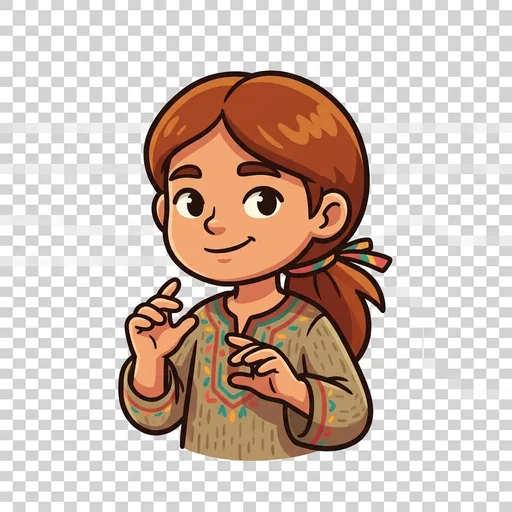
Signed languages — full natural languages spoken with hands, face, and space; each Deaf community's own, never 'just gestures'
-

Swoop
Tone — pitch that changes a word's meaning (tonal languages); precise and sophisticated, never 'sing-song' or 'exotic'
-

Weft
Word order / syntax — languages arrange words differently (SVO/SOV/verb-first); no order is 'backwards,' each is complete
-

Lex
Untranslatable words — words no other language has in one breath; not a gap in your language but a gift another can offer
-

Nook
Endangered languages + revitalization — keeping fading languages safe; decline is from histories of harm, never the speakers' fault; communities lead the revival