
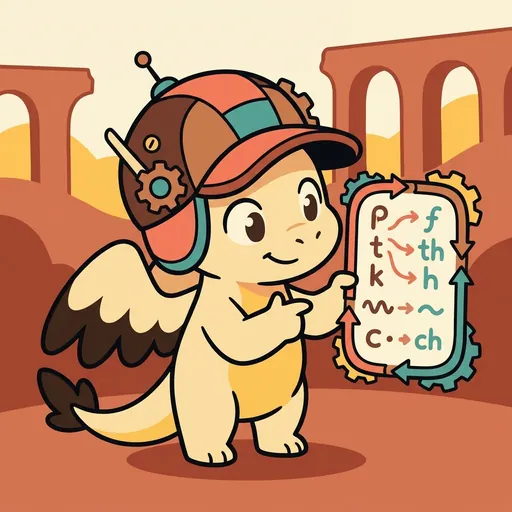
Drift
SOUND CHANGE — *sounds shift slowly across generations. systematic patterns; predictable directions.*
Listen along — Drift
Loading audio…
Press play to listen along. The line being read lights up as you go.
Show full transcript
Loading transcript…
Chapter 2 — Drift and the Slow Slide of Sounds
High on the cliffside, Drift the swift-tween pressed his ear to the wind and caught a sound sliding out from under a word.
Two farmers were arguing about a fish downhill, and Drift’s whole body went still. “There,” he whispered, tugging his too-big time-traveler cap out of his eyes. “Fish.” He hopped along the ledge, following the sound like a scent. “In Latin it was pisces — with a hard p right at the front. Same fish. Same old root. But somewhere, long ago, a whole crowd of p sounds got tired and softened into f.” He tapped his glowing little chart. “Pater became father. Pisces slid to fish. Not one word — every last one of them. The whole crowd walked the same way at once.” He beamed at the empty air. “You can’t hear it happening. But you can catch it after it’s done.”
Drift’s family were generation-watchers — swifts who lived long enough to remember how the village’s own speech had shifted, and who kept track of every slide.
When Drift was small he came home crying, because an elder from the next valley had laughed at how he said a word. “That’s not how it goes,” the elder had sniffed.
His grandmother took him up to their favorite ledge and pointed her wing at the wind. “Youngsters always speak a little differently from the elders,” she said. “Always have. When I was your age, they laughed at me.” She chuckled. “That’s not you being wrong, little one. That’s just the wave. Sounds don’t stand still — they drift, slow as tide, across the years.” She smoothed his ruffled feathers. “The trick isn’t to stop the wave. It’s to learn to read it. Then you’re never lost in it — you’re riding it.” Drift stopped crying. He started listening. He never really stopped.
He was twelve when he glided down into LinguaQuest, chart tucked under one wing, and Mira met him with a riddle.
“There’s a word older than anyone alive,” she said. “Nobody ever wrote it down. Nobody ever heard it. How would you find out how it sounded?”
Drift didn’t blink. He landed, spread his glowing chart on the grass, and pointed. “You look at all its grandchildren,” he said. “The words alive today that came from it. You line them up. You watch which sounds drifted, and which way.” His feathers puffed with quiet excitement. “The drifts follow rules — if a k softened to an h over here, it softened everywhere in that family. So you run the rules backward. Step by step, valley by valley, until you’re standing in a village nobody’s seen in six thousand years.” He looked up. “That’s how we know how the oldest language sounded, even though no one alive ever heard it spoken.”
Mira crouched over the chart, eyes moving along his traced lines. “You didn’t tell me a rule,” she said softly. “You dug up a lost village and handed it to me.” She helped him fold the chart. “There’s a workshop up on the ridge. It’s yours.”
Drift’s workshop was carved into the cliff face, all wind and echo, and the day a knot of students climbed up to visit, he held his chart out over the drop so the light caught it.
“Watch,” he said, and traced a slow line. A little p sound bloomed on the tablet, shimmered, and melted into an f. Then a t softened into a th. Then a hard k thinned into a breathy h. “Trēs became three,” he said. “Kṃtom became hundred. One slide, one direction, and it caught every word in the whole branch of the family at the same time.” He let the wind tug the chart. “That’s the thing to feel in your bones: it’s not sloppy, and it’s not random. When a sound drifts, it drifts regular. That’s how you know it’s real change and not just one person’s mumble.”
A boy squinted. “But English is done changing, right? It’s finished?”
Drift laughed so hard his cap slipped. “Finished! Oh, no.” He steadied it. “You and your grandmother don’t say every word the same. Listen close and you’ll hear it right now — different in the mountains, different in the city. Every one of those little differences is a wave just starting.” He grew warmer. “The way you and your friends talk today? Somebody older probably calls it ‘wrong.’ It isn’t. It’s tomorrow’s ordinary, drifting in early.”
After the others scrambled back down, the boy stayed on the ledge, kicking a pebble off the edge.
“An older kid told me I say a word ‘lazy,’” he said. “That I’m doing it wrong.”
Drift settled beside him, quiet now, the way he got when something mattered. “You’re not doing it wrong,” he said. “You’re doing it next. Your mouth is standing on the newest edge of a wave that’s been rolling for a thousand years.” He nodded at the horizon. “The elders said it one way. You say it another. Someday kids who aren’t even born yet will say it a third way — and they’ll get laughed at too, and they won’t be wrong either.” He tucked his chart away. “There’s a peace in that, once you feel it. Nobody’s speech is broken. Not the old way, not your way, not the way that’s coming.”
The boy said his word — his own way, out loud, unhurried — and for the first time it didn’t feel like a mistake. It felt like his place in a long, slow line.
“Feel that?” Drift said, gentle as the wind. “That calm settling in? That’s you letting go of being ashamed. We’re all just riding the same slow wave together. It never stops. And it was never yours to fix.”
The LinguaQuest ensemble
Drift is part of LinguaQuest's distributed-narrative cast. Each character embodies a different curricular primitive; together they teach the full subject.
-

Bough
Language families (genetic descent — Indo-European / Sino-Tibetan / Afro-Asiatic / Niger-Congo / Austronesian)
-

Glyph
Writing systems (alphabetic / abjad / abugida / syllabic / logographic — and how each captures speech)
-
Bridge
Cognates and loanwords (shared roots across languages; trade-route borrowings)
-
Cant
Sociolinguistics — dialect, register, code-switching, formal/informal speech
-
Sign
Signed languages — full natural languages spoken with hands, face, and space; each Deaf community's own, never 'just gestures'
-
Swoop
Tone — pitch that changes a word's meaning (tonal languages); precise and sophisticated, never 'sing-song' or 'exotic'
-
Weft
Word order / syntax — languages arrange words differently (SVO/SOV/verb-first); no order is 'backwards,' each is complete
-

Lex
Untranslatable words — words no other language has in one breath; not a gap in your language but a gift another can offer
-

Nook
Endangered languages + revitalization — keeping fading languages safe; decline is from histories of harm, never the speakers' fault; communities lead the revival