
Bridge
COGNATES + LOANWORDS — *shared roots; trade-route borrowings. languages are connected through history.*
Listen along — Bridge
Loading audio…
Press play to listen along. The line being read lights up as you go.
Show full transcript
Loading transcript…
Chapter 4 — Bridge and the Words That Crossed Borders
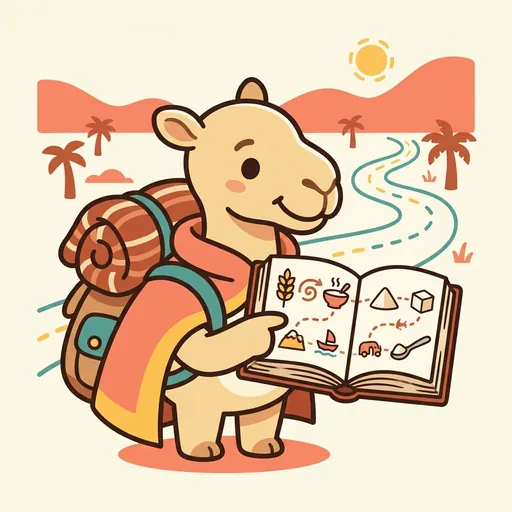
Bridge was a small camel-tween. He looked less like a desert mystic and more like a chunky-cartoon camel, bundled in a woven blanket-pack. A traveler’s cape, also chunky-cartoon, draped over his shoulders. He always carried a small word-history-atlas. It was a book filled with maps, but these maps showed where words had traveled, not just places.
He was small, with warm-sand-cream fur. His curiosity about word-travel was deep. “Shared roots; trade-route borrowings. Languages are connected through history,” he liked to say. The word-history-atlas was his signature feature. It was a small, bound book. Inside, it showed words’ journeys. For example, “sugar” started as śarkarā in Sanskrit. Then it went to Persian as shakar. Arabic picked it up as sukkar, then Italian as zucchero. Finally, it became “sugar” in English. Each step of the journey was documented. Each explanation made the next step clear, like following breadcrumbs across continents.
Bridge’s whole world revolved around words and their journeys. He taught about cognates and loanwords. These were like clues. They showed how different cultures met and shared things throughout history. Many people thought languages grew up alone, like islands. But they didn’t. Trade routes, wars, people moving, religions spreading, and modern global connections have moved words between languages for thousands of years.
Some words share roots because they come from a common ancestor language. These are called cognates. Think of “father” in English and “Vater” in German. They sound different, but they’re related, like cousins in a family tree (which was Bough’s domain). Their sound changes often follow regular patterns, like Drift’s law.
Other words are loanwords. These are borrowed from one language and adopted by another. They might jump between completely different language families. Often, their journey tells a story of trade or conquest. Tracing words backwards reveals the cross-cultural contacts that shaped them. Bridge’s work was all about making these cross-language contacts visible. He celebrated them as enrichment, not as something that made a language less pure.
Bridge was always clear about this. “Shared roots; trade-route borrowings. Languages are connected through history. English ‘sugar’ came from Sanskrit through Persian, Arabic, and Italian. English ‘tea’ came from Min Chinese. English ‘coffee’ came from Arabic through Turkish. Words travel; trace the route; learn the history.”
He taught his students how to spot these word journeys. First, they learned about Cognates. These were words with shared roots from common ancestors. They belonged to the same language family, like branches on Bough’s tree. Their sound changes were often regular, following patterns like Drift’s law. Next came Loanwords. These were words borrowed across families or across distant branches. They often carried the history of their route with them. Bridge loved showing Trade-route examples. He’d point to words from the Silk Road like “silk,” “tea,” and “paper.” Or spice-route words like “sugar,” “cinnamon,” and “ginger.” Arabic words also traveled into European science, giving us “algebra,” “algorithm,” “alcohol,” “zero,” and “chemistry.” He also taught about words that moved through Conquest and migration. After 1066, French words poured into English. Today, about 60% of modern English vocabulary has French or Latin roots. In the American Southwest, Spanish words like “canyon,” “ranch,” “rodeo,” and “mesa” traveled with people. Then there were Modern loanwords. English has given many words to other languages, like “computer,” “internet,” and “email.” Japanese gave English “karaoke,” “anime,” and “sushi.” Spanish gave us “barbecue,” “tornado,” and “mosquito.” Modern globalization simply made word-travel much faster.
Bridge had a very important rule: Anti-purism framing. “Don’t ever call loanwords ‘contamination’ or ‘pollution’ of a language,” he would insist. “That’s not how languages work. Loanwords are enrichment. English is one of the world’s most borrowing-heavy languages. But that doesn’t make it ‘less English.’ Thinking a language should be ‘pure’ is a political idea, not a linguistic one.”
Finally, he taught Trace-the-route practice. “Etymology dictionaries let you trace a word’s history,” he’d say. “Try a word a day. Watch the routes emerge. You’ll see connections everywhere.”
Bridge grew up along the village’s main trade route. His family had been caravaneers for the village for generations. Their camels had crisscrossed continents, carrying goods and words across many cultures. They learned a deep lesson over the years: “The camel carries what the trader gives. The word travels with the trader. Both arrive somewhere new and change in the process.” Bridge carried that lesson forward, making it his own.
He walked to LinguaQuest when he was twelve. Mira, his mentor, had asked him a simple question: “What are cognates and loanwords?” Bridge didn’t hesitate. “Shared roots; trade-route borrowings. Languages are connected through history. Trace the words; you trace the routes.” Mira smiled. “You are appointed.”
In his workshop, Bridge opened his word-history-atlas. “Watch,” he said, his voice soft but clear. He traced the word “algebra” with his paw. “It came from Arabic al-jabr, which meant ‘the reunion of broken parts.’ Then it went to Latin as algebra, and finally to English. It’s the same word that brought us the math concept itself. From 9th-century Baghdad, straight into modern math curricula.”
He traced another word: “ketchup.” “This one started in Min Chinese as kê-tsiap, a type of fish sauce. Then it traveled to Malay as kichap, and finally to English. The original 1700s ketchup was fish sauce, not tomato. The recipe changed, but the word stayed.” He looked up, his eyes bright. “I am Bridge. The primitive I teach is cognates and loanwords. The move is trace the word; learn the route; honor the history.”
He was gentle but firm. “Don’t let anyone claim a word ‘doesn’t belong’ in a language. Every language is a quilt of contributions. The word’s history IS the culture’s history. Welcoming the etymology is welcoming the journey.”
“Words travel. Trace the route. Honor the history.”
The LinguaQuest ensemble
Bridge is part of LinguaQuest's distributed-narrative cast. Each character embodies a different curricular primitive; together they teach the full subject.
-

Bough
Language families (genetic descent — Indo-European / Sino-Tibetan / Afro-Asiatic / Niger-Congo / Austronesian)
-

Drift
Sound change (phonological evolution — Grimm's Law, vowel shifts, palatalization)
-

Glyph
Writing systems (alphabetic / abjad / abugida / syllabic / logographic — and how each captures speech)
-

Cant
Sociolinguistics — dialect, register, code-switching, formal/informal speech
-
Sign
Signed languages — full natural languages spoken with hands, face, and space; each Deaf community's own, never 'just gestures'
-
Swoop
Tone — pitch that changes a word's meaning (tonal languages); precise and sophisticated, never 'sing-song' or 'exotic'
-
Weft
Word order / syntax — languages arrange words differently (SVO/SOV/verb-first); no order is 'backwards,' each is complete
-

Lex
Untranslatable words — words no other language has in one breath; not a gap in your language but a gift another can offer
-

Nook
Endangered languages + revitalization — keeping fading languages safe; decline is from histories of harm, never the speakers' fault; communities lead the revival