
Verity and Ada
SUBJECT-VERB AGREEMENT — a singular subject takes a singular verb, a plural subject takes a plural verb (the dog barks / the dogs bark). Verity is the verb who flips her ending; Ada is the one who reads whether the subject is one or many — and points past distracting in-between phrases to the true subject.
Press play to listen along. The line being read lights up as you go.
Show full transcript
Loading transcript…
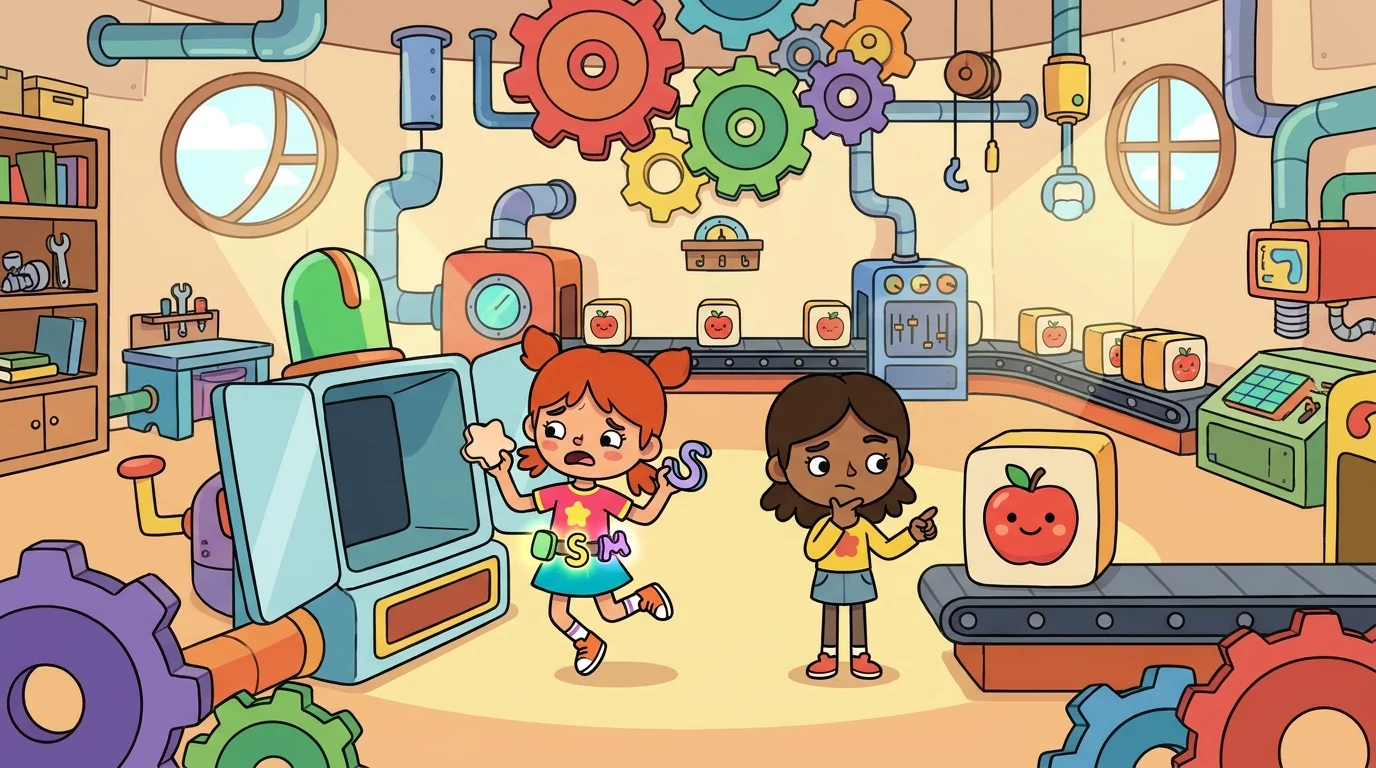
*Verb* Verity worked in the drafty center of the sentence workshop, where the air smelled of wet ink and hot metal. She was always moving. Nothing in a sentence ever happened until Verity jumped into the middle of the frame and kicked it into motion. Without her, the nouns just sat around like heavy bags of cement on a construction site.
She wore a heavy leather utility belt clinking with glowing brass endings. There was a simple, plain cap, a soft -s hook, and a few strange, jagged shapes for special occasions. When a line of words needed to move, Verity would leap onto the scaffolding. She would hurl an action—run, shatter, whisper, is—directly into the gap. Instantly, the cold iron letters would hum and spark with life. She loved that sudden, electric spark.
What she did not love was the tedious business of choosing the right ending. It was a constant, nagging puzzle. If she picked the wrong brass hook, the sentence would tilt. It would hang slightly crooked on the wall, like a picture frame after an earthquake. Nobody could point to the exact problem, but everyone in the workshop felt a dull headache looking at it.
“Close enough,” Verity would mutter, wiping grease from her forehead. She would slap on whichever ending was closest to her hand and hurry to the next job.
But it was almost never close enough.
One Tuesday morning, she assembled a quick, energetic line.
“The dog run across the yard,” she announced, dusting off her hands. She expected the usual satisfying snap of a completed job.
Instead, the sentence groaned. The scruffy brown terrier at the front of the line looked back over its shoulder. Its hind legs were twisted, as if its tail were caught in a door. The word yard sagged toward the floorboards, pulling the whole phrase out of alignment.
The workshop went quiet. It was the uncomfortable silence of people pretending they hadn't seen someone trip on the stairs.
Verity stared at the crooked line, her cheeks burning. “It’s fine,” she said, though her voice lacked its usual bounce. “The dog. Run. Across the yard. Look, it has all the necessary parts.”
“It has the parts,” a calm voice agreed from the shadows of the doorway. “It just doesn't have them listening to each other.”
The speaker was a small, unhurried girl wearing round spectacles and a faded canvas apron. Her head was tilted slightly, as if she were listening to a very distant radio station. This was Agreement Ada. Ada didn't carry heavy crates of actions, and she never leaped onto the high scaffolding. Instead, she did something Verity had never even considered: before any word moved, Ada counted.
“May I?” Ada asked, stepping onto the dusty floorboards.
Verity shrugged, relieved to hand the awkward, groaning sentence over to someone else. “Go ahead,” Verity said. “It’s giving me a headache.”
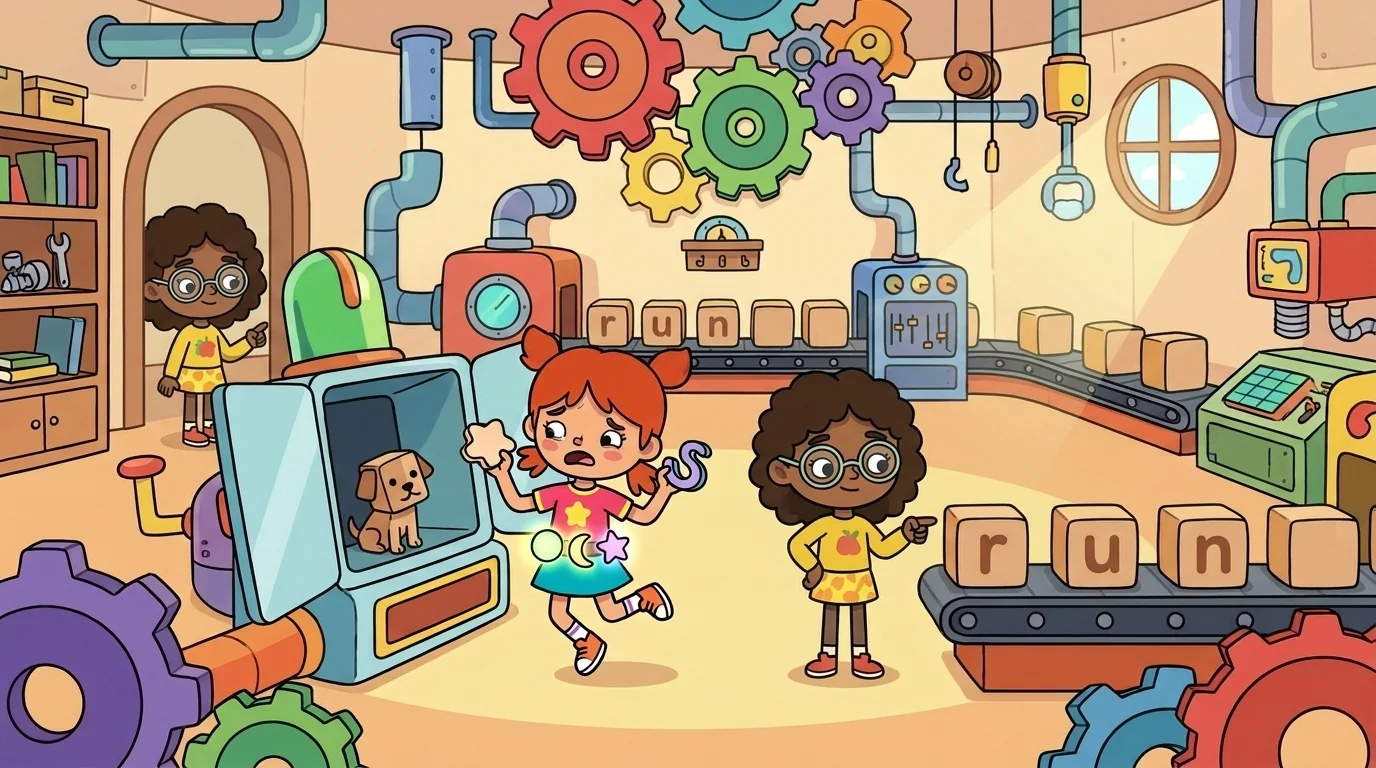
Ada walked to the very front of the line. She stood right before the noun, peering over her spectacles at the scruffy terrier.
“One dog,” Ada said softly, tapping the letter D with her finger. “Just a single, lonely pup. See him?”
Verity squinted. “Sure. He’s right there.”
“So when he comes to you for an action, you have to answer him in the singular,” Ada explained. She pointed a slender finger at the glowing brass charms on Verity's leather belt. “For a single subject, in the present tense, you must use the -s ending.”
“The -s?” Verity repeated, touching the small, curved piece of metal.
“Exactly,” Ada said. “The dog barks. The dog runs. Try it now.”
Verity unclipped the plain, flat ending she had forced onto the verb. She reached for the polished -s charm and snapped it onto the tail of run. The metal clicked, a sharp, clean sound that echoed in the rafters.
“The dog runs,” Verity said aloud.
Immediately, the terrier’s hind legs straightened. The dog sat up, panting happily, its tail wagging against the wooden frame. The word yard lifted off the floor, and the entire sentence settled into a perfectly straight line. The tense silence in the workshop dissolved into an easy, comfortable hum.
Verity stared at her belt, her mouth slightly open. “Oh,” she whispered. “It wasn't looking for a bigger, fancier word.”
“No,” Ada smiled. “It just wanted the one that matched.”
A student named Perry had been watching them from the scrap heap. Perry was fourteen, with grease on his chin and a habit of building difficult sentences just to watch them collapse. He walked over, dragging a heavy iron frame behind him. On the frame, he had bolted a particularly nasty set of words. It was the kind of sentence adults used when they wanted to make children feel foolish.
“Try this one,” Perry said, a mischievous grin spreading across his face. He tapped the metal letters: The box of crayons...
He looked at Verity, holding up two different verbs like a magician showing cards. One was is, and the other was are.
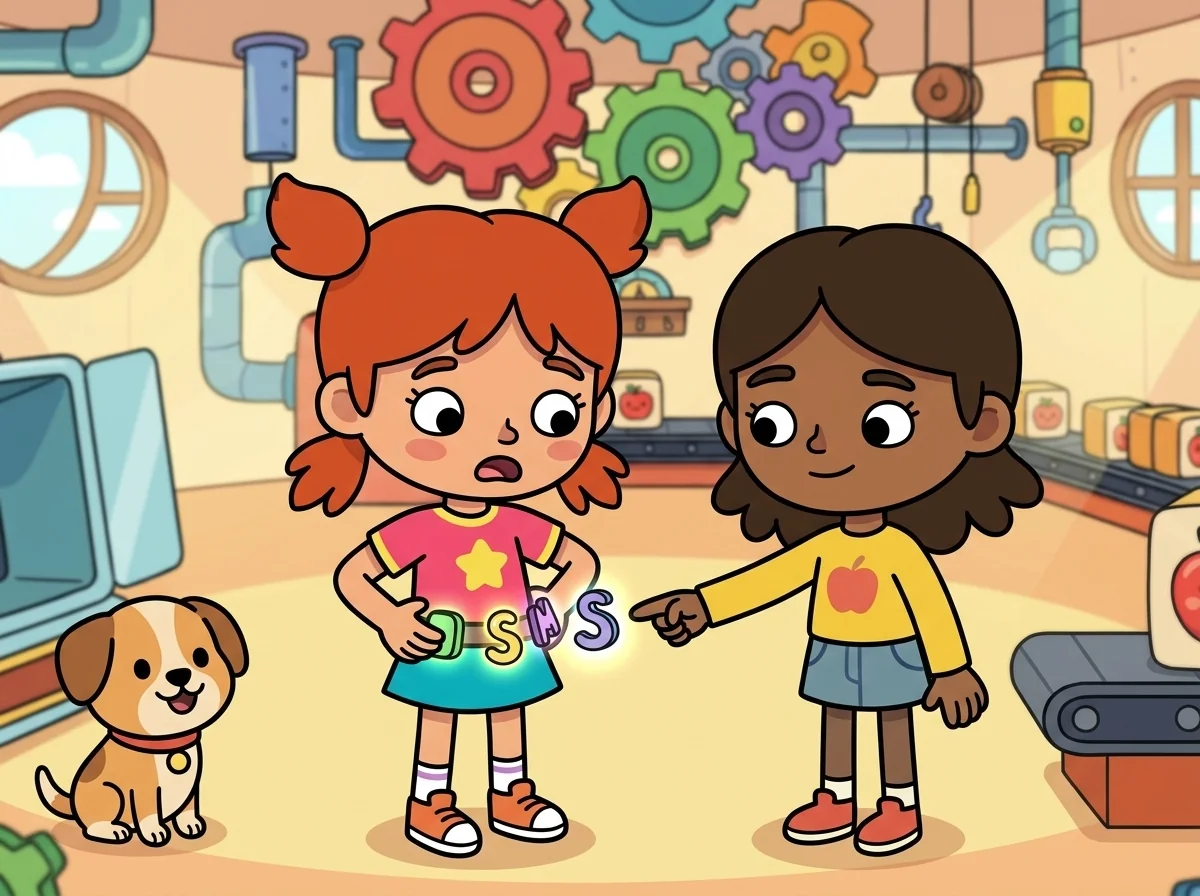
“So, which one goes on the shelf?” Perry asked. “There’s a whole bunch of crayons in there. Dozens of them. So it has to be are, right?”
Verity’s hand drifted toward her plural ending, her fingers hovering over the brass hook. Perry’s logic seemed solid. Crayons were plural; there were red ones, blue ones, and yellow ones. Surely a crowd of colors needed a crowd of verbs.
“Wait,” Ada said. She reached out and gently caught Verity’s wrist. “Don't let the crowd distract you, Verity. We must find the true subject.”
Ada stepped closer to the heavy iron frame. She did the thing that was her special gift in the workshop. She didn't look at the loud, colorful words in the middle. Instead, she cupped her hands around the phrase of crayons. She blew a soft breath over them. The words dimmed, fading into a quiet, translucent gray. They were still there, but they no longer demanded attention. Only the very front of the sentence remained glowing in the dim light.
“What is left shining?” Ada asked.
Verity squinted at the bright letters. “Box,” she said. “Just the word box.”
“And how many boxes do you see?”
“One,” Verity realized. “Just one cardboard box.”
“Exactly,” Ada said, stepping back. “The crayons are just visiting inside it. The box is the actual leader of this sentence.”
Verity felt a sudden surge of clarity. She bypassed the plural hook entirely. She grabbed the singular verb is and slotted it firmly into place.
“The box of crayons is on the shelf,” she declared.
The sentence rang out like a struck bell. It was perfectly balanced, solid, and undeniable.
Perry let out a dry, appreciative chuckle. “Darn,” he muttered, though he looked pleased. “I thought I had you with that one.”
Verity turned to Ada, her eyes wide with a new kind of respect. “You looked right past the noise,” Verity said. “I never do that. I just run in and start throwing actions around.”
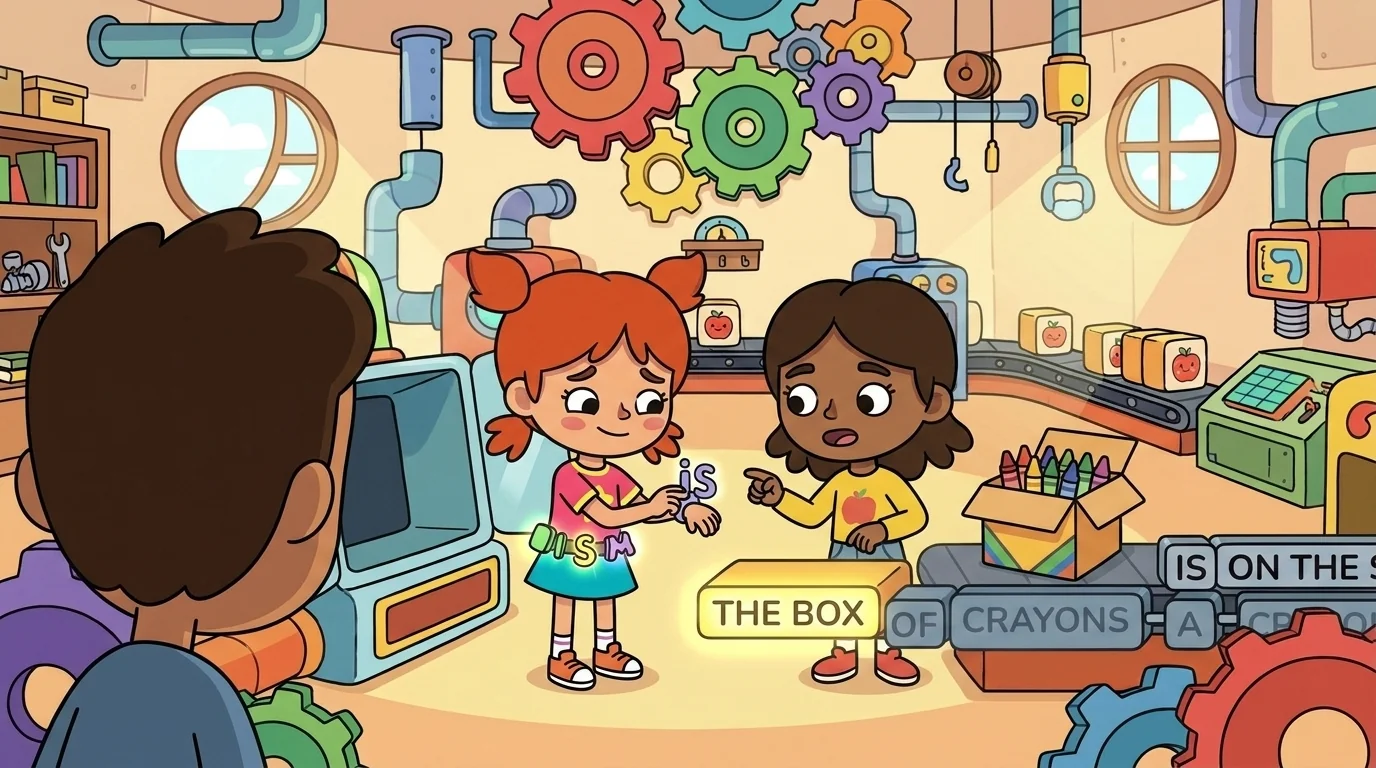
“You have the energy,” Ada said, her eyes crinkling behind her glasses. “I have the patience. That is why we make a good team.”
“Why does a single dog need an -s?” Verity asked, kicking a stray comma out of her way. “It seems backward. Usually, the -s means there are more of something.”
“For nouns, yes,” Ada agreed, adjusting her spectacles. “But verbs are different. They are the givers of action, not the receivers.”
“A single subject is a heavy burden for a verb,” Ada continued. “It needs the extra support of the -s to hold it up.”
“And if there are many dogs?” Verity asked, leaning against a stack of adjectives.
“Then they share the load,” Ada said. “They don't need the extra support. The dogs run. No -s required.”
Verity thought about this, her fingers tracing the smooth brass of her charms. It was like a system of levers and pulleys. If one side was heavy, the other side had to adjust to keep the balance.
“What about this one?” Verity asked, suddenly eager to try her new skill. She dragged a dusty wooden frame from under her own workbench. On it, she had spelled out: The players on the team...
She looked at Ada, her eyes bright with anticipation. “Okay, let's see,” Verity said, mimicking Ada's analytical posture. “The subject is players. But there is a phrase in the middle: on the team.”
“Excellent,” Ada said, nodding encouragingly. “Now, what do we do with the middle phrase?”
“We dim it,” Verity said. She cupped her hands over on the team and imagined them fading away. The words seemed to lose their luster, leaving only players glowing brightly.
“Players is plural,” Verity said, her voice confident. “There are many of them. So they share the load.”
She reached for her plain, unadorned verb practice. She snapped it into place.
“The players on the team practice every day,” she read.
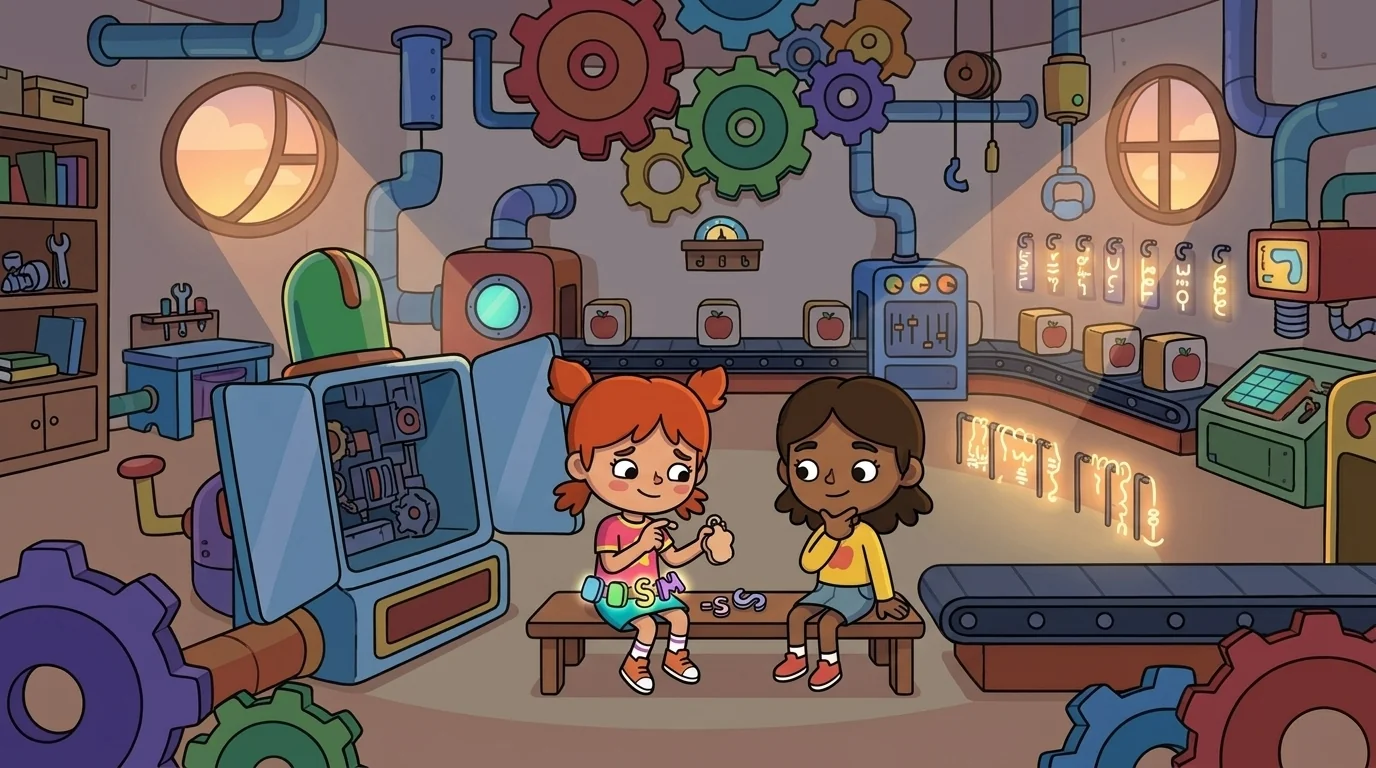
The sentence stood perfectly straight, strong and proud.
Ada clapped her hands together, a small, dry sound. “Perfect,” Ada said. “You see? You don't need me to hold your hand.”
“I just needed to know where to look,” Verity said, smiling.
Later, when the workshop had emptied and the last sentences hung straight and quiet on the wall, Verity sat on the bench beside Ada. The room was cool and smelled of cedar shavings and old paper. Verity turned the little -s charm over in her fingers. It felt warm, as if it still held some of the energy from the sentences they had built.
“I used to hate this part,” Verity admitted, her voice quiet in the empty room. “Picking the ending always felt like a test I was destined to fail.”
She looked up at the rows of perfectly aligned sentences glowing in the twilight. “It felt like everyone was watching, waiting for me to make a mistake.”
Ada nodded, her eyes soft behind her round glasses. “I know,” Ada said. “Rules can feel like walls sometimes.”
“But they aren't walls,” Verity said, realizing it for the first time. “It’s more like... tuning an instrument.”
“Exactly,” Ada said. “When two notes are almost the same, they fight each other.”
“But when they slide into the exact same frequency, your chest kind of unclenches.”
“That is the feeling of agreement,” Ada said softly. “It is not about obedience. It is about two words choosing to speak the same language.”
“Agreeing is just a way of listening.”
Verity leaned back against the brick wall. Her heavy leather belt felt lighter now. The brass charms no longer felt like a burden of choices. They felt like keys, each one ready to unlock a perfect, balanced moment. She didn't have to guess anymore. She just had to count, look past the noise, and listen.
“Matching feels good,” Verity said, closing her eyes. “I didn't know I could feel this calm about getting something right.”
And that was the truest feeling of her whole day. It was the warm, settled calm of two words that had finally stopped fighting and simply agreed. It felt, Verity thought as she drifted off to sleep, a little like belonging.
The GrammarForge ensemble
Verity and Ada is part of GrammarForge's distributed-narrative cast. Each character embodies a different curricular primitive; together they teach the full subject.
-

Mayor Subject
Subject (noun/pronoun performing the action)
-

Verb Verity
Verb (action / state of being)
-

Object Otto
Direct / indirect object (receiver of the verb's action)
-

Modifier Mike
Adverb (modifies verb / adjective / other adverb)
-

Modifier Madge
Adjective (modifies noun / pronoun)
-

Connector Chen
Conjunction (coordinating / subordinating — *and*, *but*, *because*, *although*)
-

Pronoun Perry
Pronoun (substitute for noun — *he*, *she*, *they*, *it*, *who*)
-

Article Anne
Article (*a*, *an*, *the* — definite vs. indefinite)
-

Preposition Pat
Preposition (spatial / temporal relations — *on*, *under*, *between*, *before*)
-

Clause-Chief Carla
Clause-types (independent / dependent / subordinate / relative)
-

Punctuator Polly
Punctuation guardian (commas, semicolons, apostrophes, colons, dashes)
-

Agreement Ada
Subject-verb agreement (singular subject → singular verb; plural subject → plural verb; tricky cases — collective nouns, *either/or*, indefinite pronouns)