
Twoby and Swatch
two-coloring meets parity — a loop of connected things can be painted with just two colors, neighbors never matching, exactly when the loop has an even number of things (it pairs up two by two). An odd loop can never be two-colored: one clash is always left over. Bipartite graphs are the even ones.
Press play to listen along. The line being read lights up as you go.
Show full transcript
Loading transcript…
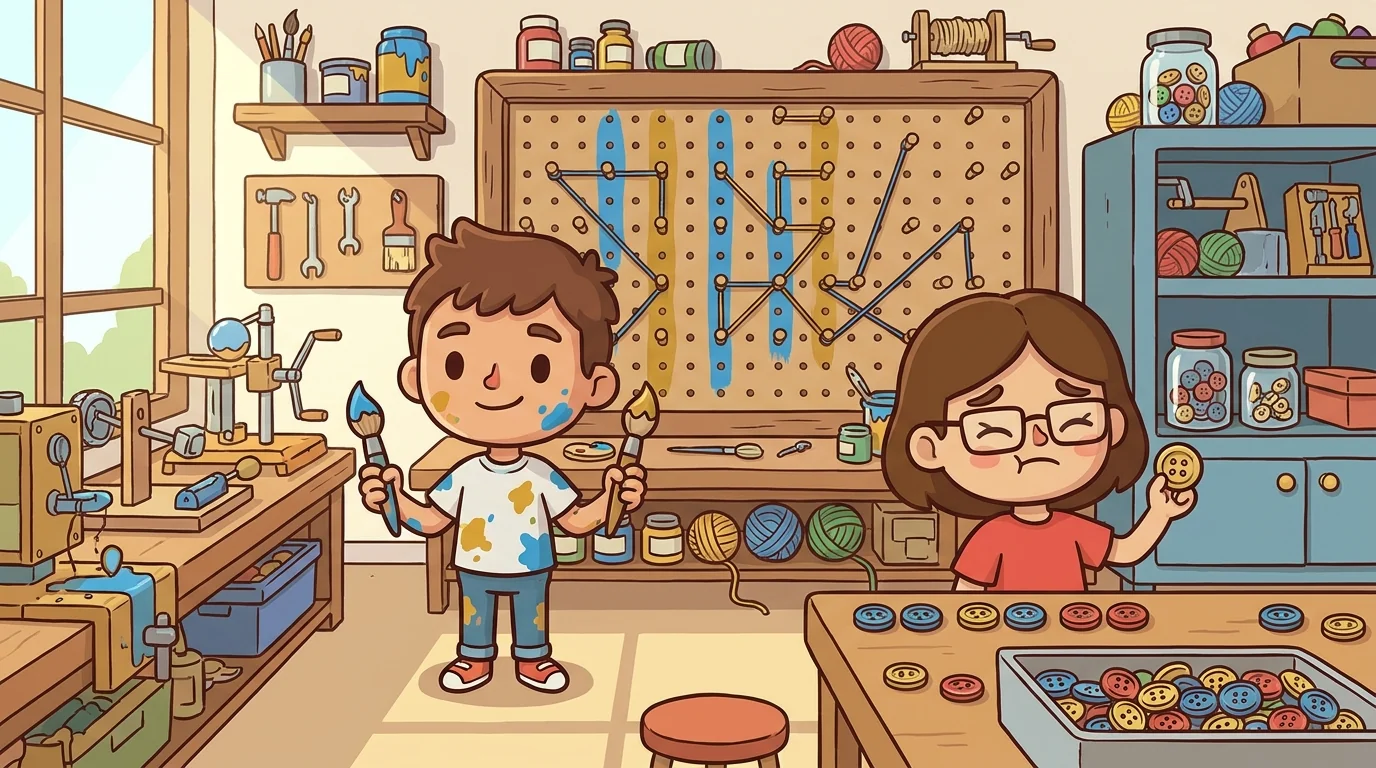
In the quietest corner of the discretequest workshop, the afternoon light always smelled of turpentine and shaved pine. High windows let in long shafts of dusty gold, illuminating the workbenches where the tools of the trade lay in neat, silent rows. Swatch stood before a massive plywood pegboard, holding a stiff-bristled paintbrush in each hand. One brush was dipped in cobalt blue, the other in a bright, metallic gold. Dozens of wooden pegs jutted from the board, connected to one another by thin, taut pieces of black string. Swatch’s entire job was to paint these pegs so that no two connected by a string ever shared the same color.
They called this task *two-coloring*, and Swatch took a quiet, fierce pride in it.
"Blue, gold, blue, gold," Swatch murmured, dabbing the brushes in a steady, alternating rhythm. "Neighbors never match. That's the only rule."
They stepped back, wiping a smear of gold paint onto their heavy canvas apron. A neat, perfect line of alternating pegs stretched across the center of the board. It looked like a tiny, colorful fence. Swatch smiled at the sight.
"See?" Swatch said, gesturing with a blue-tipped brush. "Two colors. That is all a good border-painter ever needs to keep the peace."
At the adjacent workbench, Twoby was busy with a task that looked entirely useless to anyone else. Twoby sat before a wide ceramic bowl filled with hundreds of mismatched buttons. There were heavy brass buttons from old military coats, and flat pearl ones from Sunday shirts. Twoby’s fingers moved through the pile with a dry, rustling sound, sliding them across the scarred wood two at a time.
Click. A pair of black plastic. Click. A pair of heavy brass.
The table was soon covered in neat little islands of two. Whenever the pile came out perfectly even, with every single button matched to a partner, Twoby smiled. But whenever a single button sat alone at the end of the sorting, Twoby’s nose wrinkled in disapproval.
"The odd one out," Twoby sighed, holding up a lonely, green glass button between two fingers. "There is always something slightly uncomfortable about an odd number, and you can feel it in your teeth."
Swatch laughed, a quick, sharp sound in the dusty air of the workshop. "You and your pairs. I paint actual borders, and you just count by twos. We couldn't be more different if we tried."
Twoby did not look up, but set the green glass button down with extreme gentleness. "Maybe," they said softly. "Or maybe we are just looking at the same coin from different sides."
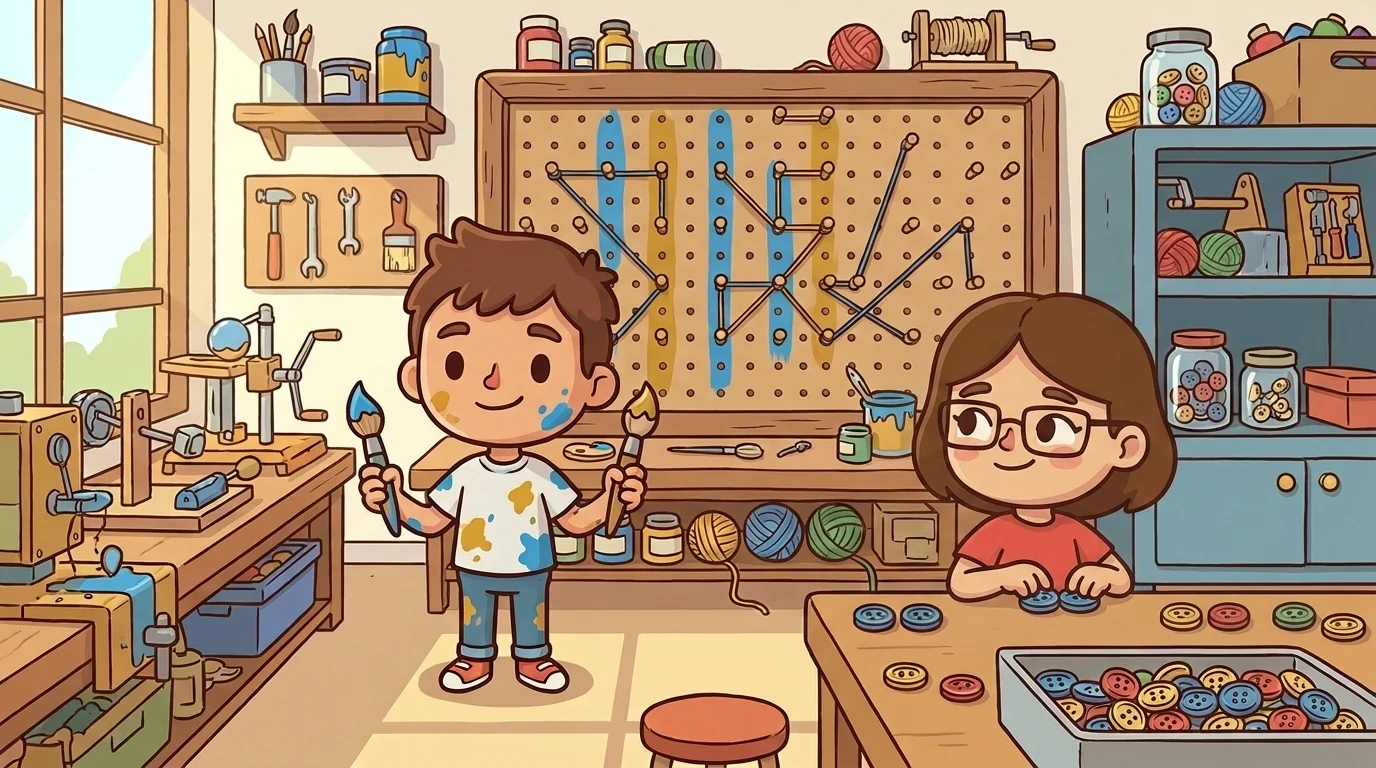
Twoby liked to explain how they first learned to trust the feeling in their nose. Swatch, who used to think the whole routine was ridiculous, had long since stopped rolling their eyes at it.
"When I was small," Twoby said, lining up a fresh row of white bone buttons, "the instructors told me to count everything. One, two, three, four, all the way up. I could do it, of course, but it was slow, and if someone banged a door, I would lose my place."
They pushed two buttons together with a soft click.
"Then I found a shortcut," Twoby continued. "I stopped counting how many. I don't need the number. I just need to know if it's even or odd."
They shrugged, their eyes reflecting the pale workshop light.
"That is *parity*. It is the smallest, truest fact you can find about a group of things."
Swatch had wandered over, the paintbrushes still balanced in their fingers, dripping tiny dots of blue and gold onto the sawdust floor. "But what is the point of it all? Even, odd—who actually cares about a leftover button in a bowl?"
"The world cares," Twoby said, not looking up from their work. "If you have an extra, you can't divide things fairly, and everything gets slightly off-balance."
They looked up with a small, knowing smile. "And besides, you are about to care a very great deal."
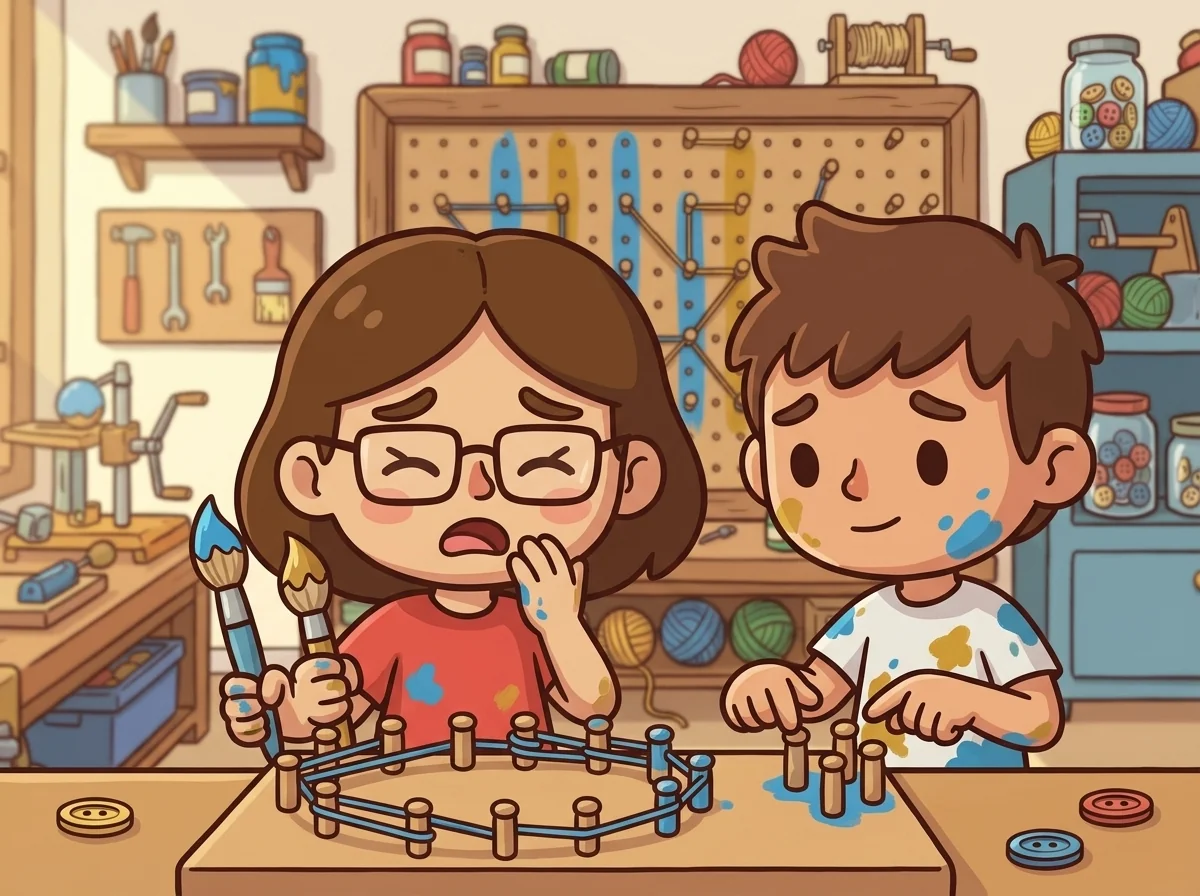
The next assignment on Swatch's pegboard was the most complicated layout they had ever faced. It was a closed ring of five pegs, each connected by a black string to the next one, forming a perfect pentagon.
"This is simple enough," Swatch said, confidence returning. "Blue. Gold. Blue. Gold."
They worked their way around the circle, dabbing the paint with practiced precision. The rhythm was familiar and comforting, but as the brush hovered over the fifth and final peg, Swatch froze.
The fourth peg was gold, and the first peg, right next to it, was also gold.
If Swatch painted the final peg blue, it would touch the blue peg at the start. If they painted it gold, it would touch the gold peg next to it. No matter what they did, two neighbors would share a color.
"No," Swatch whispered.
They grabbed a damp rag, wiped the wood clean, and started over. This time they began with gold, painting gold, blue, gold, blue, all the way around the ring. But the exact same disaster met them at the end of the loop.
A clash.
"I don't understand," Swatch said, their voice rising slightly. "It worked perfectly on the straight line. Why won't the ring take two colors?"
They stared at their hands, which were suddenly trembling, the skin of their knuckles stained with dry blue paint.
"Is my hand shaking? Did I mix the paint wrong?" Swatch’s shoulders slumped, and they let the brushes rest against the edge of the tray. "I must have ruined the pegs. I always ruin the delicate ones."
Twoby, who had been watching quietly from the stool, walked over to the board. They did not touch the paint, but gently placed their fingers on the wooden pegs, sliding them together in pairs.
Click. Click.
Two pairs of pegs sat close together, but the fifth peg remained alone, isolated at the top of the ring.
"You did not ruin anything," Twoby said, their voice steady and calm. "Count them with me. Do not look at the colors this time, but just look at the pegs. Do they pair up?"
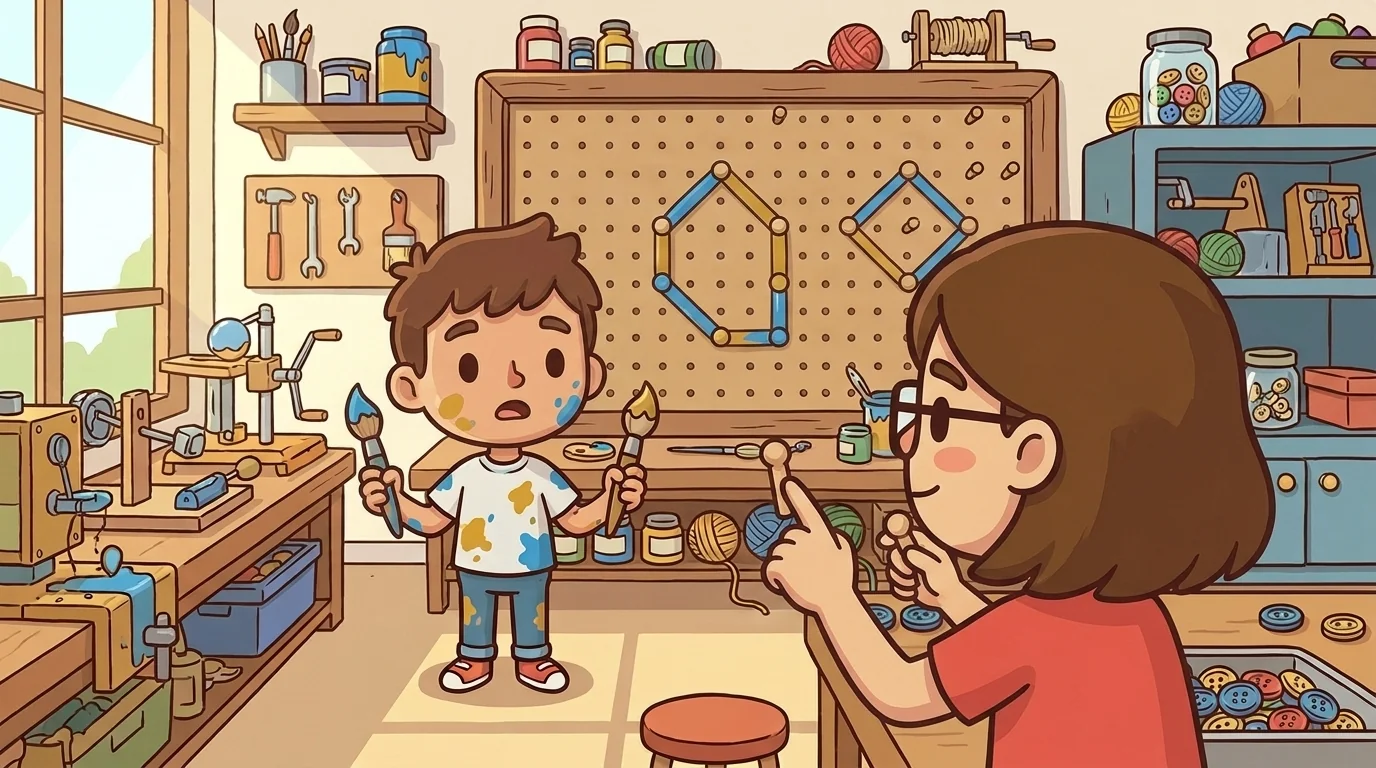
Swatch watched Twoby’s fingers move around the wooden circle. Pair, pair, and one lonely peg left over.
"Five pegs," Swatch said, the realization settling heavily in their chest. "Five is an odd number."
"Exactly," Twoby agreed. "And that is the secret of the border, my friend. Two colors must march in pairs—blue, gold, blue, gold. Because of that, a loop can only take two colors if the loop itself is even."
To demonstrate, Twoby set out four loose pegs on the workbench, forming a small square. They traced the shape with a dry finger.
"See? One, two, three, four. An even ring allows the colors to shake hands all the way around and meet perfectly."
They pointed back to the pentagon on the board.
"But an odd ring? There will always be one peg left out of the pairing. One clash, every single time, forever. It was never your hand. It was the five."
Swatch stared at the wooden pentagon as if the strings had suddenly turned to gold. The frustration that had been building in their chest began to evaporate, replaced by a strange, cool clarity.
"So when I feel that itch," Swatch said slowly, "that feeling that the board is fighting me... it is not because I am clumsy?"
"Not at all," Twoby said, smiling. "It is just the ring being odd. Your two colors and my two-by-twos — they were the same question the whole time."
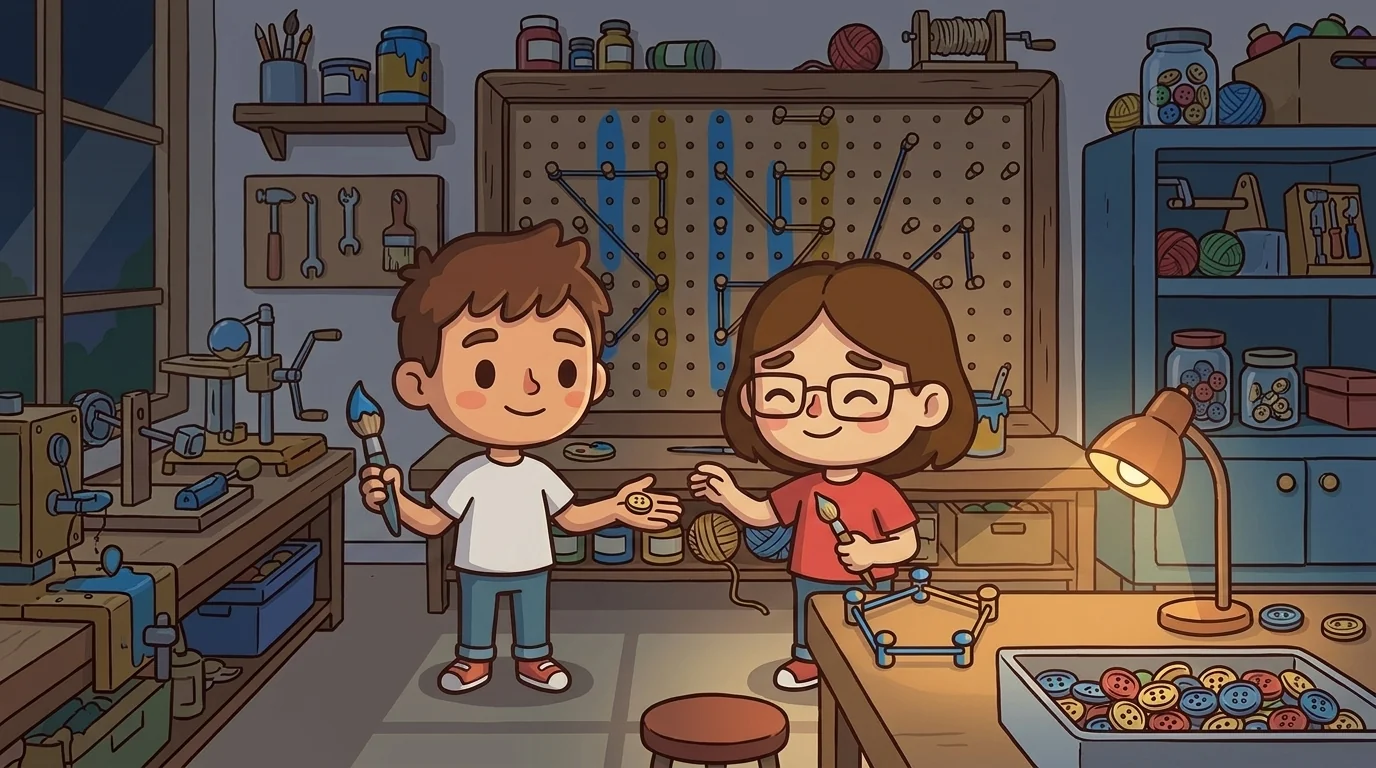
By evening, the workshop had grown dim, and the odd ring still sat on the plywood board. The single clash remained, blue touching blue, honest and bright under the hanging lamp. Swatch did not reach for the scrubbing rag this time. They just looked at it, their breathing slow and regular.
"I used to hate that clash," Swatch admitted, leaning against the workbench. "I thought it meant I was failing the test."
Twoby reached into their pocket, pulled out the lonely green glass button, and placed it gently on the table.
"It was never a failure," Twoby said. "It was just the truth of the shape. An odd loop must clash. That is not a flaw in your painting. It is a rule of the world, and you managed to find it."
Swatch let out a long breath, and the tight knot in their shoulders finally unraveled. It was a peculiar kind of relief, learning that the error they had blamed themselves for was actually just a mathematical fact, beautiful and unyielding.
"Even," Swatch said, touching the square of four pegs.
"Odd," they said, touching the five.
The clash on the board did not look like a mistake anymore. It looked like an answer.
The DiscreteQuest ensemble
Twoby and Swatch is part of DiscreteQuest's distributed-narrative cast. Each character embodies a different curricular primitive; together they teach the full subject.
-

Sortie the Set-Curator
Sets, subsets, set operations (union, intersection, difference)
-

Tally the Pattern-Counter
Counting principles and combinatorics (multiplication rule, permutations, combinations)
-

Verity the Truth-Tester
Propositional logic, truth tables, AND/OR/NOT operators
-

Wander the Bridge-Walker
Graph theory — Eulerian paths, Hamiltonian paths, connectivity
-

Coil the Self-Reference
Recursion and sequences (Fibonacci, factorials, recursive patterns)
-

Prime the Indivisible
Number theory — primes, factorization, modular arithmetic
-

Cubby the Cubby-Keeper
The pigeonhole principle — when there are more things than places, at least one place must hold two
-
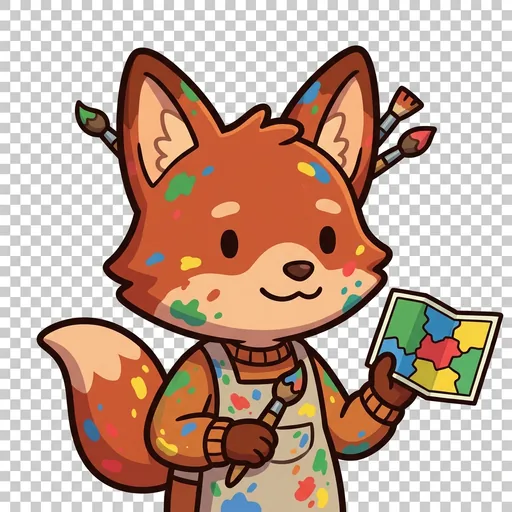
Swatch the Border-Painter
Graph coloring — coloring connected things so no two neighbors match, with the fewest colors
-
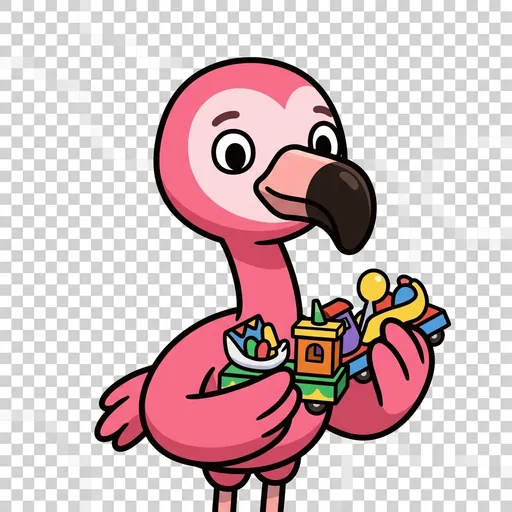
Marshal the Line-Arranger
Permutations — counting arrangements where order matters (factorials, ordered choices)
-

Twoby the Pair-Matcher
Parity and invariant arguments — even/odd pairing that proves what's possible
-

Surge the Growth-Racer
Order of growth — how the work scales as a problem gets bigger