
Twoby and Swatch
two-coloring meets parity — a loop of connected things can be painted with just two colors, neighbors never matching, exactly when the loop has an even number of things (it pairs up two by two). An odd loop can never be two-colored: one clash is always left over. Bipartite graphs are the even ones.
Press play to listen along. The line being read lights up as you go.
Show full transcript
Loading transcript…
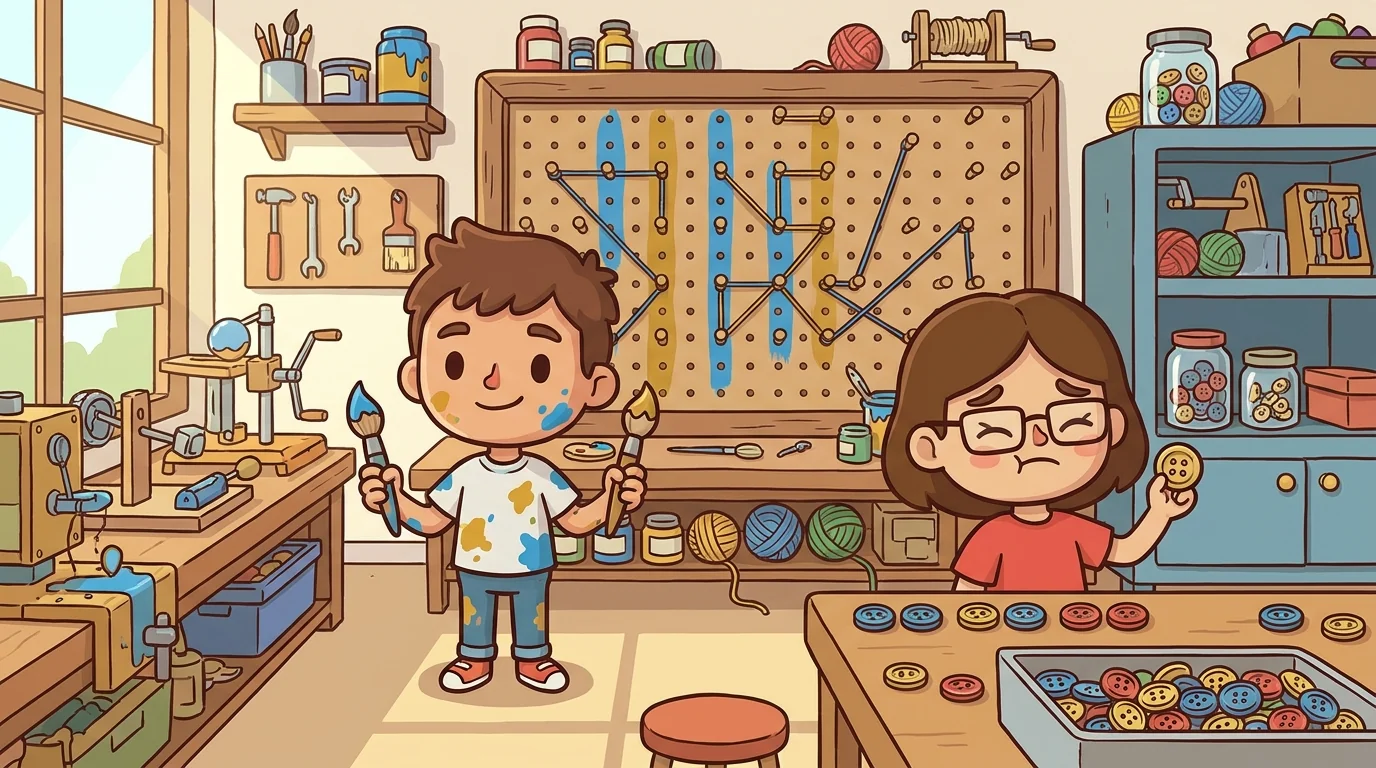
In the discretequest workshop, Swatch stood before a big pegboard, a paintbrush in each hand — one dipped in blue, one in gold. Pegs were connected by little strings, and Swatch's whole job was to paint each peg so that no two pegs joined by a string were ever the same color.
"Blue, gold, blue, gold," Swatch murmured, dabbing along a row. "Neighbors never match. That's the rule. That's the only rule." They stepped back, pleased. A neat line of alternating pegs. "See? Two colors. That's all a good border-painter ever needs."
At the next table, Twoby was doing something that looked, to anybody else, completely pointless. They were taking a bin of buttons and pushing them together, two at a time. Click. A pair. Click. Another pair. Whenever the bin came out even — every button matched with a partner — Twoby beamed. Whenever one button sat alone at the end, Twoby's nose wrinkled.
"Odd one out," Twoby sighed, holding up a single lonely button. "There's always something a little bit off about an odd number. You can feel it."
Swatch laughed. "You and your pairs. I paint, you count by twos. We couldn't be more different."
Twoby just smiled, and set the lonely button down very gently. "Maybe," they said. "Maybe not."
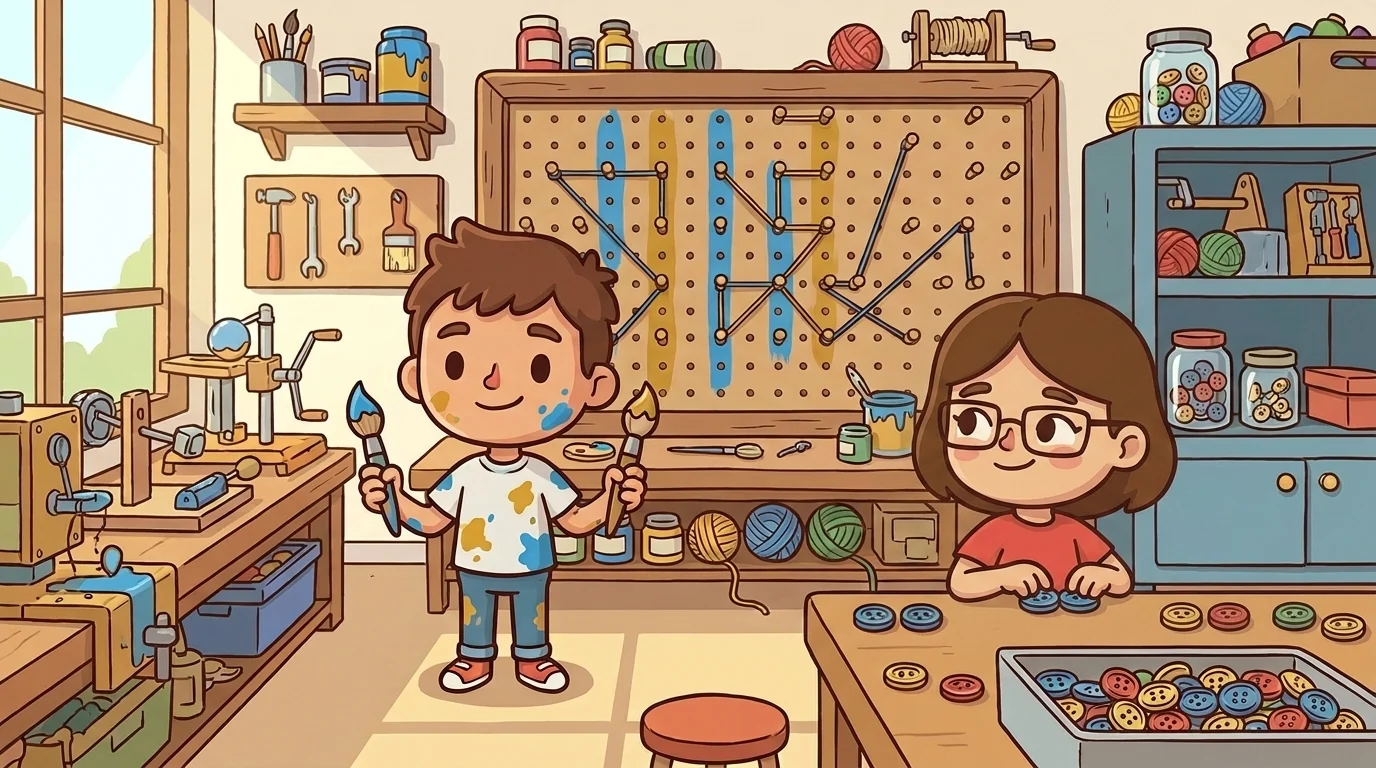
Twoby liked to tell how they first learned to trust the feeling in their nose, and Swatch, who used to think it was silly, had long since stopped rolling their eyes.
"When I was small," Twoby said, lining up buttons, "grown-ups told me to count everything. One, two, three, four. And I could. But it was slow, and I'd lose my place." They pushed two buttons together. Click. "Then I found a shortcut. I stopped counting how many. I just started asking: does it pair up? Two by two, all the way down. If it does — even. If one's left over — odd." They shrugged. "I don't need the number. I just need to know if it's even or odd. That's parity. It's the smallest, truest fact about a pile of things."
Swatch had wandered over, brushes still in hand. "But what good is it? Even, odd — who cares?"
"Oh," said Twoby, looking up with a small, mysterious smile, "you're about to care a whole lot."
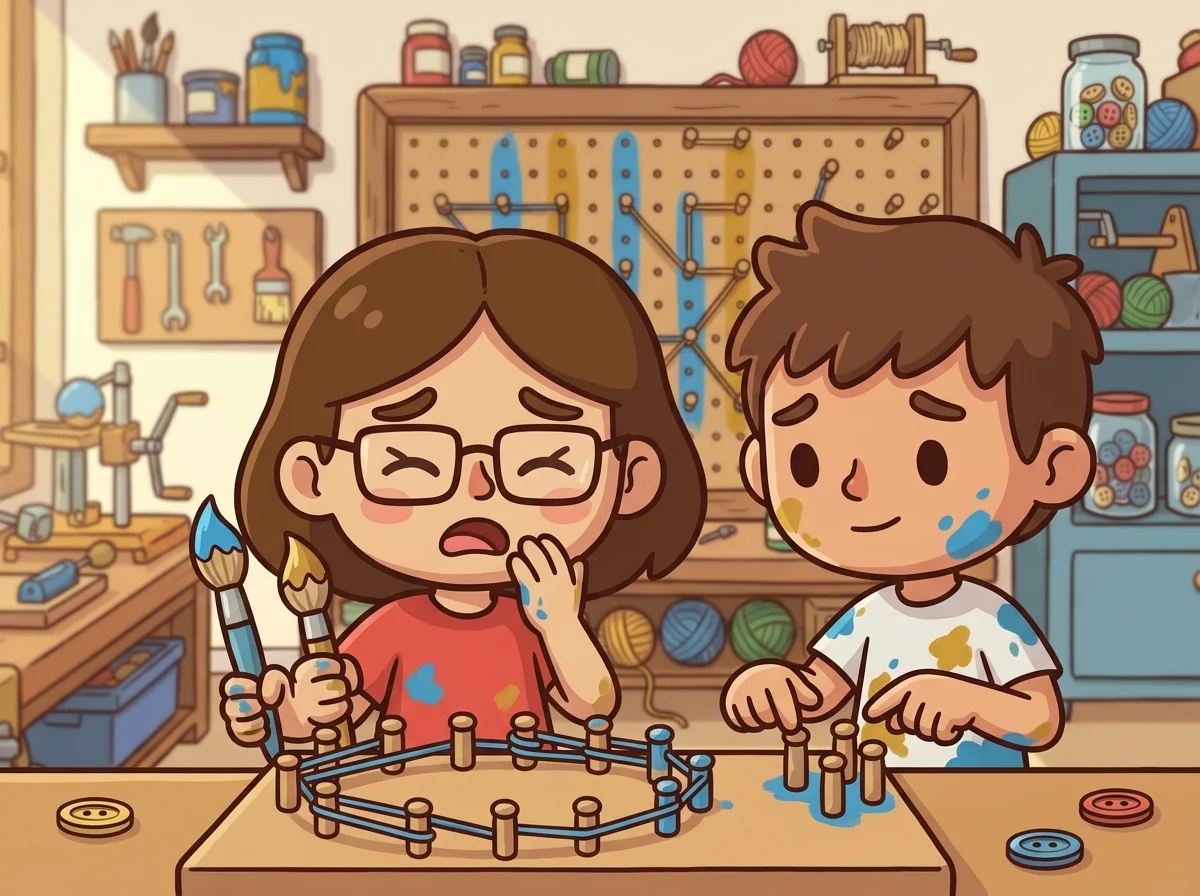
Swatch's next job was the trickiest one yet: a ring of pegs, each joined by a string to the next, all the way around in a loop.
"Easy," said Swatch, and started. "Blue. Gold. Blue. Gold. Blue. Gold—" They went all the way around the ring, confident as ever, until the brush came back to the very first peg. And there Swatch froze.
The last peg was gold. Its neighbor — the first peg — was also gold. Two neighbors, same color. A clash.
"No," Swatch whispered. They wiped it, tried again. Started with gold this time. Gold, blue, gold, blue — all the way around — and the same disaster met them at the end. A clash. "I don't— it worked on the straight line! Why won't the ring take two colors?" Swatch's voice wobbled. "Is my hand wrong? Did I break it?"
Twoby, who had drifted over to watch, gently touched the ring of pegs. And began — quietly — to push them together two at a time. Click. Click. Click. One peg sat alone at the end.
"You didn't break anything," Twoby said softly. "Count with me. Not the colors — the pegs. Do they pair up?"
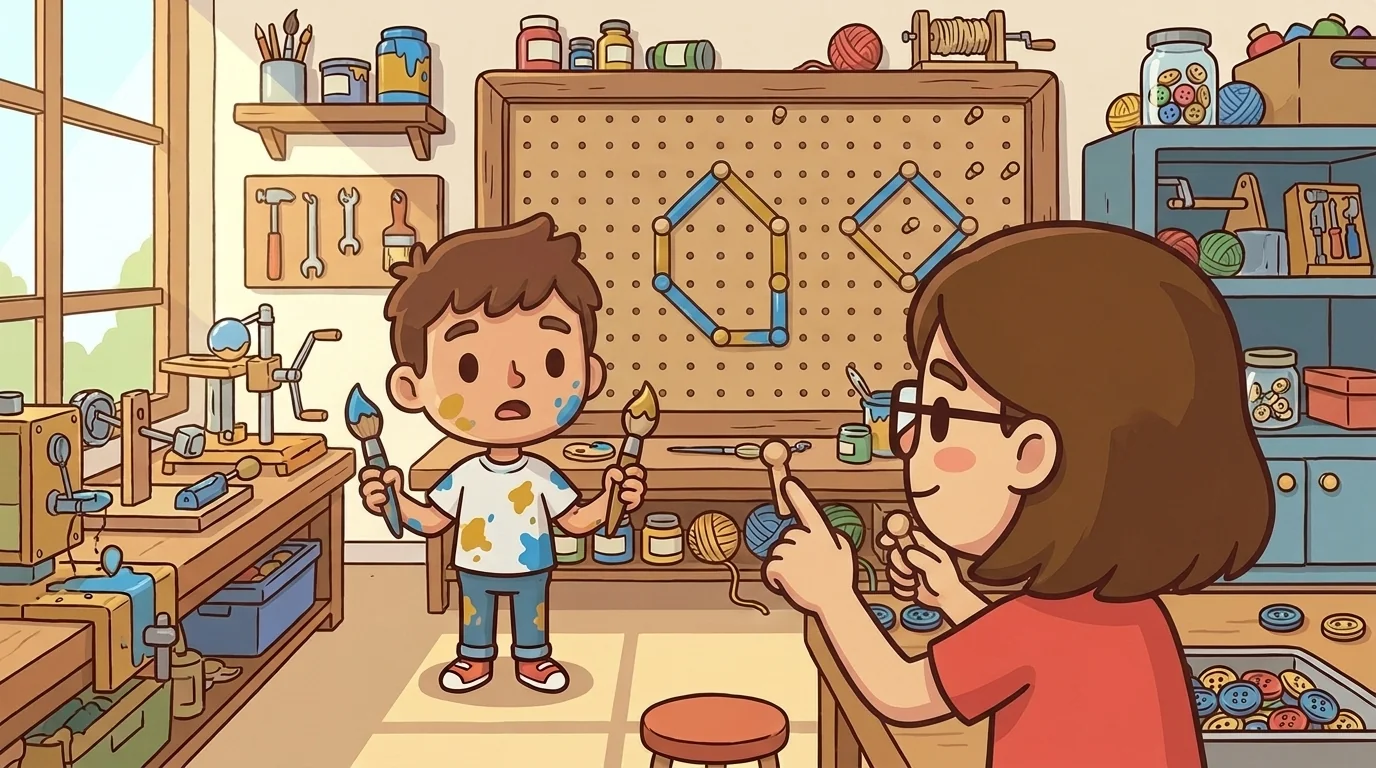
Swatch watched Twoby's hands move around the ring. Click. Click. Click. Pair, pair, pair — and one peg, all alone.
"Five pegs," Swatch said slowly. "Five. That's... odd."
"That's odd," Twoby agreed. "And here's the secret, border-painter. Two colors go blue-gold-blue-gold — they march in pairs. So a loop can only take two colors if the loop itself pairs up evenly. An even ring? Blue and gold shake hands all the way around and meet up perfectly." Twoby set out four pegs in a ring and painted them in the air with a fingertip — blue, gold, blue, gold, back to blue. No clash. "But an odd ring?" They pointed at the five. "There's always one peg left over. One clash. Every single time. Forever. It was never your hand. It was the five."
Swatch stared at the ring as if seeing it for the first time. "So when I feel that itch — that this won't work feeling — it's not me being clumsy. It's the ring being odd."
"Now you're counting like me," said Twoby, delighted. "Your two colors and my two-by-twos — they were the same question the whole time. Does it pair up?"
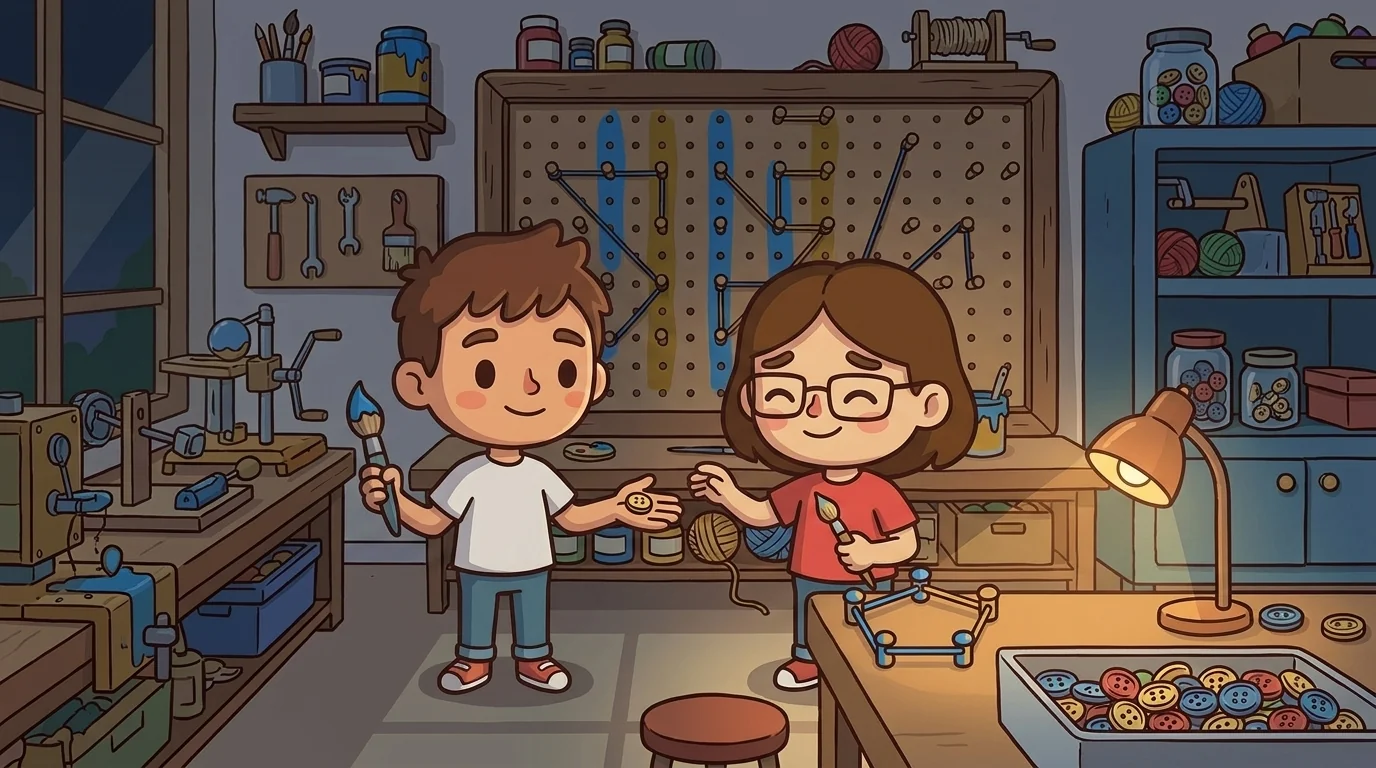
That night the workshop was dim, and the odd ring still sat on the table, five pegs, one honest clash. Swatch didn't wipe it away this time. They just looked at it, calm now.
"I used to hate that clash," Swatch admitted. "I thought it meant I wasn't good enough. I'd paint it over and over, getting more upset each time, sure the mistake was mine."
Twoby pushed the last lonely button into the middle of their palm and held it out, not as a problem, but almost as a gift. "It was never a mistake," they said gently. "It was the truth telling you something. Odd loops clash. That's not a flaw in you — it's a fact about the world, and you found it."
Swatch let out a long breath they hadn't known they were holding, and something in their chest went loose and light and warm — the particular relief of learning that the thing you'd been blaming yourself for was never your fault at all, only a number being exactly, honestly what it was.
"Even," Swatch said quietly, touching the four-peg ring. "Odd," they said, touching the five. And for the first time the clash didn't sting at all — it just felt calm, and honest, and strangely kind, and Swatch found they were smiling, warm and unbothered, glad to have a friend who could look at a lonely leftover button and see the truth in it instead of a fault.
The DiscreteQuest ensemble
Twoby and Swatch is part of DiscreteQuest's distributed-narrative cast. Each character embodies a different curricular primitive; together they teach the full subject.
-

Sortie the Set-Curator
Sets, subsets, set operations (union, intersection, difference)
-

Tally the Pattern-Counter
Counting principles and combinatorics (multiplication rule, permutations, combinations)
-

Verity the Truth-Tester
Propositional logic, truth tables, AND/OR/NOT operators
-

Wander the Bridge-Walker
Graph theory — Eulerian paths, Hamiltonian paths, connectivity
-

Coil the Self-Reference
Recursion and sequences (Fibonacci, factorials, recursive patterns)
-

Prime the Indivisible
Number theory — primes, factorization, modular arithmetic
-

Cubby the Cubby-Keeper
The pigeonhole principle — when there are more things than places, at least one place must hold two
-
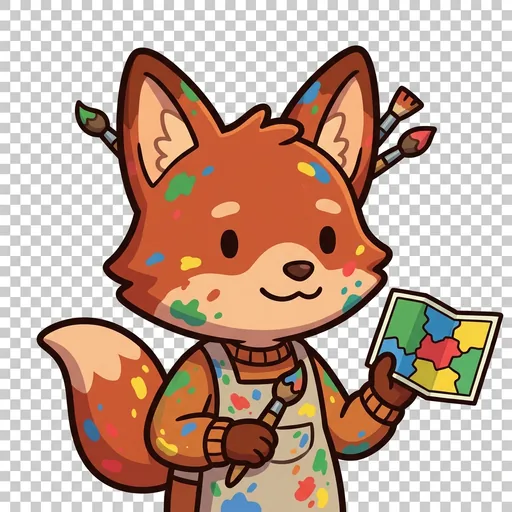
Swatch the Border-Painter
Graph coloring — coloring connected things so no two neighbors match, with the fewest colors
-
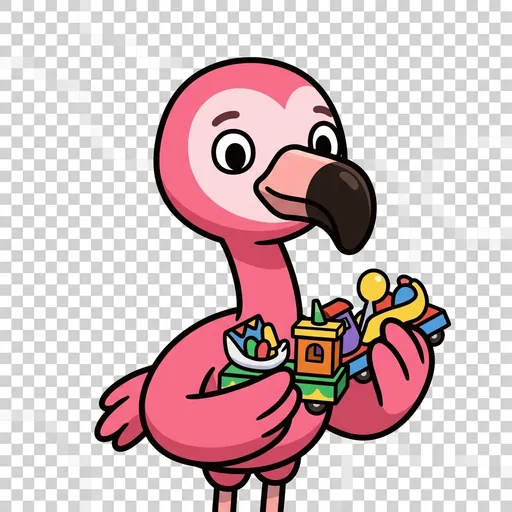
Marshal the Line-Arranger
Permutations — counting arrangements where order matters (factorials, ordered choices)
-

Twoby the Pair-Matcher
Parity and invariant arguments — even/odd pairing that proves what's possible
-

Surge the Growth-Racer
Order of growth — how the work scales as a problem gets bigger