The Counter
COUNTER — cards played are cards gone. memory is the whole game. The card-craft primitive of MEMORY-TURNS-UNCERTAINTY-INTO-CERTAINTY.
A story read by The Counter
Press play to listen along. The line being read lights up as you go.
Show full transcript
Loading transcript…
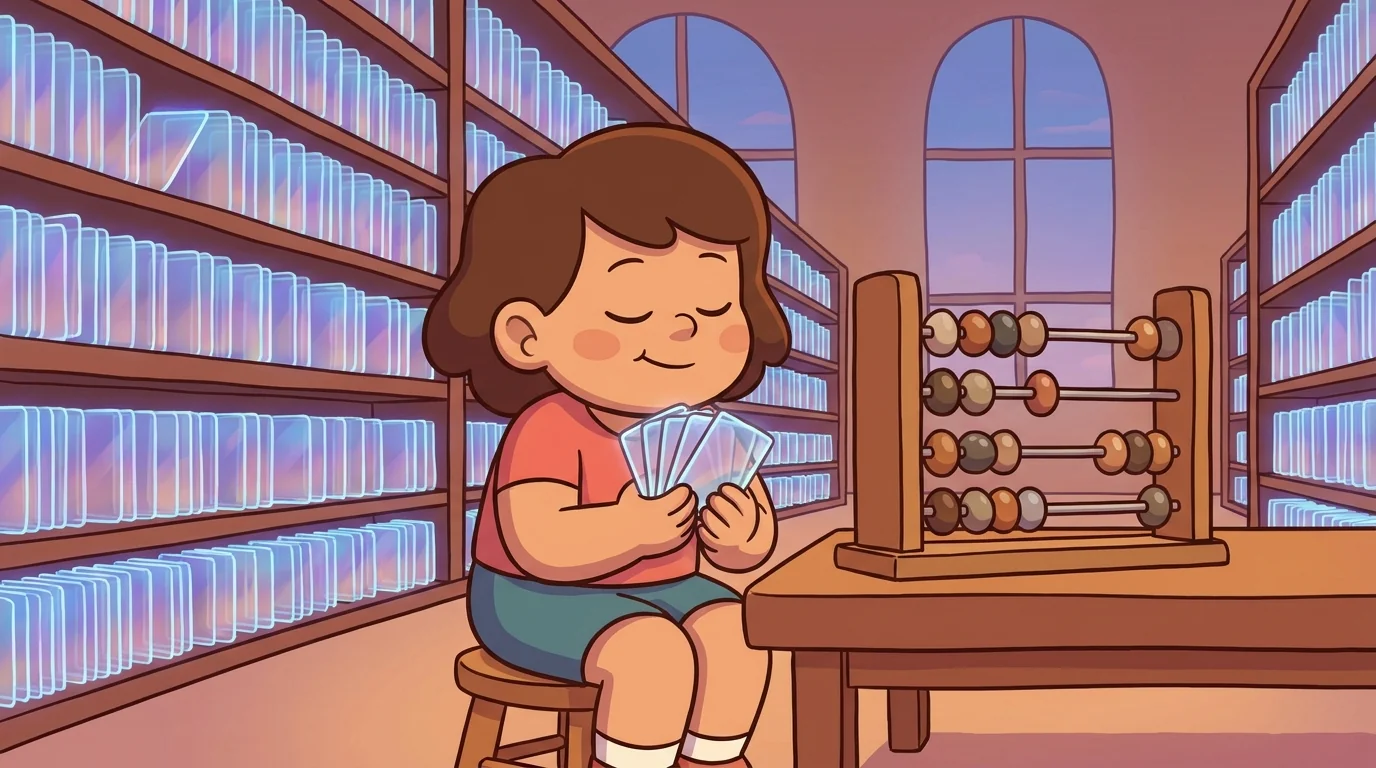
The Counter sat alone in the Archive of Echoes, a library where nothing was written down. Instead, every sound ever made was stored in thin, glass-like cards. She held a deck labeled "Sparrow Flock, First Flight, Last Tuesday." She closed her eyes, listening not with her ears, but with her memory. A quiet chorus of chirps, wing-flutters, and tiny squabbles filled her mind. On the low table beside her sat a simple wooden abacus, its beads carved from polished river stones.
She fanned the sound-cards, her fingers tracing their smooth edges. One chirp, a bead slid. A flutter, another bead. Click. Clack. Click. The sounds were a song she had heard only once, when the flock passed her window last Tuesday, but once was enough. The song had 74 notes. She held 73 cards.
Her eyes opened. The calm in the room was now punctuated by the single empty space on her abacus wire. One bead had not been moved. One sound was missing. She knew its exact tone: a short, questioning peep, the kind a young sparrow makes when it sees its very first worm. She pictured the small bird, its head cocked to one side. A card played is a card gone. A sound uttered is a sound that has been. To know what remains, you must first honor what has passed. She stood and walked to the archives, her footsteps silent. She knew exactly which shelf to check: "Sounds That Slipped Away."
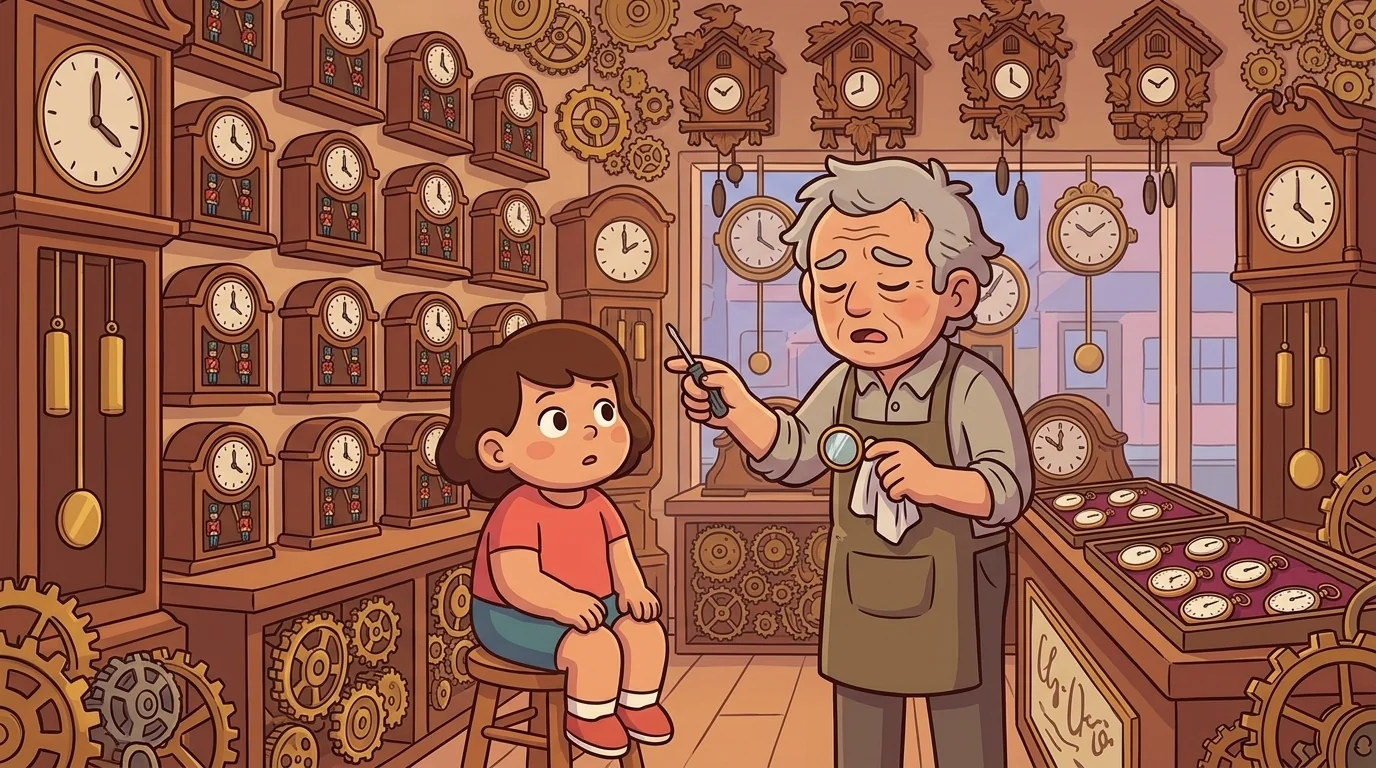
The Counter wasn't always The Counter. She was once a girl named Elara who lived with her grandfather in a shop filled with a thousand clocks. Big grandfather clocks boomed in the corners, tiny cuckoo clocks chirped from the walls, and delicate pocket watches ticked softly from velvet-lined trays. To most people, the sound was a roaring, chaotic mess. To Elara, it was a symphony. Her grandfather, a man whose hands were as intricate as the gears he fixed, had taught her to listen.
One afternoon, a deep quiet fell over the shop. It wasn't silence, not really. Hundreds of clocks still ticked and chimed. But it was a flawed quiet. A gap in the music. Her grandfather sighed, polishing a monocle. "One of my little soldiers has fallen silent," he said. He gestured to a wall of identical mantel clocks, each with a tiny, painted soldier that marched back and forth. "Finding the one that has stopped... it will take all afternoon."
But Elara just closed her eyes. She didn't look for the still soldier. She listened for the missing tick. Each clock had its own voice. The big oak one had a deep, slow tock. The little silver one had a quick, tinny tik-tik-tik. She let the familiar orchestra of sounds wash over her, and she focused on the hole. There. A steady, proud tick-tock that should have been right by the window was gone. She walked directly to a clock on the far wall, one her grandfather had already passed. "This one," she said, her voice soft. Her grandfather looked, and saw the tiny painted soldier had stopped, his little arm raised halfway. He smiled, a slow, wonderful grin. "Ah," he said. "You did not find the broken clock. You found the shape of its silence."
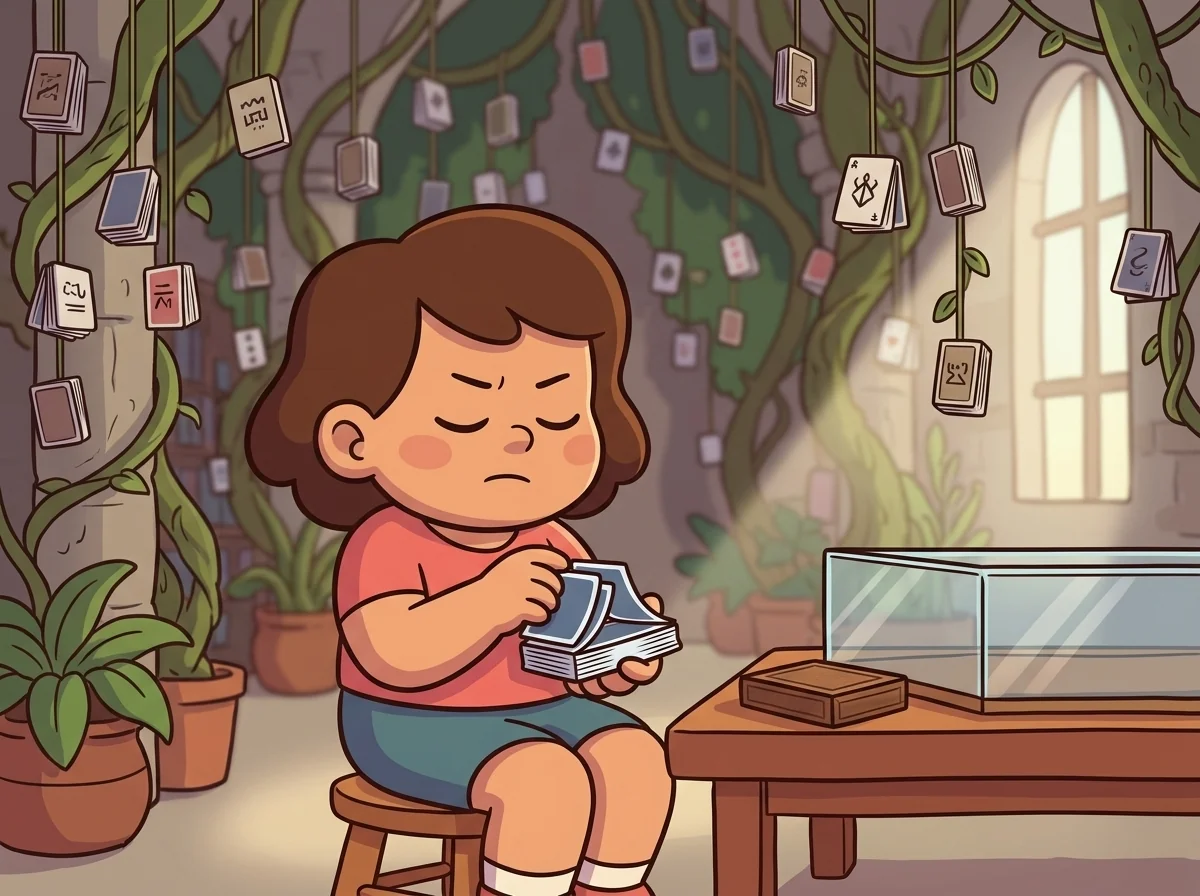
The day The Counter arrived at Cardforge Academy, the Head Forgemaester met her at the gates. They walked through the Great Hall, where decks of cards grew on vines and hung from trees like strange fruit. The Forgemaester was immensely proud of his collection. He led her to a glass case lit by a single, soft beam of light. Inside rested a deck called the "First Edition Whispering Deck."
"Perfectly complete," the Forgemaester boomed. "All fifty-two original cards, each imbued with a unique, silent whisper." He unlocked the case and handed the deck to The Counter.
She took the small stack of cards in her hands. They felt cool and smooth. She did not look at their faces. She did not try to hear their whispers. She simply held them, closed her eyes, and felt their presence in her palms. She gave the deck a single, expert riffle. The cards made a soft thrum as they interlaced, a sound like autumn leaves skittering across pavement. She frowned slightly. She handed the deck back.
"The Two of Sighs is a forgery," she said calmly.
The Forgemaester sputtered. "Impossible! This deck has been certified by—"
"The original card," The Counter interrupted gently, "was made from birchwood paper. It was lighter. The deck's center of gravity is off by a millimeter. The sound of your riffle is a fraction of a tone too low." She pointed to the Two of Sighs, which the Forgemaester had now drawn. "That one is made of pine paper. It remembers being a different tree." The Forgemaester stared at her, his mouth agape. He knew she was right. She hadn't seen the cards, but she remembered the one that wasn't there.
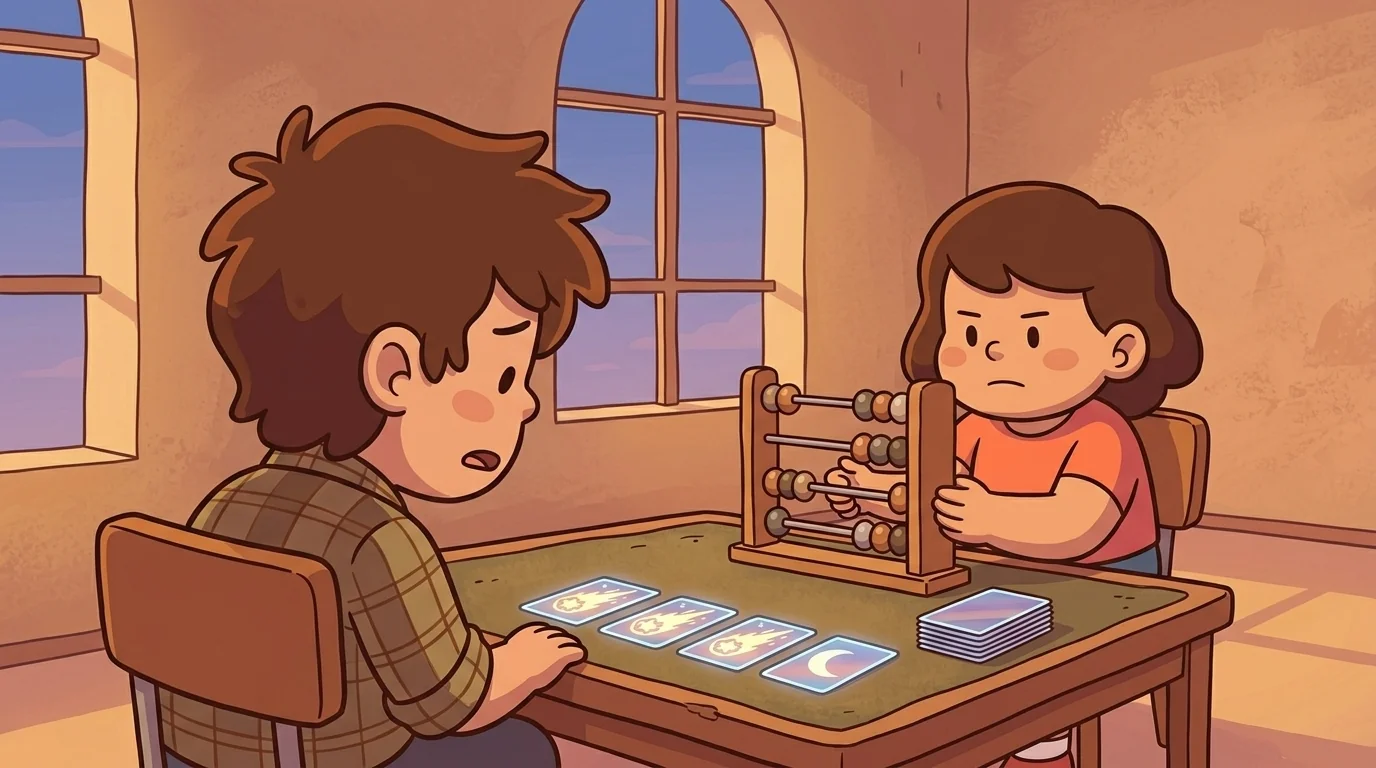
In The Counter's classroom, there were no desks, only low tables with worn, felt tops. A young student named Leo slumped in his seat, glaring at a ten-card deck. The game was "Fallen Stars," a simple exercise. Five cards were Comets, five were Moons. The dealer laid five cards face-down. The player had to guess if the next card turned over would be a Comet or a Moon.
"It's just guessing," Leo complained, after getting it wrong three times in a row. "It's all random. There's no skill."
The Counter sat opposite him. She placed her abacus between them. "Let us play again," she said. "But this time, we will watch. We will remember."
She turned over the first card. It was a Comet. Click. The Counter slid a single stone bead on her abacus. She turned over the second card. A Moon. Clack. She slid a bead on a different wire. The third was a Comet. Click. The fourth, a Comet. Click. Four cards were now face-up on the table. Three Comets, one Moon. Six cards remained face-down.
"Now," The Counter said, her voice even. "Tell me what we know for certain."
Leo looked at the abacus. "Three Comets are gone," he said slowly. "And one Moon is gone."
"Correct," she said. "The deck started with five of each. Knowing what is gone, what do you now know about what remains?"
Leo’s eyes widened. He looked from the face-up cards to the abacus, then to the face-down cards. The frustrated slump in his shoulders disappeared. "There are only two Comets left," he whispered. "But... there are four Moons still in there."
"So," The Counter asked, a small smile on her face. "Is the next card a guess? Or is it something more?"
Leo reached for the next face-down card, no longer guessing, but calculating. The uncertainty was fading. The game wasn't about luck anymore. It was about memory.
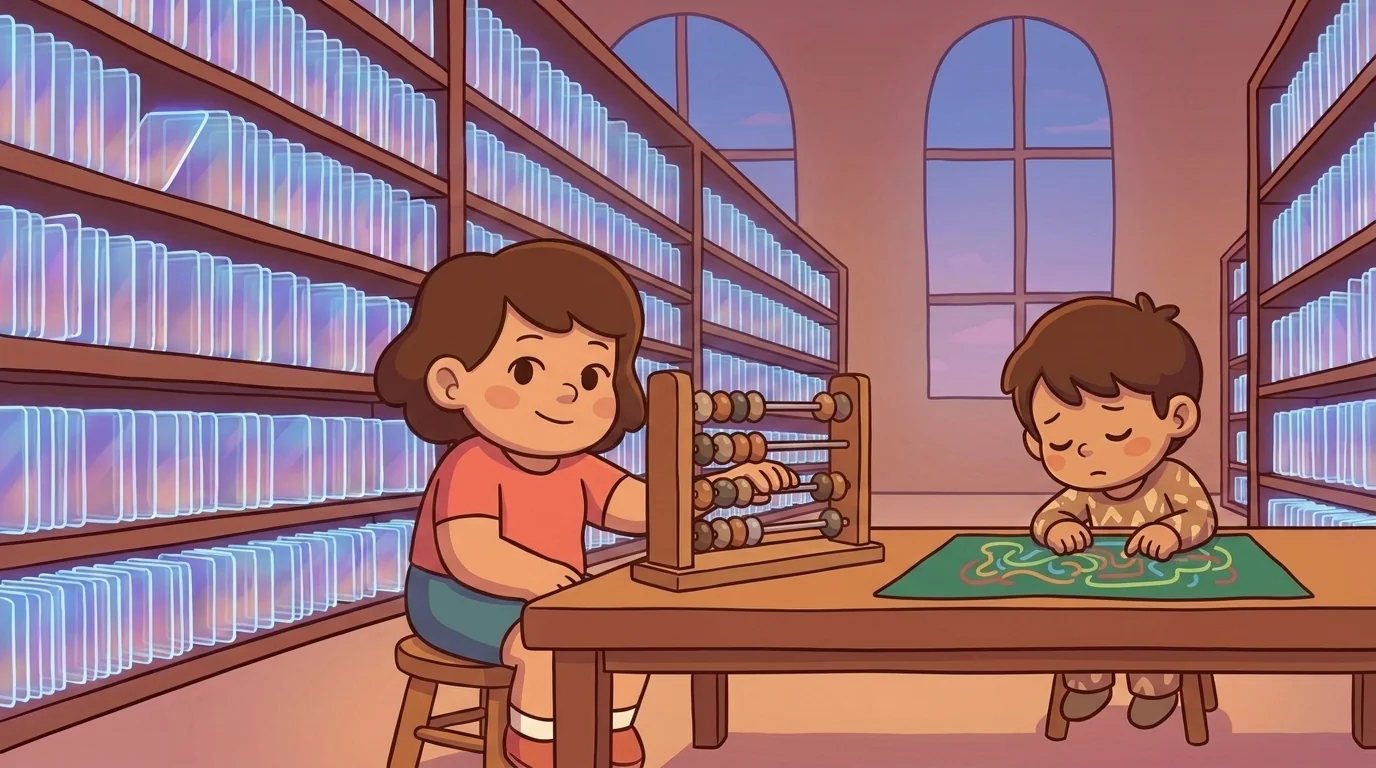
After the lesson, Leo stayed behind, tracing the patterns on the felt table with his finger. The abacus sat between them, its counted beads a silent record of their game.
"But my brain isn't an abacus," Leo said quietly. "What happens if I forget?"
The Counter looked at him with a warm, steady gaze. She didn't offer a simple platitude or a promise that he wouldn't forget. "Forgetting is not a failure," she said. "It is your mind showing you the part of the path that needs to be walked again. Memory is not a box you fill up. It is a garden you tend. Sometimes you have to weed it, or water a certain patch more than others."
She reached out and gently slid all the beads on the abacus back to their starting positions. The slate was wiped clean, ready for a new game, a new memory to be built.
"Every card played is a step taken," she murmured, more to herself than to him. "The journey becomes clear when you remember where you have been." Leo felt the tight, anxious knot in his chest loosen, replaced by a quiet, steady calm. For the first time all day, he felt glad — not because he had won, but because the game no longer felt like something happening to him.
--- ---
The CardForge ensemble
The Counter is part of CardForge's distributed-narrative cast. Each character embodies a different curricular primitive; together they teach the full subject.
-

The Finesseur
Finesse (force an opponent's high card via positional play; bridge / hearts / spades)
-

The Squeezer
Squeeze (force a discard that gives up a winner; advanced bridge + hearts)
-

The Endplayer
Endplay (throw opponent in to force a losing lead; bridge / hearts / whist)
-

The Long-Suit
Suit establishment (set up a long suit to run for tricks late in the hand; bridge / whist / spades)
-

The Bluffer
Deception under uncertainty (poker betting; representing a hand you don't have)
-

The Discarder
Strategic discard (hearts: avoid points; spades / gin / rummy: shed dead wood)
-

The Trumpkeeper
Trump management (when to ruff, when to hold; whist / spades / euchre / pinochle)
-

The Forcer
Magic forcing (the spectator "freely chooses" the card you intended)
-

The Shuffler
False-shuffle / stack management (control card order while appearing to randomize; mathematical card magic)