
The Long-Suit
LONG-SUIT — play out the opponent's cards in your long suit, then your small cards win. The card-craft primitive of LONG-AT-THE-FINISH: exhausting opponents' suit so your last small cards become winners.
A story read by The Long-Suit
Press play to listen along. The line being read lights up as you go.
Show full transcript
Loading transcript…
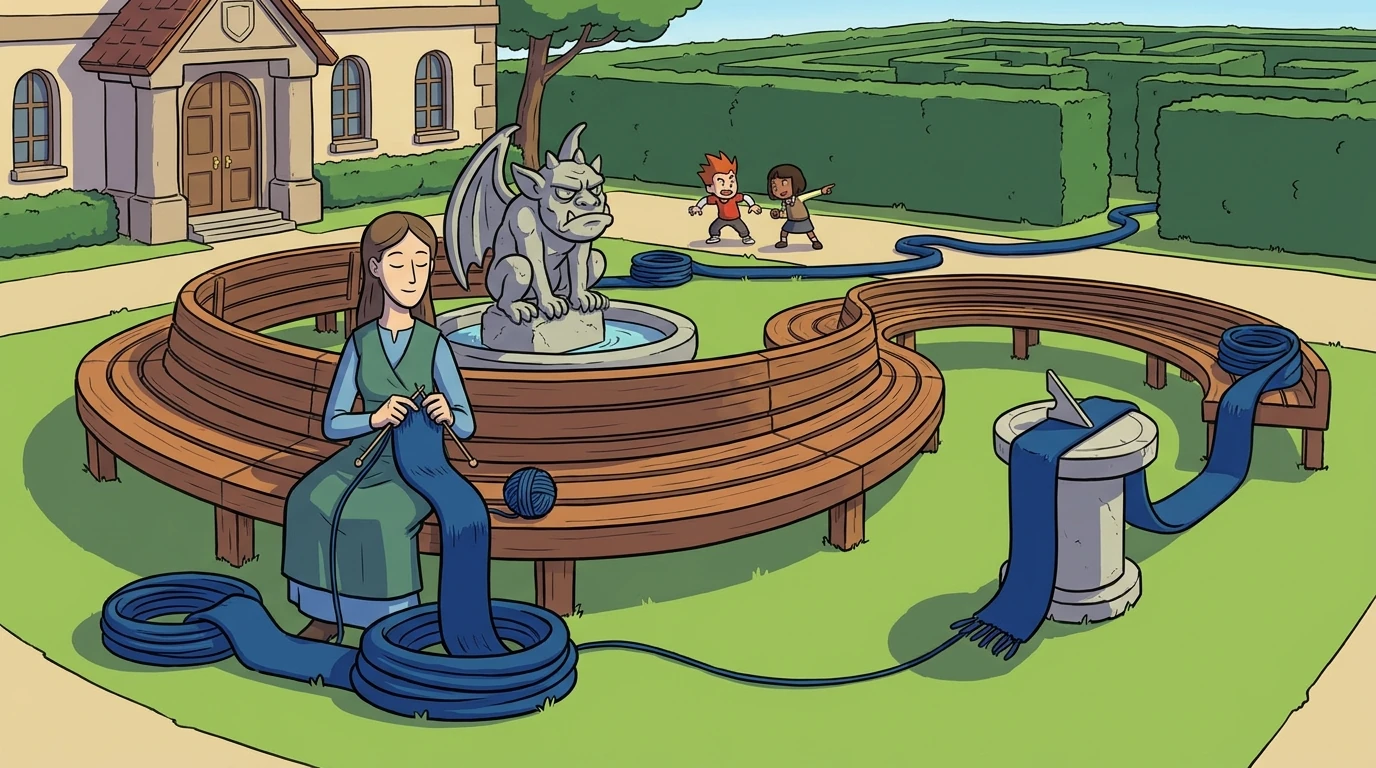
The Long-Suit sat on the longest park bench in the Cardforge Academy courtyard, knitting. The bench, a proud oak monstrosity named "The F marathon," snaked around the entire central lawn. So did The Long-Suit’s scarf. It was the color of a deep blue evening sky, and it pooled in neat coils at her feet before stretching out along the bench, following its every curve and corner. It disappeared behind a grumpy-looking gargoyle, reappeared on the other side of the sundial, and finally vanished into the distant hedge maze.
Two students, bustling with the hurried energy of a game just won, skidded to a stop nearby. One of them, a boy with a shock of red hair, pointed. "She's still knitting that thing," he whispered, not quite quietly enough. "It must be miles long by now."
The Long-Suit’s needles gave a gentle click-clack. She didn’t look up. She was a tall, serene figure, whose movements were never rushed. Her focus was on the simple, steady loop and pull of the yarn. The boy’s friend nudged him. "Come on, Fidget. We'll be late for The Ruff’s lecture on aggressive plays."
"But what's the point?" Fidget asked, his voice now aimed directly at The Long-Suit. "Of a scarf so long? Who could ever wear it?"
The Long-Suit paused her knitting for a single beat. She looked toward the far-off hedge maze where the end of her work lay hidden. A small, knowing smile touched her lips. "Oh, it's not about the beginning," she said, her voice as soft as the yarn in her hands. "It's not even about the middle. It's about the very, very end. The part no one else has the patience to reach."
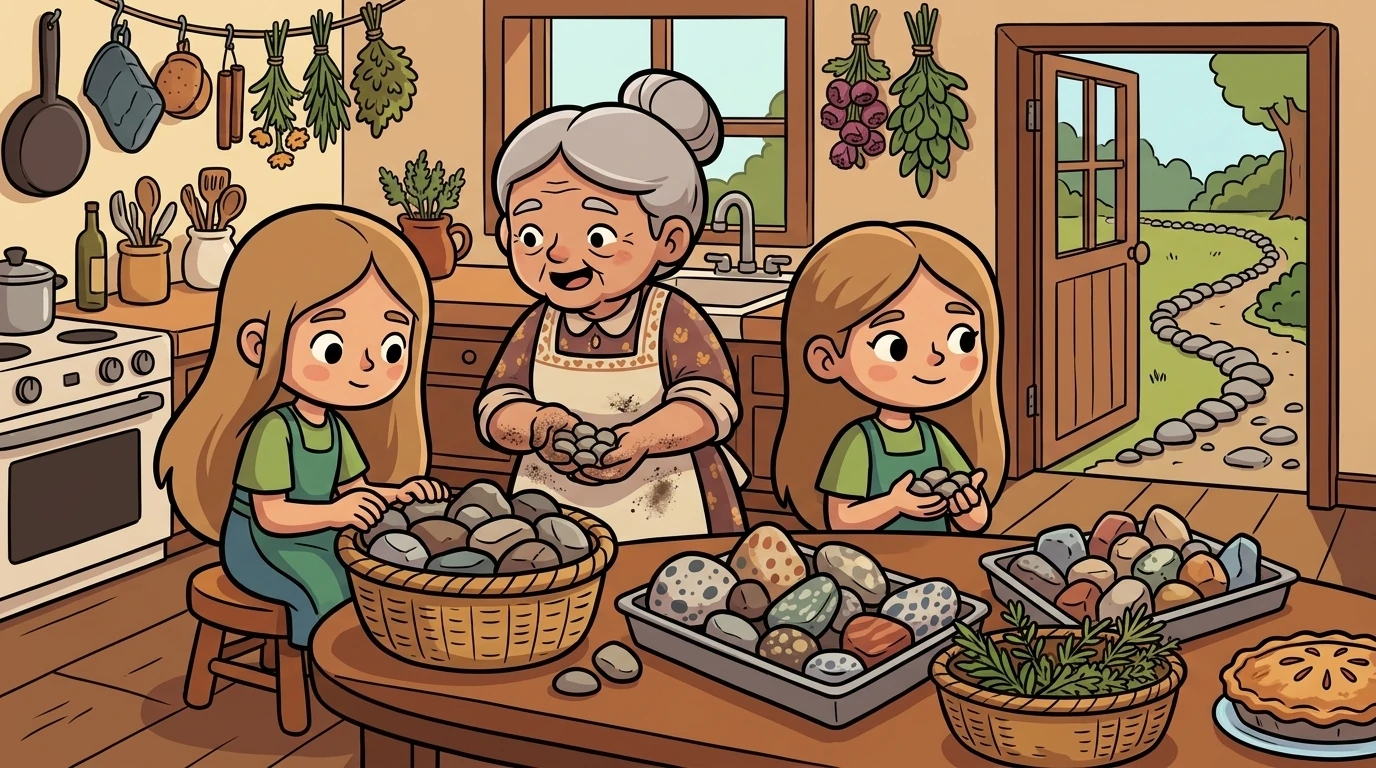
She remembered being small, sitting on a wooden stool in her grandmother’s kitchen. The air smelled of cinnamon and drying herbs. Her task was to sort a giant basket of river stones they had collected that morning. Her grandmother wanted to build a long, winding border for her garden path. "Put the biggest, prettiest ones aside for the entrance," her grandmother had instructed, her hands dusty with soil.
Young Suit did as she was told. She pulled out the large, smooth, speckled stones. Then the medium, interestingly shaped ones. Soon, all that was left was a heap of small, plain, grey pebbles. They seemed boring. Useless. Her shoulders slumped. "What about these, Nana?" she had asked. "They're just little ones. They're not special."
Her Nana wiped her hands on her apron and came over. She picked up a handful of the small grey stones. "Ah, but these are the most important," she said, her eyes twinkling. "The big stones make the start of the path grand. But there are only a few of them. These little ones? There are so many. They will make up the whole rest of the journey. They will go on and on, long after the fancy ones are all used up. By the end of the path, they are the only stones left. And that makes them the winners." She poured the pebbles from one hand to the other, a cascade of quiet clicks. "Patience," she had murmured, "makes the little things mighty."
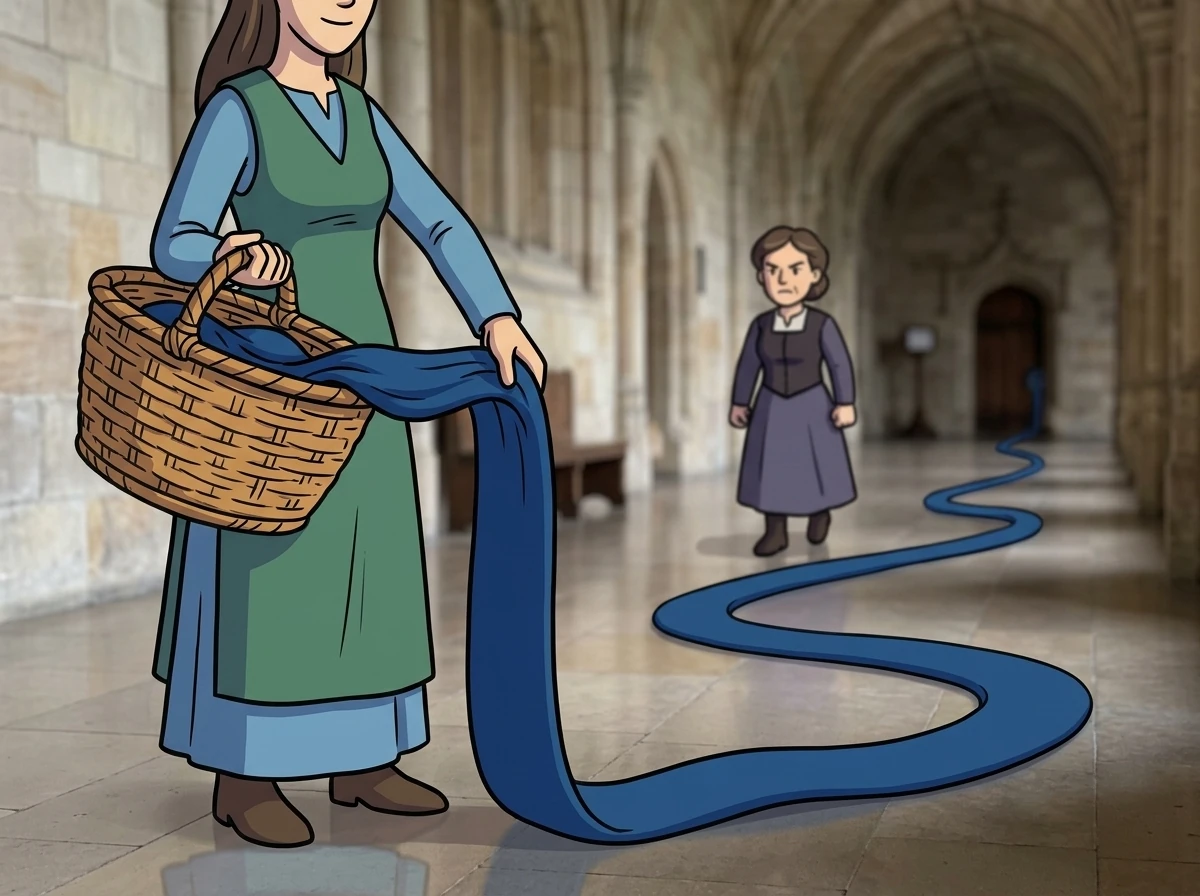
On her first day at the Cardforge Academy, The Long-Suit didn't carry a fancy briefcase or a stack of glowing tablets. She carried a large wicker basket, from which spilled the beginning of her deep blue scarf. The Head Dean, a stern but fair woman known only as The Finesse, met her in the Great Hall. The Dean’s eyes scanned The Long-Suit’s simple attire and her singular, strange accessory.
"Your application was... brief," The Finesse said, her voice echoing slightly off the high stone ceilings. "It just said, 'I teach the finish.'"
"That's right," The Long-Suit replied calmly.
"Cardforge is about complex strategy. Daring plays. Swift victories," The Finesse continued, beginning to walk down the hall. "We need instructors who can demonstrate immediate value."
The Long-Suit said nothing. She simply opened her basket and let the scarf unspool onto the polished floor. As The Finesse walked, the scarf followed, a silent blue river chasing her heels. The Dean walked the entire length of the hall, turned the corner, and continued down another long corridor toward her office. The scarf kept coming. When The Finesse finally stopped at her oaken door, she turned to see the blue yarn stretching all the way back to the entrance, a single, unbroken line. The Long-Suit was standing at the very end of it, holding up the final, tiny stitch before she tied it off. "It is also about endurance," The Long-Suit said gently. "It is about outlasting everyone else. It's about making your last, smallest piece the one that wins the day, simply because no one else has any pieces left."
The Finesse looked at the tiny knot, then back down the impossibly long line of blue. A slow smile spread across her face. "Welcome to the faculty," she said.
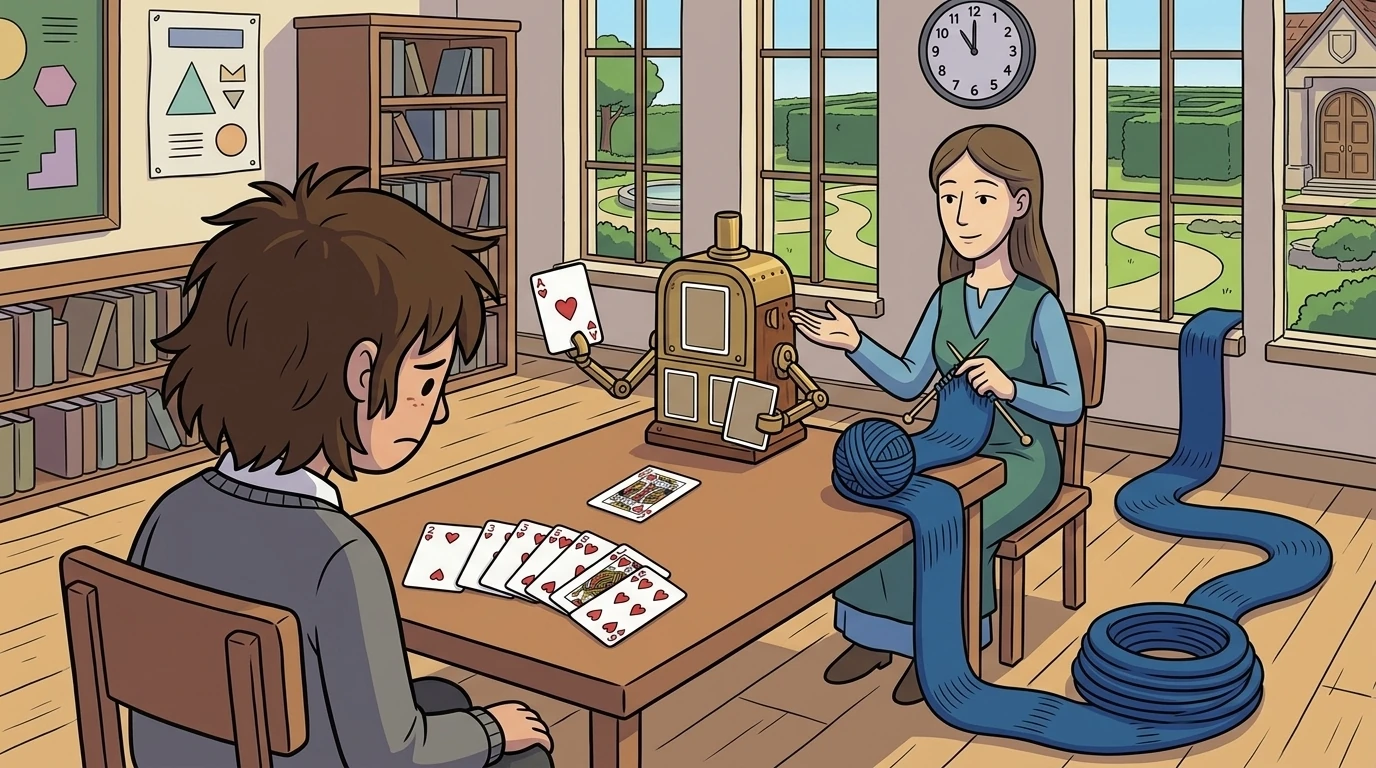
A young student named Pip sat slumped over a table in The Long-Suit’s classroom. The room was long and narrow, with windows that looked out over the winding garden paths. Pip’s cards were fanned out, showing a frustrating hand: seven Hearts, but most of them were low. A two, a three, a five, a six. The only good ones were the King and the Jack.
"This hand is terrible," Pip sighed. "It's full of useless little cards. I'll lose every trick."
The Long-Suit pulled up a chair. Her own knitting rested in her lap, the blue scarf trailing around the legs of the table. "Show me useless," she said softly. She gestured to an opponent simulator across the table. "Play a hand with me. But do exactly as I say. Lead your highest Heart."
Pip, skeptical, played the King of Hearts. The simulator played the Ace, winning the trick. "See?" Pip said. "Lost."
"Again," The Long-Suit encouraged. Pip played the Jack of Hearts. The simulator played the Queen and won again. Pip groaned. "It's taking all my good cards!"
"Excellent," The Long-Suit murmured, a hint of excitement in her voice. "It is taking the simulator's good cards, too. Now, the simulator is out of Hearts. You have exhausted them. Look at your hand. What do you have left?"
Pip looked down at the five small Hearts. "Just the little ones."
"Play one," she urged.
Pip hesitantly placed the six of Hearts on the table. The simulator played a Diamond. The trick belonged to Pip. A flicker of understanding crossed Pip's face. They played the five of Hearts. The simulator played a Club. Pip won again. Then the three. Then the two. Each small, forgotten card landed on the table with a triumphant little flick. They were unbeatable. They were the only Hearts left in the world.
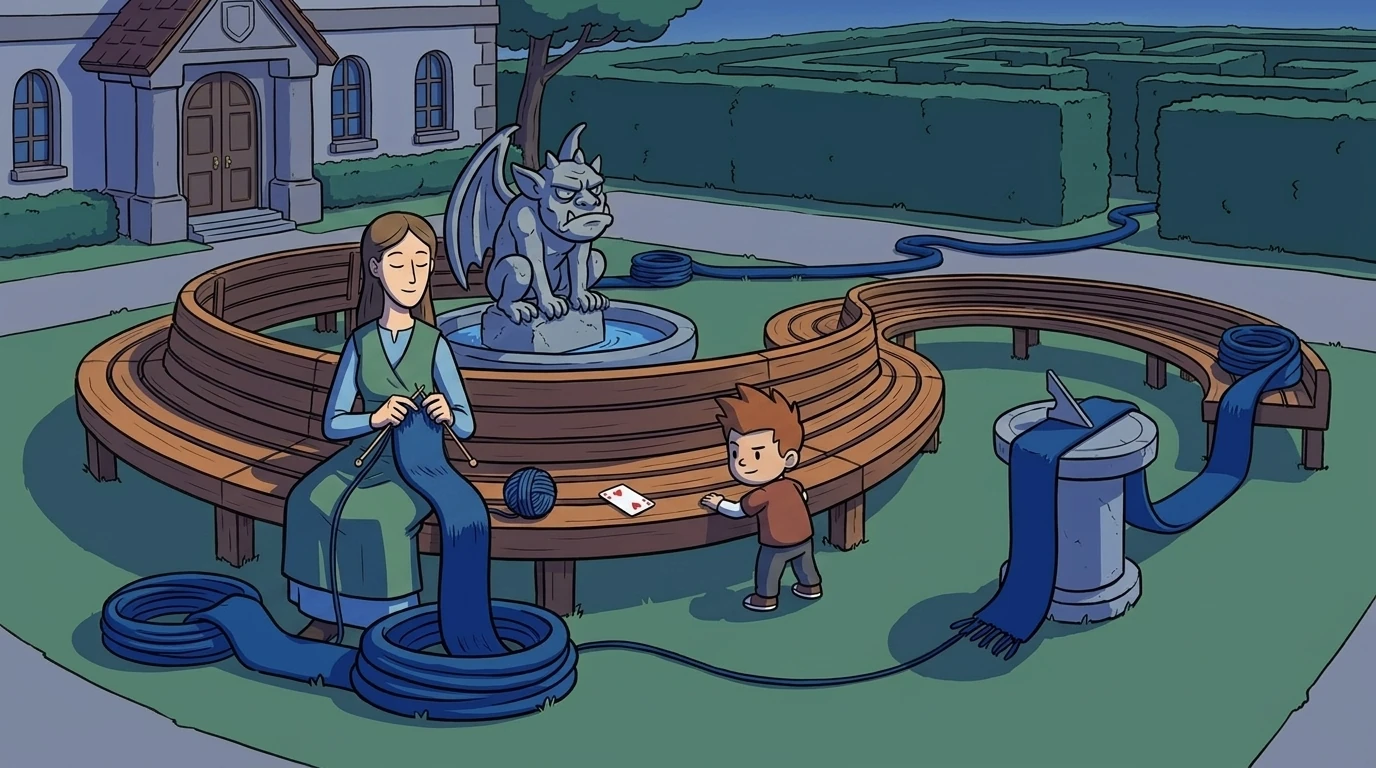
The lesson was over, but Pip remained at the table, staring at the little two of Hearts. The card looked different now, holding the memory of its quiet, final victory. The Long-Suit had resumed her work, the click-clack of her needles a gentle rhythm in the quiet room.
"So a small card isn't always a weak card?" Pip asked, not looking up.
The Long-Suit paused her knitting, her hands resting on the soft blue wool. "Nothing is always anything," she said. "A card is only what the state of the game allows it to be. A lonely two of Hearts is weak. But a two of Hearts that is the last one standing, after all its bigger, louder brothers and sisters have done their job? That two of Hearts is a champion."
She looked down at her endless scarf, which now curled out the classroom door and down the hall, a patient blue line waiting for its final knot.
"It is not about being the strongest," she added, her voice a warm whisper. "It is about being the last. Patience makes winners of us all."
The CardForge ensemble
The Long-Suit is part of CardForge's distributed-narrative cast. Each character embodies a different curricular primitive; together they teach the full subject.
-

The Finesseur
Finesse (force an opponent's high card via positional play; bridge / hearts / spades)
-

The Squeezer
Squeeze (force a discard that gives up a winner; advanced bridge + hearts)
-

The Endplayer
Endplay (throw opponent in to force a losing lead; bridge / hearts / whist)
-

The Counter
Card-counting / pip-tracking (track played cards to deduce remaining hands; gin / bridge / blackjack-style)
-

The Bluffer
Deception under uncertainty (poker betting; representing a hand you don't have)
-

The Discarder
Strategic discard (hearts: avoid points; spades / gin / rummy: shed dead wood)
-

The Trumpkeeper
Trump management (when to ruff, when to hold; whist / spades / euchre / pinochle)
-

The Forcer
Magic forcing (the spectator "freely chooses" the card you intended)
-

The Shuffler
False-shuffle / stack management (control card order while appearing to randomize; mathematical card magic)