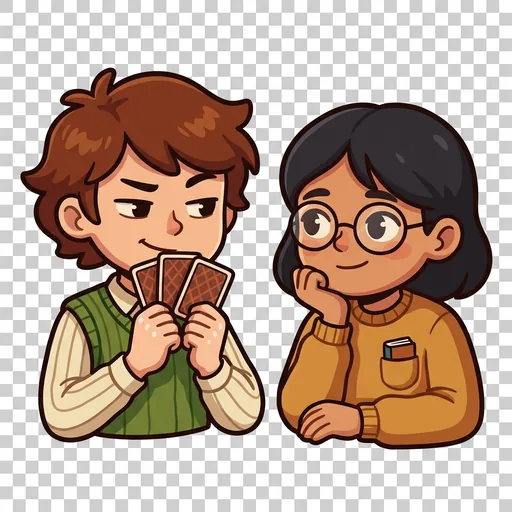
The Bluffer
BLUFFER — bet a hand you don't have so they fold the one they do. The card-craft primitive of strategic deception: your bets tell a story and the story can be a lie.
A story read by The Bluffer
Press play to listen along. The line being read lights up as you go.
Show full transcript
Loading transcript…
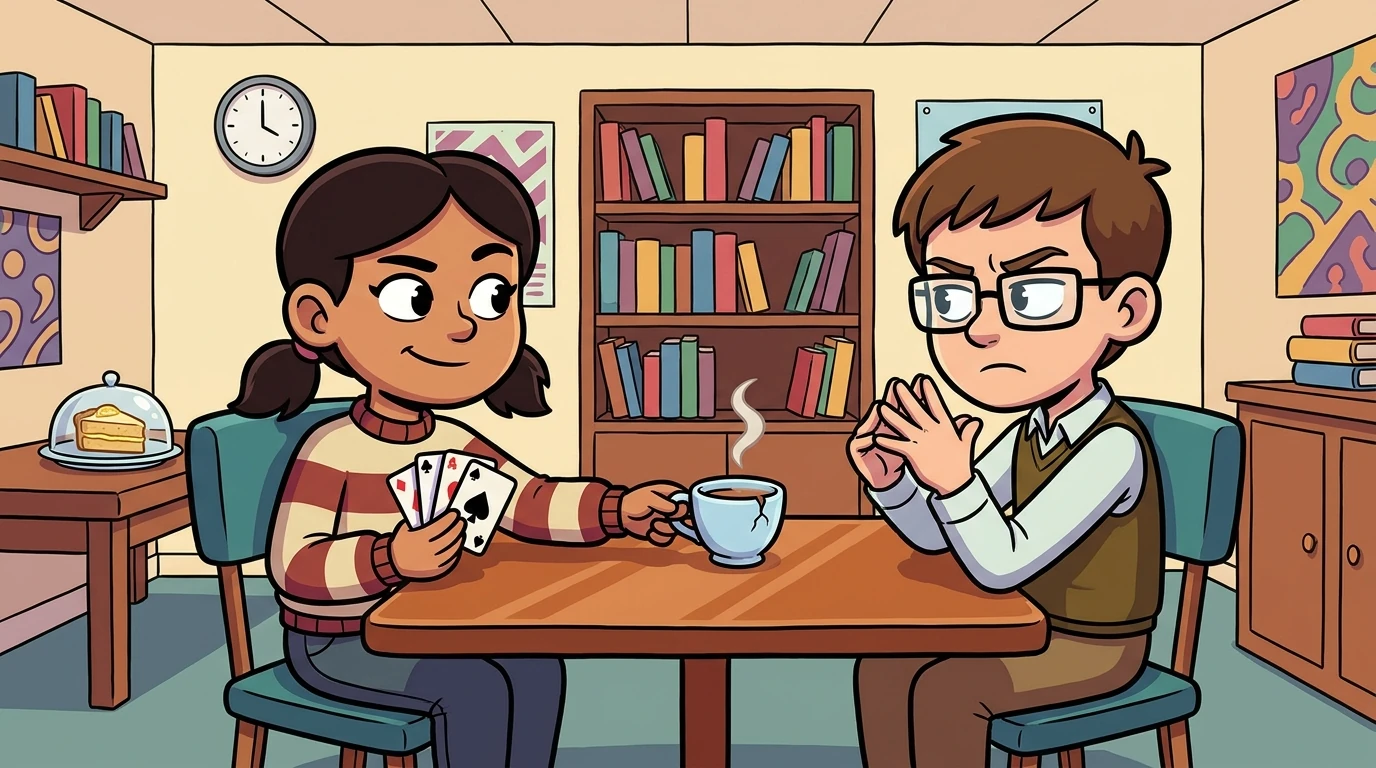
The Bluffer held a truly terrible hand. Her five cards showed a jumble of mismatched suits and numbers, a hand so poor it was almost impressive. Across the small, polished table, her opponent, The Calculator, steepled his fingers. His face was a mask of concentration, his eyes ticking back and forth, calculating odds. They were playing a final, silent round of Glimmer to decide who would get the last slice of lemon drizzle cake from the faculty lounge.
The Bluffer did not look at her cards. She looked at her teacup. It was a simple ceramic thing, pale blue with a tiny, almost invisible crack near the handle. Steam rose from it in a gentle curl. Legend at Cardforge Academy called it the Tell-Tale Teacup, an artifact that supposedly clouded over if its owner told a lie. With a quiet, deliberate motion, The Bluffer pushed her teacup to the center of the table.
This was her bet. In Glimmer, you could bet anything: game tokens, promises, teacups. The bet wasn't about the object, but the story it told. The Calculator’s eyes flicked from her calm face to the cup, then back again. Her story was clear: My hand is so certain, I wager this cup of truth on it. He saw no flicker of doubt in her expression. He saw no unusual clouding of the steam. After a long, tense moment, he sighed and slid his own cards facedown across the table, folding.
The Bluffer smiled softly. She drew the teacup back, took a warm sip, and said nothing at all. The story had done its work.
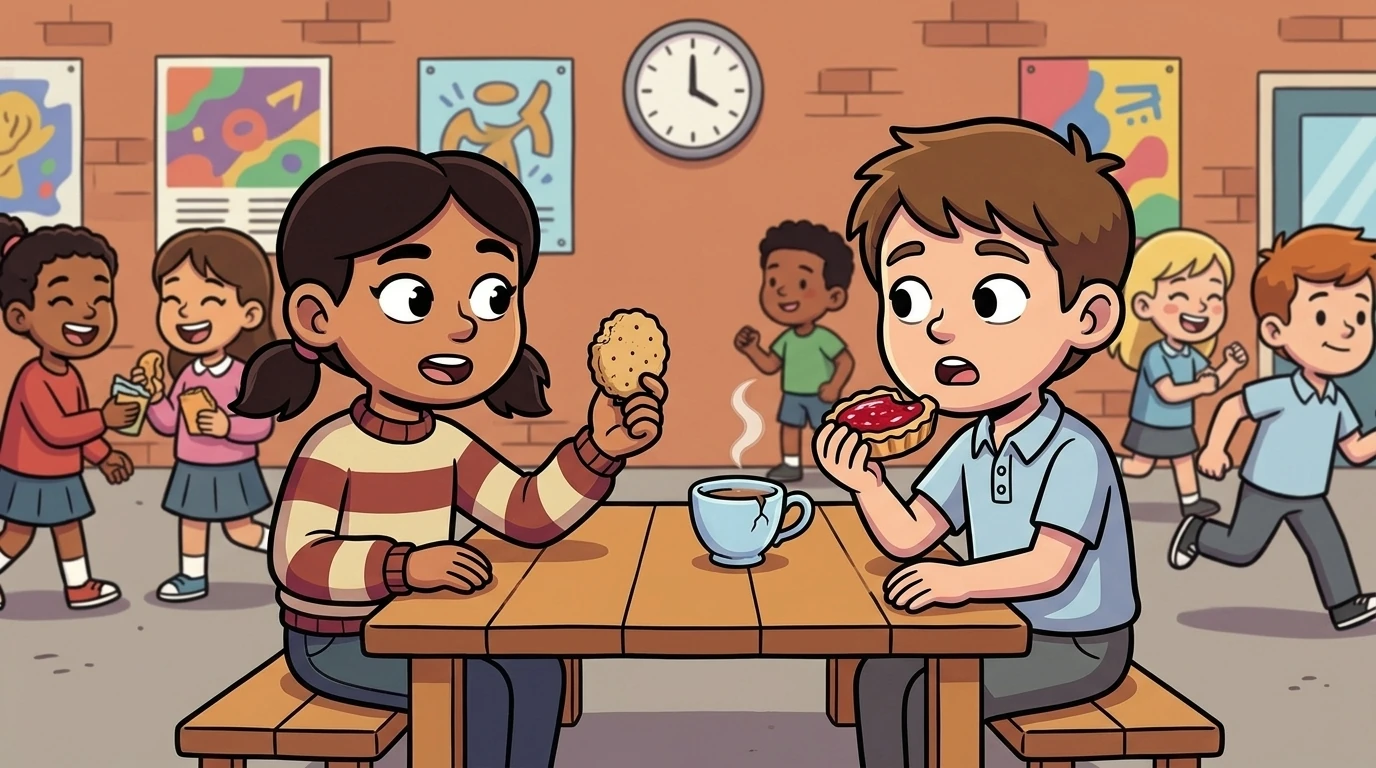
Years before the academy, she was just a girl with a very plain biscuit. It was lunchtime, and the schoolyard buzzed with the commerce of snack-trading. A boy named Finn had a glorious jam tart, glistening with sugar. Her own offering was a dry, crumbly thing her grandmother called a "traveler's biscuit." It was nutritious but monumentally boring. A trade was impossible. A direct request would be denied. So she decided to tell a different story.
She didn’t brag. She didn’t lie, not exactly. She unwrapped her biscuit with the care of a jeweler revealing a rare gem. She held it up to the light. “Have you ever seen a Pathfinder’s Biscuit?” she murmured, just loud enough for Finn to hear. He paused, tart halfway to his mouth. "A what?" he asked.
"My grandmother gives me one when I have a long journey," she explained, her voice low and serious. "She says it helps you find your way if you get lost. You just have to hold it and think hard about where you want to be." She stared at the biscuit, her eyes wide with manufactured wonder. "I've never gotten lost while I had one."
Finn looked at his jam tart. It was delicious, but it was just a tart. He looked at her biscuit. It was an adventure. It was a map. It was a promise of safety. Five minutes later, she was happily nibbling on the jam tart while Finn carefully wrapped the Pathfinder’s Biscuit in his napkin, saving it for a future emergency. She hadn’t told him the biscuit was magical. She had simply told a story where it was, and let him believe.
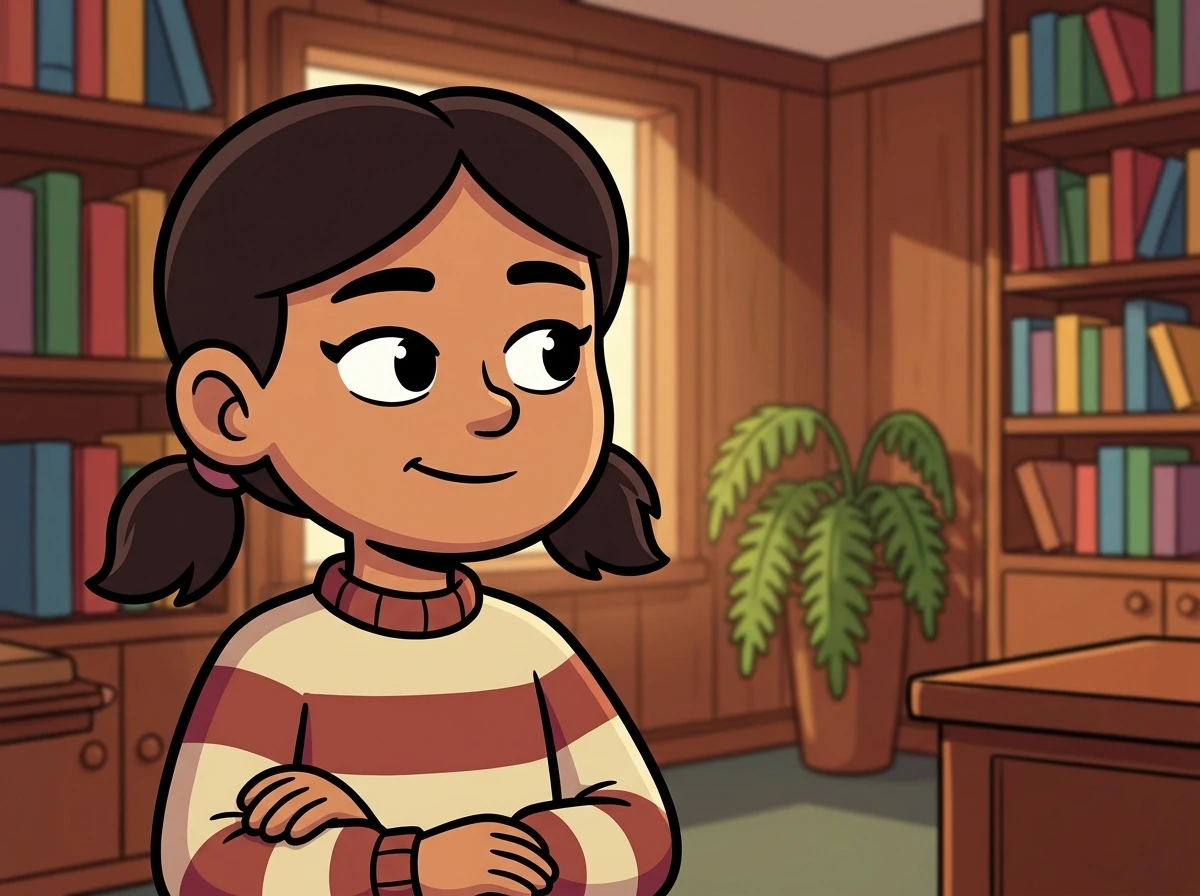
The day The Bluffer arrived at Cardforge Academy, the Headmaster met her in his cavernous, wood-paneled office. Books climbed the walls like ivy. A single, sad-looking fern drooped in the corner. The Headmaster, a man whose eyebrows seemed permanently fixed in a state of skepticism, peered at her over his spectacles. “Your file is… unusual,” he said. “You teach deception. Story-betting. We teach logic, probability, honor. Why should a place of truth have a master of falsehoods on its faculty?”
The Bluffer didn't answer right away. Her gaze drifted past him to the unhappy plant. "That fern believes it is dying of thirst," she said quietly.
The Headmaster frowned. "Nonsense. I watered it myself this morning."
The Bluffer gave a small, patient smile. "You may have watered it, Headmaster," she said. "But does it know that? Look at its leaves. The story it is telling itself is one of drought."
Her calm certainty was unsettling. The Headmaster, with an annoyed huff, stood up and walked to the fern. He pushed a finger deep into the soil. His eyebrows shot up. The earth was bone dry. He had watered the plant in the library, not the one in his office. Flustered, he grabbed a watering can and gave the thirsty fern a long, satisfying drink. When he turned back, The Bluffer was watching him, her expression unchanged. "Sometimes," she said softly, "the most important thing isn't what is true. It's what we can be convinced to believe is true. And what we do next." He hired her on the spot.
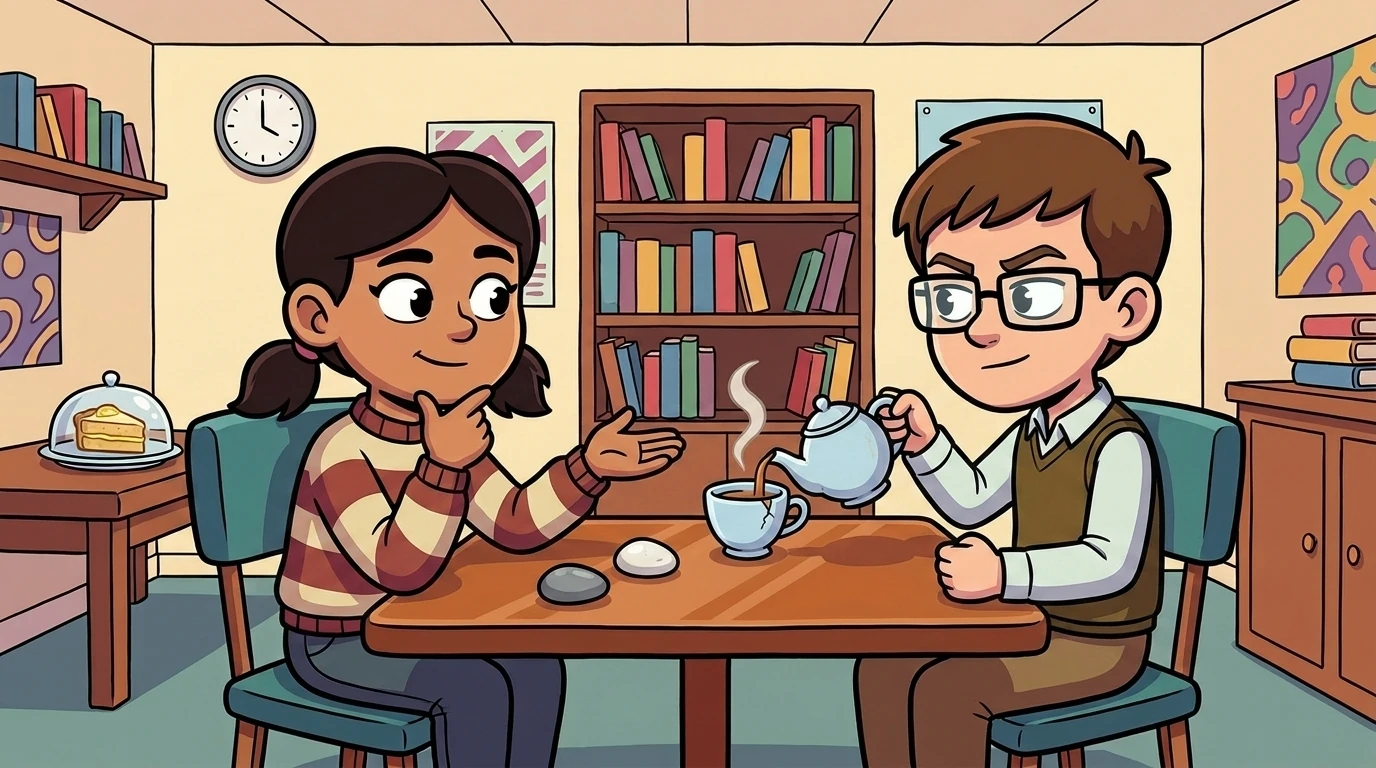
In her classroom, which felt more like a cozy parlor, a young student named Leo slammed his cards on the table. "It's no use!" he groaned. "I had the winning hand, but everyone folded before I could even play it. They say I'm too easy to read." The Bluffer poured him a cup of tea. She set the deck of cards aside and placed two small, smooth stones on the table: one was river-gray, the other moon-white.
"Forget the cards for a moment, Leo," she said. "Pick one stone and hide it in your fist. Don't let me see." Leo did as he was told, hiding the white stone. "Now," The Bluffer instructed, "your only job is to convince me that you are holding the white stone."
Leo’s face immediately transformed. He puffed out his chest, stared her straight in the eye, and declared, "I have the white stone!" His voice was loud, his jaw set. It was a performance of confidence, and it was completely unconvincing.
The Bluffer shook her head gently. "You are acting like someone who wants me to believe they have the white stone," she explained. "That's not the same as telling the right story. A story is quiet. A story has reasons. Ask yourself: if you really had the precious white stone, what would you be doing?"
Leo thought for a moment. He relaxed his shoulders. He let his gaze drift away from hers, down toward his closed fist, as if he were guarding something valuable and secret. He even curled his other hand protectively around the first. He said nothing. The silence was more powerful than his shout had been.
"There," The Bluffer murmured, a warm smile touching her lips. "That is a much better story."
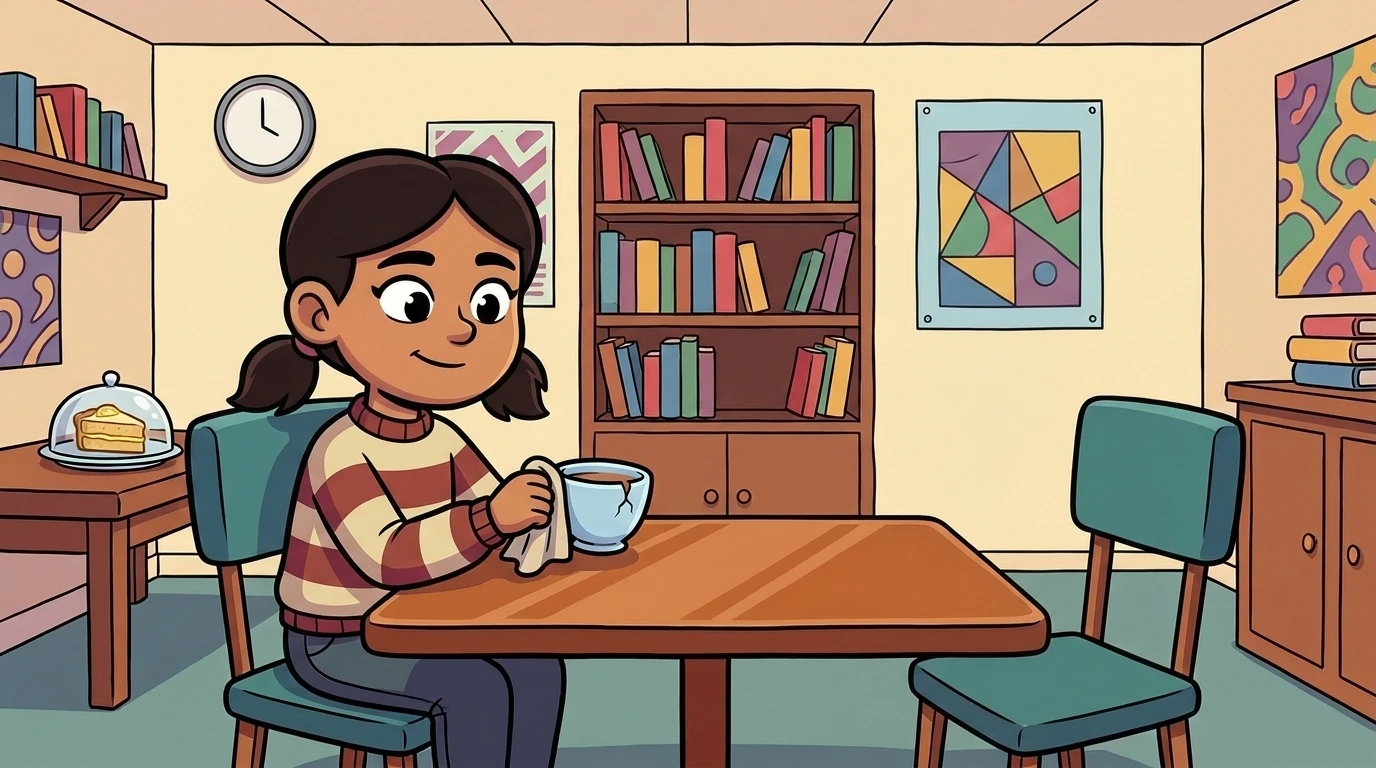
The other students had left, but Leo remained. The classroom was quiet now, smelling of old paper and chamomile tea. He picked up the pale blue cup from The Bluffer’s desk, turning it over in his hands. "Professor," he asked, his voice barely a whisper, "is the legend about your teacup true? Does it really show you when someone's lying?"
The Bluffer took the cup from him and began polishing its rim with a soft cloth. Her movements were slow and methodical. "The cup tells you a great deal," she said, not looking at him directly. "But perhaps not what you think."
She paused her polishing and met his eyes. "It tells you who believes in easy answers. It shows you who is looking for a magical trick to save them from the hard work of paying attention." She placed the cup back on its saucer with a gentle click. "A good player doesn't watch the cards, or the cup. They watch the other person's story. They watch their eyes."
She gave him a knowing smile. "The most powerful stories, Leo, aren't the ones you tell with your voice. They're the ones you tell with your silence."
The CardForge ensemble
The Bluffer is part of CardForge's distributed-narrative cast. Each character embodies a different curricular primitive; together they teach the full subject.
-

The Finesseur
Finesse (force an opponent's high card via positional play; bridge / hearts / spades)
-

The Squeezer
Squeeze (force a discard that gives up a winner; advanced bridge + hearts)
-

The Endplayer
Endplay (throw opponent in to force a losing lead; bridge / hearts / whist)
-

The Counter
Card-counting / pip-tracking (track played cards to deduce remaining hands; gin / bridge / blackjack-style)
-

The Long-Suit
Suit establishment (set up a long suit to run for tricks late in the hand; bridge / whist / spades)
-

The Discarder
Strategic discard (hearts: avoid points; spades / gin / rummy: shed dead wood)
-

The Trumpkeeper
Trump management (when to ruff, when to hold; whist / spades / euchre / pinochle)
-

The Forcer
Magic forcing (the spectator "freely chooses" the card you intended)
-

The Shuffler
False-shuffle / stack management (control card order while appearing to randomize; mathematical card magic)