The Forcer
FORCER — they freely choose the card you wanted them to choose. The card-craft primitive of THE-DESIGNED-CHOICE: making chosen-feel-free what is in fact pre-arranged.
A story read by The Forcer
Press play to listen along. The line being read lights up as you go.
Show full transcript
Loading transcript…
- "I" - "II" - "III" - "IV" - "V" - "VI" - "VII" - "VIII" - "IX" - "X" - "XI"
- "Q" - "J" - "10" - "Head" - "Odds" - "Tells" gate-allow-text-pattern: '^([0-9]{1,2}|[A-Z]{1,5}|[I]{1,4}|[VX]{1,3}|[A-Z][a-z]+)$' ---
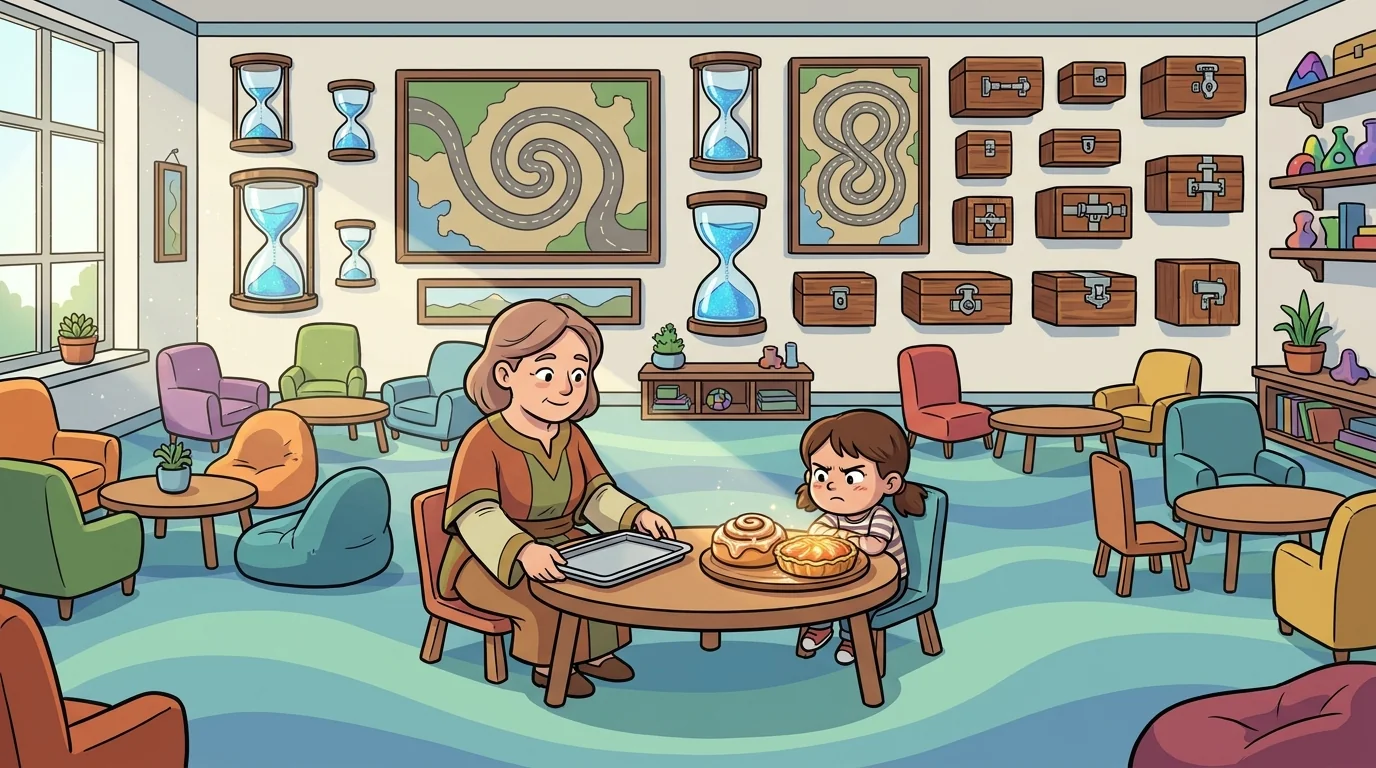
The Forcer’s classroom wasn’t like the others at Cardforge Academy. It had no desks, only comfortable chairs and low tables scattered like islands in a calm sea. The walls were lined not with rulebooks, but with curiosities: hourglasses filled with shimmering blue sand, maps of roads that spiraled into themselves, and dozens of polished wooden boxes, each with a different, intriguing latch. At the center of the room, The Forcer sat with a young student named Elara, who was staring at a tray of snacks with the focused frown of a world champion thinker.
The Forcer smiled gently. Her voice was like the soft hum of a spinning top. "A choice is a story you tell yourself about the future," she said, her gaze drifting toward the window. "Some stories are about comfort. Others are about discovery. I remember my grandfather used to say the shiniest things often hide the sweetest secrets." She subtly adjusted a silver tray on the table, and for a moment, the morning light caught the glaze of the apple tart, making it gleam.
Elara’s eyes followed the flash of light. Her frown melted away. “The tart,” she said, her voice suddenly certain. “I feel like an adventure today.” She took the tart and bit into it, her eyes widening at the taste of spiced apple and apricot jam. “Wow. This is the best one. How did I know?”
"You listened," The Forcer said, her smile never wavering. "You always know. You just have to listen for the right story."
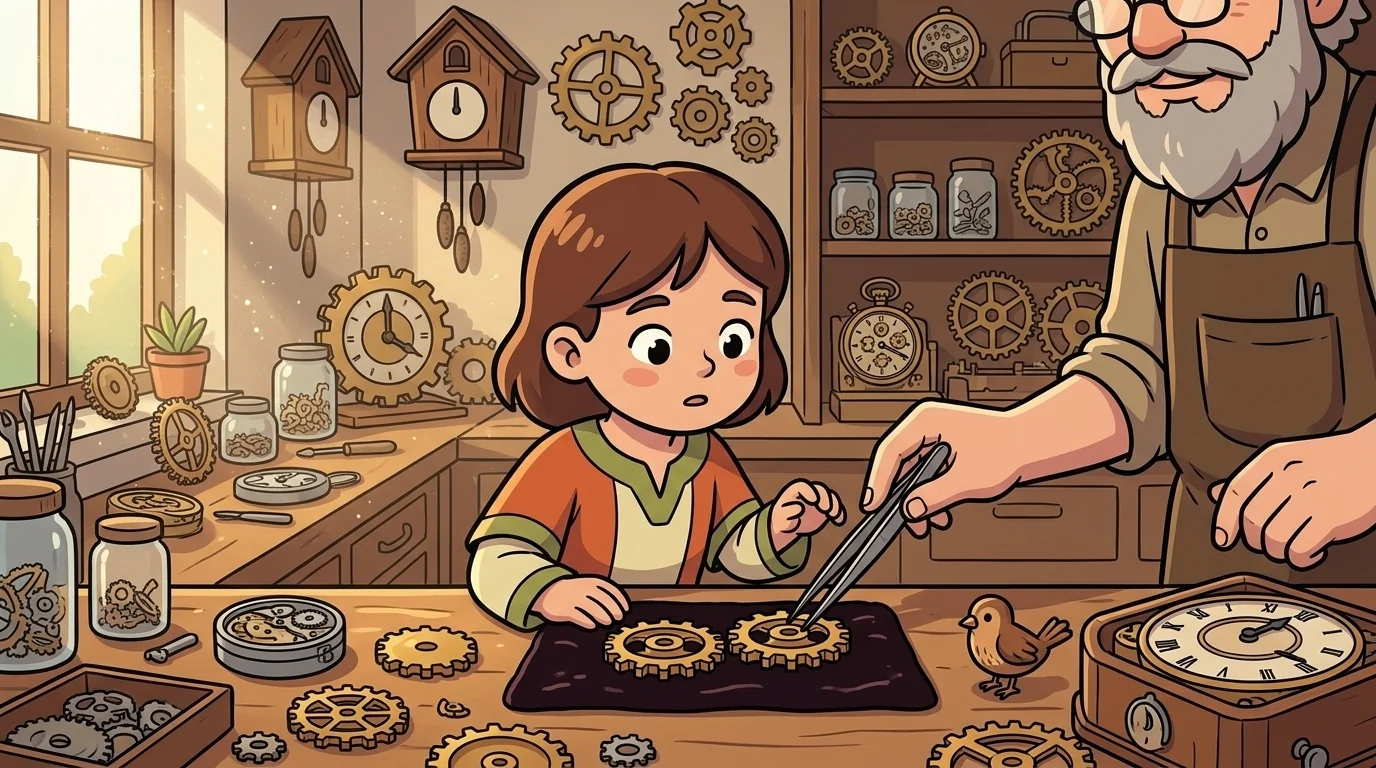
The Forcer hadn't always understood about the stories inside choices. When she was a girl, she lived with her grandfather, a watchmaker whose workshop smelled of oil and old wood and time itself. One afternoon, he called her over to his workbench. Sunlight streamed through the dusty window, illuminating two tiny brass gears lying on a piece of dark velvet. They looked exactly the same.
She stared at the gears. They were perfect twins. How could she possibly know? She felt a flutter of panic. But then, she quieted her mind and just… looked. Her grandfather hummed a little tune, a wandering, happy melody. As he did, he used a pair of tweezers to nudge the right-hand gear just a millimeter forward. It was a tiny movement, almost nothing. But it was a movement toward her. It made the gear seem more present, more expectant. It was a story. A beginning.
Her hand moved without thinking. She picked up the right-hand gear.
Her grandfather’s humming stopped. He fitted the gear into the clock’s intricate metal heart, and with a gentle click, a tiny wooden bird popped out and sang a cheerful, perfect note. She beamed with pride. “How did you know?” she asked him later, after the clock was fixed.
He polished his spectacles. “I didn’t,” he said, which confused her. “Both gears were correct. I just wanted to see if you could feel which one I was hoping you’d choose. I gave it a little nudge, made it a little more important in the moment. The choice was always yours, my dear. I just helped you feel good about making it.”
Her arrival at Cardforge Academy was quiet. She carried only a small leather satchel containing three silver coins and a book of blank pages. The Headmaster, a tall woman named Dean Elmsworth with spectacles perched on her nose, greeted her in a grand office that smelled of old paper and beeswax. The Dean was known for being direct, and she didn't waste time. She pushed a thick employment contract across her polished oak desk.
“Your methods are… unusual, I’m told,” Dean Elmsworth said, her tone perfectly neutral. She gestured to two pens lying beside the contract. One was a magnificent goose-feather quill with a silver nib. The other was a simple, modern black pen. “You can sign with either.”
The Forcer looked at the pens, then at the Headmaster. “The quill is beautiful,” she said warmly. “It speaks of tradition, of history. It makes one think of long, careful work.” She paused, letting the words settle in the quiet room. “The black pen, though,” she continued, her voice becoming a little more crisp, “is for getting things done. For a clear, bold line. For starting something new without delay.”
Dean Elmsworth’s hand had been drifting toward the fancy quill, but now it stopped. Her eyes flickered from the quill to the plain black pen. She thought of the mountain of work she had to do, the new semester that needed a bold start. Without another word, she picked up the black pen. Its click was loud in the silence as she signed her name with a flourish.
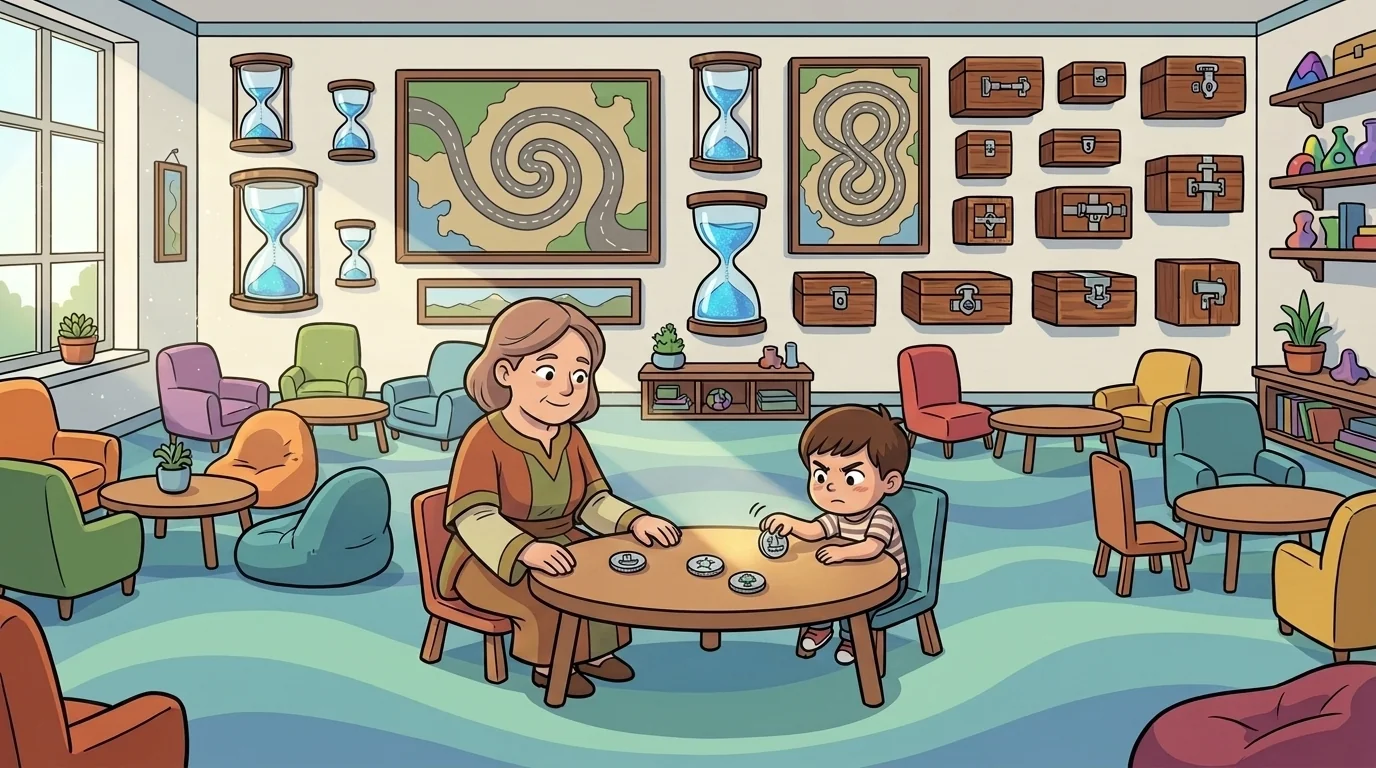
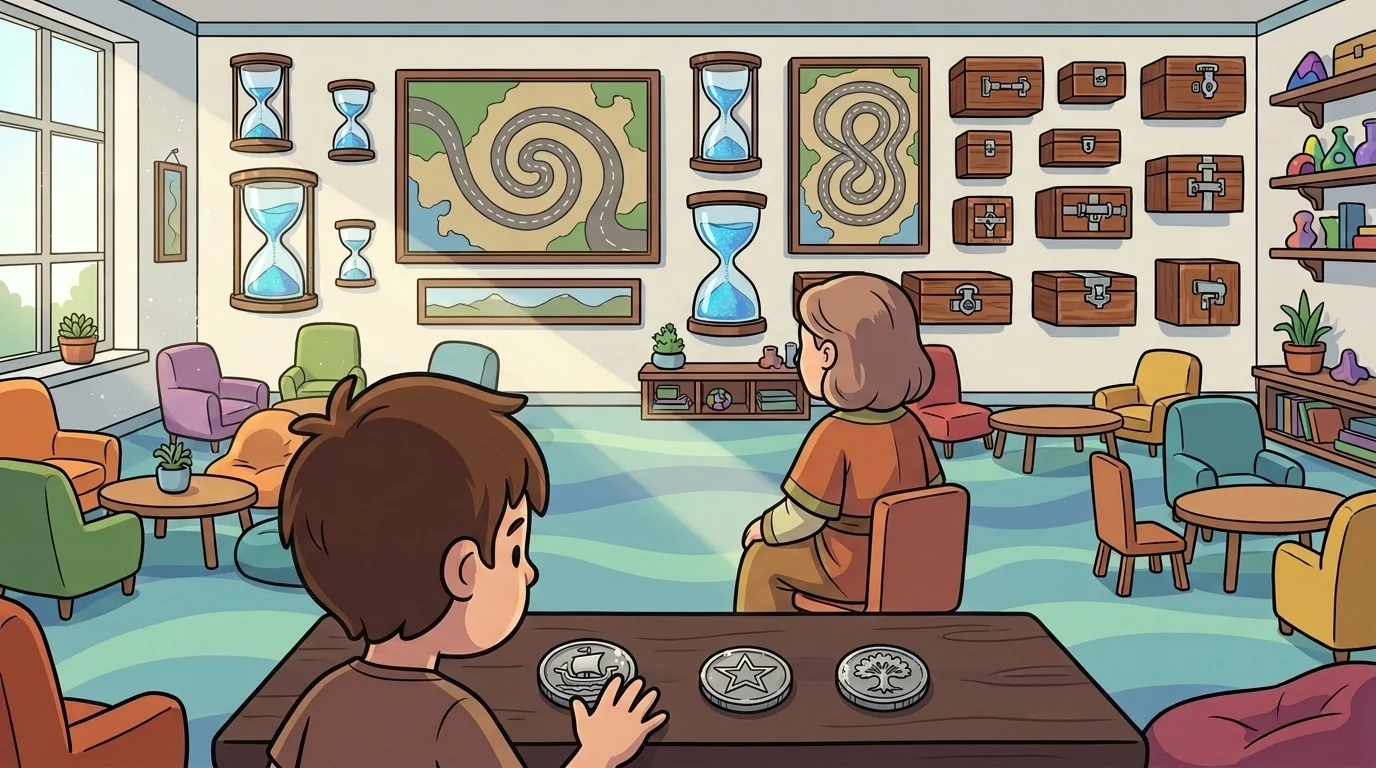
In her classroom, The Forcer taught a single student at a time. Today it was Leo, a boy with restless hands who loved the idea of making games but got tangled up in giving players too many confusing options. The Forcer placed three old silver coins on the dark wood of the table between them.
“Each of these coins is different,” she said. “One has a ship, for a journey. One has a star, for a destination. And one has a tree, for staying home. I’m going to turn around. I want you to look at them, and then just pick one up. Don’t overthink it. Just choose.”
She turned her back, her posture calm and still. “Sometimes,” she said to the wall, “we think a game is about the big, flashy prize at the end. We look up at the sky, hoping for a sign, for a single point of light to guide us.” She waited a beat. “But other times, the real fun is just being on the water, feeling the boat move, not even knowing where you’re going.”
She heard a faint clink of metal as Leo picked up a coin. She turned back around. Leo’s hand was closed in a fist.
The CardForge ensemble
The Forcer is part of CardForge's distributed-narrative cast. Each character embodies a different curricular primitive; together they teach the full subject.
-

The Finesseur
Finesse (force an opponent's high card via positional play; bridge / hearts / spades)
-

The Squeezer
Squeeze (force a discard that gives up a winner; advanced bridge + hearts)
-

The Endplayer
Endplay (throw opponent in to force a losing lead; bridge / hearts / whist)
-

The Counter
Card-counting / pip-tracking (track played cards to deduce remaining hands; gin / bridge / blackjack-style)
-

The Long-Suit
Suit establishment (set up a long suit to run for tricks late in the hand; bridge / whist / spades)
-

The Bluffer
Deception under uncertainty (poker betting; representing a hand you don't have)
-

The Discarder
Strategic discard (hearts: avoid points; spades / gin / rummy: shed dead wood)
-

The Trumpkeeper
Trump management (when to ruff, when to hold; whist / spades / euchre / pinochle)
-

The Shuffler
False-shuffle / stack management (control card order while appearing to randomize; mathematical card magic)