The Discarder
DISCARDER — the right card to throw away is the move that wins the hand. The card-craft primitive of KNOWING WHAT TO LET GO OF.
A story read by The Discarder
Press play to listen along. The line being read lights up as you go.
Show full transcript
Loading transcript…
- "I" - "II" - "III" - "IV" - "V"
- "IX" - "X" - "XI"
- "Q" - "J" - "10"
gate-allow-text-pattern: '^([0-9]{1,2}|[A-Z]{1,5}|[I]{1,4}|[VX]{1,3}|[A-Z][a-z]+)$' ---
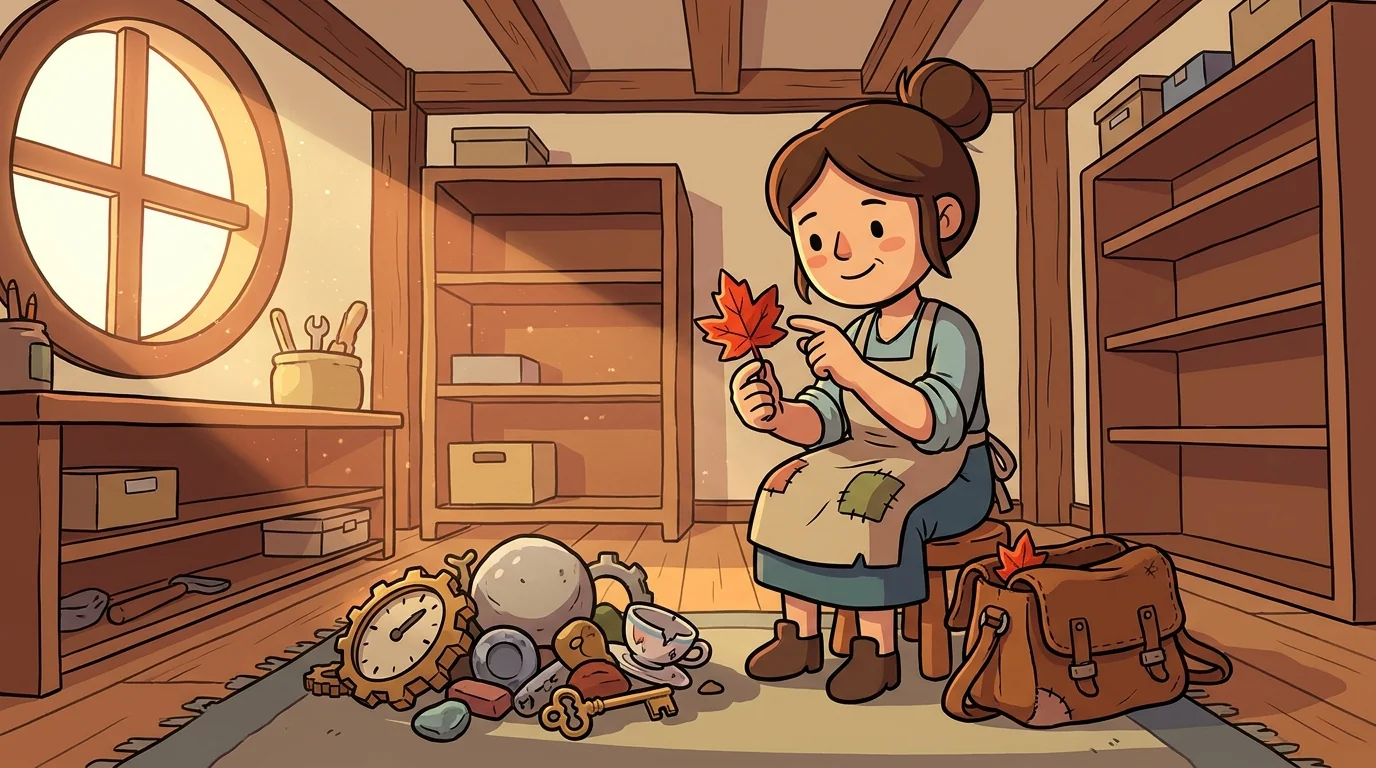
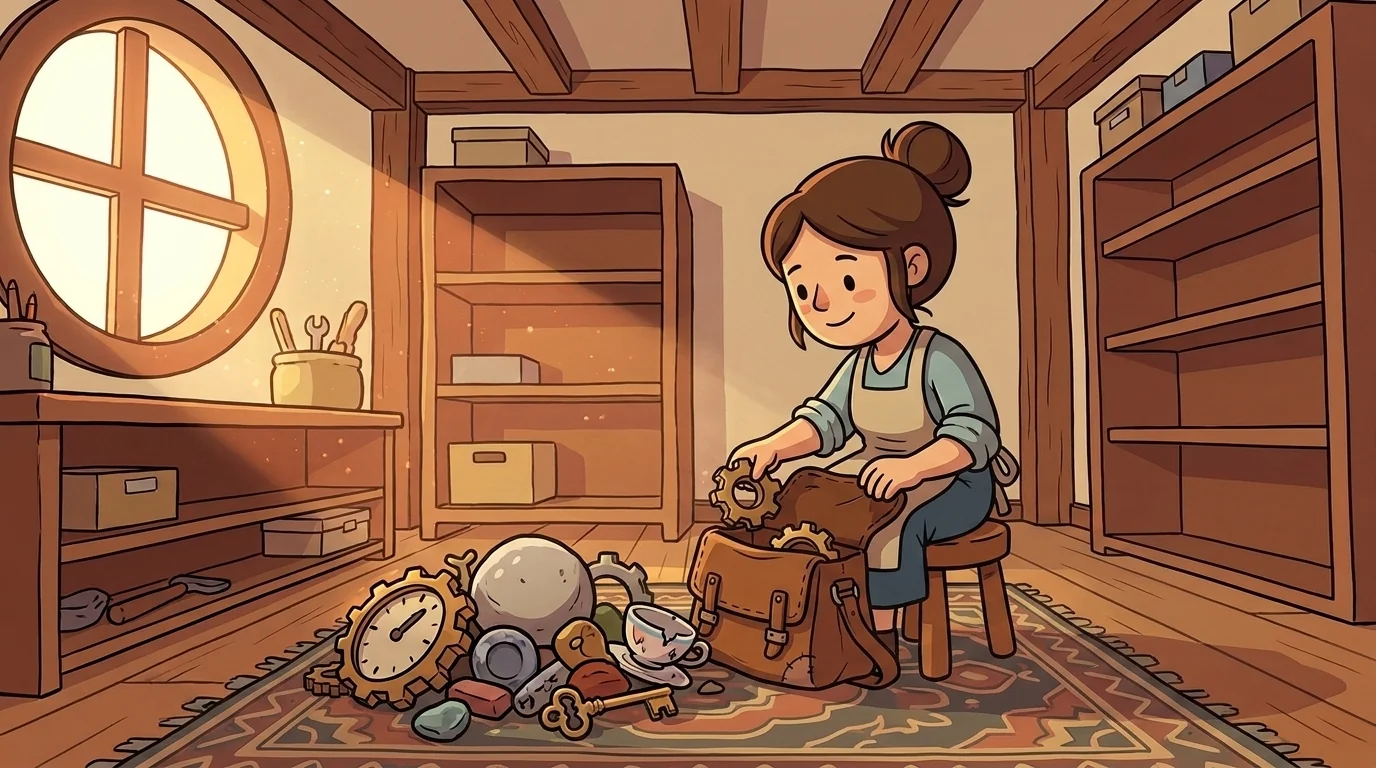
The Discarder sat on a low stool in her workshop, humming a tune that sounded like a sleepy bumblebee. Sunlight streamed through a large, round window, illuminating dust motes dancing in the air. Before her was a mountain of objects—not junk, but things that had finished their jobs. There was a gear from a clock that had ticked its last tock, a perfectly smooth stone that had been skipped across a pond exactly once, and a key for a lock that no longer existed. Her workshop was tidy, with mostly empty shelves lining the walls, making the pile on the floor seem like a temporary visitor.
She picked up a single, brilliant red autumn leaf. She turned it over in her palm, tracing its veins with her finger. “You were a wonderful blanket for a sleeping seed,” she whispered to it. Then, with a small, fond smile, she dropped it into the worn leather satchel by her side. The satchel didn't bulge. It didn’t get heavier. It simply accepted the leaf. Next, she picked up a chipped teacup. “You held so much warmth,” she said, and placed it gently into the satchel’s opening. It vanished without a sound. One by one, she considered each object, gave it a quiet word of thanks, and let it go. This was not cleaning. It was a ceremony of happy endings.
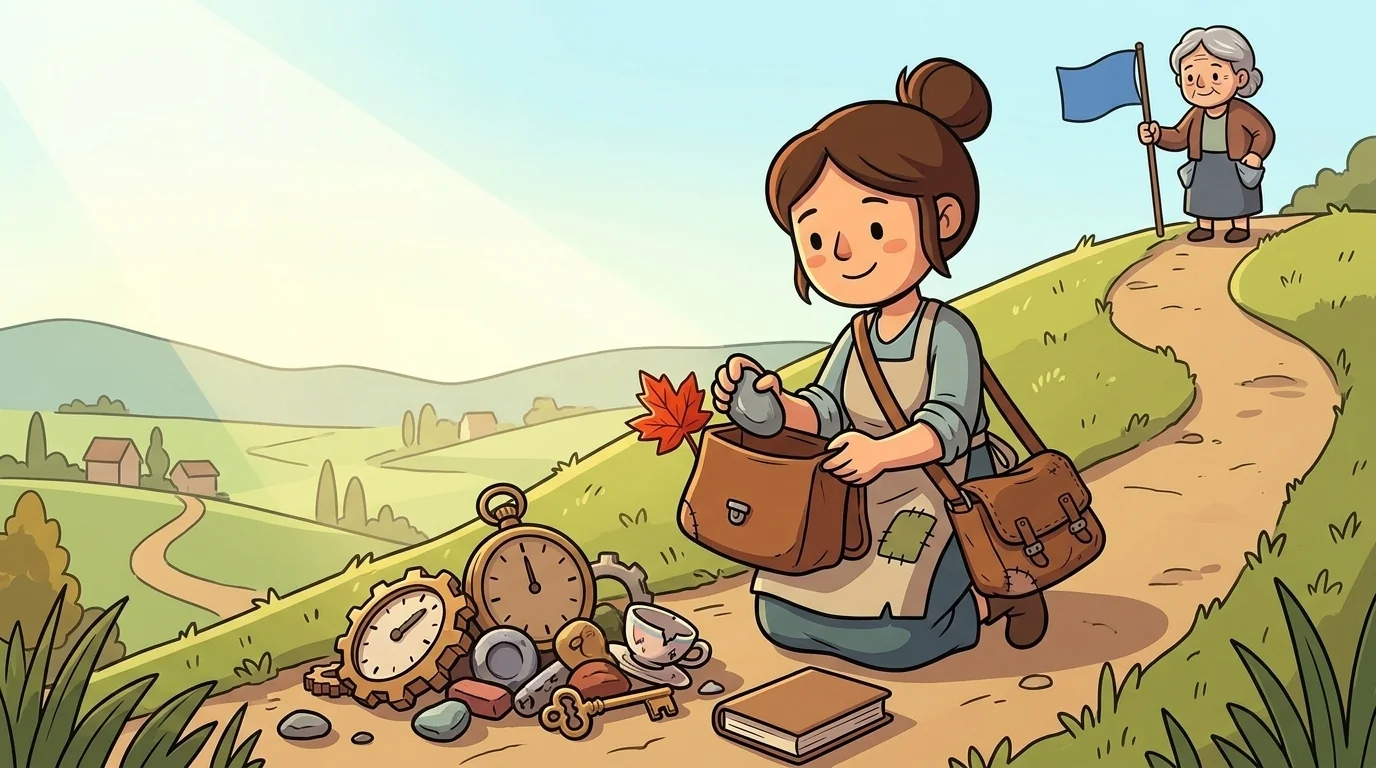
Years ago, when she was a small girl with pockets always full of treasures, she played a game with her grandmother called Hilltop King. The goal was to be the first to carry a special flag to the top of the tallest hill in the valley. The path was steep and winding. On her first try, the girl loaded her pockets with her favorite things: a sparkling piece of quartz, a bird’s feather, a handful of shiny acorns, and a tiny whistle carved from wood. They were all so wonderful, she couldn't imagine leaving any of them behind. But the weight slowed her down. The quartz dug into her hip, and she kept stopping to make sure the feather wasn't bent.
Her grandmother, whose own pockets were empty, reached the top with ease. She found the girl halfway up the path, sitting on a rock and looking sadly at her heavy collection. “Some things are lovely to hold for a moment,” her grandmother said, her voice as soft as moss, “but a burden to carry for a mile.” She pointed to the heavy, beautiful quartz. “That one is very bright. But is its job to be bright in your pocket, or bright in the sunshine on the path?” The girl thought about it. Carefully, she placed the quartz on a stump where the sun made it glitter. She left the acorns for a squirrel. Her pockets felt strangely light. On her next try, she ran up the hill, feeling fast and free, and won the game easily.
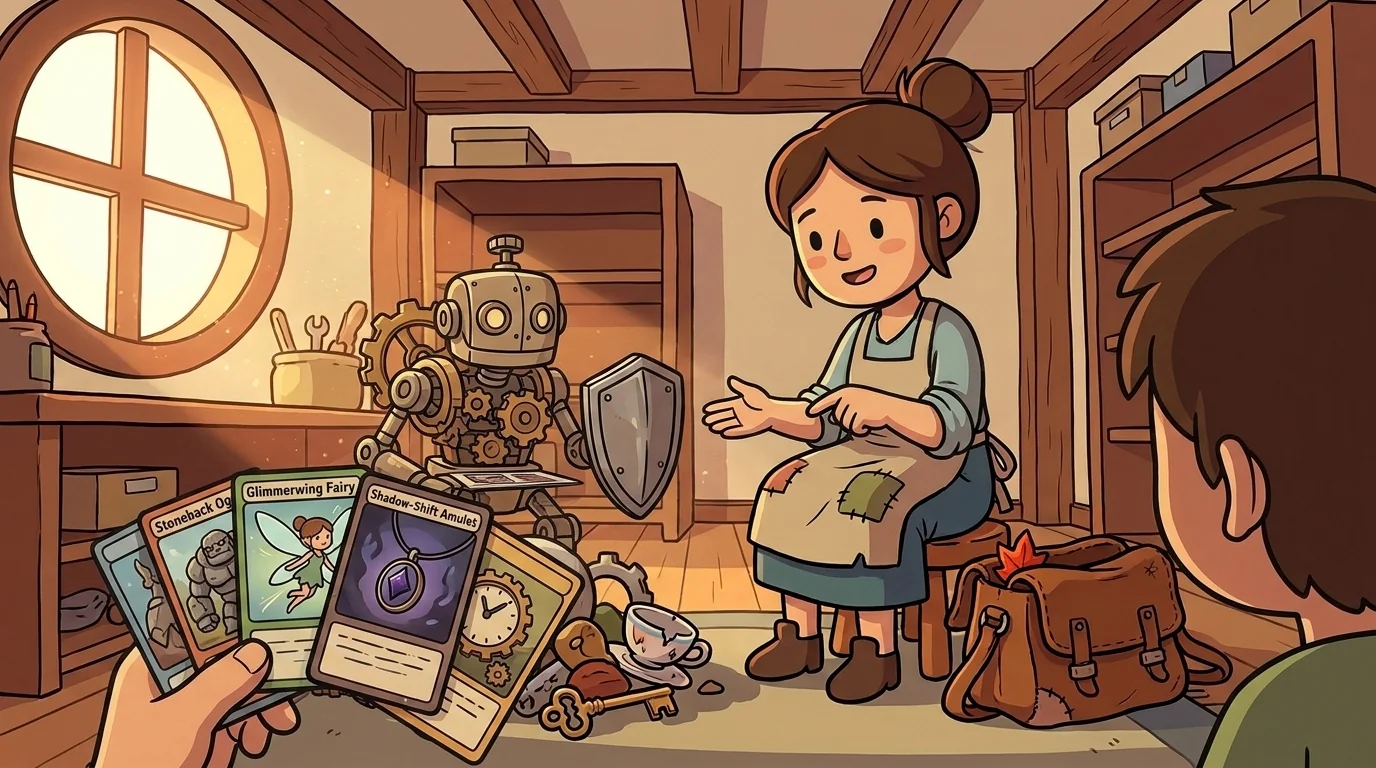
On her first day at the Cardforge Academy, Headmaster Eldrin led The Discarder to her new workshop. The previous instructor, a man known only as The Collector, had left it in a state of magnificent chaos. Stacks of half-finished decks teetered on every surface. Dusty scrolls of abandoned rulesets curled in the corners. A complicated machine designed to shuffle twelve decks at once sat in the middle of the room, hopelessly jammed. Headmaster Eldrin sighed, looking at the mess. “It may take a few weeks to sort through all this,” he said apologetically.
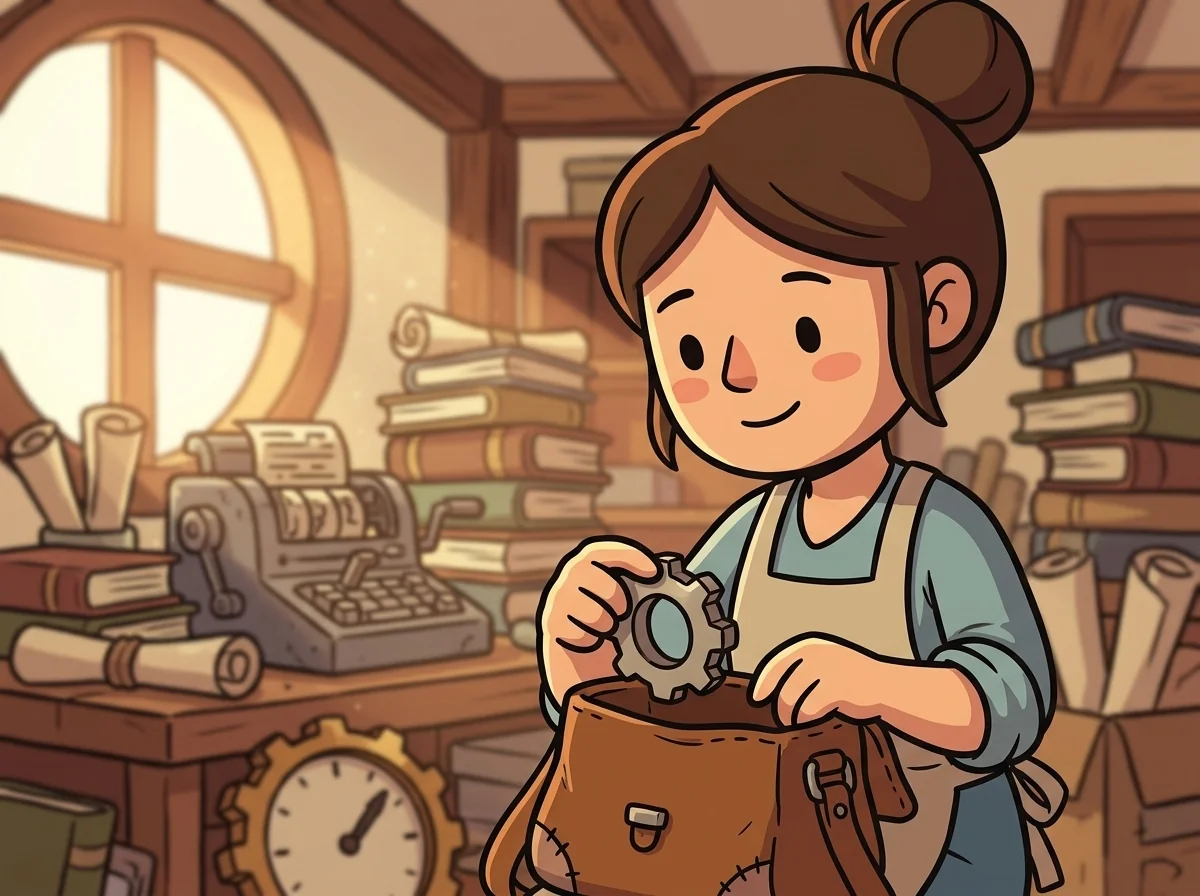
The Discarder just smiled. She set her leather satchel on the floor. It looked small and unassuming against the clutter. She walked to the jammed shuffling machine. “This tried its very best to do a big job,” she murmured, patting its metal side. Then, she opened her satchel. Instead of trying to fix the broken machine, she began to carefully dismantle it, placing each gear and spring inside her bag. She did the same with a deck of cards that had been drawn with a wobbly hand. “This taught someone how to draw a straight line,” she said, and fed the cards into the satchel. Within an hour, the room was half-empty. She wasn't throwing things away; she was thanking them for their service and giving them a place to rest. Headmaster Eldrin watched, amazed, as she made room for new ideas.
The CardForge ensemble
The Discarder is part of CardForge's distributed-narrative cast. Each character embodies a different curricular primitive; together they teach the full subject.
-

The Finesseur
Finesse (force an opponent's high card via positional play; bridge / hearts / spades)
-

The Squeezer
Squeeze (force a discard that gives up a winner; advanced bridge + hearts)
-

The Endplayer
Endplay (throw opponent in to force a losing lead; bridge / hearts / whist)
-

The Counter
Card-counting / pip-tracking (track played cards to deduce remaining hands; gin / bridge / blackjack-style)
-

The Long-Suit
Suit establishment (set up a long suit to run for tricks late in the hand; bridge / whist / spades)
-

The Bluffer
Deception under uncertainty (poker betting; representing a hand you don't have)
-

The Trumpkeeper
Trump management (when to ruff, when to hold; whist / spades / euchre / pinochle)
-

The Forcer
Magic forcing (the spectator "freely chooses" the card you intended)
-

The Shuffler
False-shuffle / stack management (control card order while appearing to randomize; mathematical card magic)