
Instance and Counter
testing a conjecture with examples and counterexamples — trading cases that fit against cases that break it, until the guess either holds or gets sharper
Press play to listen along. The line being read lights up as you go.
Show full transcript
Loading transcript…
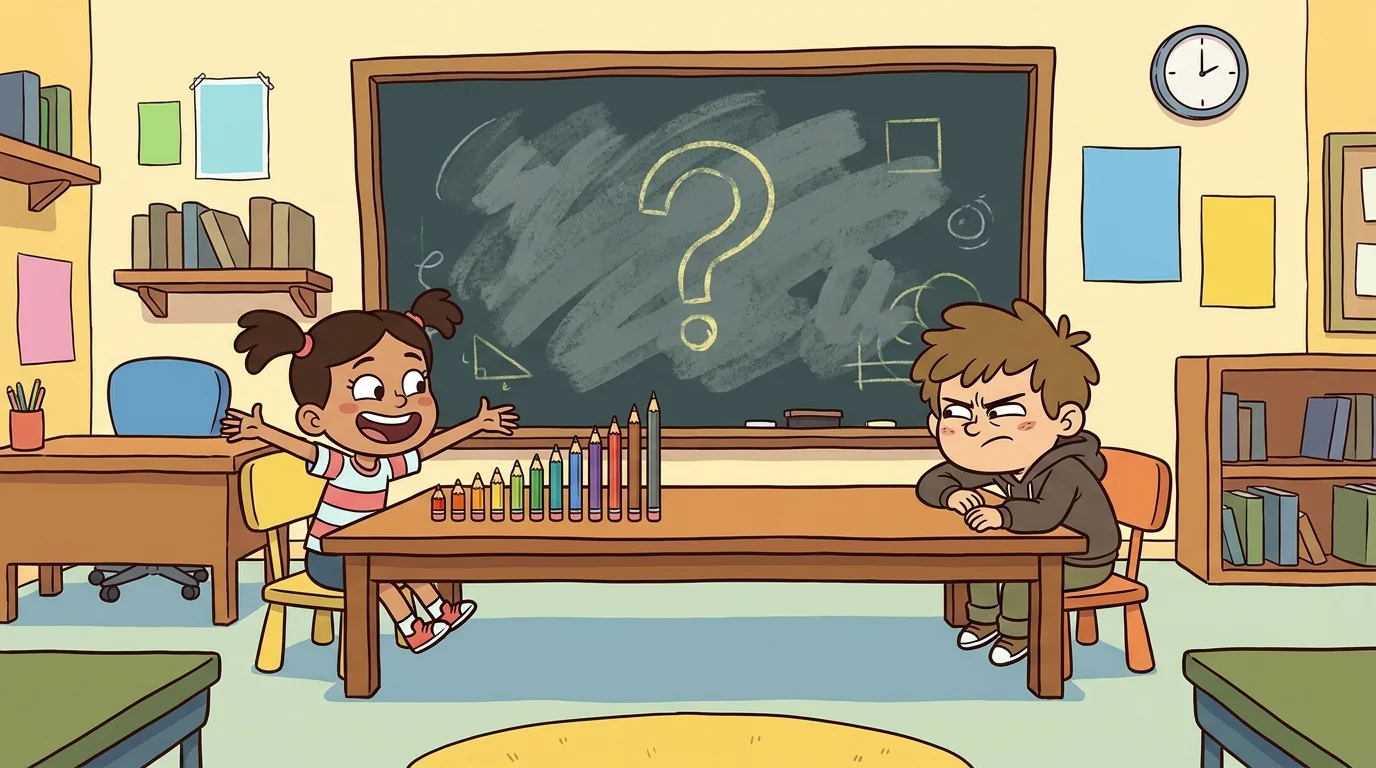
The math circle met on Thursdays in the room with the wobbly chalkboard, and today someone had written a bold sentence across the top in yellow chalk: *Every prime number is odd.* Under it, a question mark the size of a fist.
At the long table, Instance Ivy was already grinning. She loved a sentence like that — a claim you could go hunting for. She lined up her pencils by length, the way she always did before a good problem, and pulled her notebook close. Ivy collected examples the way some kids collect stickers. Give her a rule and she would go find case after case that fit, until the fit felt like a warm blanket.
Across from her, Counter Cato was quieter. He read the yellow sentence twice. Something about the word every made his shoulders creep up toward his ears. Every was a big word. Cato's job, the one nobody had given him but he always ended up doing anyway, was to squint at big words until he found the crack. And he wasn't sure the circle wanted a crack today. Everyone looked so happy.
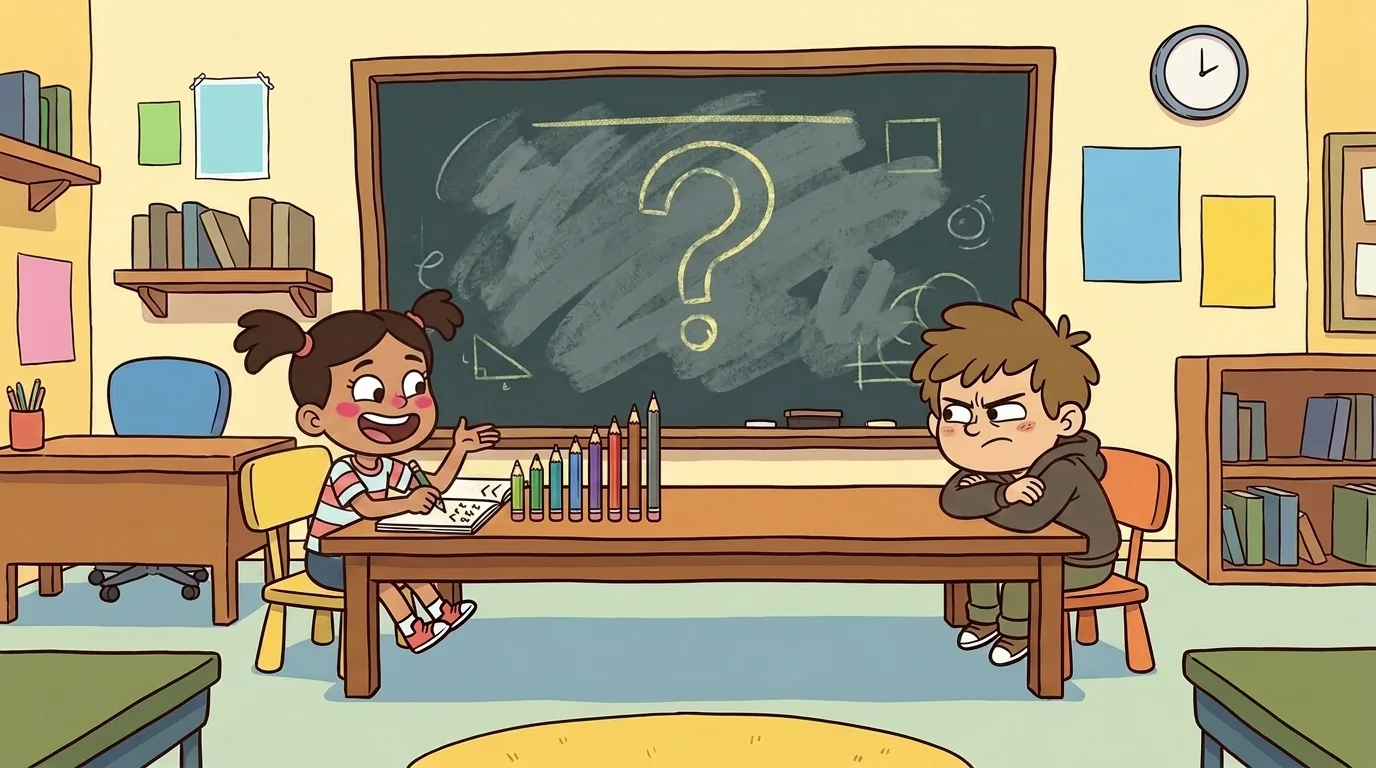
"Okay," said Ivy, and she was off. "Prime means a number you can only build from 1 and itself — no other whole pieces. So watch." She wrote 3 and drew a little check. "Three is prime. And three is odd. Fits." She wrote 5. "Five — prime, odd. Fits." Then 7, then 11, then 13, each with a satisfied little tick beside it. "Prime, odd. Prime, odd. Prime, odd."
Her pile of examples grew down the page like a happy staircase. Each one that fit made the yellow sentence feel truer, and Ivy felt that trueness settle in her chest like the last piece of a puzzle clicking home. "See?" she said. "They keep fitting. Three, five, seven, eleven, thirteen — every single prime I try is odd." She looked up, cheeks pink with the pleasure of a pattern behaving.
And, if she was honest, a small part of her hoped that this time, just this once, Cato would look at her lovely staircase and simply nod.

Cato wanted to nod. He really did. But his eyes had already slid down to the bottom of the number line, to the small, easily-forgotten numbers that everyone skips past on their way to the interesting ones.
1. Not prime — everyone agreed on that; it only had one piece. He kept going down. 2.
He stopped. He felt the familiar little knot tighten under his ribs, the one that showed up right before he had to say the unwelcome thing.
"Ivy," he said carefully. "What about two?"
Ivy's pencil paused. "Two?"
"Two." Cato pointed at it like it might bite. "You can only build it from 1 and itself. Nothing else divides it evenly. So — two is prime." He swallowed. "And two is even."
The room went quiet. Ivy's happy staircase suddenly had a shadow on it. A prime number. An even one. Sitting right there at the bottom of the line the whole time, small and stubborn, breaking the beautiful yellow sentence in half. Cato stared at the table. He'd done it again — found the crack, spoiled the warm blanket. He braced for Ivy's face to fall.
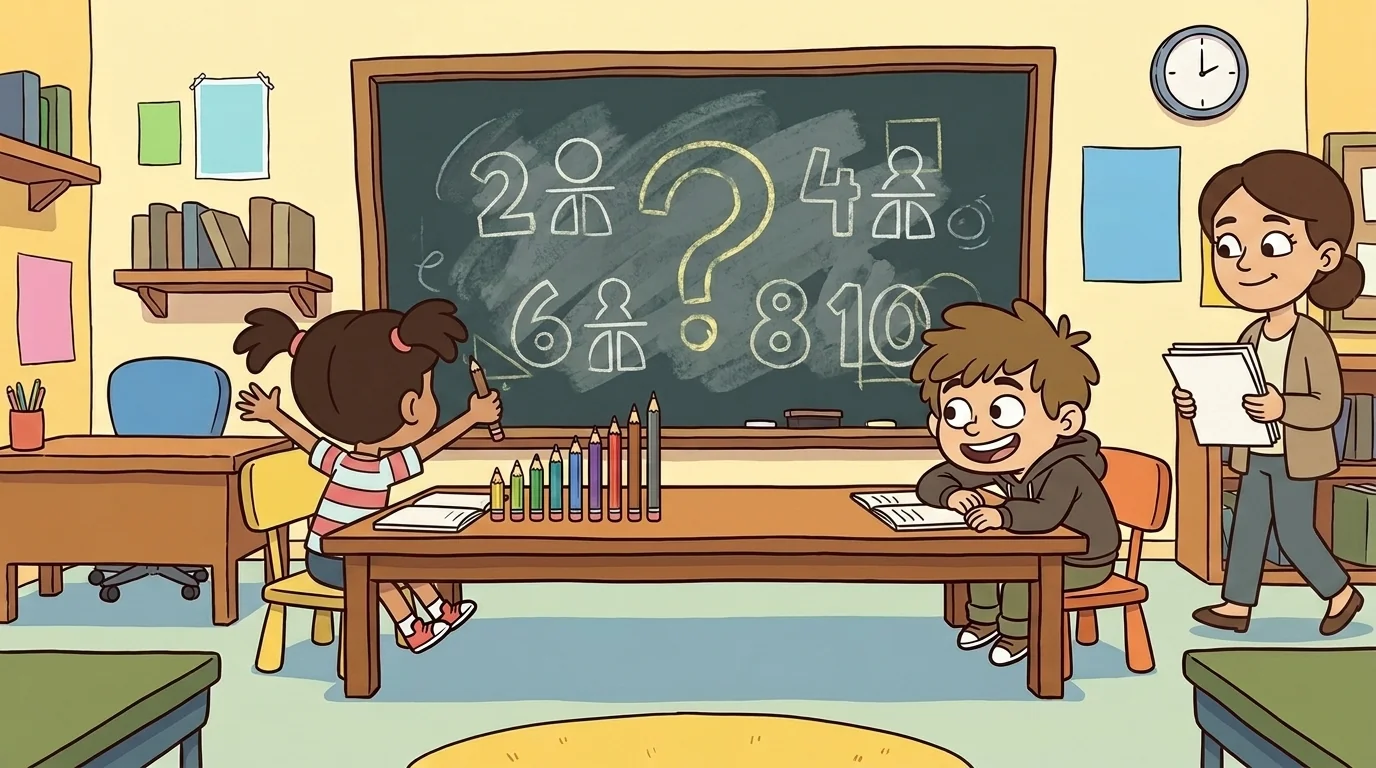
But Ivy didn't look upset. She looked interested.
"Say it back to me," she said slowly. "Two is prime, and two is even. So not every prime is odd." She underlined the every on the board. "Which means the yellow sentence is... wrong."
"A little wrong," Cato mumbled.
"No — wrong is good!" Ivy grabbed a fresh pencil. "Because look what your two does." She wrote out even numbers: 4, 6, 8, 10. "Four — you can split it with two. Six — split with two. Every even number bigger than two has two hiding inside it as a piece. So it can't be prime." She turned to him, eyes wide. "Which means two is the only even prime there will ever be. The one and only. Your counterexample didn't wreck the pattern, Cato. It found the real one."
Their teacher, passing with a stack of scratch paper, smiled without stopping. "That's the whole game," she said. "A guess that survives a good counterexample comes out sharper than it went in. Ivy, you bring the cases that fit. Cato brings the one that doesn't. Neither of you gets there alone."

They rewrote the yellow sentence together, taking turns with the chalk: *Every prime is odd — except 2, the only even prime.* It was longer now. It was also, finally, true.
Cato looked at it and felt the knot under his ribs quietly come undone, loosening into something that felt almost like pride. For once, the crack he'd found hadn't ended the fun — it had opened a door, and there behind it was the strangest, most special little number of all, waiting to be noticed. Ivy bumped his shoulder with hers and grinned, and Cato found he was grinning back, warm all the way through, already wondering what other big yellow sentences the two of them could go break open next.
The MathCircle ensemble
Instance and Counter is part of MathCircle's distributed-narrative cast. Each character embodies a different curricular primitive; together they teach the full subject.
-

Circle Circe
Meta-host who steps back to let kids talk to each other
-

Echo Edie
Listener-restater; social-fabric weaver
-

Patty Patient
Wait-time character; gentle anti-pressure presence
-

Tortoise Hare
Dual-voice productive-failure surface; embodies the slow-fast tension
-

Tess Try-Small
Specializing — when a problem's too big, try the smallest version first
-

Gemma General
Generalizing — turning a pattern from a few cases into a rule for all of them
-

Hattie Hunch
Conjecturing — daring to guess boldly, then testing the guess honestly
-

Reva Reverse
Working backwards — starting from the goal and reasoning back to the start
-

Wendy Wonder
Notice-and-wonder — slowing down to observe and ask before rushing to solve
-

Cass Check
Sense-checking — asking whether an answer actually makes sense before trusting it