The Shuffler
SHUFFLER — the deck looks random. the order is yours. The card-craft primitive of HIDING ORDER INSIDE WHAT LOOKS LIKE A MESS: keeping a stacked deck secret while appearing to shuffle.
A story read by The Shuffler
Press play to listen along. The line being read lights up as you go.
Show full transcript
Loading transcript…
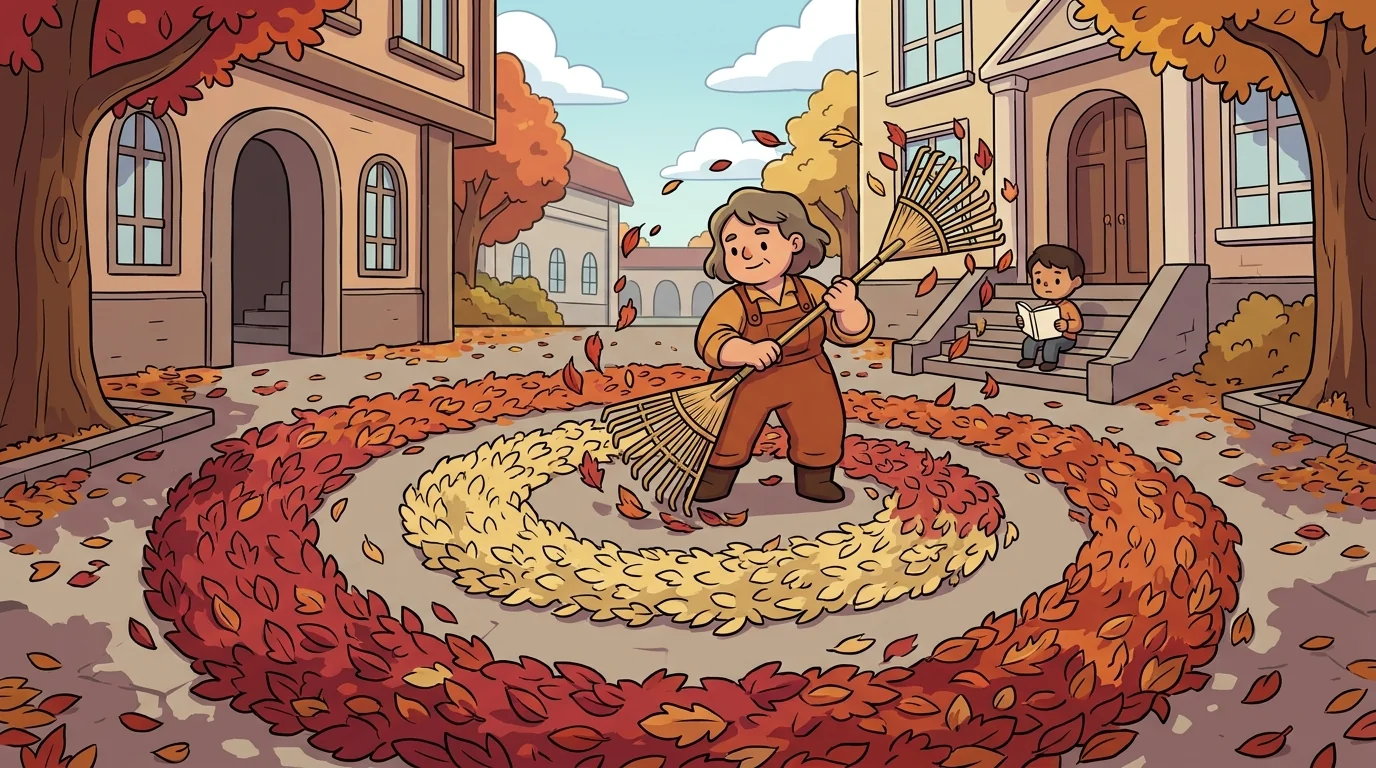
The Shuffler did not use a rake. Not in the typical sense. Standing in the middle of the Cardforge Academy's main courtyard, she held two long, fan-like rakes made of polished bamboo. A swirling ocean of autumn leaves, every shade from fiery crimson to dusty gold, surrounded her ankles. A young student, clutching a book to his chest, watched from the stone steps. He’d seen groundskeepers tidy leaves before. They made neat, boring piles. This was different.
With a motion as smooth as pouring tea, The Shuffler began to move. She didn't push the leaves. She lifted and tossed them, her rakes crossing and uncrossing in a quiet rhythm. A flurry of red and orange leaves would fly into the air, only to land in a slightly different place. It looked like she was just making a bigger, more glorious mess. The student squinted, certain she was playing some kind of game. But as she worked her way across the lawn, a pattern began to emerge from the chaos. The noisy, crunchy mess was becoming a quiet, flowing river of color, a perfect spiral that coiled into the center of the courtyard, with the deepest reds on the outside flowing seamlessly into the palest yellows at the heart of the design. She hadn't collected a single leaf. She had simply rearranged the mess into a masterpiece.
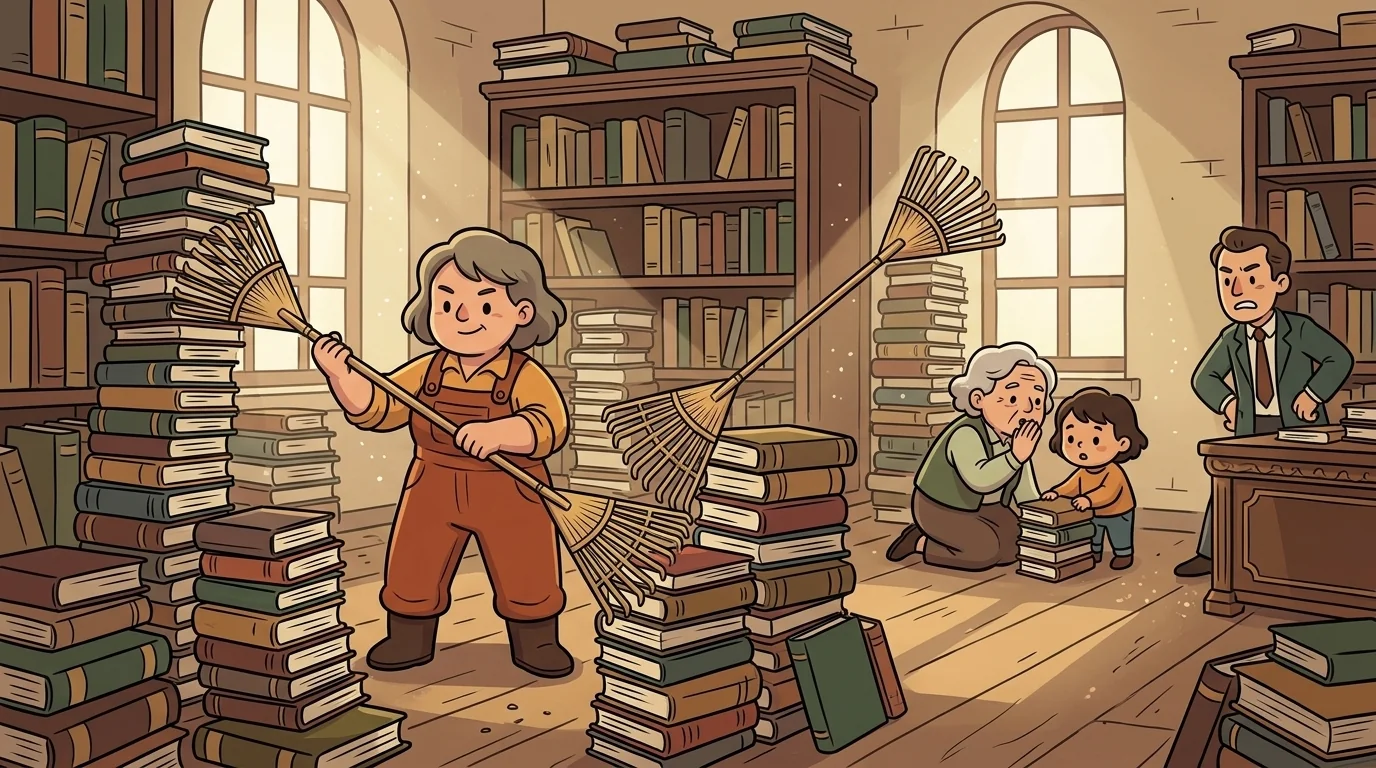
Long before she came to the academy, The Shuffler had learned her craft in a library that smelled of old paper and dust motes dancing in sunbeams. It wasn’t a tidy library. Books overflowed from shelves, living in teetering stacks that rose from the floor like ancient trees. Her grandmother, the Head Librarian, never seemed worried by the clutter. "It's not a mess, my dear," she would say, her voice a low hum. "It's just resting."
One afternoon, a man in a hurry asked for a very specific book: Turtles and Their Peculiar Notions of Time. It hadn't been checked out in fifty years. The Shuffler’s grandmother simply nodded. "My granddaughter will find it." The young Shuffler looked at the thousand-book towers with wide eyes. But her grandmother knelt beside her and whispered, not a location, but a rhythm. A sequence. "Two from the top of the poetry pile, slide them under the history stack by the window. Then three from that stack, move them to the fables corner. Go."
To the man, it looked like a child making a game of shuffling books. She moved stacks, slid volumes, and spun piles around with a focused, playful energy. The towers of books shifted and settled. But she wasn't being random. She was following the path her grandmother had whispered. After a minute of this frantic, yet graceful, reorganization, she stopped. She walked to a tall, wobbly stack of biographies, reached two-thirds of the way down, and pulled. The book slid out as if it had been waiting there for her. Turtles and Their Peculiar Notions of Time. Her grandmother smiled. "You see?" she murmured later, "Chaos is just a story you haven't learned to read yet. We just taught it a new chapter."
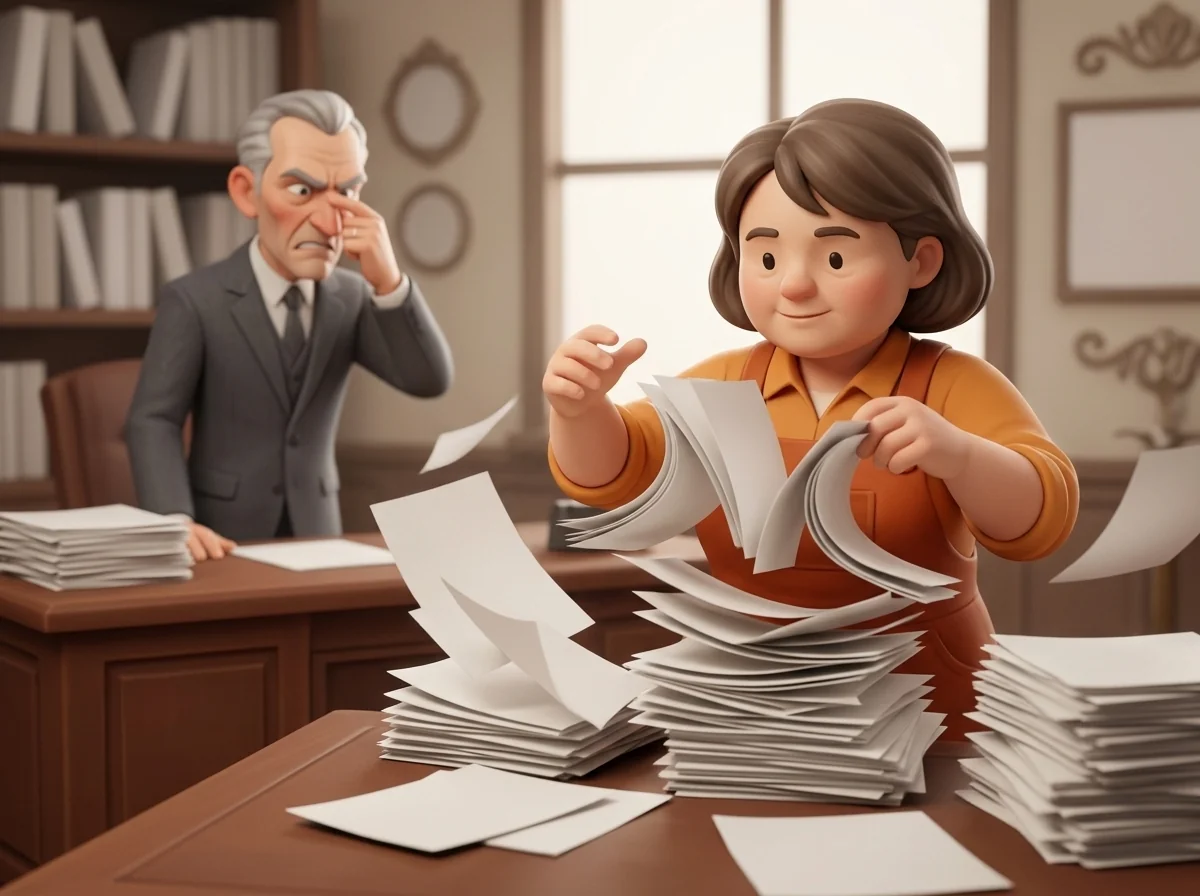
The Shuffler’s arrival at the Cardforge Academy was a quiet affair. She carried a single leather satchel that seemed to contain nothing but decks of cards. The Headmaster, a stern man named The Caliper who valued straight lines and sharp corners above all else, greeted her in his office. His desk was buried under a mountain of student application files. He sighed, pinching the bridge of his nose. "It will take me all night to sort these," The Caliper said, gesturing to the paper chaos. "A necessary evil. We must impose order."
The Shuffler set her satchel down. "Perhaps the order is already there," she said softly. "It's just hiding." The Caliper raised a skeptical eyebrow. With a nod of permission from him, she approached the desk. She did not read the files. She simply gathered the towering pile into her arms. Then, in a series of movements too quick and fluid to follow, she began to shuffle them. Not like cards, but like a baker kneading dough. The pile was split, folded, merged, and fanned in a flurry of paper. It looked utterly destructive. The Caliper winced, certain his entire filing system was now ruined.
After a few moments, she stopped. She calmly dealt the files into three distinct, perfectly squared-off piles on his once-cluttered desk. "Accepted," she said, tapping the largest pile. "Wait-listed," she said, tapping the medium one. "And these," she finished, touching the smallest, "are the interesting ones. The ones you'll want to read twice." The Caliper stared, then picked one at random from the "Accepted" pile. It was his top candidate. He picked another. His second choice. He looked at The Shuffler, his rigid posture softening just a little. "Welcome to the Academy," he said.
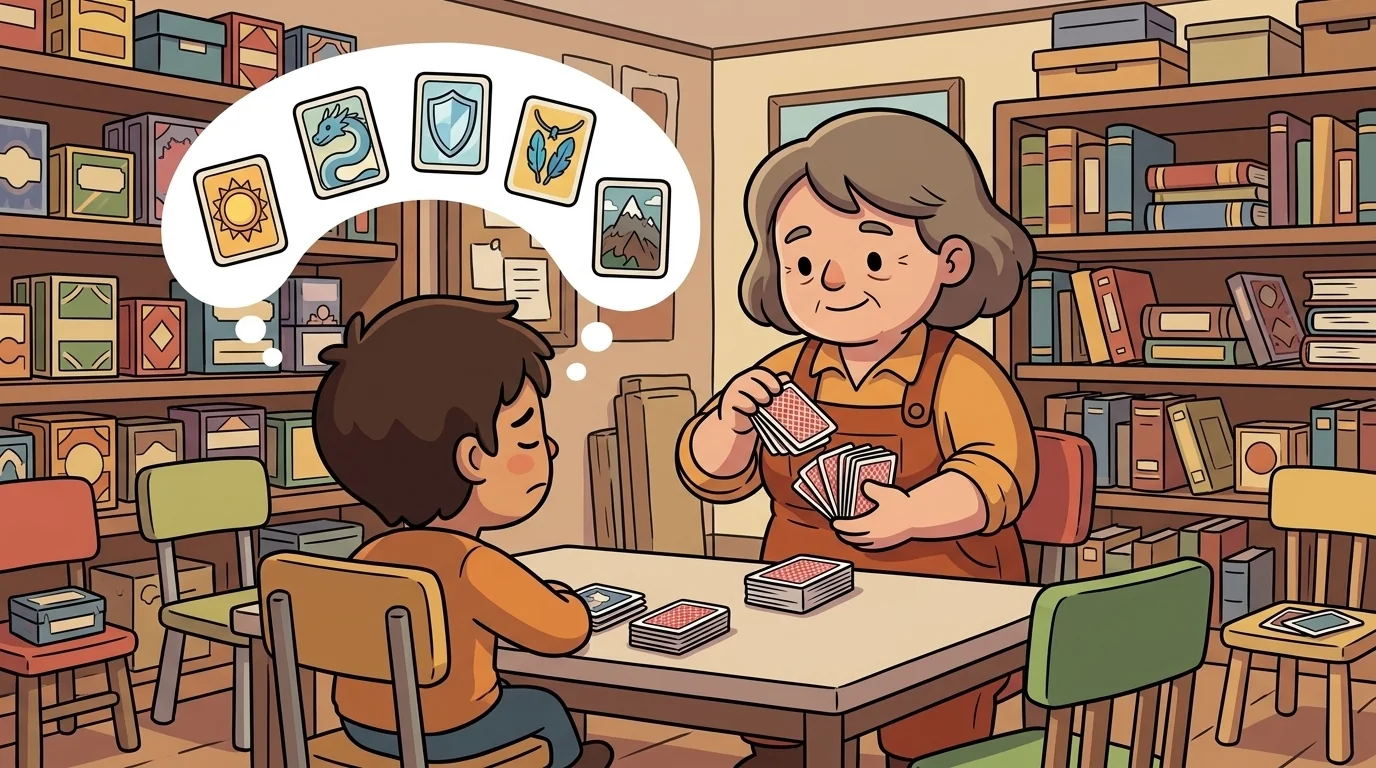
"It's just luck," said a student named Leo, slumping in his chair. "I build the perfect deck, but the cards come out in the wrong order every single time. It's useless." They were in The Shuffler's classroom, a cozy room that felt more like a den, with mismatched chairs and shelves filled with card boxes of every shape and size.
The Shuffler picked up Leo's deck. "You think the cards are in charge," she said, her voice gentle. She held the deck in her hands and began to shuffle. It wasn't a fancy magician's shuffle. It was a comfortable, slightly messy one. A few riffles that didn't perfectly interlace, an overhand shuffle where some clumps seemed to fall at random, and a simple cut. It looked exactly like the way Leo's dad shuffled when they played Go Fish. It looked, for all the world, completely and totally random.
She placed the deck back in front of him. "Don't draw," she instructed. "Just close your eyes. Imagine your first five turns. What cards do you need to see?"
Leo sighed but did as she asked. He imagined his first turn, needing his little resource card, the Sun-Stone. Then the Sky-Serpent on turn two. The Shield of Glass on turn three. The Twin-Feather Amulet and the Mountain-Caller on turns four and five. It was the perfect opening. An unstoppable sequence he’d never once drawn.
"Okay, I've imagined it," Leo said, opening his eyes.
"Good," The Shuffler said with a small smile. "Now, turn over the top five cards."
Leo did. There was the Sun-Stone. Then the Sky-Serpent. The Shield of Glass. The Twin-Feather Amulet. And the Mountain-Caller. They were all there, in the exact order of his perfect dream. His mouth fell open. "But... you shuffled it," he whispered, his voice full of awe. "I saw you. It was a mess."
The Shuffler’s smile widened. "Was it? Or did I just make the mess look convincing?"
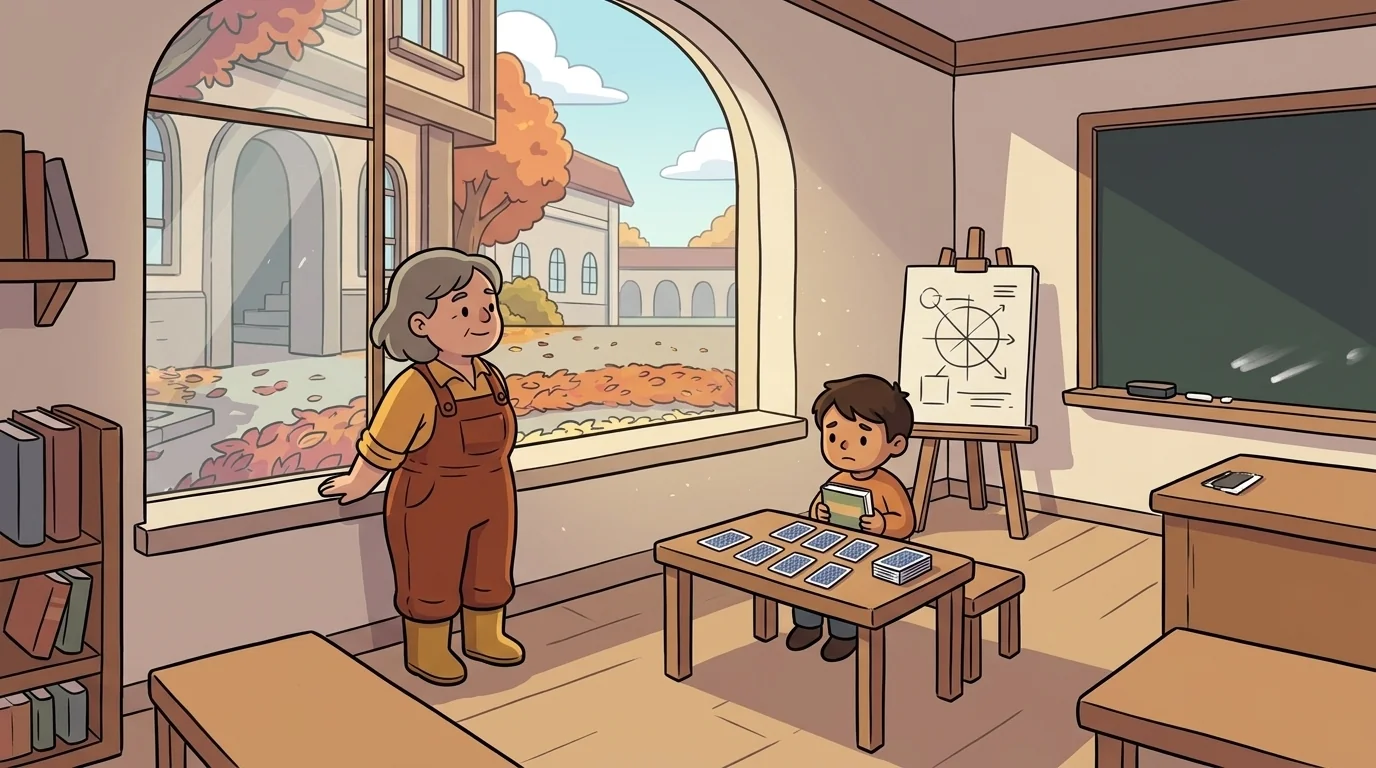
Leo stared at the five perfect cards laid out before him, then at the rest of the deck, then back at his teacher. He looked troubled. "But... isn't this cheating?" he asked, his voice barely a whisper.
The Shuffler had moved to the window, watching the last of the autumn leaves drift down from the trees in the courtyard. She didn't turn around immediately, letting his question hang in the quiet air of the classroom. The spiral of leaves she’d made earlier was still there, a perfect pattern on the grass.
"Is it cheating for a river to know which way it's flowing?" she asked, her voice calm and even. She turned to face him, her expression warm. "You didn't change the cards in your deck, Leo. You just learned the path they wanted to take. All a good shuffle does is hide that path from your opponent, while making it clear to you."
She walked back to the table and tapped the deck gently with one finger.
"The deck looks random," she said. "The order is yours."
Leo let out a slow breath, and the worried knot behind his ribs came undone. He felt calm now, and quietly proud — not because he had a secret trick, but because the world felt a little less random and a little more his to understand.
--- ---
The CardForge ensemble
The Shuffler is part of CardForge's distributed-narrative cast. Each character embodies a different curricular primitive; together they teach the full subject.
-

The Finesseur
Finesse (force an opponent's high card via positional play; bridge / hearts / spades)
-

The Squeezer
Squeeze (force a discard that gives up a winner; advanced bridge + hearts)
-

The Endplayer
Endplay (throw opponent in to force a losing lead; bridge / hearts / whist)
-

The Counter
Card-counting / pip-tracking (track played cards to deduce remaining hands; gin / bridge / blackjack-style)
-

The Long-Suit
Suit establishment (set up a long suit to run for tricks late in the hand; bridge / whist / spades)
-

The Bluffer
Deception under uncertainty (poker betting; representing a hand you don't have)
-

The Discarder
Strategic discard (hearts: avoid points; spades / gin / rummy: shed dead wood)
-

The Trumpkeeper
Trump management (when to ruff, when to hold; whist / spades / euchre / pinochle)
-

The Forcer
Magic forcing (the spectator "freely chooses" the card you intended)