Unit the Per-One-Counter
RATES AND UNIT RATES — comparing different rates requires normalizing them to a common per-one denominator. Cost per yard, miles per hour, calories per serving — all reductions to per-one.
A story read by Unit the Per-One-Counter
Press play to listen along. The line being read lights up as you go.
Show full transcript
Loading transcript…
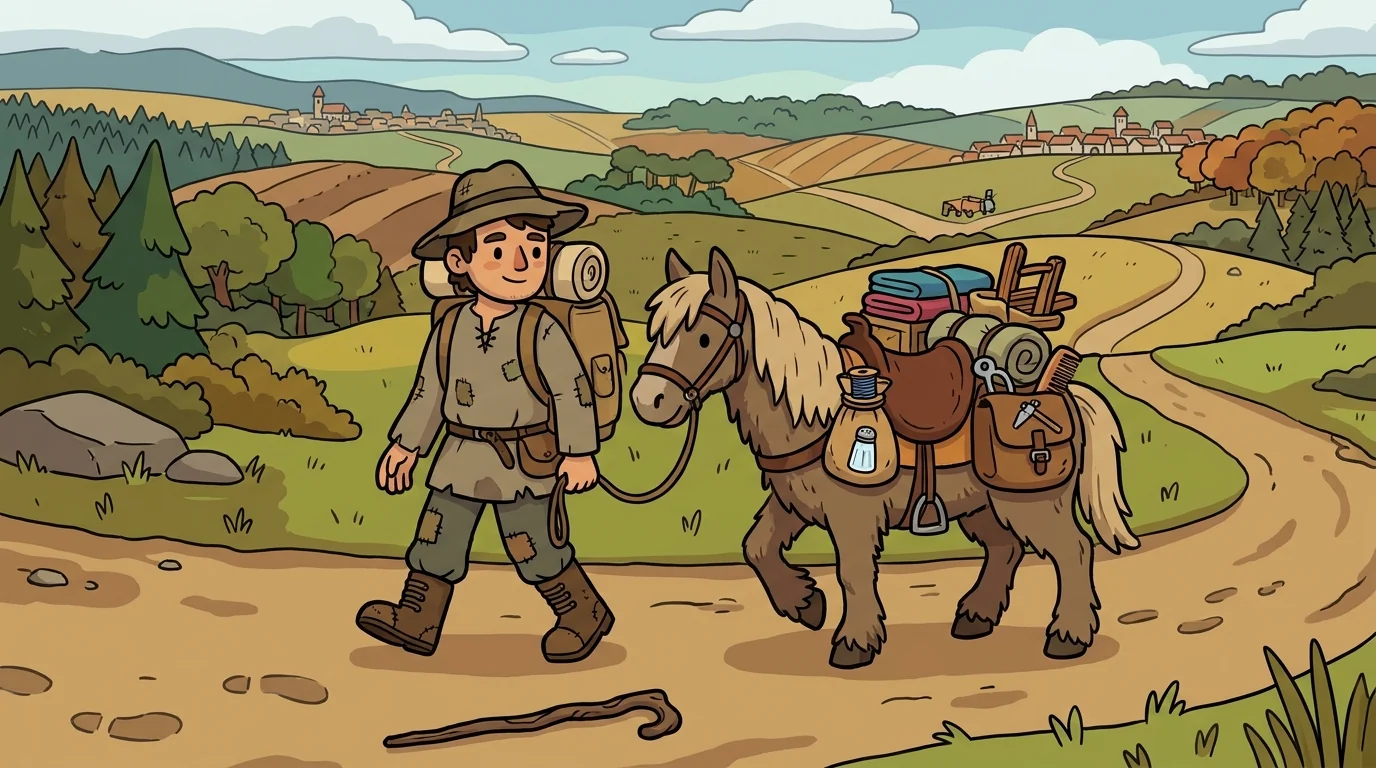
Unit walked for twelve years.
This is, by most standards, a lot of walking. Most people walk a great deal in the course of their lives — to school, to market, to work, to a friend's house — but they do not, ordinarily, do all of their walking with the same packhorse and the same canvas pack. Unit did. He spent twelve years as a travelling pedlar, walking from market to market across the kingdom's three central provinces, selling cloth, salt, small metalwork, and (occasionally) wooden combs.
He had been apprenticed to a master pedlar — a gruff old man named Tenstride — at the age of seventeen. He had inherited the packhorse and the canvas pack at the age of twenty-five when Tenstride retired. He had walked the routes himself for twelve years after that, between twenty-five and thirty-seven, before joining the academy.
What Unit eventually understood — and what made him the teacher he became — was that every market measured things differently.
This was, when he was new to the trade, infuriating.
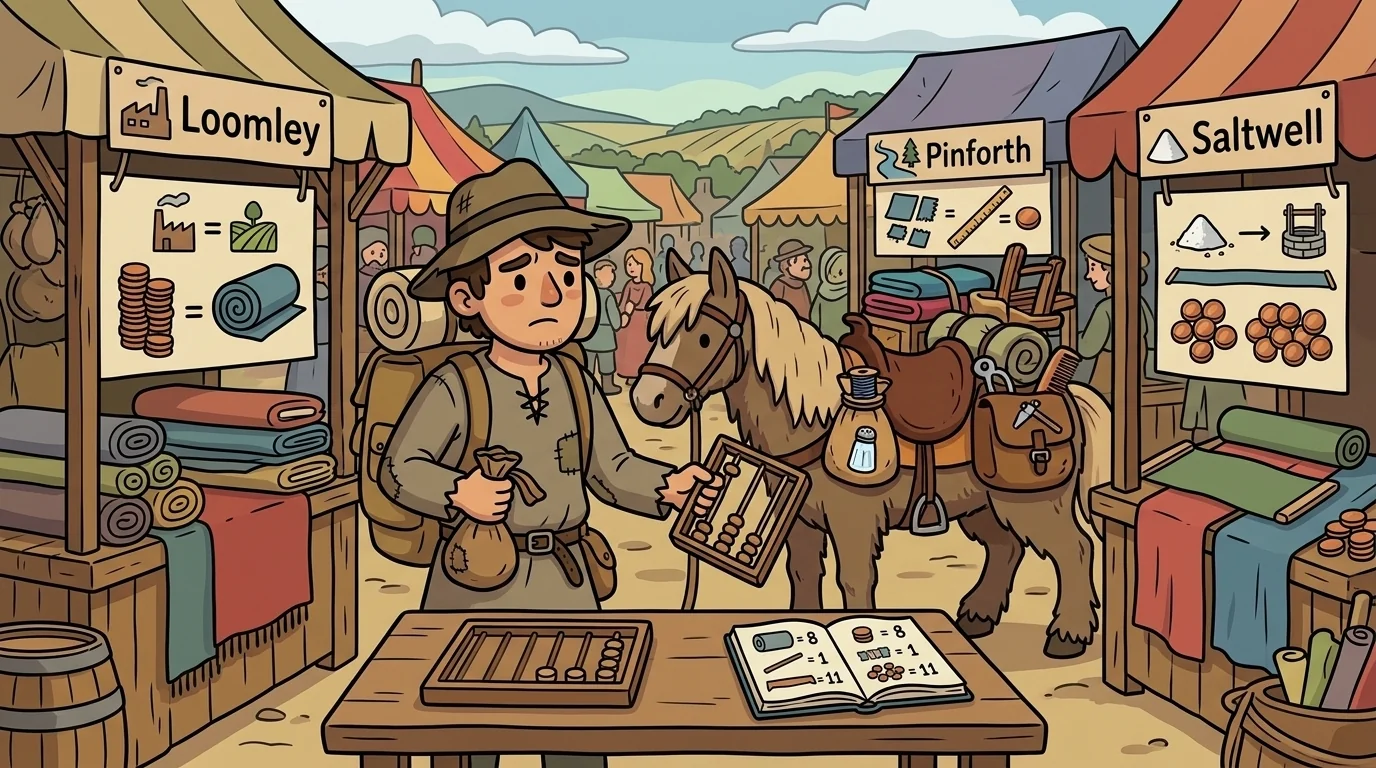
He would walk into the market town of Loomley and see a bolt of woolen cloth quoted at eight coppers per bolt. He would walk into the next market town of Pinforth (about half a day east) and see a bolt of woolen cloth quoted at one copper per yard. He would walk into the third market town of Saltwell (another half-day) and see armspan of cloth quoted at eleven coppers.
He had three prices. In three different units. For what was, essentially, the same product.
Was Loomley's cloth a better deal than Pinforth's? Was Pinforth's better than Saltwell's? He could not tell — not directly. The numbers were not comparable.
What he learned to do — what Tenstride had taught him in the first year of apprenticeship, in the master pedlar's gruff voice — was reduce everything to per-one.

A bolt of cloth, Tenstride had said, was eight yards. An armspan was roughly a yard and a half. So Loomley's eight-coppers-per-bolt was one copper per yard. Pinforth's one-copper-per-yard was, well, one copper per yard. Saltwell's eleven-coppers-per-armspan was roughly seven-and-a-half coppers per yard.
Loomley and Pinforth were the same price. Saltwell was a bad deal.
The key was per yard. The key was per one of a common thing.
Unit, who was nineteen at the time, sat with this for several weeks. He realized it was general. Any time you had a rate quoted in different units, you could reduce it to per-one-of-a-common-thing and then the rates were directly comparable.
He started doing this in his head. Cost per yard. Distance per day. Calories per serving (when he was negotiating for food at inns). Wages per hour. Salt per pound. He could not look at any rate without reducing it to per-one.
By the end of his twelve years on the road, he could do it instantly. Quote him any price in any unit and he would, within seconds, have a per-one comparison ready.
When the RatioRealm academy was looking for someone to teach rates and unit rates to children, the academy master had heard about Unit from a Loomley merchant who said: "He is the only pedlar I have ever met who treats price-comparison as an arithmetic discipline rather than an instinct."
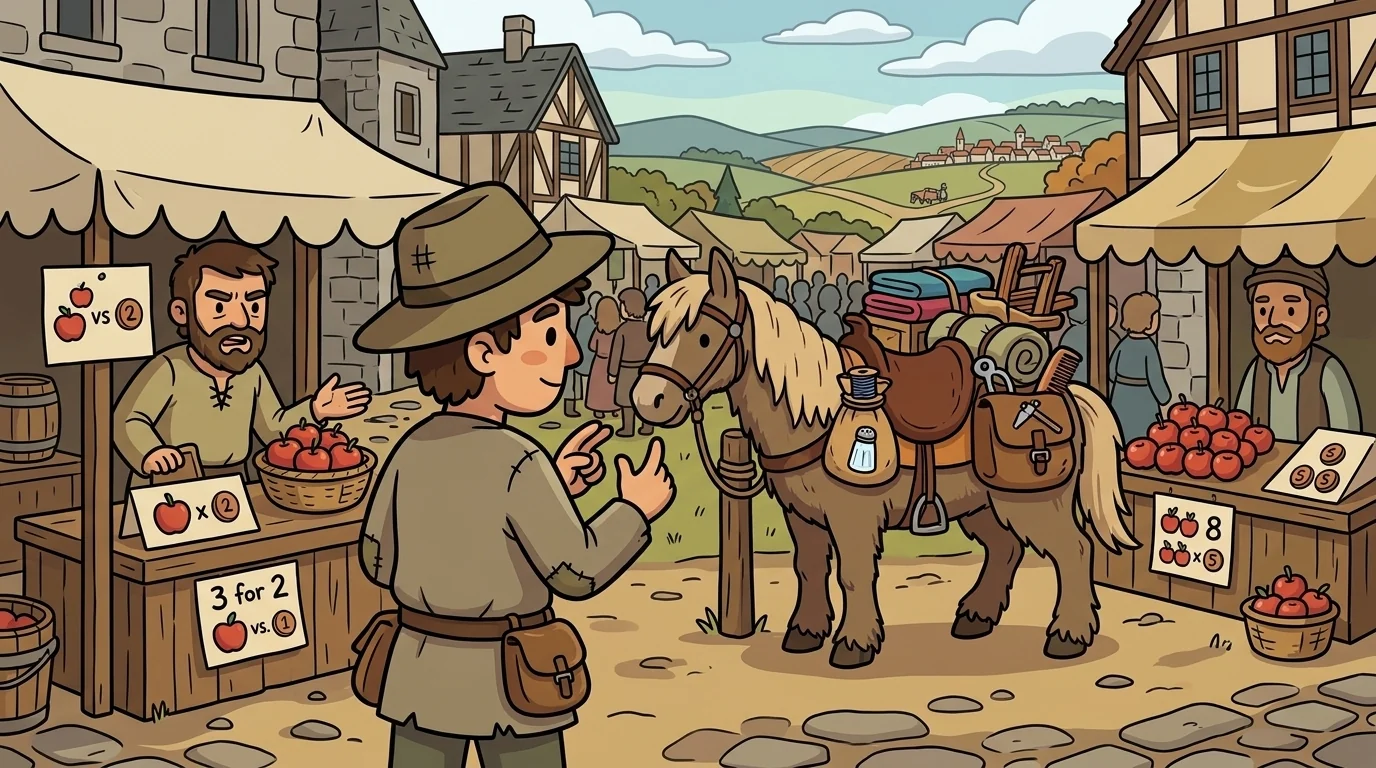
The academy master walked the long road to find Unit on his route. He found him at a market in Saltwell, haggling over the price of a basket of apples. (Three for two coppers, versus eight for five coppers in the next stall. Unit had the per-one comparison ready: 0.67 coppers per apple versus 0.625 coppers per apple. The second stall was cheaper. The merchant of the first stall was, by Unit's standards, trying to confuse customers with awkward numbers.) The academy master invited Unit to teach. Unit, who was thirty-seven and beginning to think his knees would not survive another decade of walking, accepted.
He brought, to the academy, his packhorse (an elderly mare named Pace, who was happy to retire to the academy's stable) and the canvas pack. The canvas pack is now hung on the wall of his classroom. He uses it as a teaching prop.
In his classroom, he begins every first-day lesson the same way. He brings, from the academy kitchen, three small bags of apples. He labels them: Bag A — 3 apples for 2 coppers. Bag B — 5 apples for 3 coppers. Bag C — 8 apples for 5 coppers. He turns to the class. He says: "Which is the best deal?"
The children — always — try to compare them directly. They get confused. They protest that the bags are different sizes.
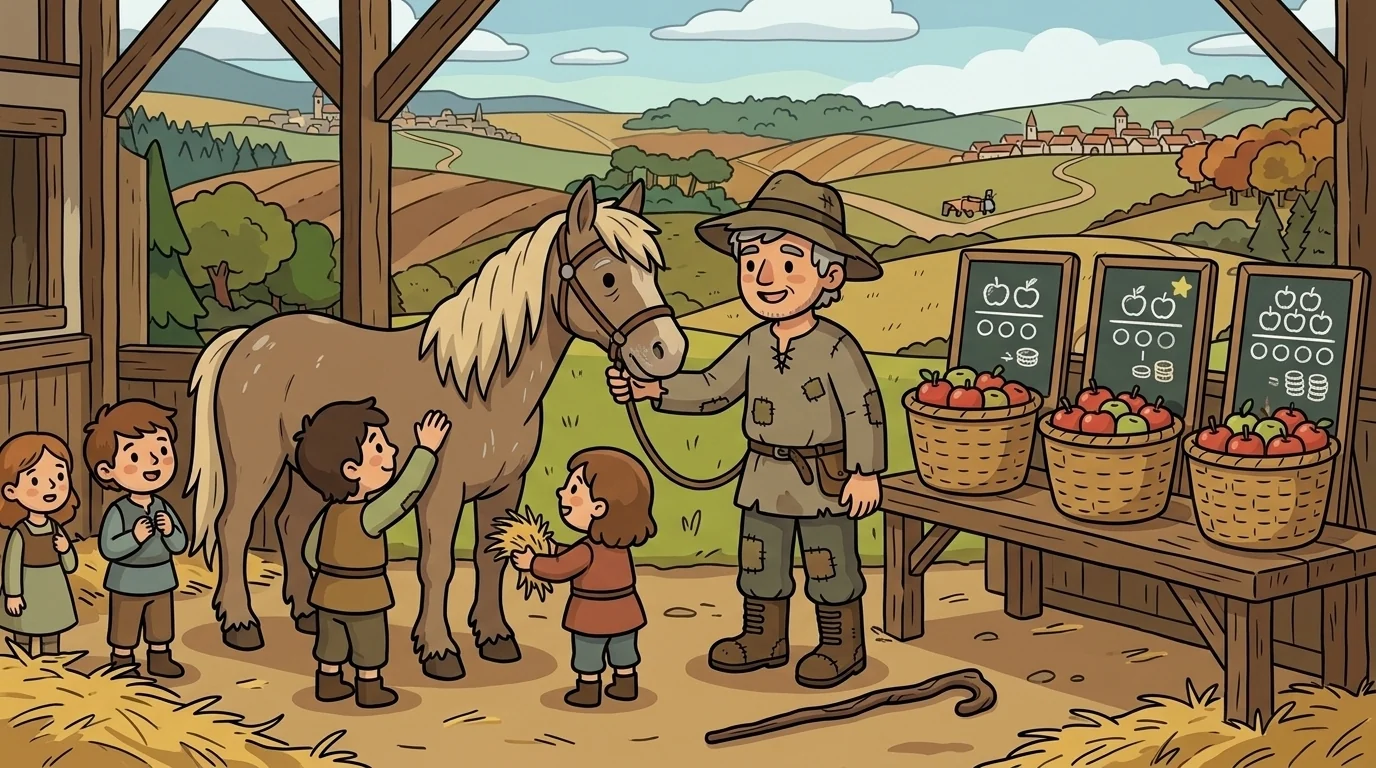
Unit smiles. He says: "Yes. You cannot compare them as they are. The bags are quoted differently. You must reduce them to per-one-apple. Cost per apple. Then they are comparable."
He shows them. Bag A: 2 ÷ 3 = 0.67 coppers per apple. Bag B: 3 ÷ 5 = 0.60 coppers per apple. Bag C: 5 ÷ 8 = 0.625 coppers per apple. Bag B is the best deal. (Bag C is second best. Bag A is worst.)
The children — always — see it. They understand. They sometimes ask if this trick works for anything, and Unit says yes: anything quoted as a rate can be reduced to per-one-of-something, and then any two rates can be compared. Miles per hour. Words per minute. Calories per serving. Eggs per nest. Coppers per yard.
When children ask whether rates are hard, Unit always says the same thing:
"They are not hard. They are per-one comparisons. Always reduce to per-one. Once you do, every rate is just a number, and every number is comparable."
He still has the packhorse. The mare Pace is twenty-three years old and very tolerant of children. They visit her in the stable on warm afternoons. Unit, who walked twelve years with her, sometimes joins them.
The RatioRealm ensemble
Unit the Per-One-Counter is part of RatioRealm's distributed-narrative cast. Each character embodies a different curricular primitive; together they teach the full subject.
-

Pair the Ratio-Speaker
Simple ratios (a:b) — the foundational "for every A, there are B" pattern
-

Scale the Doubler
Equivalent ratios (scaling both parts by the same factor; recipe-doubling primitive)
-

Cross the Proportion-Solver
Proportions and cross-multiplication (the canonical "if a/b = c/d then ad = bc" mechanic)
-

Centa the Percent-Translator
Percentages — the per-hundred special case + percent change