
Boom
VOLUME + EMPHASIS — a told story should not stay at one loudness. Going soft pulls listeners closer; going loud at the right moment lands a surprise. Changing your volume is how you point at the parts that matter.
Press play to listen along. The line being read lights up as you go.
Show full transcript
Loading transcript…
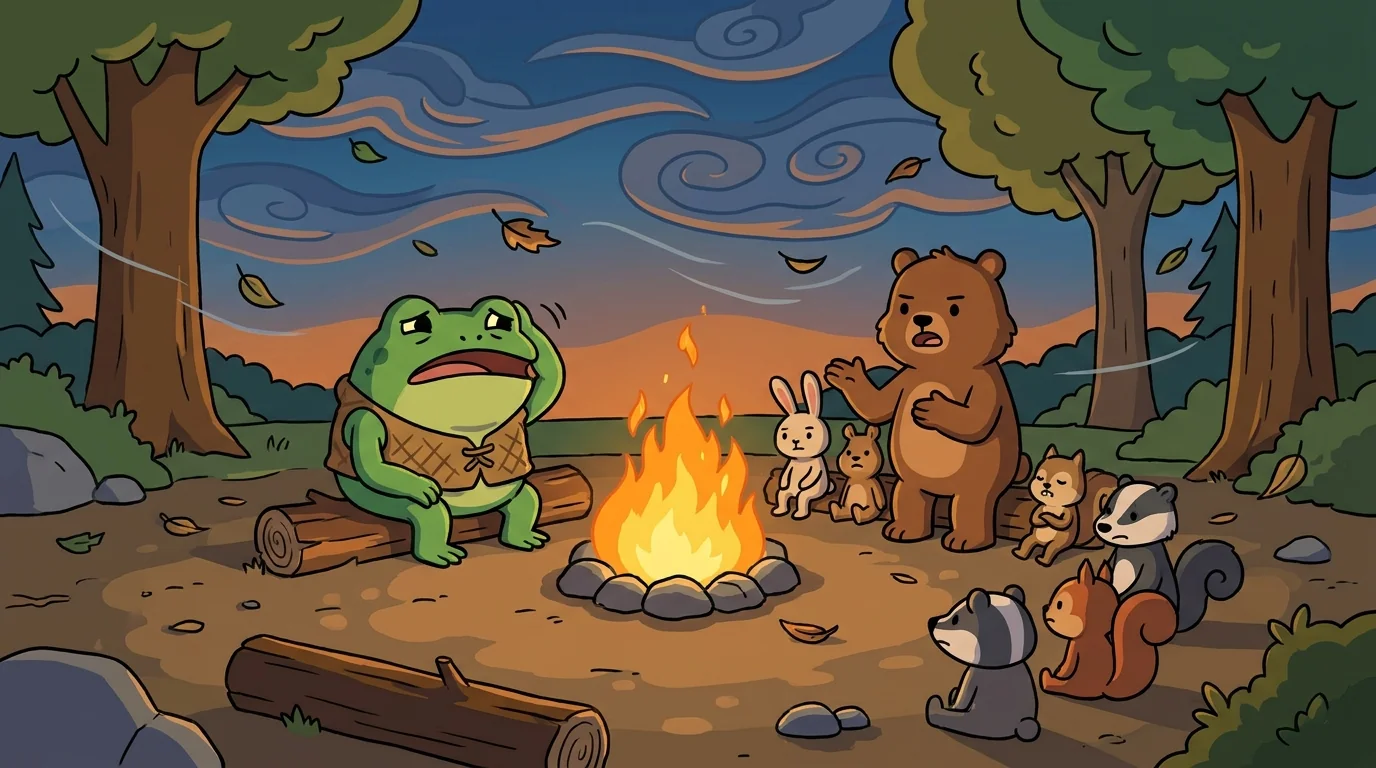
Bramble met Boom on a blustery evening, and he heard him before he saw him.
A creature was telling a story across the circle, and every single word came out at exactly the same loudness. "And the giant stomped and the bridge shook and everyone ran and it was very exciting." It should have been exciting. But said all on one flat level, it just washed over the listeners like rain on a roof. Nobody jumped. Nobody leaned. The big giant landed like a small mouse.
Near the fire sat a round, sturdy frog with a wide mouth and a twinkle in his eye. "All one size," the frog said, shaking his head. "A story can't be all one size."
Bramble hopped over. "What do you mean, one size?"
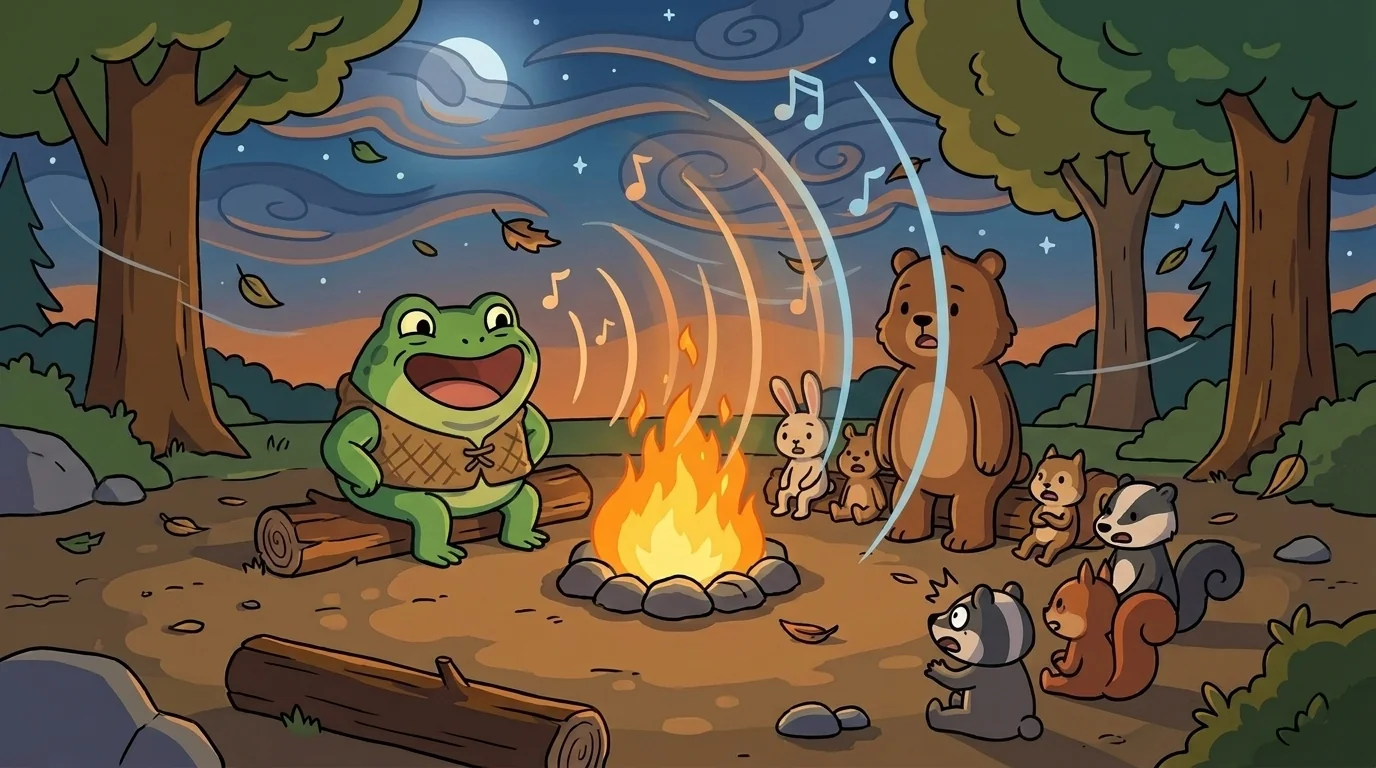
The frog grinned. "Watch. Or — listen." He leaned in close to Bramble, and dropped his voice to the tiniest whisper. "Once," he breathed, so softly that Bramble had to lean right in to catch it, "there was a sound in the dark that nobody could explain." Bramble's branches prickled. He was leaning so far forward he nearly toppled. The whisper had reeled him in like a fish on a line.
Then the frog filled his chest, and his voice came out big and round and warm: "And it was the SEA, my friends — the whole wide SEA, come all the way up the valley to say hello!"
Bramble jumped. The loud part had surprised him, in the best way. "My name is Boom," the frog said, back to a normal, friendly level. "Soft pulls them close. Loud wakes them up. You point at the important parts with your volume."
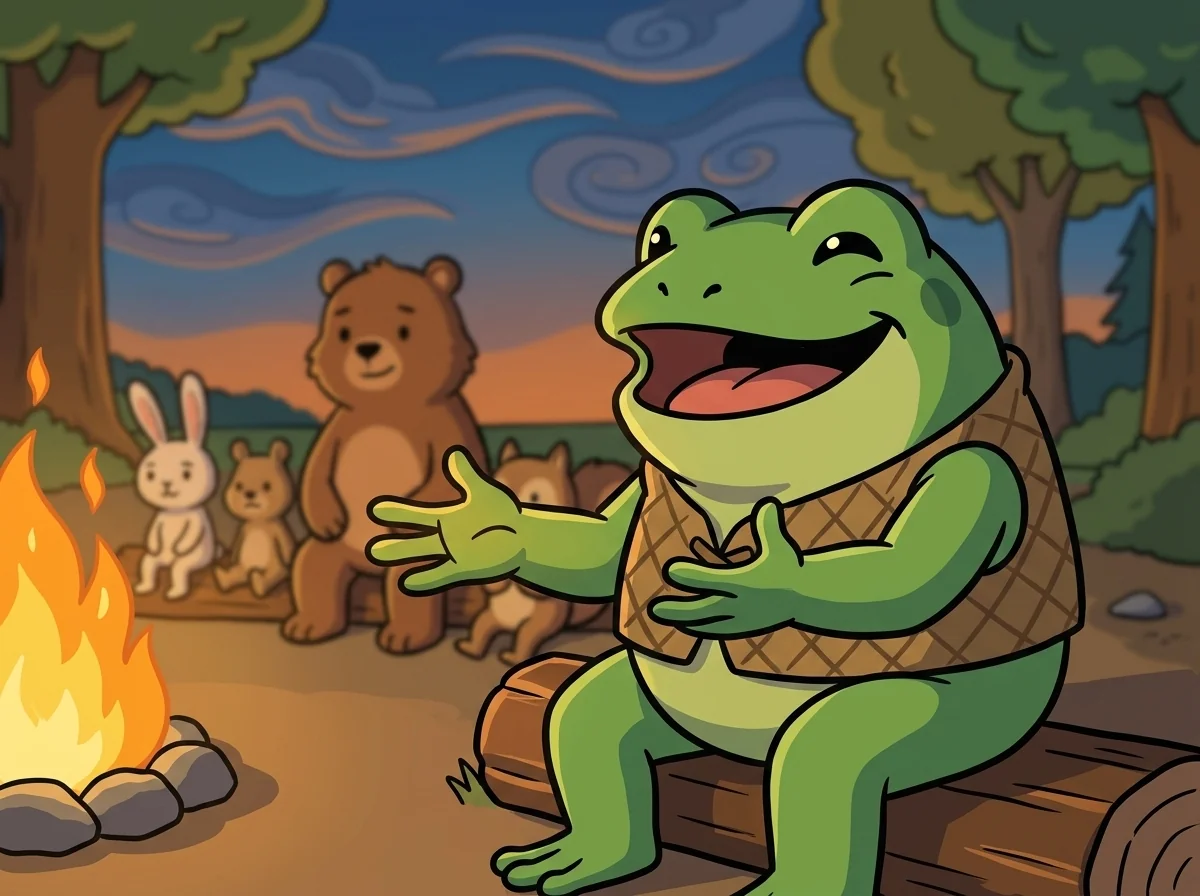
"Boom," Bramble said, still a little breathless, "I run a listening-circle. The kids tell tales out loud, and they all tell them at one flat size — every word the same. Their giants are tiny and their whispers are gone." He brightened. "Would you join my circle? Teach them to change their size?"
Boom laughed, a warm rolling laugh. "I'd be glad to. I've got every size there is — from the smallest hush to the biggest roll. I'll lend them all out."
So Boom joined the listening-circle, and the tales there have never been flat since.
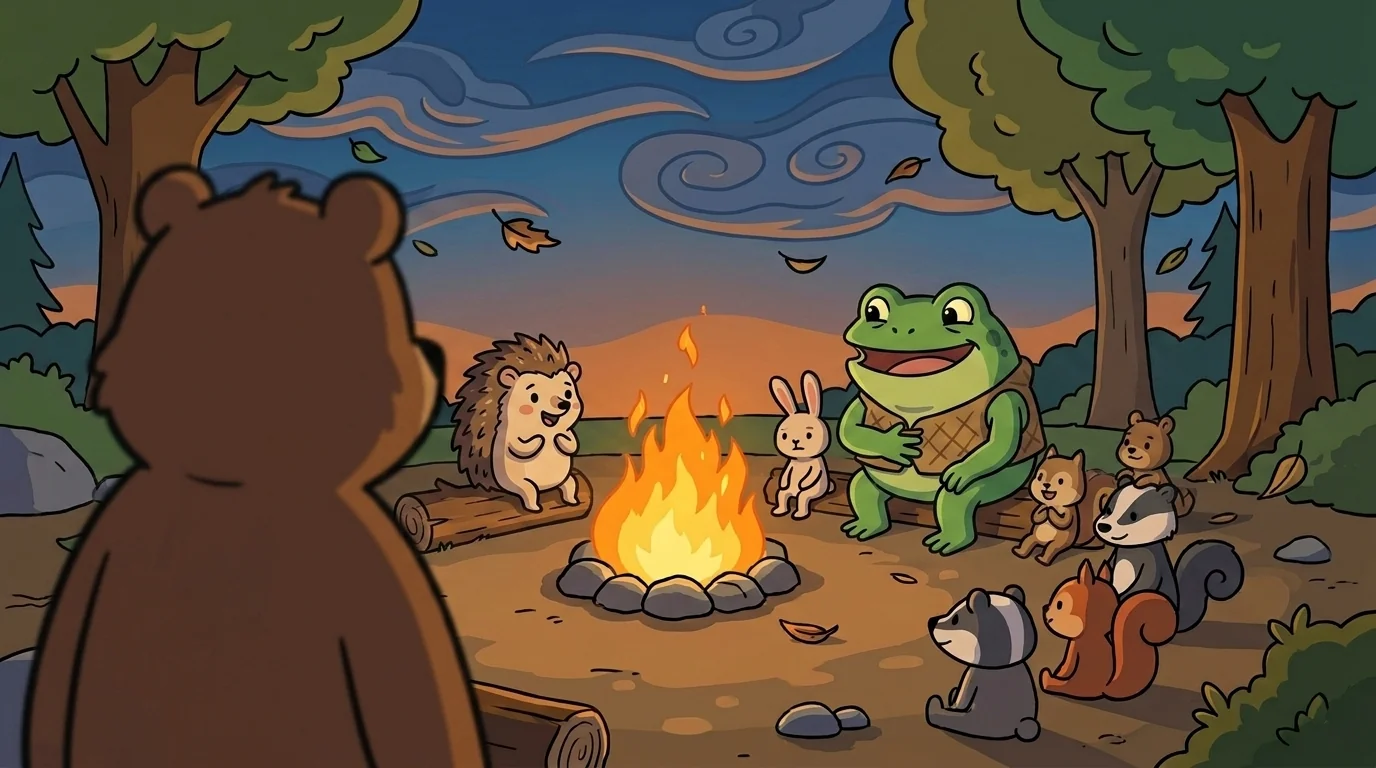
Now, when Bramble teaches about volume, he calls on Boom. "Tell us a story," Bramble says, "but find the soft parts and the loud parts."
A young hedgehog tried. She told a tale about a secret. When she got to the secret itself, she remembered Boom's lesson — and she dropped her voice to a whisper. The whole circle scooted in. Then, when the secret burst out into the open, she let her voice swell up big. The circle leaned back, delighted.
"You felt that, didn't you?" Boom rumbled. "But here's the trick most folks miss." He leaned in. "The loud part only works because of the soft parts around it. If you shout the whole way through, nobody can tell which part matters. Loud-all-the-time is the same as flat. You need the quiet to make the big moment big." He patted his round belly. "Save your biggest size for your biggest moment. Spend the rest of the time soft and warm and close."
A young creature asked, "What if I'm shy about being loud?"
"Then start with soft," Boom said kindly. "Soft is powerful too. A whisper can hold a whole circle. You don't have to be the loudest frog in the pond. You just have to change — to give your story some big and some small."
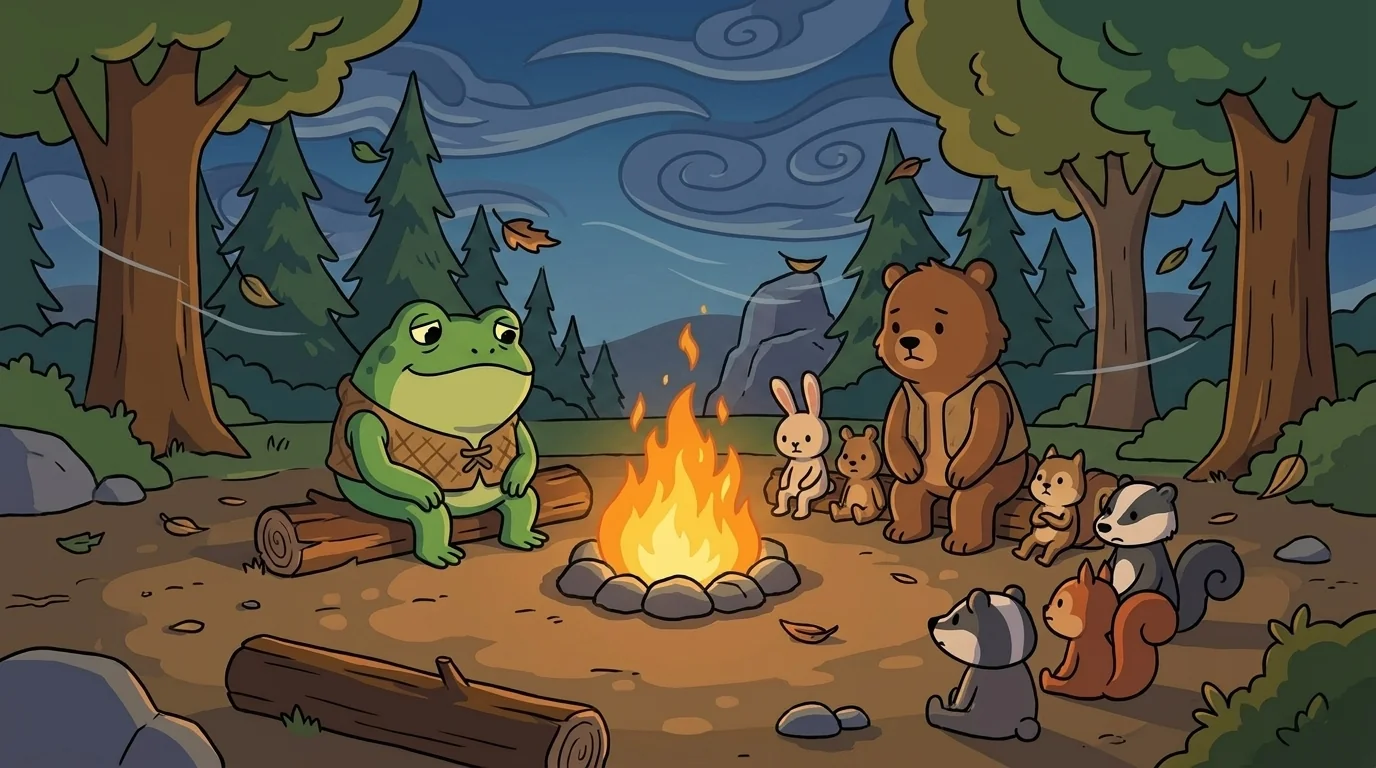
After the circle, Boom sat with Bramble under the windy stars. He was quiet now — a comfortable, ordinary quiet.
"It's funny," Bramble said. "I thought a big storyteller would be loud all the time."
Boom chuckled softly. "Most folks think that. But the loud is just a spice. You only need a pinch." He looked into the fire, his wide face gentle. "My favorite part isn't the big roll, you know. It's the whisper. It's that moment when I go soft, and I watch a whole circle of creatures lean in toward me — all of them, together, quiet and close and listening with their whole hearts." A warm, full feeling crossed his face. "That leaning-in — that's the best feeling there is. Not because I was loud. Because, for one soft moment, every single one of them wanted to be near enough to hear."
And he smiled, glad all the way down, and let the windy quiet be loud enough on its own.
The VoiceTale ensemble
Boom is part of VoiceTale's distributed-narrative cast. Each character embodies a different curricular primitive; together they teach the full subject.
-

Lean
Hook / leanability — badger-tween whose upper body visibly tips forward at second 5; if hook is weak she rocks back to neutral
-

Slow
Pacing across the 5-beat arc — tortoise-elder with wooden hourglass; her tempo-trail stretches (slow) or bunches (fast) on purpose
-

Pivot
The turn at beat 4 — barn-owl-tween whose head rotates 180° at the exact moment story / teller / listener turn together
-

Refrain
Callback / refrain — mockingbird-tween with carved-wood phrase-token who repeats one phrase identically at the closing (same words, same shape, said again, said better)
-

Hush
The pause / strategic silence — soft round owl who holds a held beat of quiet right before the important word, pulling the whole circle forward
-
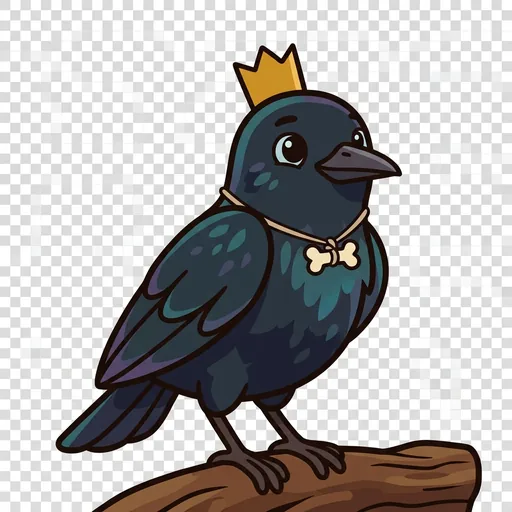
Mimic
Character voices — sleek starling who gives each character in a told tale one small distinct voice so listeners always know who is speaking
-

Flourish
Gesture — tall crane whose wings paint the story in the air (wide for huge, close for tiny); the body shows what the words say
-

Gaze
Eye contact / reading the listeners — soft-eyed deer-fawn who tells to the faces of the circle and reads their faces back to know when to slow or hurry
-

Recover
Recovering when you lose your place — easygoing otter who treats a stumble as a tiny ripple: stay calm, build a bridge, carry on