Slow
PACING — the deliberate variation of tempo across the 5-beat arc (hook → setup → rising → turn → close). Each beat has its characteristic tempo; the variation is what gives a told tale its shape.
Press play to listen along. The line being read lights up as you go.
Show full transcript
Loading transcript…

Bramble met Slow at the listening-circle's far edge, on an evening when the fire had been burning low and steady.
A small tortoise-elder had been walking very deliberately toward the circle. The walk had been patient. The tortoise had been carrying a small wooden hourglass. The hourglass had been upside down in the carry-position. The tortoise had been trailing a visible tempo-trail behind her — a faint glow in the grass that stretched out when she walked slowly and bunched up when she walked fast.
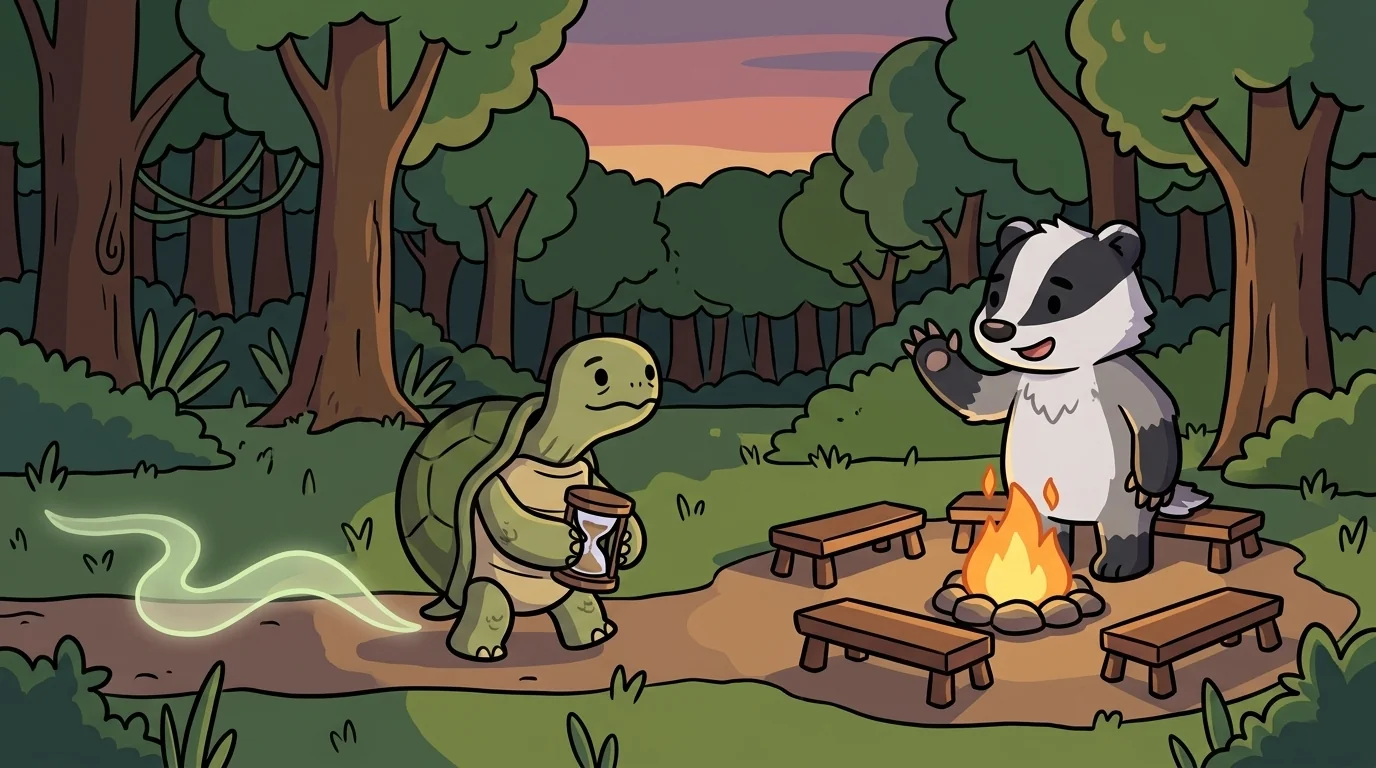
Bramble had said: "Hello."
The tortoise had said — in her unhurried voice — "Hello. I am Slow. I am here for the pacing lesson."
Bramble had said: "What pacing lesson?"
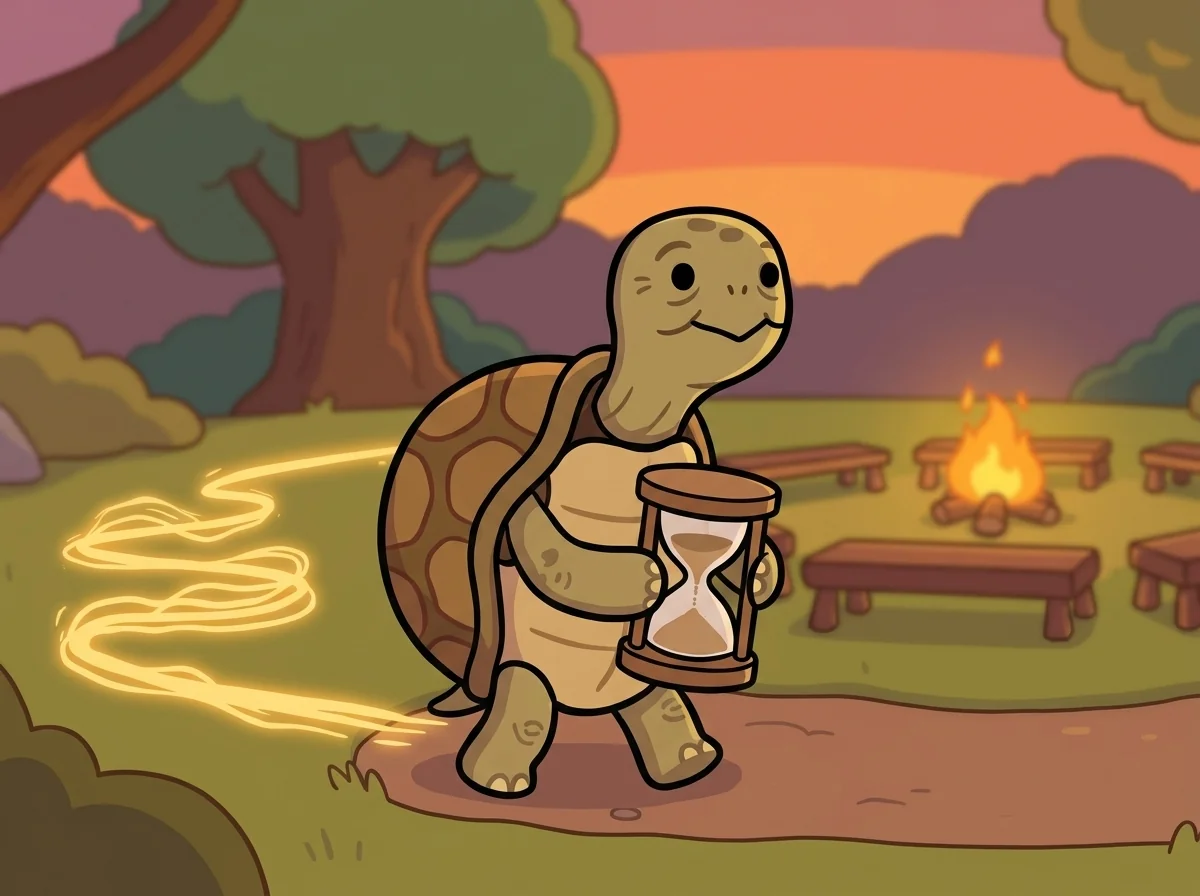
Slow had said: "The one you have been thinking about teaching. The one about how a told tale has five beats and each beat has its own tempo. You have been thinking about this. I have come to help."
Bramble had been fascinated. (Bramble had, in fact, been thinking about this.) He had said: "How did you know?"
Slow had said: "My hourglass tells me when a teacher is ready to teach pacing. It tipped over earlier. I came."
Bramble had not pressed for further explanation. (Some hedgerow creatures have small specific magics; Slow's hourglass-knowing was one such.) He had said: "Tell me about pacing."
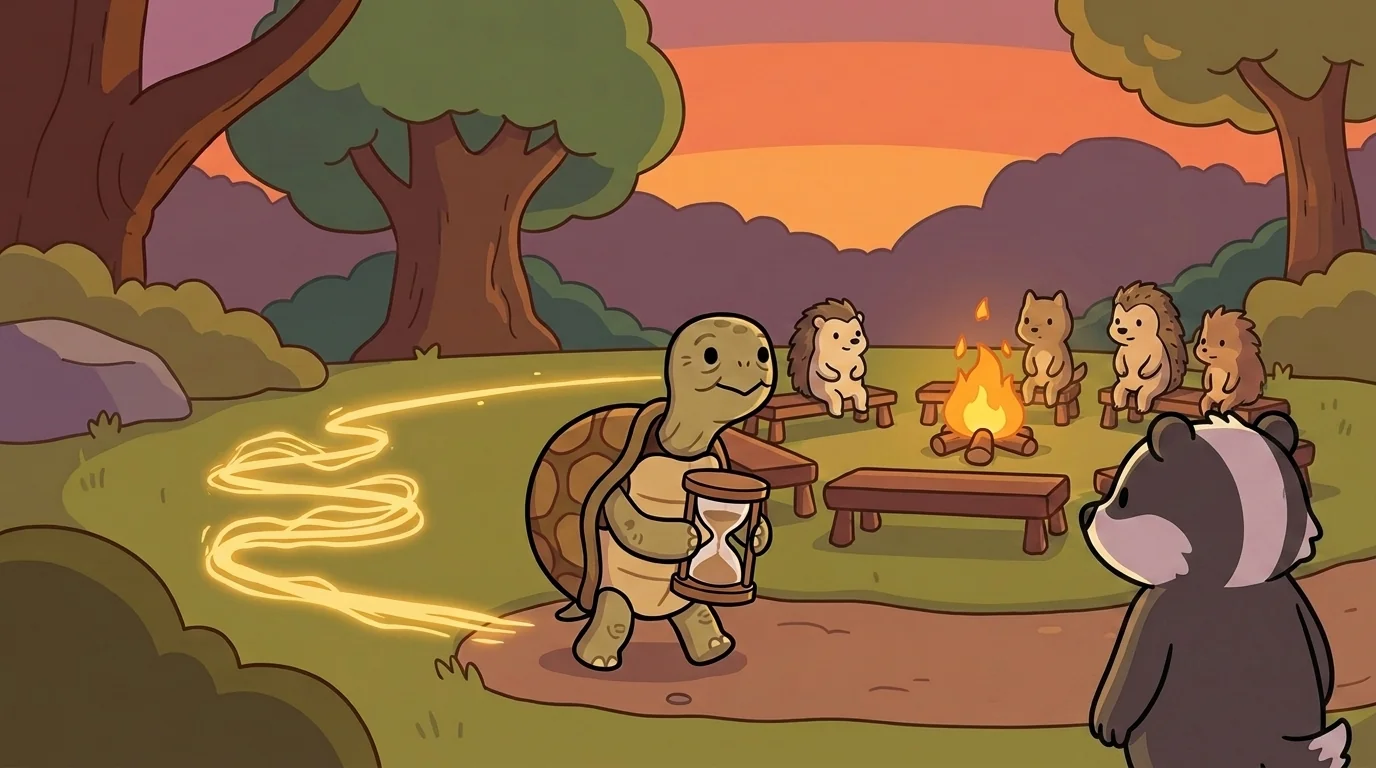
Slow had said: "A told tale has five beats. Hook. Setup. Rising. Turn. Close. Each beat has its tempo. Hook is fast — you have 5 to 10 seconds to pull the listener in. Setup is steady — you give the listener what they need to follow. Rising is building — the tempo accelerates as the stakes increase. Turn is sharp — the moment of realization happens quickly. Close is slow — you let the listener absorb the meaning. The variation is the shape."
She had then demonstrated. She had walked the 5-beat arc in the circle's clearing. Her tempo-trail had stretched short during the hook (fast walking, short tail of glow), stretched medium during the setup (steady walking, medium tail), stretched longer-and-tighter during the rising (accelerating walking, accumulating tail), snapped sharp at the turn (a sudden 90-degree pivot), and stretched long and steady during the close (slow walking, long trailing tail).
Bramble had been stunned. He had said: "You walk the tempo."
Slow had said: "The body knows pacing. Most tellers do not. They speak at the same tempo throughout the tale. The tale becomes flat. With pacing, the tale gets shape. Watch me walk it. Tell your story to my walking. The pacing will match."

In Bramble's introductory lesson on pacing, he gestures at Slow — who is, as always, at the listening-circle with her wooden hourglass — and says: "This is Slow. She walks the 5-beat arc. Tell your story to her walking. Your tempo will follow hers. Fast for the hook. Steady for the setup. Building for the rising. Sharp for the turn. Slow for the close. The shape is in the tempo-variation."
Slow walks the arc. The students tell stories to her walking. The pacing settles. The tales acquire shape.
When students ask Bramble whether pacing is hard, Bramble says — quoting Slow — "It is not hard. It is varying the tempo. Each beat has its tempo. Walk Slow's arc. Tell your story to her walking. The shape will emerge."
And when a story finally slows for its close — when Slow's long, glowing trail stretches out across the grass and the last words settle — the tellers feel it: a soft loosening in the shoulders, a calm, full quiet, the good kind of tired that comes after telling something all the way through. Slow feels it too, and she rests her old head, content.
The VoiceTale ensemble
Slow is part of VoiceTale's distributed-narrative cast. Each character embodies a different curricular primitive; together they teach the full subject.
-

Lean
Hook / leanability — badger-tween whose upper body visibly tips forward at second 5; if hook is weak she rocks back to neutral
-

Pivot
The turn at beat 4 — barn-owl-tween whose head rotates 180° at the exact moment story / teller / listener turn together
-

Refrain
Callback / refrain — mockingbird-tween with carved-wood phrase-token who repeats one phrase identically at the closing (same words, same shape, said again, said better)
-
Hush
The pause / strategic silence — soft round owl who holds a held beat of quiet right before the important word, pulling the whole circle forward
-

Boom
Volume + emphasis — wide-mouthed frog whose voice swells from the tiniest whisper to a big round roll; the soft pulls listeners close, the loud lands the surprise
-
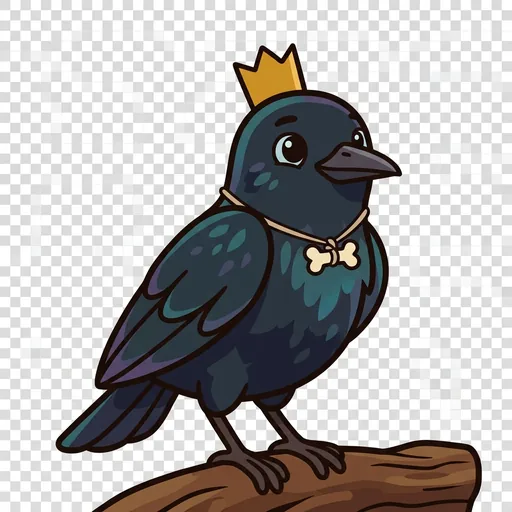
Mimic
Character voices — sleek starling who gives each character in a told tale one small distinct voice so listeners always know who is speaking
-

Flourish
Gesture — tall crane whose wings paint the story in the air (wide for huge, close for tiny); the body shows what the words say
-

Gaze
Eye contact / reading the listeners — soft-eyed deer-fawn who tells to the faces of the circle and reads their faces back to know when to slow or hurry
-

Recover
Recovering when you lose your place — easygoing otter who treats a stumble as a tiny ripple: stay calm, build a bridge, carry on