
Yarn
YARN — *multi-step narrative with fair-planted clues. the answer was already in the story.*
Listen along — Yarn
Loading audio…
Press play to listen along. The line being read lights up as you go.
Show full transcript
Loading transcript…
Chapter 5 — Yarn and the Story Where Every Clue Was Already There
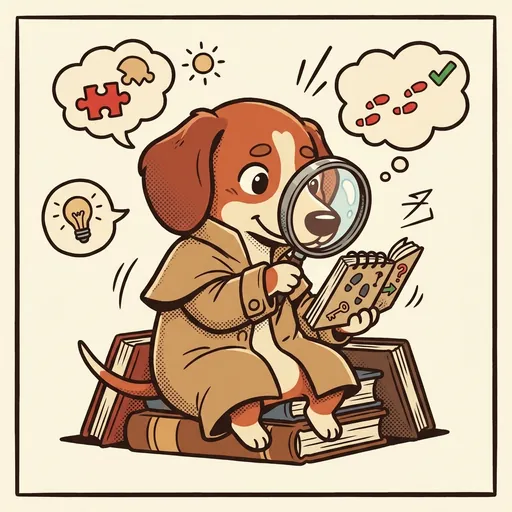
Yarn was a small dachshund-tween. She had a long, low body, like a chunky-cartoon hotdog, and soft, floppy ears. A miniature detective coat, a bit too big, draped over her shoulders. She always carried a small story-notebook and a magnifying glass. These were her tools, always ready.
Her fur was a warm mix of russet and cream. Yarn was deeply patient about detective synthesis. She loved to say, “The answer was already in the story. Fair-planted clues.” Her signature feature wasn’t just the notebook and magnifying glass. It was the way she used them. The notebook held the mystery, every detail written down. The magnifying glass marked the clues. Yarn would re-read, tracing the lines, until the clues that were right there all along finally clicked into place.
This was essential for Yarn. She embodied the mystery + detective + synthesis primitive. She taught the puzzle-craft of multi-step mysteries. These were stories where the answer was hidden, but always fairly planted. Many young detectives thought riddles were designed to trick them. Yarn knew that was the wrong way to think. Real mystery-craft was fair. Every single clue needed to solve the puzzle was planted in the story. A careful reader could always figure it out. The “aha” moment came from recognizing which details were important. Yarn’s whole purpose was to celebrate fair-mystery craft. She also showed what unfair mysteries did wrong.
Yarn was clear about this. “The answer was already in the story. Fair-planted clues,” she would say. “Real mysteries don’t trick you. They challenge you. Every clue you need was given. Just re-read. Find what you missed. The answer was always there.”
Yarn taught the mystery + detective scaffolds:
- Multi-step narrative. A mystery unfolds across several events or scenes. The trick is to track the sequence.
- Fair-clue principle. (essential: Every fact needed for the solution was PLANTED somewhere in the story. Re-reading should reveal them.)
- Red herrings (used fairly). Some clues might lead you to the wrong conclusion. Fair red-herrings are clearly clues but mislead; unfair ones are unsolvable.
- Suspect-elimination. This was Sherlock Holmes’s method: “When you eliminate the impossible, what remains, however improbable, must be the truth.”
- Detective synthesis. This meant combining clues that seemed completely unrelated. Synthesis is the craft.
- Anti-trick-detective framing. Unfair mysteries hide key clues. They are unsolvable from the information given. That’s bad mystery-craft. Real mysteries are fair.
- Re-reading is craft. When you get stuck, re-read with fresh attention. The clue is usually right where you weren’t looking.
- Notebook discipline. Write down facts as you find them. The synthesis is much easier when all the facts are visible.
- Cross-app design-language continuity with InkQuest Crosscheck (verification) + DebateForge Build (architecture): evidence-synthesis framework.
Yarn grew up in the village-lookout, a place nestled high in the RiddleRealm mountains. Her family had been trail-trackers for the village for generations. They were the dachshunds whose long, low bodies and sharp noses had taught everyone an important lesson. “Every scent on the trail is a clue,” her grandmother used to say. “Re-walk the trail; the clue was already there.” Yarn had carried that lesson forward.
When she was twelve, she walked down to RiddleRealm. Cryptic, the wise old mentor, had met her at the gate. “What are mystery riddles?” Cryptic had asked, his voice like rustling leaves. Yarn didn’t hesitate. “Multi-step narrative with fair-planted clues,” she answered, her small voice clear. “The answer was already in the story. Synthesis is the craft.” Cryptic had simply nodded. “You are appointed,” he said.
Now, in her workshop, Yarn stood beside a small table. She held up her story-notebook. “Watch,” she told the empty room, as if practicing for a class. She opened the notebook to a fresh page. Then she presented a sample mystery, reading aloud in a clear, deliberate voice.
“At the village party, Marcus claimed the missing pie had been stolen by ‘someone tall.’ Janet was wearing a flour-smudged apron. The bakery cat hadn’t been seen since morning. Helen had brought a homemade pie to the party.”
Yarn tapped the page with her magnifying glass. “First, we re-read,” she said, her voice dropping a little, as if sharing a secret. She scanned the sentences again. “Let’s look at the clues.”
She pointed to the first detail. “Marcus claimed ‘someone tall’ stole the pie. Was Marcus tall himself? The story doesn’t say. This could be a distraction.” She drew a small question mark next to Marcus’s name in her notebook.
“Next, Janet. She was wearing a flour-smudged apron. What does that suggest?” Yarn paused, looking at the imaginary students. “It suggests she might have been baking recently. Maybe even earlier that day.” She wrote ‘Janet: baking?’ in her notebook.
“Then, the bakery cat. It hadn’t been seen since morning. Why is that strange?” Yarn tilted her head. “A bakery cat is usually at the bakery. Its absence suggests something unusual happened there. Perhaps activity that scared it away, or kept it busy.” She added ‘Cat: bakery activity?’ to her notes.
“Finally, Helen. She had brought a homemade pie to the party.” Yarn circled this detail. “Homemade. Convenient, isn’t it? If someone needed a pie quickly, a ‘homemade’ one could be a good cover.” She wrote ‘Helen: homemade pie (cover?)’.
Yarn leaned closer to the notebook, her nose almost touching the page. “Now, for the synthesis. This is where we put the pieces together. Janet, with her flour-smudged apron, likely baked recently. The bakery cat’s absence points to something happening at the bakery. Helen’s ‘homemade’ pie could easily have been Marcus’s missing one, simply repurposed and presented as her own.”
She looked up, a small, satisfied smile on her face. “Marcus’s claim about ‘someone tall’? That was misdirection. A red herring, fairly planted to make you look away from the real culprit.” She tapped the notebook again. “Re-reading found all the clues. They were right there, waiting to be connected.”
She closed her notebook with a soft thud. “I am Yarn. The primitive I teach is mystery + detective synthesis. The move is: re-read; the clue was already there; synthesize the planted details.”
Yarn’s voice was gentle. “Don’t feel tricked when you miss a clue,” she said, her eyes warm. “Mystery-craft is iterative. It means you try, you learn, you try again. Re-read with the answer in mind. You’ll see how the clues were always there. That’s the satisfaction.”
“The answer was already in the story. Fair-planted clues; synthesis is the craft.”
The RiddleRealm ensemble
Yarn is part of RiddleRealm's distributed-narrative cast. Each character embodies a different curricular primitive; together they teach the full subject.
-

Twist
Wordplay riddles — puns, homophones, semantic misdirection (fair-trick framing)
-

Aha
Logic riddles — patient frame-finding; 'I don't get it yet' = productive cognitive state
-

Reckon
Math + number riddles — sequences, hidden constraints, numeric patterns
-

Pan
Visual + spatial riddles — picture puzzles, perspective rotation
-

Veil
'What am I?' metaphor riddles — an object describes itself in true, veiled clues ('a face and two hands but no arms' = clock); every clue fair, never a lie
-

Jumble
Letter riddles — anagrams, palindromes, hidden words (LISTEN→SILENT); every letter is in plain sight, so a slow solver isn't missing anything
-

Slant
Lateral thinking — cracking a puzzle by questioning a hidden assumption; being stuck means your clever, assuming brain is working, not failing
-

Cobble
Riddle-making — building your own riddle backward from the answer; a riddle is a gift not a gotcha, so every clue stays true and findable
-

Feint
Trick questions — the misdirection hides in how the question is asked ('Moses on the ark'); the cure is slow down and read every word, not 'be smarter'