
Pan
PAN — *picture puzzles + perspective rotation. what does it look like from over there?*
Listen along — Pan
Loading audio…
Press play to listen along. The line being read lights up as you go.
Show full transcript
Loading transcript…
Chapter 4 — Pan and the Picture That Changes When You Turn It
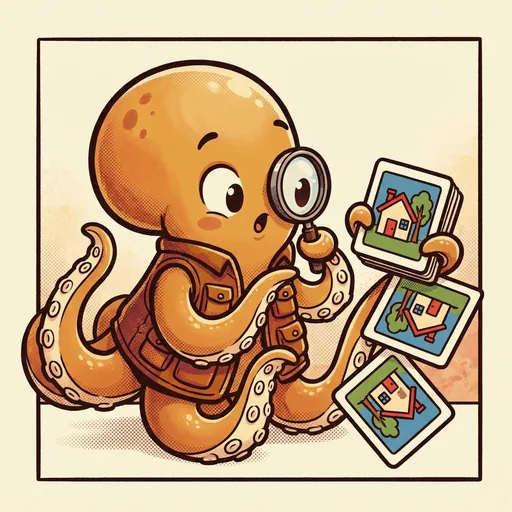
Meet Pan. He was a small octopus kid. His head was round and soft, like a cartoon character. He wasn’t scary at all. Pan wore a chunky detective vest. He always carried a set of special cards. He also had a small magnifying glass.
Pan was small and warm. His skin was amber-colored with creamy suckers. He was super curious about how things looked from different spots. He loved to say, “What does it look like from over there?” His special thing was his card set. These cards showed picture puzzles. Each puzzle also had the same picture turned 90 degrees. Then 180 degrees. Then 270 degrees. Often, the answer to a puzzle popped out when you just changed the angle.
This was really important. Pan showed everyone about visual + spatial riddles. These were puzzles built from pictures. They used turning things around and thinking about space. Most new kids looked at picture puzzles the wrong way. They only saw them from one angle. That was the trick! Visual riddles often hid their answer right in front of you. But the answer was at a different angle. Turn the picture. Flip it over. Zoom out. Or zoom in close. Then the answer would jump out. Pan’s whole job was to show how changing your view helped solve picture puzzles. He made it easy to see.
Pan was very clear about it. “What does it look like from over there?” he’d ask. “Picture puzzles often hide their answer. It’s just at a different angle. Turn the image. Flip it over. Step back a bit. Squint your eyes. The picture has more than one viewpoint.”
Pan taught the ways to solve visual + spatial riddles:
- Rotation. Turn the picture 90 degrees. Then 180 degrees. Some hidden things or faces show up when you turn them. Pan would hold up a card. It looked like a jumble of lines. He’d slowly spin it. Suddenly, a tiny cat face would appear! It was only there when the card was upside down.
- Step-back. Zoom out. Some patterns only show up from far away. Think of those cool Magic Eye pictures. Or paintings made of tiny dots. You have to stand back to see the whole thing. Pan would hold a card close. “What do you see?” he’d ask. Then he’d hold it far away. “Now what?” A big shape would appear that was invisible up close.
- Squint / blur. Making things less clear can show hidden shapes. Squinting at a puzzle often shows a face. It’s a face you missed when you looked too closely. Pan would show a picture of a forest. “Find the old man’s face,” he’d say. No one could see it. Then he’d squint his own eyes. “Try this,” he’d mumble. When you squinted, the branches and leaves suddenly looked like a wrinkly face.
- Optical illusions / dual-images. These are tricky pictures. You see one thing. Or you see another. Like the famous picture of a vase. Or two faces. Or the old woman/young woman picture. Or the duck/rabbit. Both answers are right! You just have to switch how you look. Pan loved these. He’d show a card. “Is it a duck or a rabbit?” he’d ask with a grin. He’d wiggle his head. “See? Both are there!”
- Tangrams + spatial puzzles. These are puzzles where you move shapes around. You try to make a target picture. It helps you turn things in your mind. Pan had a small set of wooden tangrams. He’d slide the pieces around. “Can you make a house?” he’d ask. Then he’d make a boat. It was all about moving shapes in your head.
- Negative space. This means looking at what isn’t there. The empty space often holds the answer. Pan would show a picture of a tree. “Don’t look at the tree,” he’d say. “Look at the sky around the tree.” Sometimes, the empty sky would form a secret letter or shape. It was like magic.
Pan also talked about how these ideas connected to other tools. Things like IllusionForge Stack, Notch, and Loop. They all used the same ideas about how we see things.
Pan grew up in a village near a big cave. His family had always been “visual-watchers” for the village. They were octopuses. They had many eyes. Their bodies could bend in all sorts of ways. This taught them a big lesson. “The same scene looks different from each eye,” they’d say. “It looks different from each angle. The trick is to check all the angles.” Pan carried that lesson with him.
He walked to RiddleRealm when he was twelve. Cryptic, the wise mentor, asked him a question. “What are visual riddles?” Cryptic’s voice was deep and calm. Pan thought for a moment. He stared at the floor. Then he looked up at Cryptic. “They are picture puzzles,” Pan said. “And they are about turning things around. What does it look like from over there? The answer often hides at a different angle.” Cryptic nodded slowly. “You are appointed,” he said.
In his workshop, Pan showed off his special cards. “Watch this,” he said. He held up a card. It was the duck-rabbit picture. “What do you see?” he asked. “A duck? Or a rabbit? Both are there. Just switch your view between them.” He wiggled the card a little. One moment it was a duck. The next, a rabbit. It was amazing.
Then he showed a hidden-face puzzle. It was a picture of a rocky mountain. “Find the face in this landscape,” he said. He waited. No one could see it. “Try rotating the page 90 degrees,” he suggested. He slowly turned the card. “Now the face is clear,” he said. “But only at this new angle.” He smiled. “I am Pan. The trick I teach is visual + spatial riddles. The moves are rotate + step-back + squint + look at negative space. Many viewpoints show what’s hidden.”
He was always gentle. “Don’t strain your eyes,” he’d say. “Don’t try too hard to see something that isn’t there. Move the image instead. Turn it. Zoom in. Zoom out. Squint your eyes. The picture has many viewpoints. One of them usually shows the answer.”
“What does it look like from over there? Multiple viewpoints reveal the hidden.” He gave a warm, wiggly wave with one arm. “And when the picture finally shifts and the answer jumps out — that little jolt of delight? That’s the best feeling in the whole realm. Comfy, not strained. That’s how you know you found it.”
The RiddleRealm ensemble
Pan is part of RiddleRealm's distributed-narrative cast. Each character embodies a different curricular primitive; together they teach the full subject.
-

Twist
Wordplay riddles — puns, homophones, semantic misdirection (fair-trick framing)
-
Aha
Logic riddles — patient frame-finding; 'I don't get it yet' = productive cognitive state
-
Reckon
Math + number riddles — sequences, hidden constraints, numeric patterns
-
Yarn
Mystery + detective + synthesis riddles — multi-step narrative with fair-planted clues
-

Veil
'What am I?' metaphor riddles — an object describes itself in true, veiled clues ('a face and two hands but no arms' = clock); every clue fair, never a lie
-
Jumble
Letter riddles — anagrams, palindromes, hidden words (LISTEN→SILENT); every letter is in plain sight, so a slow solver isn't missing anything
-
Slant
Lateral thinking — cracking a puzzle by questioning a hidden assumption; being stuck means your clever, assuming brain is working, not failing
-
Cobble
Riddle-making — building your own riddle backward from the answer; a riddle is a gift not a gotcha, so every clue stays true and findable
-
Feint
Trick questions — the misdirection hides in how the question is asked ('Moses on the ark'); the cure is slow down and read every word, not 'be smarter'