
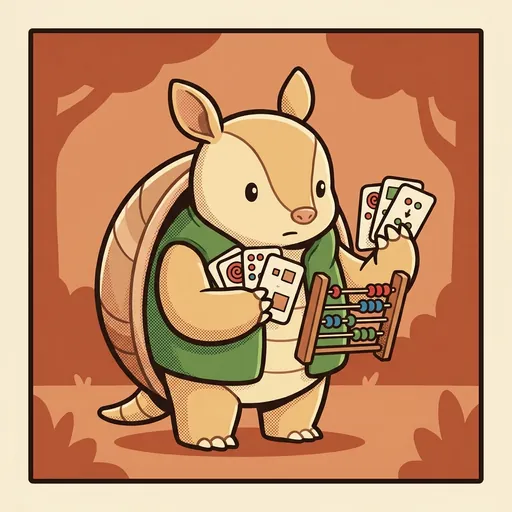
Reckon
RECKON — sequences, hidden constraints, numeric patterns.
Listen along — Reckon
Loading audio…
Press play to listen along. The line being read lights up as you go.
Show full transcript
Loading transcript…
Chapter 3 — Reckon and the Pattern Hidden in the Numbers
Reckon crouched in the sand and counted the ridges on a lizard’s tail, then the segments on a beetle’s back, then the petals on a desert flower, muttering the numbers to herself.
She was a small armadillo in a scout vest, with an abacus swinging from her belt. A boy from the next burrow watched her, arms crossed.
“You’re just counting stuff,” he said. “That’s not even hard.”
“I’m not counting,” said Reckon, without looking up. “I’m listening for the rule.” She held up three fingers, then five, then eight. “One, one, two, three, five, eight. Hear it? Each one is the two before it, stuck together.” She grinned at him. “The numbers aren’t the puzzle. The rule underneath is the puzzle. Numbers are just the noise it makes.”
She’d grown up in a desert village where her family were terrain-trackers.
They read the dunes the way other people read books. So many steps between the well and the ridge; the shadows lengthening by the same amount each evening; the rains coming in a rhythm you could feel before you could name. Her mother never said do the math. Her mother said, “The desert has a beat. Find the beat and you’ll know what comes next.”
Reckon had been a nervous little armadillo about numbers, once. She’d freeze when someone shouted a sum at her, sure everyone was timing her. Then one dusk her mother handed her a stick and said, “Draw it. Don’t add it — draw it.” And Reckon scratched the step-counts into the sand in a row, and the pattern lifted right off the ground and into her eyes.
That was the day she stopped thinking numbers were a test she was failing, and started thinking they were a code that wanted to be read slowly.
She walked to RiddleRealm at twelve, abacus clicking with every step, and Cryptic was waiting on a flat sun-warmed stone.
He didn’t quiz her speed. He laid three little pebbles in a row — one, then a gap, then four, then a bigger gap, then nine — and looked at her.
Reckon sat. She didn’t rush. She touched each pebble, moved her lips, drew a faint square in the sand beside each one. “One times one. Two times two. Three times three,” she said at last. “Square numbers. The next is sixteen.” She looked up, a little shy. “It took me a minute. I like taking the minute.”
“Everyone else guesses fast and guesses wrong,” said Cryptic. “You went slow and went right, and you weren’t ashamed of the slow.” He nodded at the horizon toward the village. “Go teach the ones whose stomachs hurt when they see numbers. Teach them the slow is allowed.”
Her workshop smelled of chalk and warm sand, and it filled with kids, and one of them, Pip, had her hood pulled halfway over her eyes.
Reckon held up a card. On it: 1, 1, 2, 3, 5, 8, ___ “No rush,” she said. “Just look.”
Pip’s voice was tiny. “I’m bad at this. I can’t do it in my head.”
“Neither can I,” said Reckon cheerfully, and pulled out the abacus. The beads clicked. “That’s what this is for. Watch.” She slid five beads, then eight. “Five and eight.” She counted the row aloud, unhurried. “Thirteen.” She wrote it on the card. “See how nobody had to be fast? We just found where the pattern was going.”
Pip pushed her hood back an inch.
Reckon set down a harder card — a knot of a riddle. “Three whole numbers. They add up to eleven. Multiply them and you get thirty-six.” She didn’t announce an answer. She started trying, out loud, so they could hear the search. “One, four, six — that’s eleven. But one times four times six is only twenty-four. Cracked branch.” She wasn’t upset. “Good. That’s one wrong pair cleared.” She tried again, beads clicking. “Two, three, six. Adds to eleven. And two times three is six, times six is —” she slid the beads ”— thirty-six!” She clapped her paws. “There it is.”
Pip was leaning forward now. “You didn’t just know it.”
“Nobody just knows it,” said Reckon. “You hunt for it. And hunting slowly still counts as finding.”
When the room emptied, Pip lingered by the door, twisting her sleeve.
“My old teacher used to time us,” she said quietly. “I’d get the shakes.”
Reckon sat down beside her in the sand, so they were the same height. “A number riddle isn’t a race,” she said. “It’s wearing math clothes to trick you into thinking it is. Underneath it’s just a pattern waiting to be seen. Use paper. Use the beads. Draw it if the drawing helps.” She bumped Pip gently with a shoulder. “The pattern doesn’t care how fast you got there.”
Pip almost smiled. “And when you finally see it?”
“Oh —” Reckon’s whole face warmed. “That’s the best feeling there is. That little click, like a bead dropping into place, like the desert telling you a secret it was keeping all along.” She watched Pip’s shoulders loosen. “You’ll feel it soon. Go slow. Let it come.”
The RiddleRealm ensemble
Reckon is part of RiddleRealm's distributed-narrative cast. Each character embodies a different curricular primitive; together they teach the full subject.
-

Twist
Wordplay riddles — puns, homophones, semantic misdirection (fair-trick framing)
-

Aha
Logic riddles — patient frame-finding; 'I don't get it yet' = productive cognitive state
-

Pan
Visual + spatial riddles — picture puzzles, perspective rotation
-

Yarn
Mystery + detective + synthesis riddles — multi-step narrative with fair-planted clues
-

Veil
'What am I?' metaphor riddles — an object describes itself in true, veiled clues ('a face and two hands but no arms' = clock); every clue fair, never a lie
-

Jumble
Letter riddles — anagrams, palindromes, hidden words (LISTEN→SILENT); every letter is in plain sight, so a slow solver isn't missing anything
-

Slant
Lateral thinking — cracking a puzzle by questioning a hidden assumption; being stuck means your clever, assuming brain is working, not failing
-

Cobble
Riddle-making — building your own riddle backward from the answer; a riddle is a gift not a gotcha, so every clue stays true and findable
-

Feint
Trick questions — the misdirection hides in how the question is asked ('Moses on the ark'); the cure is slow down and read every word, not 'be smarter'