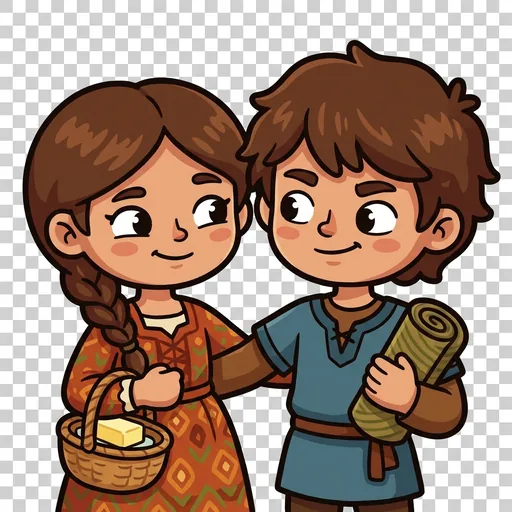
Centa the Percent-Translator
PERCENTAGES — the per-hundred special case. Any rate or ratio can be translated to a per-hundred form (a percentage) for comparison.
A story read by Centa the Percent-Translator
Press play to listen along. The line being read lights up as you go.
Show full transcript
Loading transcript…
Centa grew up at a toll-gate.
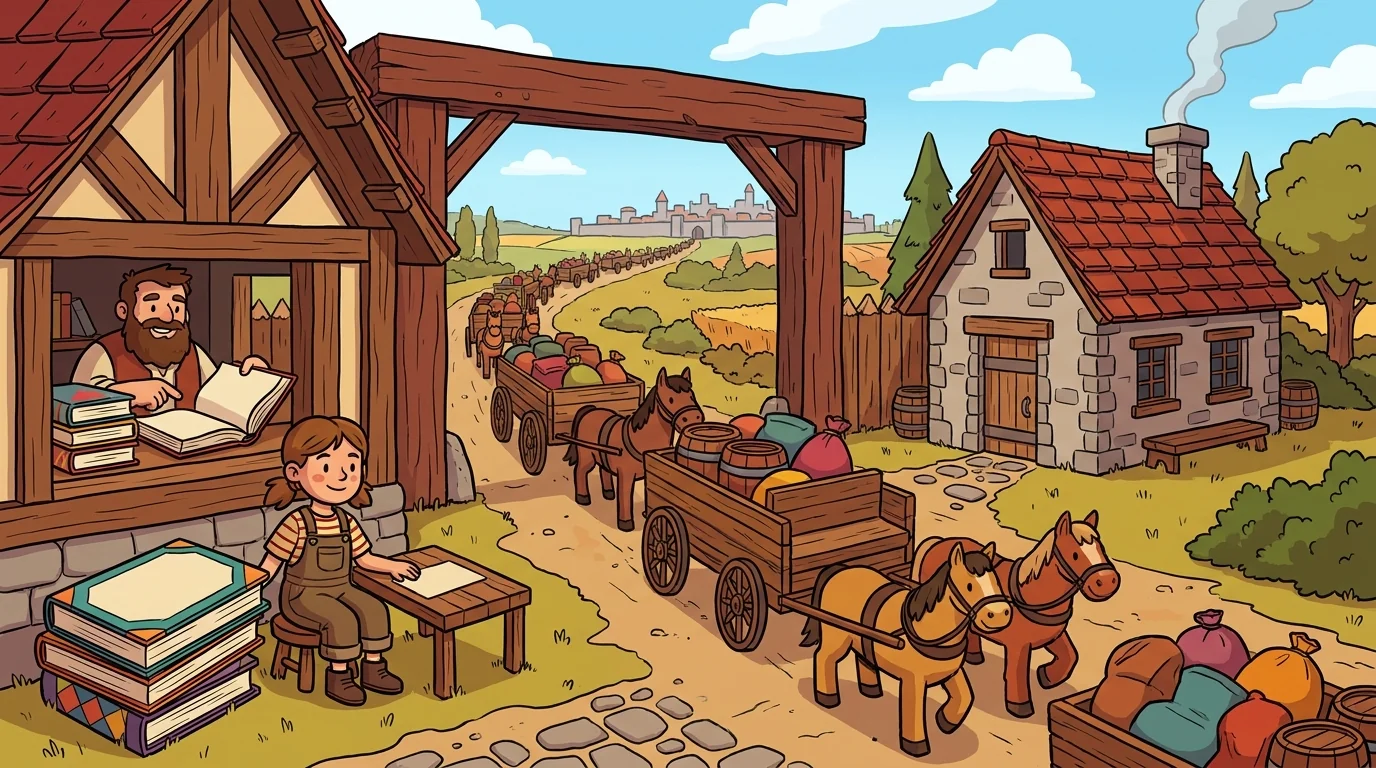
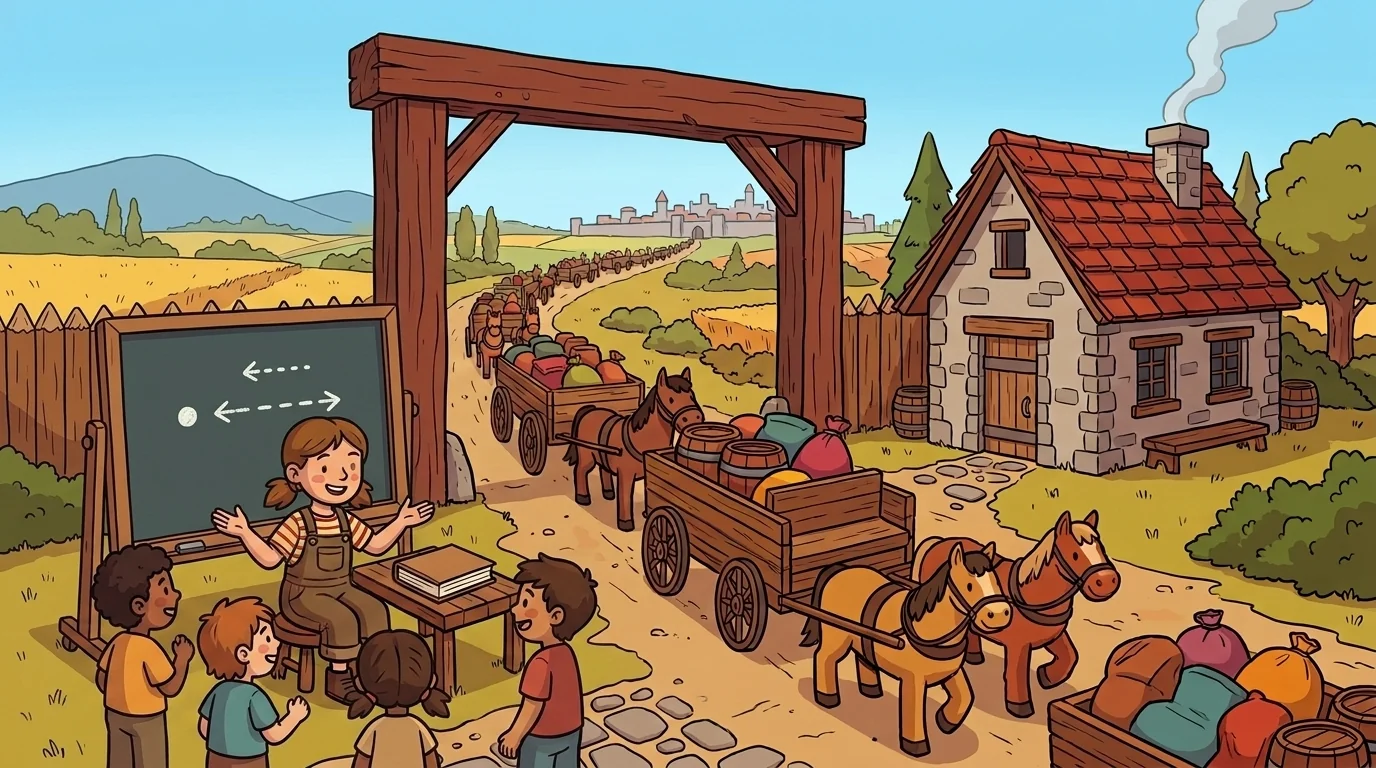
It was the Northgate Toll. This gate was on the main road in the kingdom. It was about ten miles from the big city. The Northgate Toll was always busy. On a normal day, two or three hundred carts rolled through. On market days, six or seven hundred carts came by. The toll-collectors handled many carts. They had to figure out the tax for each one. The kingdom's main tax boss lived in a stone house. It was right next to the gate.
The main tax boss was Centa's father.
His name was Centesimal. Everyone just called him Cent. He got the chief tax boss job from his father. His father got it from his father. And that father got it from his uncle. His family had been the main tax bosses at Northgate Toll for four generations.
Centa's real name was Mira. But by age twelve, everyone called her Centa. Her father gave her that nickname. She was the oldest of three kids. She grew up right at the toll-gate. As a small child, she climbed the gate's wooden beams. She ate dinner at a small table. It was in her father's office. Many nights, she fell asleep. Her father would read from big tax books. They listed all the grain taxes.
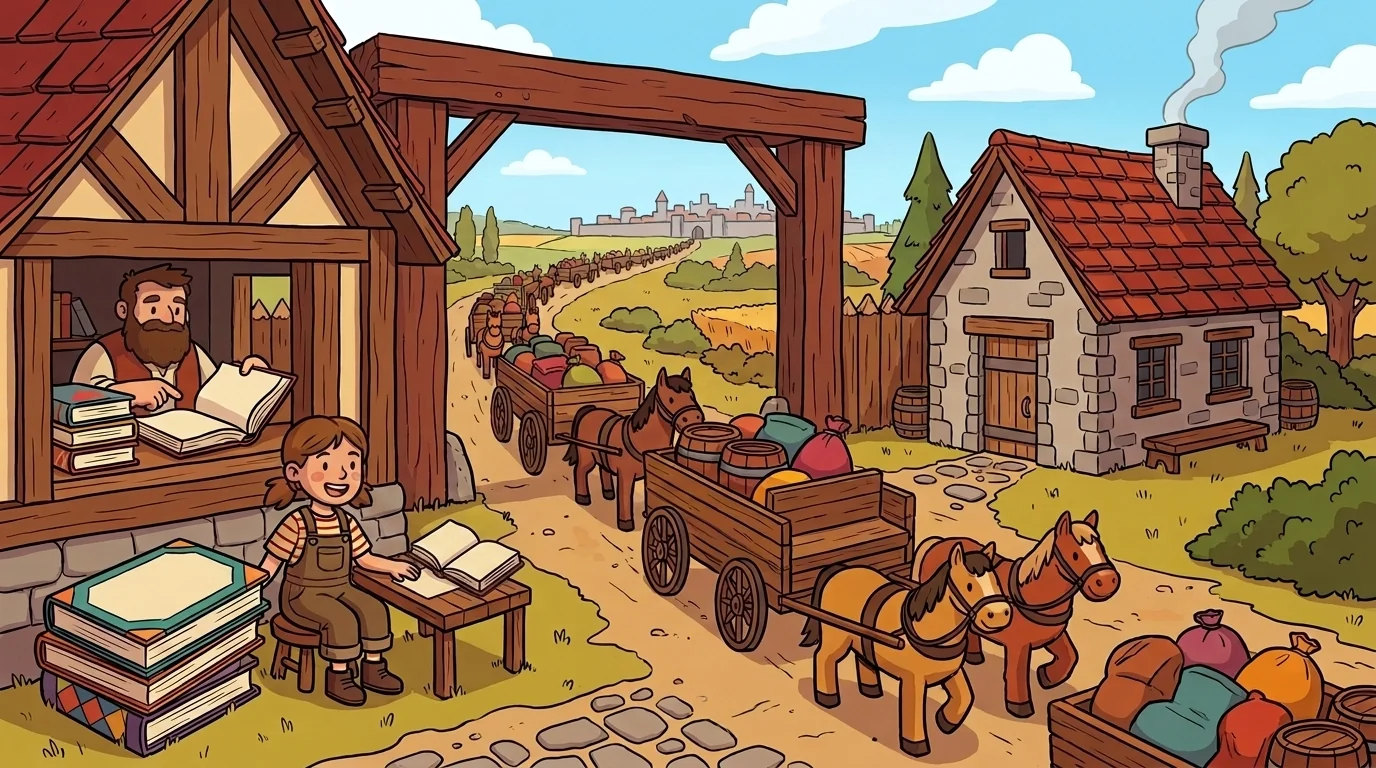
From a young age, Centa knew something important. The kingdom's taxes worked with percentages.
The kingdom did not tax things with the same amount for everyone. That wouldn't be fair. A rich trader and a poor farmer would pay the same. That wasn't right. Instead, they taxed things based on how much they were worth. It was a percentage of the cart's value. Grain was taxed at ten percent. Copper was taxed at five percent. Cloth was taxed at two percent. Salt was taxed at twelve percent. Salt was a luxury item. Imported spices were taxed at twenty percent. Spices were a big luxury.
Cent figured out these percentages. He did it for every cart. This went on for fourteen years. Centa watched him her whole childhood.
He figured them out very fast.
A merchant would arrive with a cart. Maybe it held forty bags of grain. Cent would figure out how much the grain was worth. He had a special book for prices. It was made of leather. Then he'd multiply by ten percent. He'd tell the merchant the tax. The merchant would pay. The cart would pass. The next cart would arrive.
By the time Centa was eight, she could figure out ten percent of any number. She did it in her head, super fast. Just move the dot one spot to the left. By the time she was ten, she could figure out one percent of any number. Move it two spots to the left. By the time she was twelve, she could figure out any percentage. She just put the moves together. To figure out twelve percent of three hundred: First, find ten percent. That's thirty. Next, find one percent. That's three. Multiply the one percent by two. That's six. Then add thirty plus six. That's thirty-six.
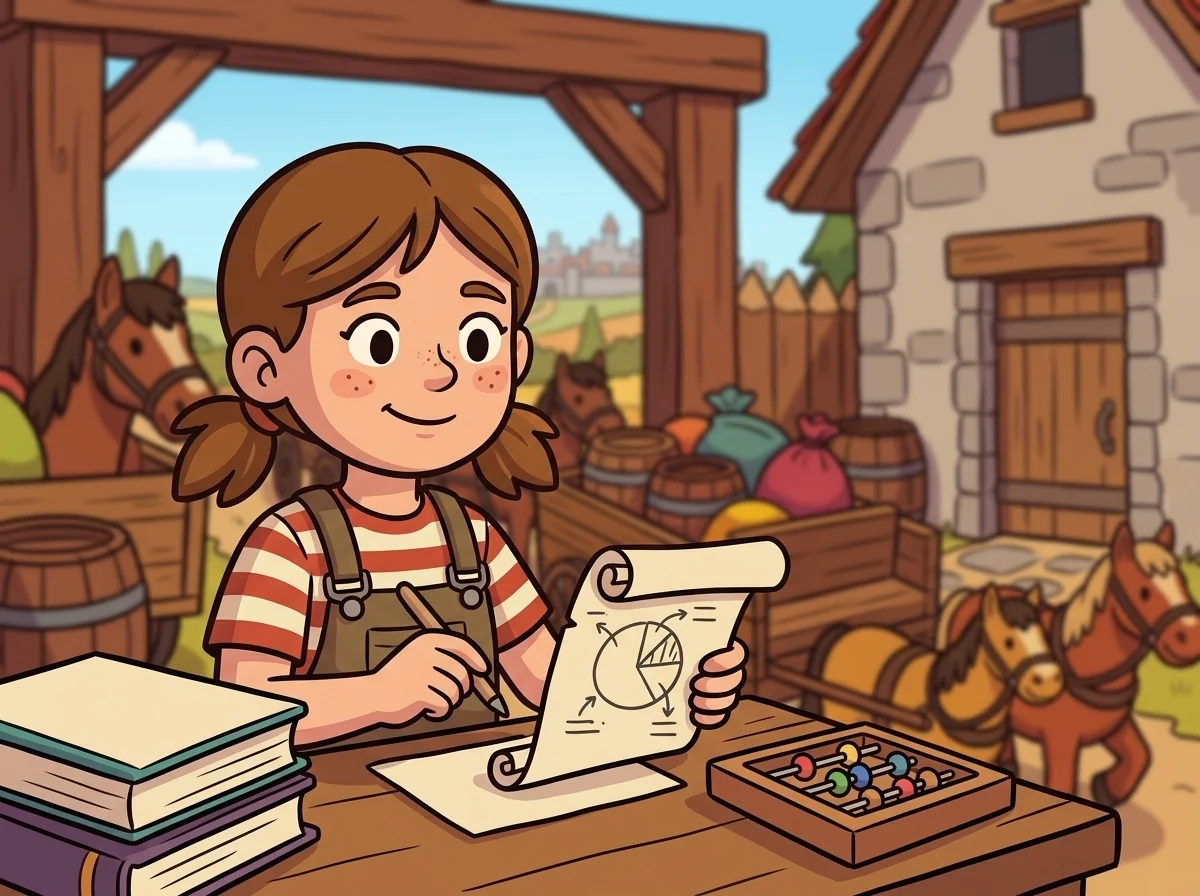
By age twelve, she was as fast as her father.
Centa realized something big. Percentages were like a secret code. They helped you translate numbers. They were the best way to show a ratio. A ratio is just a way to compare two numbers. Percentages always compared things "per hundred." You could change any ratio into a percentage. Once you did that, you could easily compare them. Three-to-five became sixty percent. One-to-eight became twelve-and-a-half percent. Seventeen-to-twenty became eighty-five percent. The kingdom used "per hundred" for its taxes. It was a common way to measure things. This made comparing any two rates super easy.
She thought about this for years.
When she was twenty, she had been helping her father at the toll-gate. She did this for many years. Then, a traveling scholar passed through Northgate. Centa's father said not to charge him. Scholars didn't pay tolls. The kingdom thought learning was important. The scholar watched Centa all afternoon. He saw her figure out percentages. When the day ended, the scholar came up to Centa. He said:
"You are the fastest percentage-calculator I have met. Have you considered teaching?"
Centa had never thought about it. She thought about it now. She talked to her father. Cent had been a tax-collector for thirty years. He was quiet, but happy. He liked that Centa had other choices. He didn't want her stuck at the toll-gate. He said: "Go. Teach. The kingdom has many tax-collectors. It has few teachers."
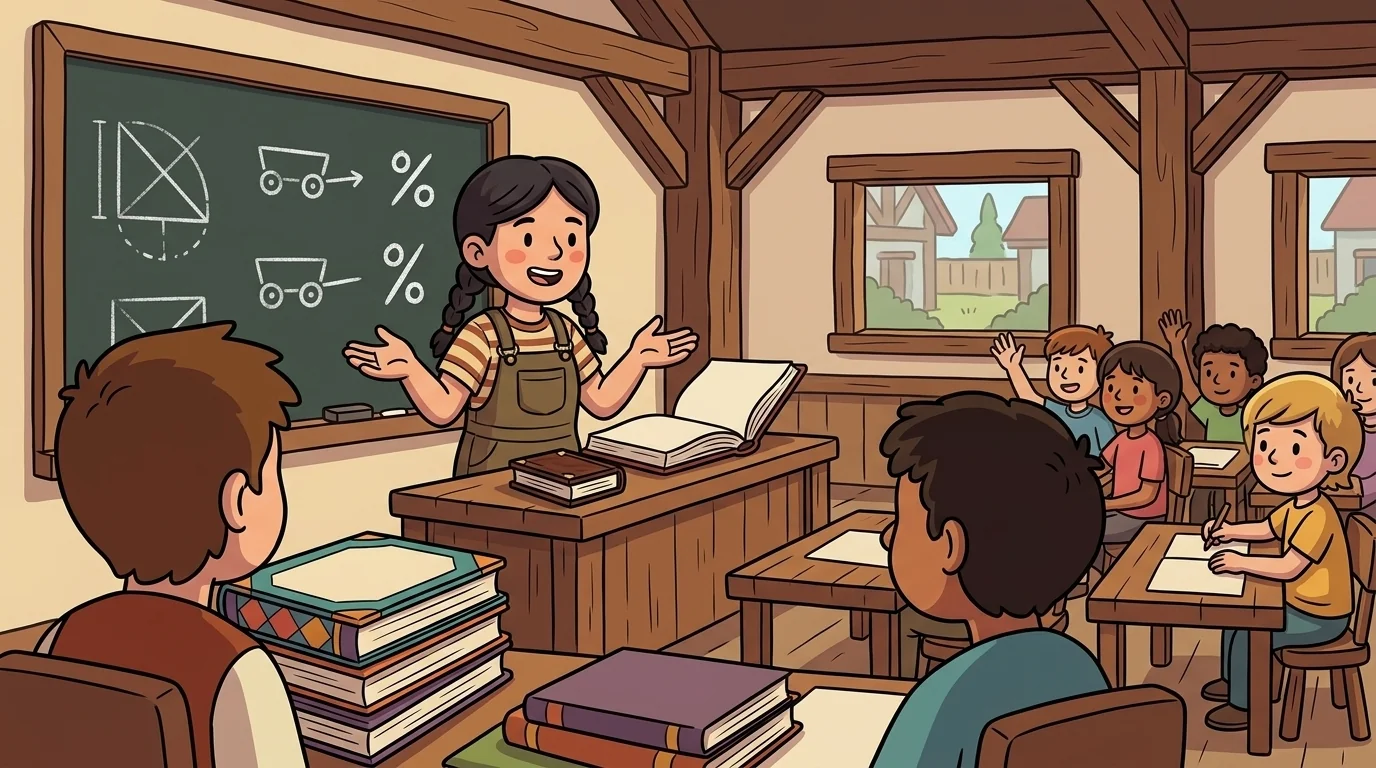
Centa went to the RatioRealm academy when she was twenty-one. She studied there for three years. She became a teacher there when she was twenty-four. She has taught percentages ever since.
In her classroom, she starts her first lesson the same way. Every time. She brings a special book. It's a small wooden ledger. Her father made it for her when she was six. It looks just like his big tax books, but tiny. It has small spaces for "cart value" and "tax percent." She places it on the desk. She turns to the class. She says: "What is ten percent of one hundred?"
The children — always — say ten.
Centa says: "What is ten percent of two hundred?"
The children say twenty.
Centa says: "What is ten percent of seventy?"
The children — most of them — say seven.
Centa smiles. She says: "You already know how to figure out percentages. You've been doing it already! Ten percent is moving the dot one spot to the left. That is the big secret for ten percent. All other percentages use this trick too."
Then she teaches them one percent. That's moving the dot two spots left. She shows them how to put them together. Like, twelve percent is ten percent plus one percent plus one percent. They can figure out any percentage this way. Just by using the simple ones.
The children — always — find it easier. Much easier than they thought. They had been told percentages were hard. They had been imagining hard multiplication problems. They didn't think it was about moving a dot. Or adding small percentages. Centa's way was a big surprise. A good one.
When children ask if percentages are hard, Centa always says the same thing:
"They are not hard. They are per hundred. Once you change any ratio to 'per hundred,' you can compare any percentage. To figure out ten percent: move the dot one spot to the left. To figure out one percent: move it two spots. Then you just put these moves together."
She still keeps the small wooden ledger. The children sometimes ask to use it. It has lines for them. They can write their own problems. She always lets them. And when a child looks up from the ledger — eyes bright, shoulders loose, a small proud smile — because a number that used to scare them has gone quiet and friendly, Centa feels the same warm gladness her father must have felt, watching her at the toll-gate all those years ago.
The RatioRealm ensemble
Centa the Percent-Translator is part of RatioRealm's distributed-narrative cast. Each character embodies a different curricular primitive; together they teach the full subject.
-

Pair the Ratio-Speaker
Simple ratios (a:b) — the foundational "for every A, there are B" pattern
-

Scale the Doubler
Equivalent ratios (scaling both parts by the same factor; recipe-doubling primitive)
-

Unit the Per-One-Counter
Rates and unit rates (the per-one normalization that lets us compare different rates)
-

Cross the Proportion-Solver
Proportions and cross-multiplication (the canonical "if a/b = c/d then ad = bc" mechanic)