
Pair and Unit
COMPARISON-BY-REDUCTION — ratios and rates are the same family of idea. Any two quantities can be compared once you reduce them to a common unit-base (per-one).
Press play to listen along. The line being read lights up as you go.
Show full transcript
Loading transcript…
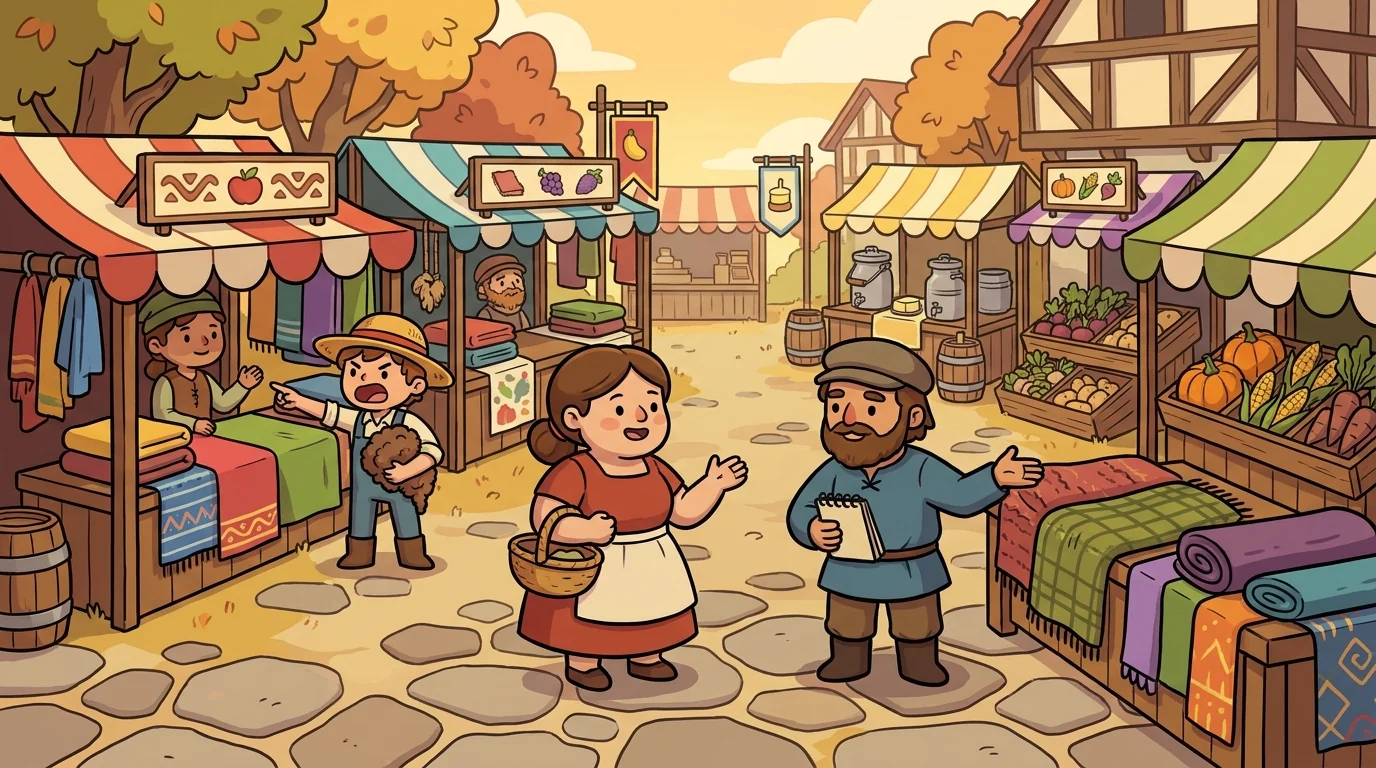
The harvest market in Loomley drew vendors from three different provinces. There were always three cloth stalls. There were always two butter stalls. There were always five vegetable stalls. The mayor of Loomley liked to keep these counts steady because the marketplace was, in the mayor's words, easier to look at if you knew what you were looking at.
Pair came up to the market that morning to buy butter for her aunt. Unit came up to the market because he had not been to Loomley in eleven years and wanted to see whether the prices had changed.
They met at the cloth stalls.
This was an accident. Pair was looking for the butter end of the market. Unit was checking the prices of woolen bolts (he had once been a pedlar of woolens; he still checked the prices wherever he went). They both arrived at the cloth stalls at the same time. They both knew each other from the academy. They both stopped to chat.
While they were chatting, an argument broke out next to them.
A young farmer was at the middle cloth stall, holding a length of brown wool against his chest. He was pointing furiously at the other two stalls.
"This is eleven coppers for an armspan!" he said to the middle stall's vendor. "That one over there is eight coppers a bolt. That one further down is one copper a yard. You're cheating me. I can buy the same cloth cheaper anywhere else."
The middle vendor, who was an old woman with very calm hands, said: "I don't think so. My cloth is the same as theirs."
"Then why do you charge more?"
The old woman said: "I don't think I do."
The farmer threw the brown wool back onto the stall and turned to leave. Unit said, very politely: "Excuse me. May I help?"
The farmer paused.
Pair, who had been listening, said: "Please. We are math teachers. We do this all day. Let us untangle it."
The farmer looked at them. Then he looked at the old woman. Then he sighed.
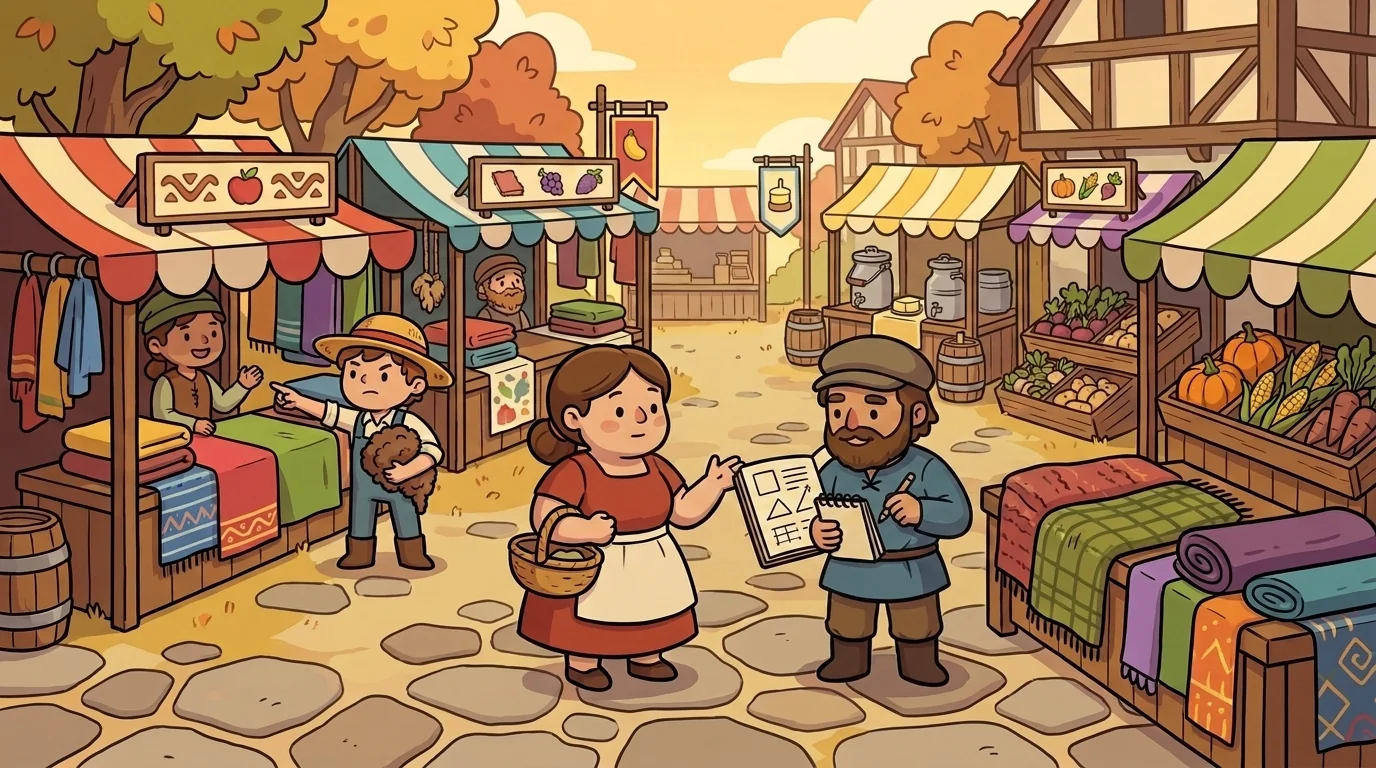
"Untangle it then," he said.
Unit walked over to the three cloth stalls. He noted the prices.
Stall one (Mira's): 8 coppers per bolt. Stall two (the old woman's): 11 coppers per armspan. Stall three (Bran's): 1 copper per yard.
He took a small notebook from his pocket. He wrote each price down.
"Three different prices," he said. "Three different units. Bolt. Armspan. Yard. These are not comparable as written."
"They are fixed-pairings," Pair said quietly. "Each price is a ratio. Stall one is eight coppers for one bolt. Stall two is eleven coppers for one armspan. Stall three is one copper for one yard. Three ratios. We just have to find a common second-side for the ratios."
Unit nodded. "Per-one. Per one of the same thing."
He turned to the farmer. "Tell me. How many yards is a bolt?"
The farmer thought. "A bolt is eight yards. Everybody knows that."
"And an armspan?"
"An armspan is, ah, about a yard and a half. Mine is a hair more than my brother's. We round it to a yard and a half."
Unit wrote in the notebook:
1 bolt = 8 yards. 1 armspan = 1.5 yards.
He drew a line. He worked through each price.
Stall one: 8 coppers per bolt = 8 coppers per 8 yards = 1 copper per yard. Stall two: 11 coppers per armspan = 11 coppers per 1.5 yards = 7.33 coppers per yard. Stall three: 1 copper per yard = 1 copper per yard.
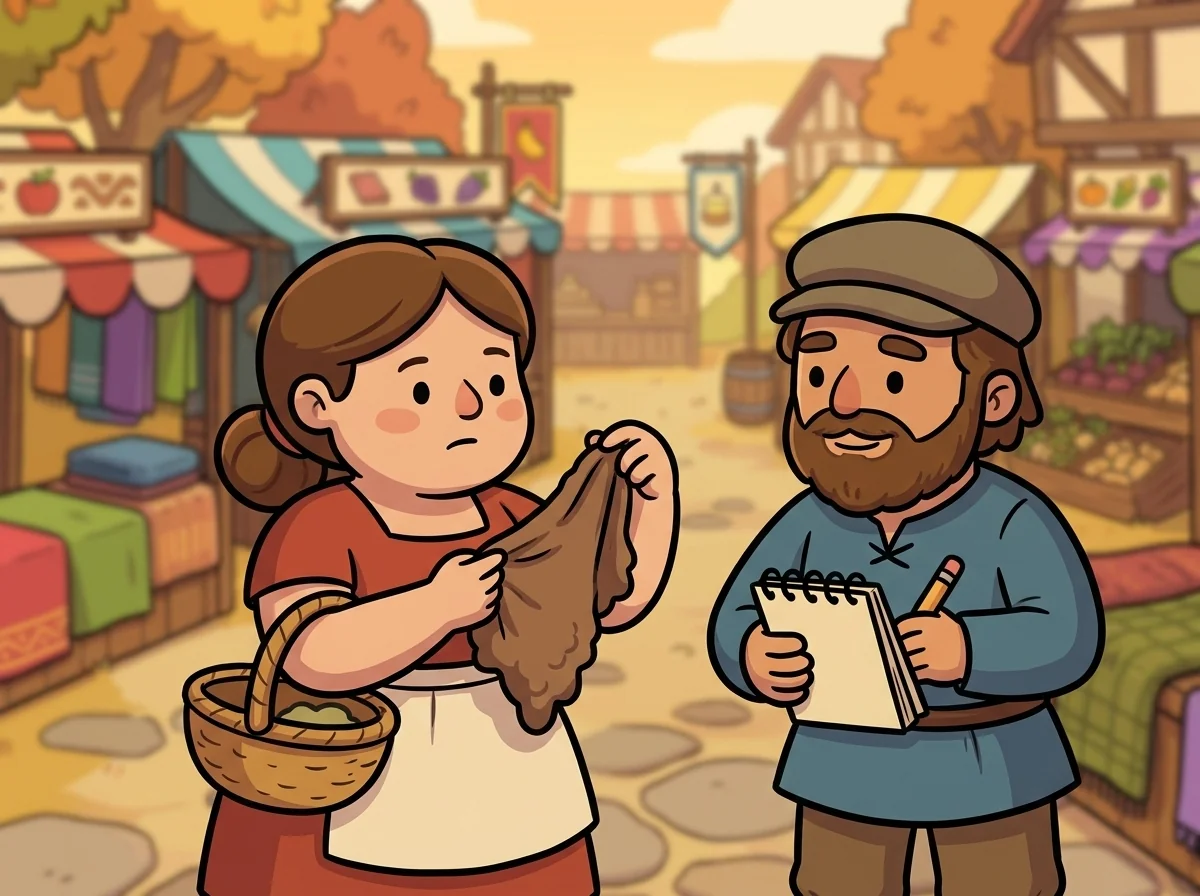
He underlined the per-yard prices.
"Stalls one and three," he said. "Same price. One copper per yard. Stall two: more than seven coppers per yard. Stall two is more than seven times as expensive."
The farmer's eyes went wide.
"I knew it!" he said. "She is cheating me!"
"Hang on," Pair said. She had been studying the cloth on the old woman's stall while Unit ran the numbers. "Look at this cloth."
She picked up a length of the brown wool. She rubbed it between her fingers. She held it up to the light.
"This isn't the same cloth as the others," she said. "This is finer. The weave is tighter. The wool has been combed twice, not once. This is a different product. You're not paying for the same yardage. You're paying for a different grade of cloth."
The old woman, who had been watching with her calm hands folded in her lap, nodded. "Three-pass wool," she said. "Costs more to make. The sheep are different. The carding is different. The price is higher."
The farmer's anger drained from his face. He went from being cheated to being confused in about three seconds.
"Then how do I compare?" he said. "If the cloth isn't the same, I can't compare prices."
"You compare the same things," Unit said gently. "Per yard. Per same grade. Stalls one and three are the same grade. Stall two is a different grade. You can compare stall one to stall three. Both one copper per yard. You can't compare stall two to either of them directly."
"Then what is stall two for?"
"For people who want finer cloth," Pair said. "Who want a 1-to-1 ratio of stitches per inch instead of a 1-to-2. The fixed-pairing is different. The price reflects the pairing."
The farmer looked at all three stalls. Then he looked at the brown wool he had just thrown back. He picked it up and rubbed it between his fingers, the way Pair had done.
"It is finer," he admitted.
"Yes."
"But I don't need fine. I need wool that won't tear."
"Then stall one or stall three," Unit said. "Same price. Pick whichever stall is friendlier."
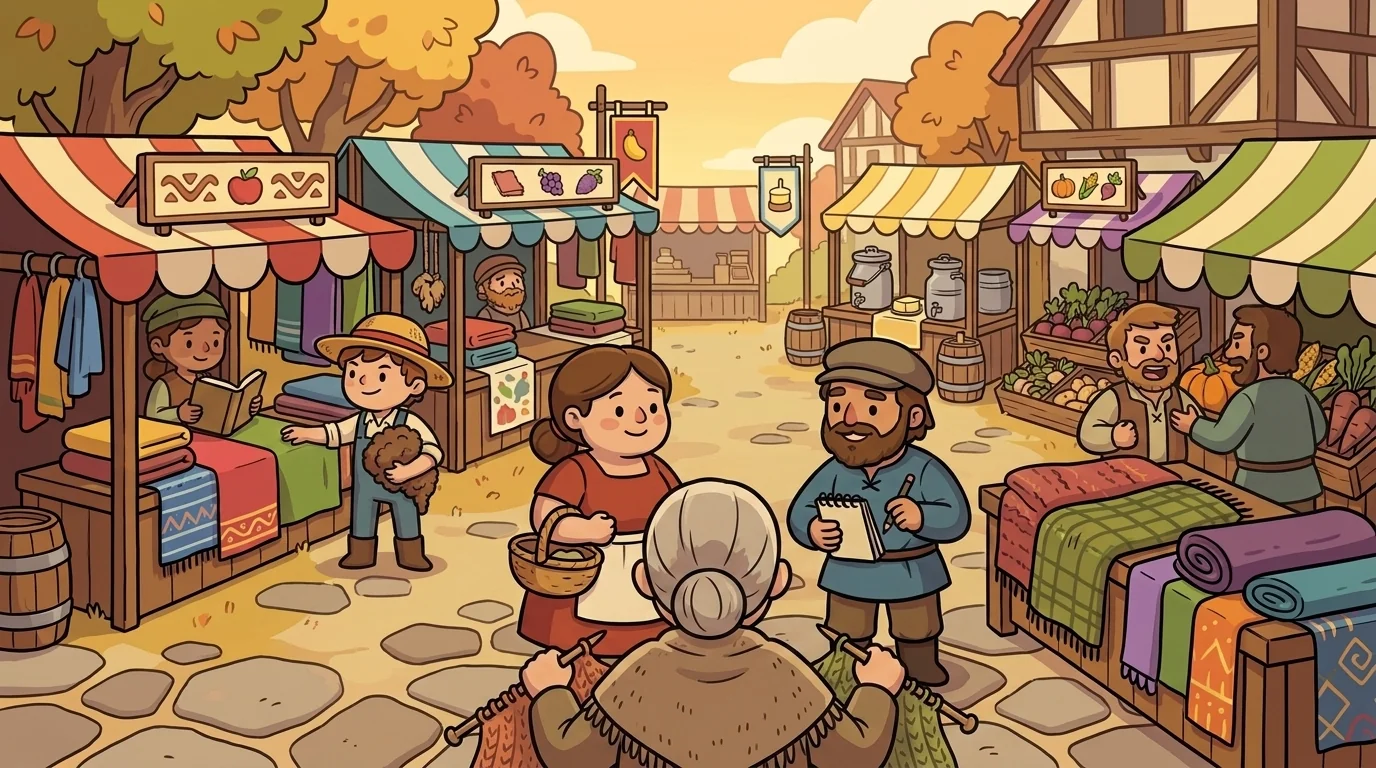
The farmer thought. He looked at the three vendors. Mira at stall one was reading a small book and did not look up. Bran at stall three was talking very loudly to another customer. The old woman at stall two had not stopped knitting since the argument began.
"Stall one," the farmer said.
He walked over to Mira and bought eight yards of brown wool for eight coppers.
The old woman put down her knitting and smiled at Pair and Unit.
"You're very good at this," she said.
"It's our job," Pair said.
"All three prices were fair," Unit said. "Once you reduce them to per-yard, the comparison is honest. Two of the per-yard prices happen to be the same. The third reflects a different grade. The farmer didn't see the grade. He just saw three different numbers."
"Most people just see the numbers," the old woman said.
"That's why the academy exists," Pair said gently. "We teach kids to look past the numbers. To see what the numbers are about. A ratio is meaningless until you know what the second side is. A rate is meaningless until you reduce to a common per-one."
"We had to teach the farmer in three minutes what we usually teach kids over a year," Unit added.
"He'll get the per-yard part now," Pair said. "The grade part will take longer. But that's all right."
The old woman picked her knitting back up. "Thank you," she said. "I make the finer wool because my daughter's hands cramp at the loom now. She works slower. The wool is better. But she sells less of it. People don't know what finer means."
Pair and Unit stayed a few more minutes. They bought a small length of the fine wool from the old woman, just so her morning wasn't a loss. They split the cost.
Then Pair remembered the butter she had come for.
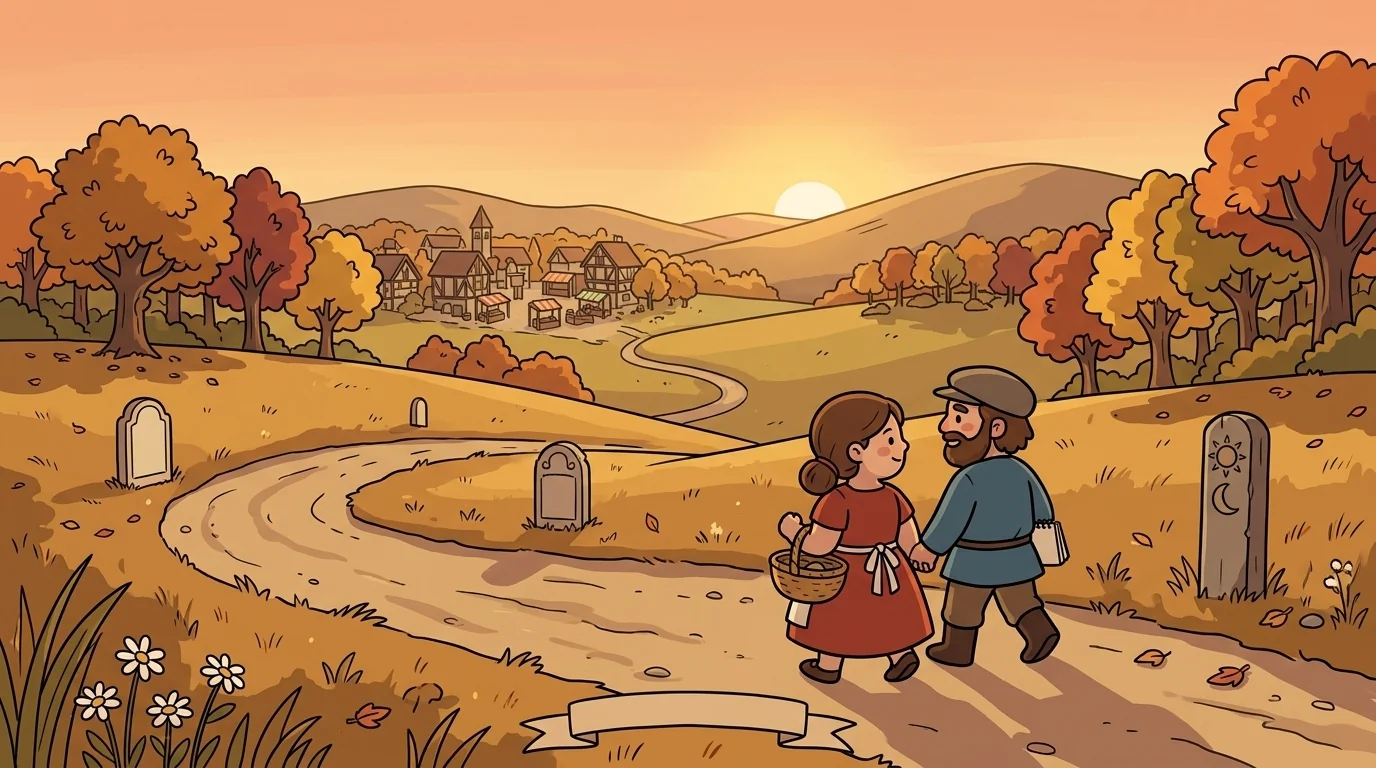
That evening, walking back to the academy together along the road, Pair said: "I was thinking about Echo today."
"Echo your sister?"
"Yes."
Unit did not say anything. He walked.
"She would have seen the three stalls the way we did," Pair said. "She always saw the pair behind the thing. She saw the what-goes-with-what."
"Mm."
"I think Echo would have liked the academy."
"I think she would have," Unit said. "I think she would have made a wonderful Per-One-Counter."
Pair smiled. They walked on.
"You know what the academy doesn't have?" Pair said after a while. "An ensemble lesson on this. On the three-stalls thing. On the grade-of-the-cloth problem. On how reducing to per-one only works when the thing on each side is comparable."
"Then we teach it next month," Unit said. "Kit four. We'll write it together."
"All right."
They walked the rest of the way without speaking. The hills outside Loomley were very quiet at sunset.
The RatioRealm ensemble
Pair and Unit is part of RatioRealm's distributed-narrative cast. Each character embodies a different curricular primitive; together they teach the full subject.
-

Pair the Ratio-Speaker
Simple ratios (a:b) — the foundational "for every A, there are B" pattern
-

Scale the Doubler
Equivalent ratios (scaling both parts by the same factor; recipe-doubling primitive)
-

Unit the Per-One-Counter
Rates and unit rates (the per-one normalization that lets us compare different rates)
-

Cross the Proportion-Solver
Proportions and cross-multiplication (the canonical "if a/b = c/d then ad = bc" mechanic)
-

Centa the Percent-Translator
Percentages — the per-hundred special case + percent change