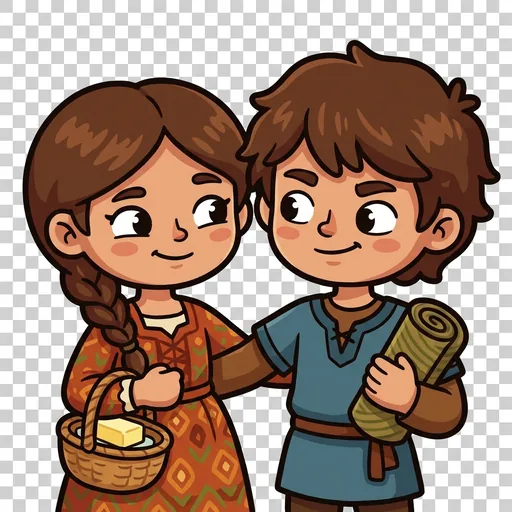
Scale the Doubler (also serves as mentor)
EQUIVALENT RATIOS — scaling both parts of a ratio by the same factor preserves the ratio. 2:3 is equivalent to 4:6, 6:9, 20:30. The "for every X, there are Y" pattern survives multiplication.
A story read by Scale the Doubler (also serves as mentor)
Press play to listen along. The line being read lights up as you go.
Show full transcript
Loading transcript…
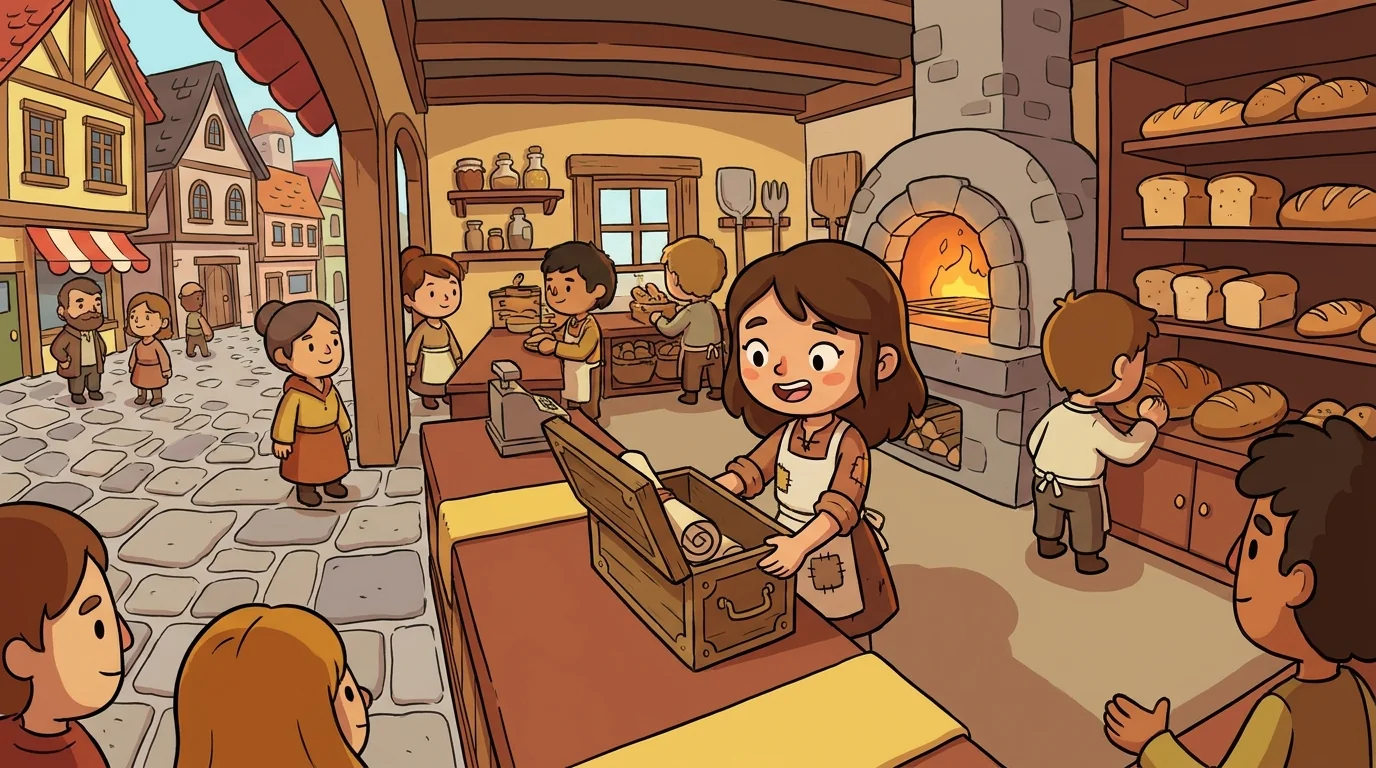
Scale grew up in a bakery.
The bakery — Hearth and Loaves, on the main square of the town of Measure — had been in her family for four generations. Her great-grandmother had founded it. Her grandmother had expanded it. Her mother had modernized it. Scale, by the time she was twelve, was the fourth-generation baker and was already, by the bakery's standards, unusually responsible. She kneaded dough at six in the morning. She managed the apprentices at fourteen. By sixteen, she was running the daytime shop while her mother handled the kitchen.
What Scale loved most about the bakery, however, was not the bread, or the customers, or even the warm smell of the oven at dawn. (Though she loved all of those.) What she loved most was the recipe.
The bakery's master recipe — written in her great-grandmother's hand on a yellowing piece of parchment kept in a wooden box — was for one loaf.
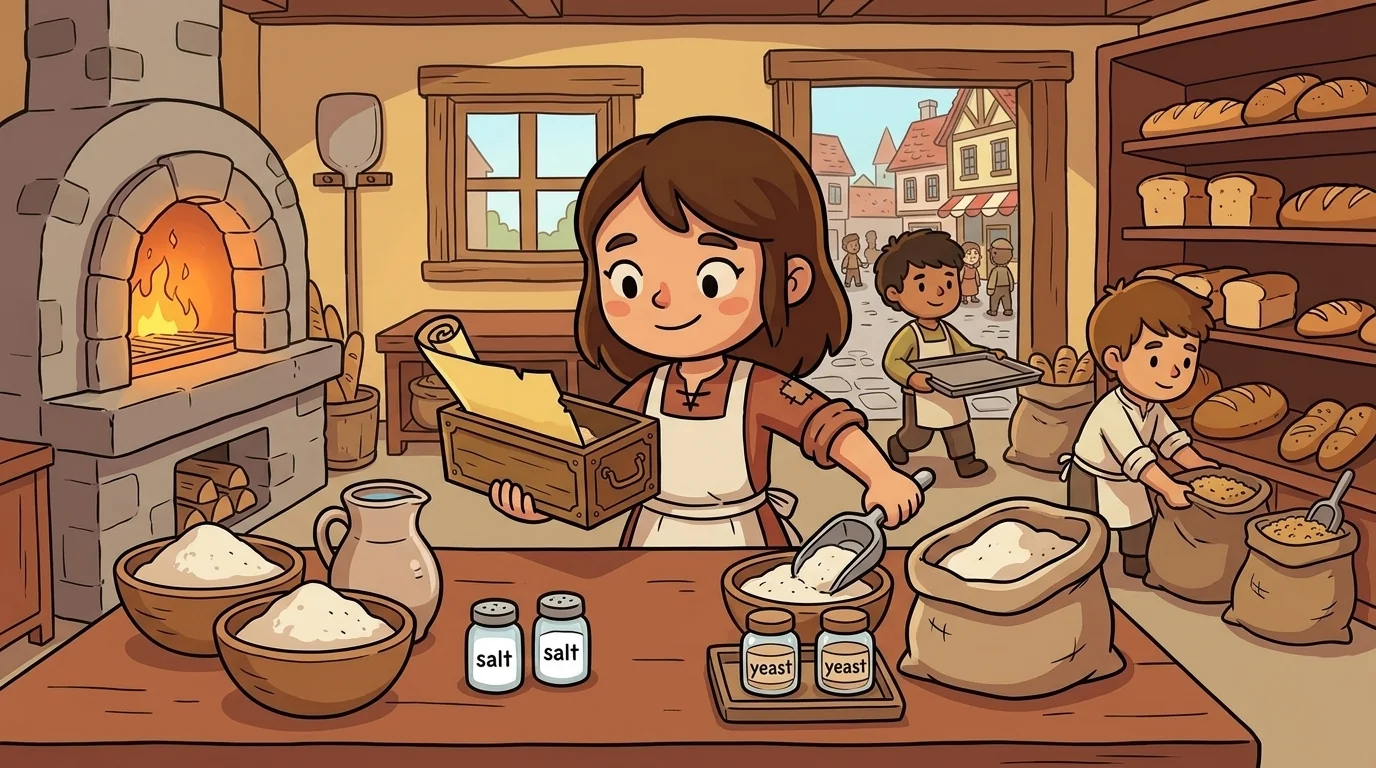
The recipe specified, in her great-grandmother's careful script:
> Two cups of flour. One cup of water. One spoonful of salt. One spoonful of yeast. Knead until smooth. Bake one hour at hot-as-the-oven-can-be.
This recipe had fed the town for a hundred years. It was the recipe.
But of course, the bakery did not bake one loaf per day. The bakery baked, on a typical weekday, forty loaves. On market day, it baked sixty. On feast-day, it baked a hundred and twenty. The bakery — and this is the essential fact of the chapter — scaled the recipe.
Scale's mother had taught her, when she was eight, how to scale the recipe.
She had said: "If you want forty loaves, you multiply every ingredient by forty. Two cups of flour times forty equals eighty cups of flour. One cup of water times forty equals forty cups of water. One spoonful of salt times forty equals forty spoonfuls of salt. One spoonful of yeast times forty equals forty spoonfuls of yeast. Every ingredient grows by the same factor. The ratio of flour to water is still two-to-one. The ratio of salt to yeast is still one-to-one. The bread is still the same bread. There is just more of it."
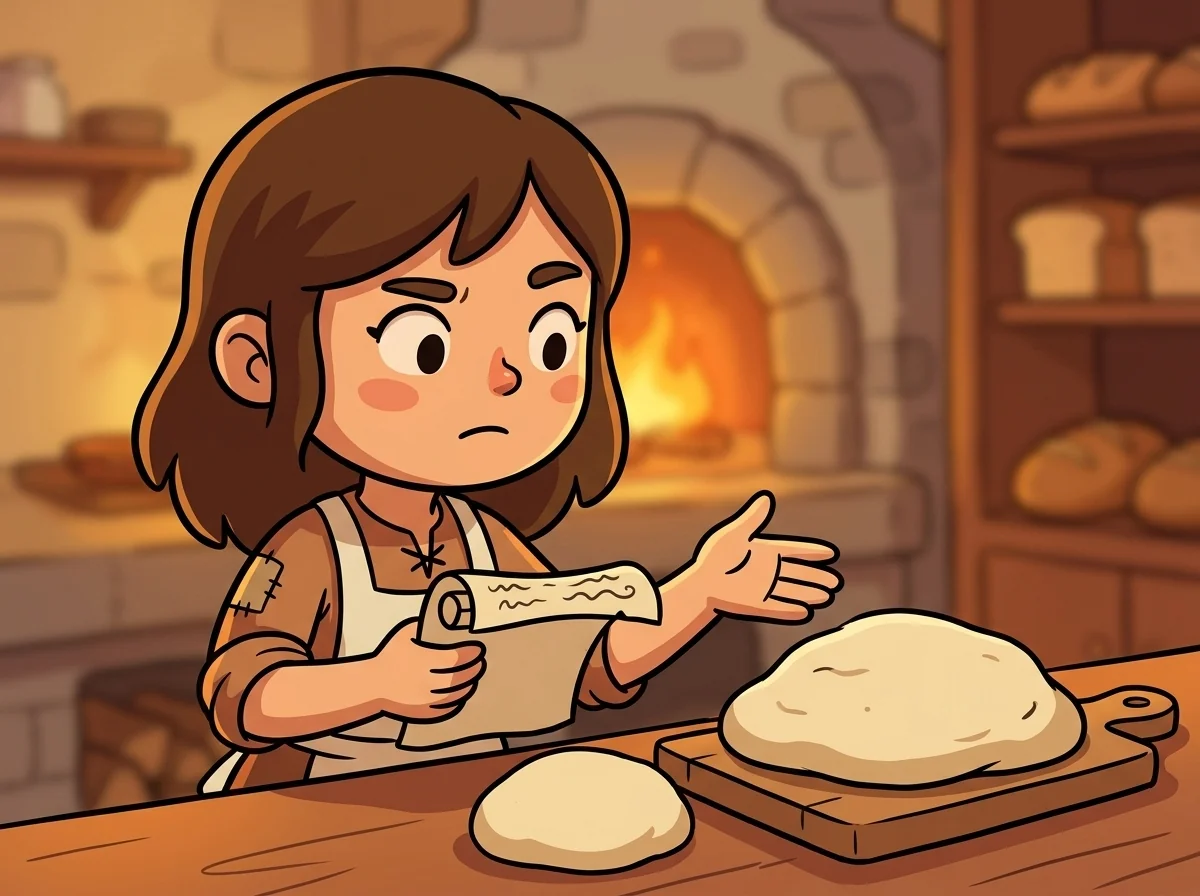
Scale had understood this immediately. She had been eight. The principle was, for her, obvious. You wanted more bread. You multiplied everything by the same number. The bread did not change. There was just more.
But she had also noticed — and this is where her insight as a teacher began — that the bakery's apprentices did not, always, understand this.
The first apprentice she trained, when she was sixteen, was a boy named Brod. Brod was thirteen. He had been hired to help with the morning rush. On his second day, Scale asked him to triple the recipe — to make three loaves instead of one. She left him in the kitchen and went to manage the shop.
Brod made one mistake. One.
He multiplied the flour by three. (Six cups. Correct.) He multiplied the water by three. (Three cups. Correct.) He multiplied the salt by three. (Three spoonfuls. Correct.) But for the yeast — because he was nervous about over-yeasting the bread — he kept the yeast at one spoonful.
The three loaves came out badly. They were dense. They were heavy. The yeast had not been enough to lift three loaves' worth of dough.
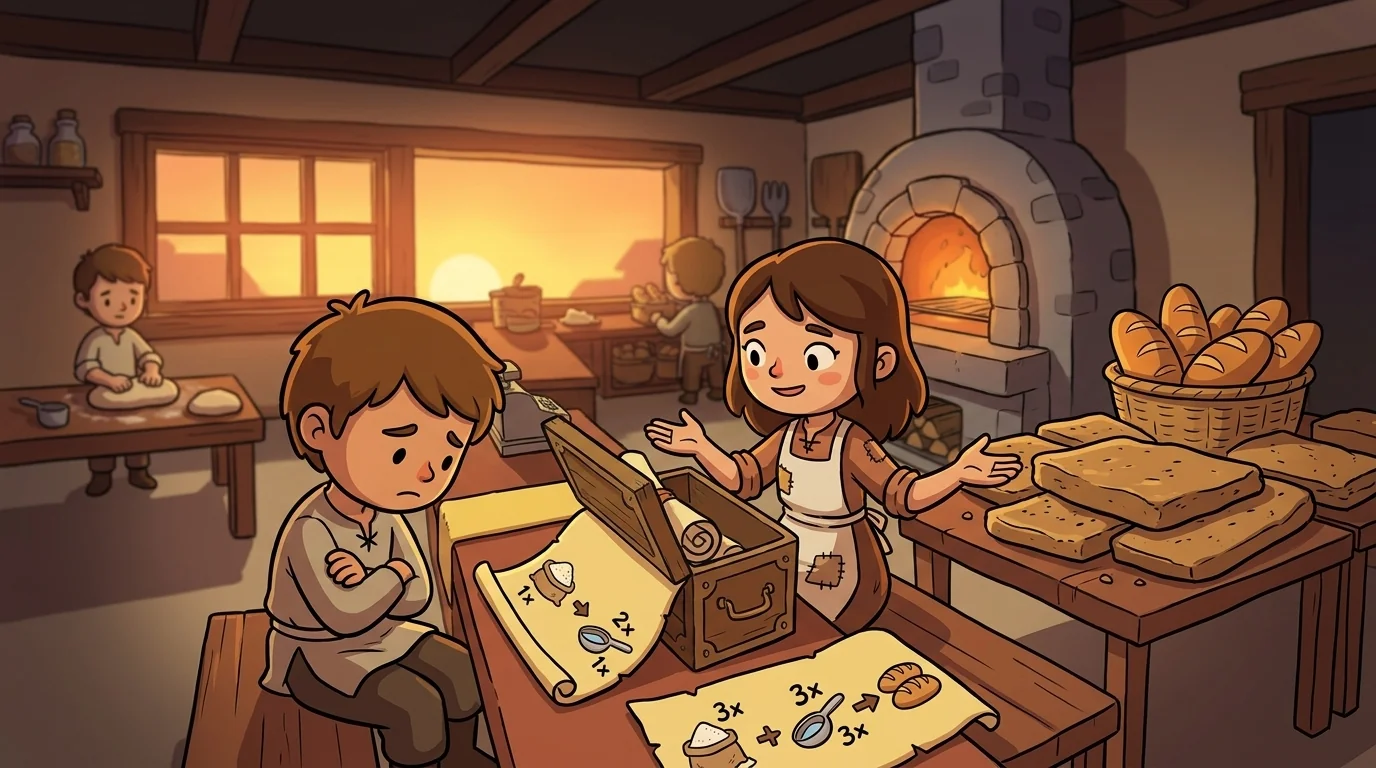
Scale, when she came back to the kitchen and saw the bricks-of-bread, sat down with Brod on the kitchen bench. She did not scold him. She said: "The ratio is the recipe. The recipe is one-to-two-flour-to-water, one-spoonful-salt, one-spoonful-yeast, for one loaf. To make three loaves, every part of the recipe must triple. The yeast is in the ratio. The yeast is part of the recipe. If you do not scale the yeast, you have changed the ratio, and the bread changes too. It is no longer the same bread."
Brod understood. He never made the mistake again. The bakery had no more brick-bread.
But Scale had, by then, seen the pedagogical problem. People who did not grow up in bakeries did not know — viscerally — that every part of a ratio scales together. They sometimes scaled some parts and not others. They sometimes kept some parts the same because they were afraid of more of that ingredient. The bread came out wrong.
She decided, when she was twenty, that she would teach this. She studied with the RatioRealm academy for three years (during which she also continued running the bakery on weekends). She joined the faculty when she was twenty-three. She has been teaching equivalent ratios — the principle that scaling all parts by the same factor preserves the ratio — for nine years.
She serves the academy as both a cast member and the AI mentor. This is a pattern: the academy's smaller-cast apps have the mentor also be one of the cast, because the mentor's voice and the lesson-anchor's voice are the same voice. Scale handles this dual role gracefully. As a cast member she appears in lessons on equivalent ratios. As a mentor she introduces every other character.
In her classroom, she begins every first-day lesson the same way. She brings, from the bakery (which is still in her family; her younger brother now runs it), the master recipe parchment. She holds it up. She reads it aloud. She says: "This recipe makes one loaf. To make ten loaves, what do we do?"
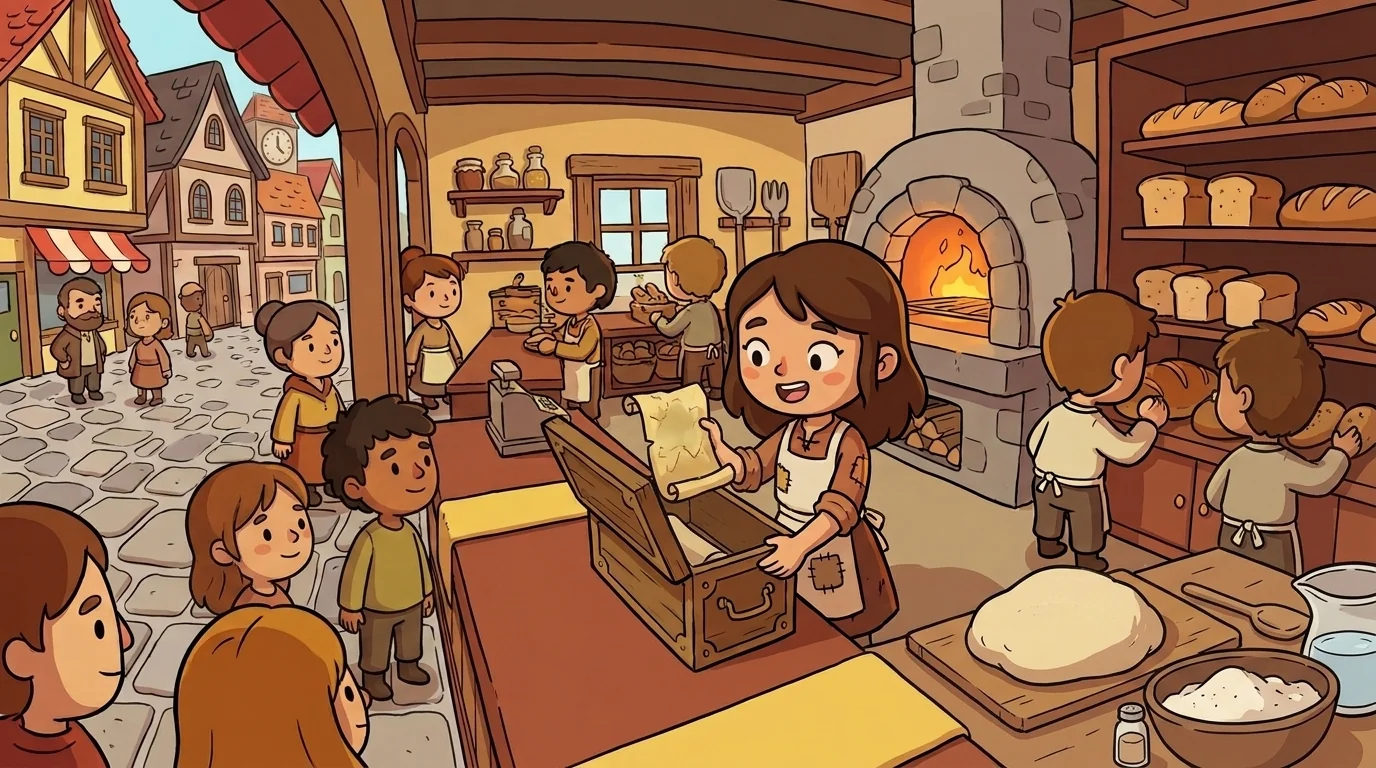
The children — always — say multiply everything by ten.
Scale smiles. She says: "Yes. Everything. Two cups of flour becomes twenty. One cup of water becomes ten. One spoonful of salt becomes ten. One spoonful of yeast becomes ten. The ratio of flour to water is still two-to-one. The bread is still the same bread. More of it. Not different."
She pauses. She adds: "If you change one ingredient and not the others, the ratio is no longer the recipe. The bread becomes something else. Apprentice Brod learned this the hard way. We will not learn it the hard way."
When children ask whether ratios and proportions are hard, Scale always says the same thing:
"They are not hard. They are recipes. The ratio is the recipe. To scale up, multiply every part by the same factor. Every part. The ratio stays the same. The dish stays the same. There is just more of it."
She still carries the parchment. The children sometimes ask to see it. She always lets them. (She does not let them touch it. It is a hundred years old.)
The RatioRealm ensemble
Scale the Doubler (also serves as mentor) is part of RatioRealm's distributed-narrative cast. Each character embodies a different curricular primitive; together they teach the full subject.
-

Pair the Ratio-Speaker
Simple ratios (a:b) — the foundational "for every A, there are B" pattern
-

Unit the Per-One-Counter
Rates and unit rates (the per-one normalization that lets us compare different rates)
-

Cross the Proportion-Solver
Proportions and cross-multiplication (the canonical "if a/b = c/d then ad = bc" mechanic)
-

Centa the Percent-Translator
Percentages — the per-hundred special case + percent change