
Pair and Unit
COMPARISON-BY-REDUCTION — ratios and rates are the same family of idea. Any two quantities can be compared once you reduce them to a common unit-base (per-one).
Press play to listen along. The line being read lights up as you go.
Show full transcript
Loading transcript…
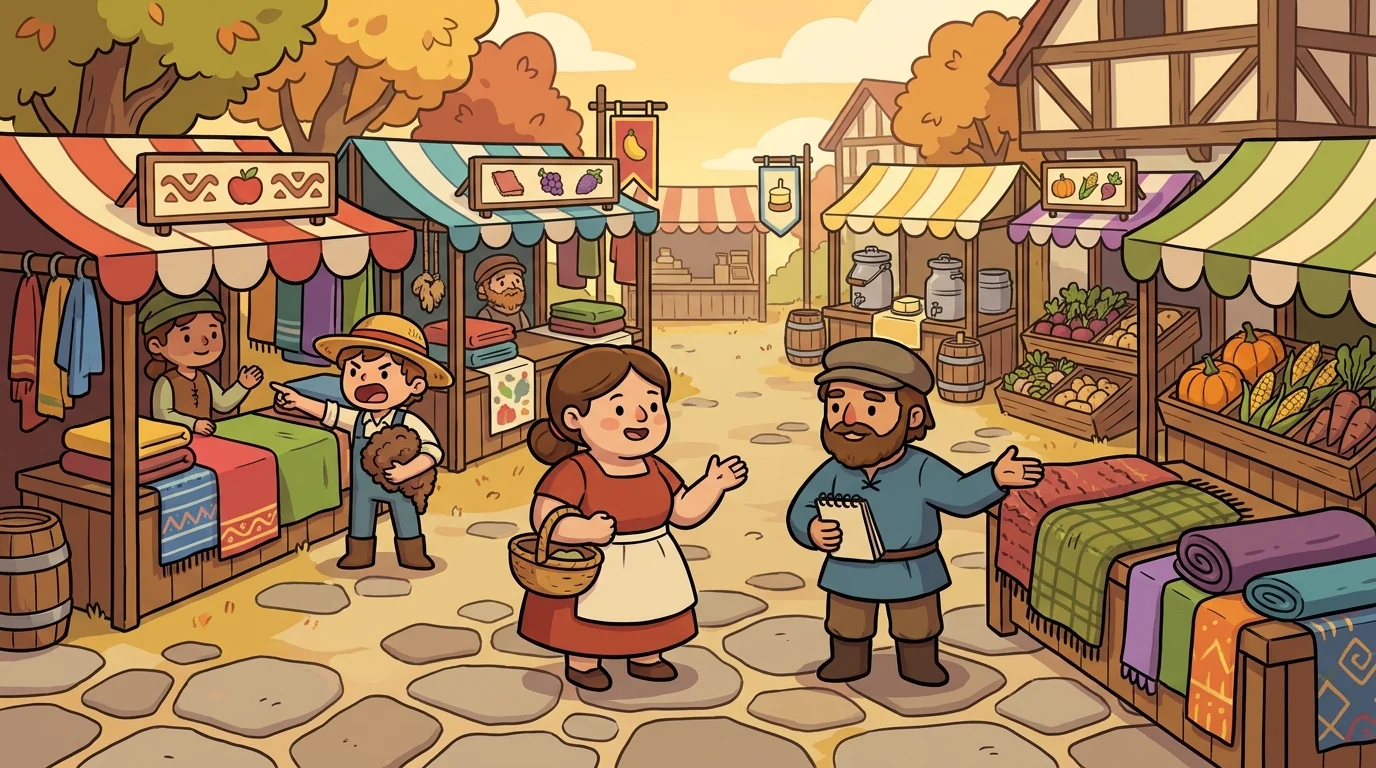
The harvest market in Loomley always drew a bustling crowd, with vendors arriving from three different provinces. A familiar pattern emerged each market day: three cloth stalls, two butter stalls, and five vegetable stalls. Loomley’s mayor insisted on these fixed numbers, believing the marketplace became easier to look at if you knew what you were looking at. This particular morning, the familiar order was about to be tested.
Pair had come to the market with a simple errand: buying butter for her aunt. Unit, however, visited Loomley for a different reason. He hadn't stepped foot in the town for eleven years and felt curious about how the prices might have shifted. Their paths crossed unexpectedly near the cloth stalls. Pair was still navigating the market, trying to locate the butter vendors. Unit, a former pedlar of woolens, habitually checked prices wherever he went, and today he was comparing woolen bolts. They arrived at the same moment, recognized each other from the academy, and paused for a quick chat.
As they spoke, an argument erupted nearby. A young farmer stood at the middle cloth stall, clutching a length of brown wool against his chest. His finger jabbed furiously toward the other two stalls.
"This is eleven coppers for an armspan!" he declared to the middle vendor. "That one over there is eight coppers a bolt. And the one further down is one copper a yard. You're clearly cheating me. I can buy the same cloth for less money anywhere else."
The middle vendor, an old woman with remarkably calm hands, simply shook her head. "I don't believe that's true," she said softly. "My cloth is the same as theirs."
"Then why do you charge more?" the farmer demanded.
The old woman’s expression remained serene. "I don't think I do," she replied.
Frustrated, the farmer tossed the brown wool back onto the stall and turned to leave. Unit, stepping forward, spoke with quiet politeness. "Excuse me. Perhaps I can assist?"
The farmer hesitated, his shoulders still tense.
Pair, who had been listening intently, offered a reassuring smile. "Please," she said. "We both teach mathematics. We untangle problems like this every day."
The farmer looked from Pair to Unit, then to the old woman. He let out a long sigh. "Untangle it then," he conceded, though his voice still held a note of suspicion.
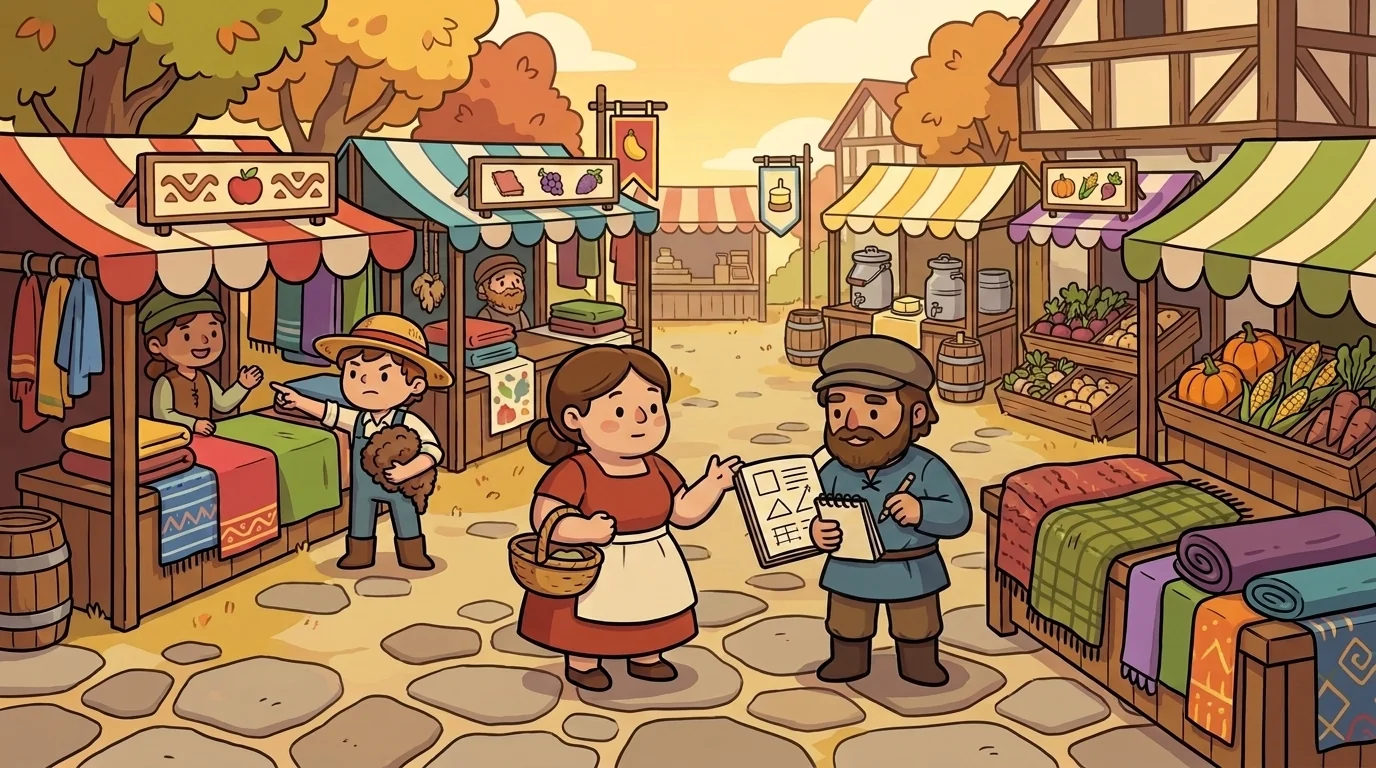
Unit moved methodically toward the three cloth stalls, his gaze sweeping over the displayed prices.
Stall one (Mira's): 8 coppers per bolt. Stall two (the old woman's): 11 coppers per armspan. * Stall three (Bran's): 1 copper per yard.
He pulled a small, worn notebook from his pocket and carefully recorded each price. "We have three different prices," he observed, "and three different units: bolt, armspan, yard. These numbers aren't directly comparable as they are written."
"They are *fixed-pairings," Pair explained in a quiet voice. "Each price represents a ratio. Stall one offers eight coppers for one bolt. Stall two sells eleven coppers for one armspan. And stall three provides one copper for one yard. We have three ratios, but we need to find a common second-side* for them."
Unit nodded, understanding immediately. "Per-one," he clarified. "Per one of the same thing."
He turned back to the farmer. "Tell me, how many yards are in a bolt?"
The farmer paused, thinking. "A bolt is eight yards," he stated. "Everyone knows that."
"And an armspan?" Unit prompted.
"An armspan is, ah, about a yard and a half," the farmer replied. "Mine is a hair more than my brother's, but we usually round it to a yard and a half."
Unit jotted down the conversions in his notebook:
1 bolt = 8 yards. 1 armspan = 1.5 yards.
He drew a neat line beneath the conversions and began to calculate each price based on a common unit.
Stall one: 8 coppers per bolt = 8 coppers per 8 yards = 1 copper per yard. Stall two: 11 coppers per armspan = 11 coppers per 1.5 yards = 7.33 coppers per yard. * Stall three: 1 copper per yard = 1 copper per yard.
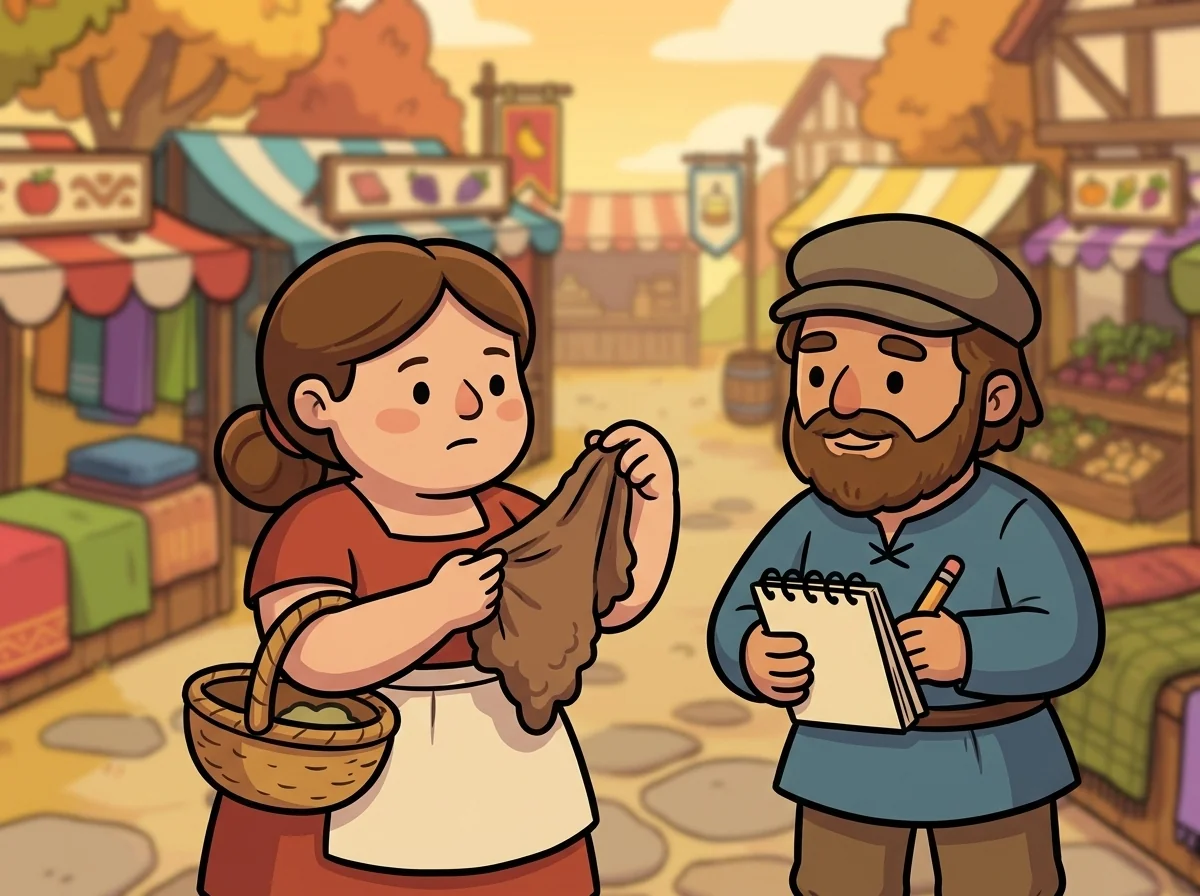
He underlined the final per-yard prices. "Stalls one and three," he announced, "offer the same price: one copper per yard. Stall two, however, charges more than seven coppers per yard. Stall two is more than seven times as expensive."
The farmer’s eyes widened, his jaw dropping slightly. "I knew it!" he exclaimed, a triumphant note returning to his voice. "She is cheating me!"
"Wait a moment," Pair interjected. While Unit had been absorbed in his calculations, she had been closely examining the cloth on the old woman's stall. "Look at this fabric."
She picked up a length of the brown wool, rubbing it gently between her fingers. Then she held it up, letting the sunlight filter through the weave. "This isn't the same cloth as the others," she observed. "This wool is finer. The weave is noticeably tighter, and the wool itself has been combed twice, not just once. It's a different product entirely. You're not paying for the same yardage; you're paying for a different grade of cloth."
The old woman, who had watched the entire process with her calm hands folded in her lap, nodded slowly. "It's three-pass wool," she confirmed. "It costs more to make. The sheep are a different breed, and the carding process is more intensive. That's why the price is higher."
The anger drained from the farmer's face, replaced by a profound confusion. He had shifted from feeling cheated to utterly bewildered in a matter of seconds. "Then how do I compare them?" he asked, his voice subdued. "If the cloth isn't the same, I can't compare prices, can I?"
"You compare the same things," Unit explained gently. "Per yard, yes, but also per same grade. Stalls one and three offer the same grade of wool. Stall two offers a different grade. You can honestly compare stall one to stall three; both are one copper per yard. But you cannot directly compare stall two to either of them."
"So what is stall two for?" the farmer wondered.
"It's for people who specifically want finer cloth," Pair answered. "People who might prefer a 1-to-1 ratio of stitches per inch, rather than a 1-to-2. The *fixed-pairing* here is different, and the price naturally reflects that particular pairing."
The farmer looked at all three stalls again, then at the brown wool he had so dramatically thrown back. He picked it up once more, rubbing it between his fingers just as Pair had done. "It is finer," he admitted, a note of surprise in his voice.
"Yes," Pair confirmed.
"But I don't need fine wool," he said. "I need wool that won't tear easily."
"Then stall one or stall three would suit your needs," Unit suggested. "They are the same price. You can pick whichever vendor seems friendlier."
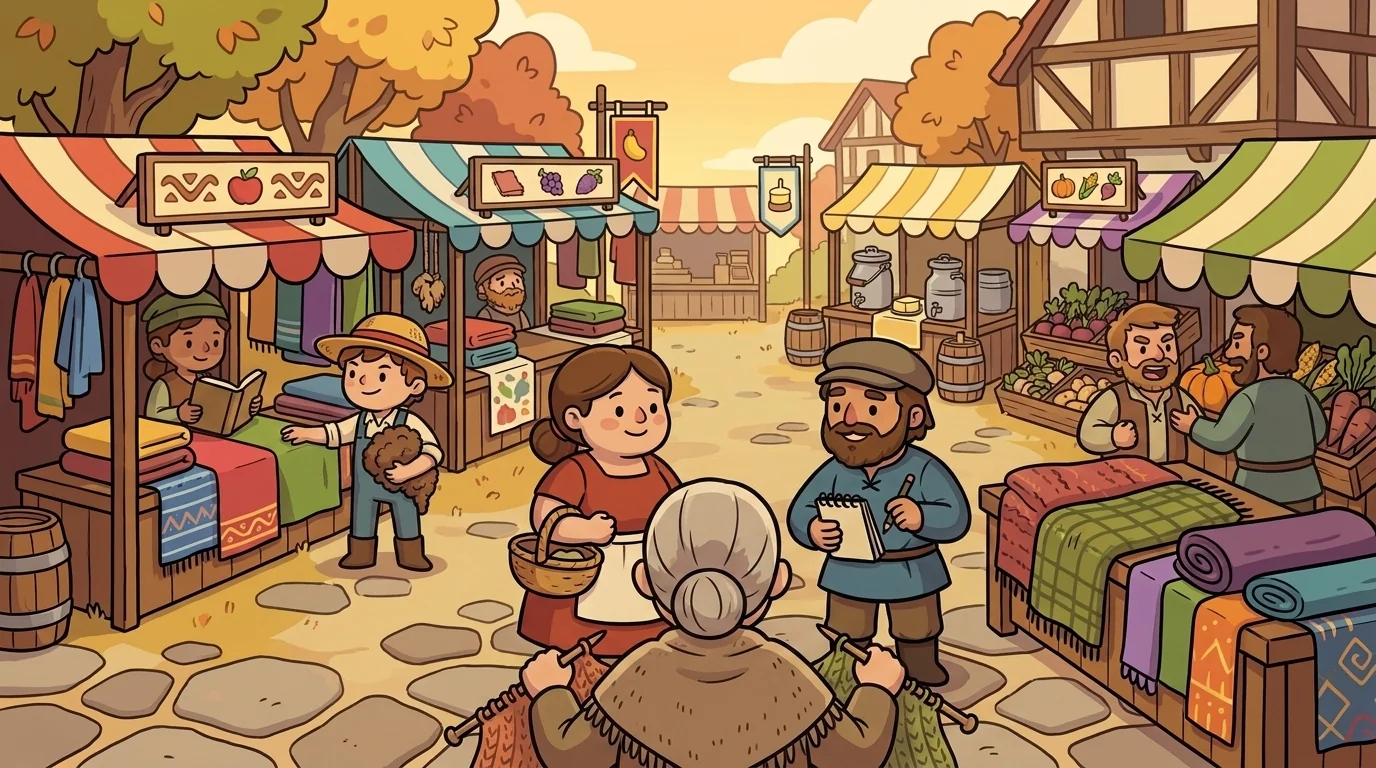
The farmer considered this, scanning the three vendors. Mira at stall one was engrossed in a small book, not looking up. Bran at stall three was loudly chatting with another customer. The old woman at stall two had simply resumed her knitting, her needles clicking softly.
"Stall one," the farmer decided.
He walked over to Mira’s stall and quietly purchased eight yards of brown wool for eight coppers.
The old woman set down her knitting, offering Pair and Unit a warm smile. "You two are very skilled at this," she said.
"It's simply our profession," Pair replied.
"All three prices were fair, in the end," Unit mused. "Once you reduce them to a common per-yard unit, the comparison becomes honest. Two of the per-yard prices happened to be identical. The third, however, clearly reflected a different grade of material. The farmer didn't see the grade; he only saw three different numbers."
"Most people only see the numbers," the old woman agreed, her gaze thoughtful.
"That's precisely why the academy exists," Pair said gently. "We teach children to look past the raw numbers. We help them see what the numbers are actually about. A ratio remains meaningless until you truly understand its second side. A rate, similarly, is meaningless until you reduce it to a common per-one."
"We had to teach that farmer in three minutes what we typically teach our students over an entire year," Unit added with a wry smile.
"He'll grasp the per-yard concept now," Pair predicted. "The idea of differing grades will take him longer to understand. But that's perfectly acceptable."
The old woman picked up her knitting once more. "Thank you," she said. "I make this finer wool because my daughter's hands cramp at the loom now. She works more slowly. The wool is better, but she sells less of it. People often don't truly understand what finer means."
Pair and Unit lingered for a few more minutes. Before leaving, they purchased a small length of the fine wool from the old woman, ensuring her morning wasn't a complete loss. They split the cost between them.
Only then did Pair remember the butter she had originally come for.
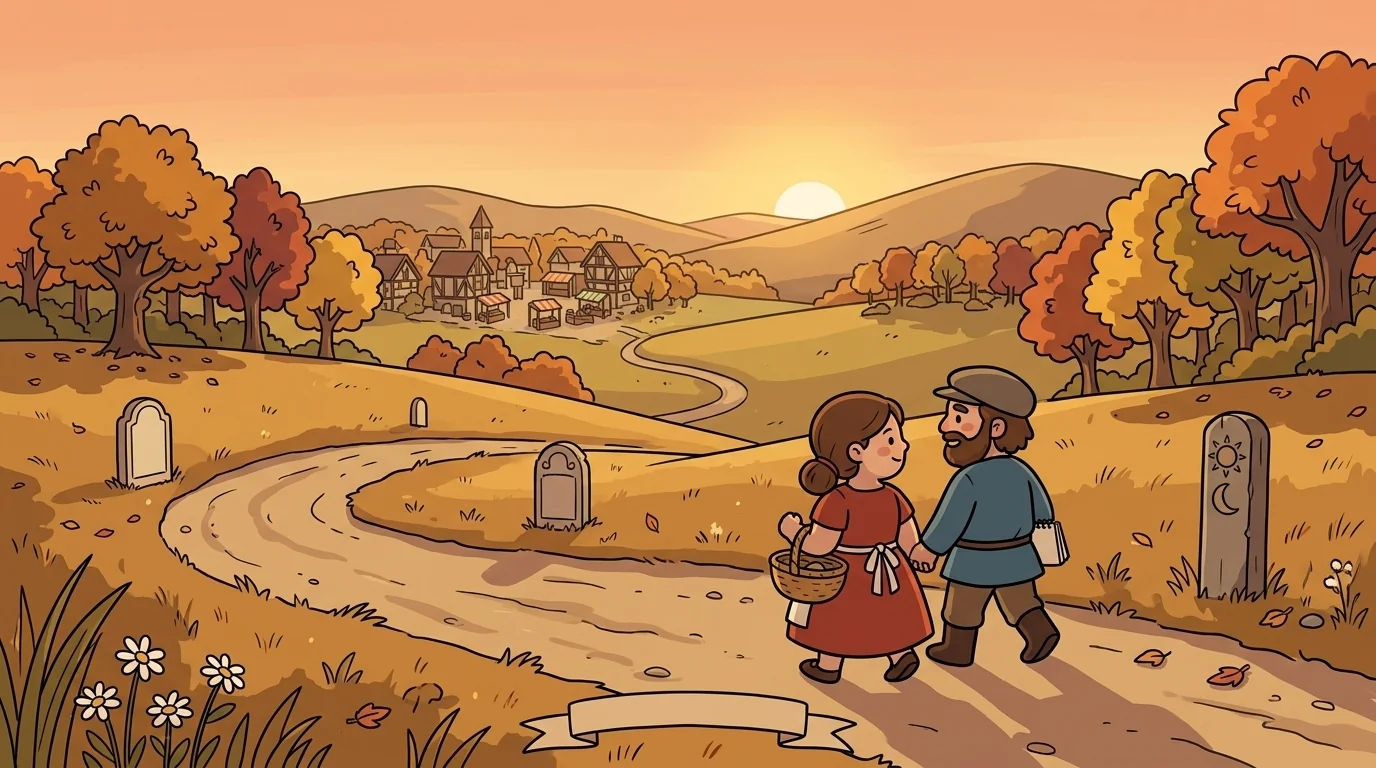
That evening, as they walked back to the academy along the quiet road, Pair broke the silence. "I was thinking about Echo today," she said.
"Echo, your sister?" Unit asked softly.
"Yes."
Unit offered no further words, simply continuing their steady pace.
"She would have seen the three stalls just as we did," Pair continued, her voice tinged with melancholy. "She always saw the *fixed-pairing behind everything. She understood the what-goes-with-what*."
"Mm," Unit murmured.
"I think Echo would have truly liked the academy."
"I think she would have," Unit agreed, his tone gentle. "I believe she would have become a wonderful Per-One-Counter."
Pair offered a small, wistful smile. They walked on, the silence comfortable between them.
"You know what the academy doesn't have yet?" Pair said after a while. "An ensemble lesson specifically about this. About the three-stalls scenario. About the grade-of-the-cloth problem. About how reducing to per-one only works when the thing on each side of the ratio is genuinely comparable."
"Then we shall teach it next month," Unit decided. "For Kit Four. We'll write it together."
"All right," Pair said, a hint of renewed energy in her voice.
They completed the rest of their journey without speaking. The hills outside Loomley grew very quiet as the sun dipped below the horizon.
The RatioRealm ensemble
Pair and Unit is part of RatioRealm's distributed-narrative cast. Each character embodies a different curricular primitive; together they teach the full subject.
-

Pair the Ratio-Speaker
Simple ratios (a:b) — the foundational "for every A, there are B" pattern
-

Scale the Doubler
Equivalent ratios (scaling both parts by the same factor; recipe-doubling primitive)
-

Unit the Per-One-Counter
Rates and unit rates (the per-one normalization that lets us compare different rates)
-

Cross the Proportion-Solver
Proportions and cross-multiplication (the canonical "if a/b = c/d then ad = bc" mechanic)
-

Centa the Percent-Translator
Percentages — the per-hundred special case + percent change