
Wendy Wonder
notice-and-wonder — slowing down to observe what's actually there and ask genuine questions before rushing to solve
Press play to listen along. The line being read lights up as you go.
Show full transcript
Loading transcript…
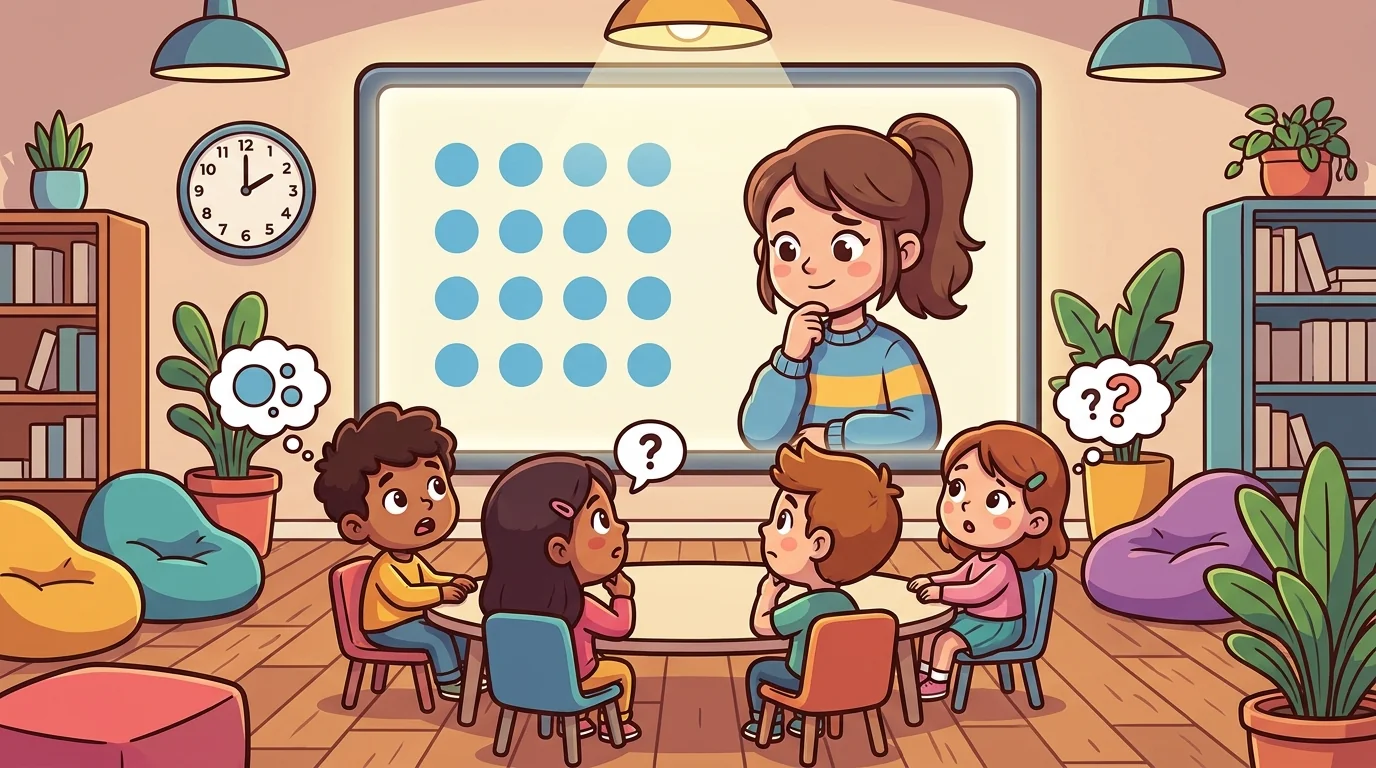
The circle wanted to start solving before they'd even looked.
Mateo, Priya, Lux, and Jess had a picture in front of them — a grid of dots arranged in a square, four by four — and the problem asked how many squares of any size you could find hidden inside it. The circle immediately started counting the little ones, fast, racing, and almost as quickly got tangled and frustrated.
"Sixteen little squares," Lux said. "Then... wait, are we counting big ones too? How many even are there?"
A girl appeared on the screen, looking at the grid the way you'd look at something genuinely interesting, head tilted, eyes soft.
"Before you count anything," she said gently, "can we just look at it for a second? I'm Wendy. And I never start a problem by solving it. I start by noticing. What do you actually see? Not the answer — just... what's there?"
The circle slowed down, a little reluctantly.
"There's a four-by-four grid," Mateo said.
"The dots make rows and columns," Priya added.
"There it is," Wendy said warmly. "You're noticing. Now — what do you wonder?"
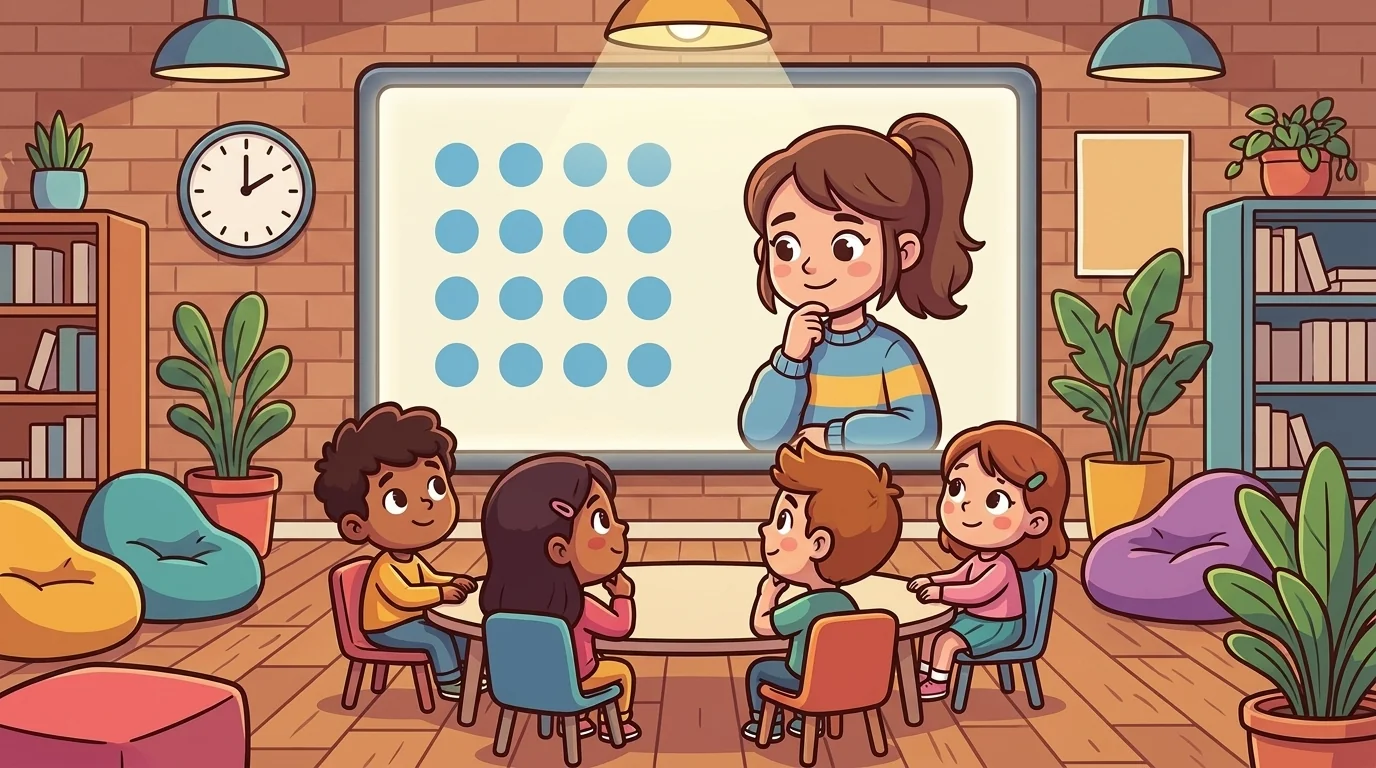
Wendy settled in, in no hurry at all.
"Here's my whole thing," she said. "Most people see a problem and immediately start attacking it — counting, calculating, racing. And they miss what's right in front of them. I do the opposite. I slow way down and just notice — every detail I can see — and then I wonder. I ask the real questions. 'Huh, I wonder if the bigger squares follow the same pattern as the little ones.' 'I wonder what happens at the corners.' The noticing and the wondering do half the work before you've solved a single thing."
She smiled. "When I was little, I thought being good at math meant being fast. Racing to the answer. But I kept missing things — easy things, right in front of me — because I was moving too quick to see them. So I learned to slow down and look. And the strangest thing happened: the problems got easier, because I finally noticed what they were actually made of. And they got more fun, because wondering is just... fun."
"But isn't slowing down a waste of time?" Jess asked.
"Try it and see," Wendy said. "What do you notice about the squares once you really look?"

So the circle stopped racing and started looking.
"There are little one-by-one squares," Lux said slowly. "But also... bigger ones. Two-by-two squares, sitting on the grid. And even a three-by-three. And the whole thing's a four-by-four square itself."
"I wonder," Priya said, catching the spirit, "how many of each size there are. Like, are there fewer big ones than little ones?"
"Let's find out," Wendy said.
They counted by size, calmly now. Sixteen of the smallest. Nine of the two-by-twos. Four of the three-by-threes. One four-by-four.
"Sixteen, nine, four, one," Mateo read out, and then stopped. "Those are square numbers. Backwards. Four squared, three squared, two squared, one squared."
"I wondered if there'd be a pattern," Priya breathed, "and there is."
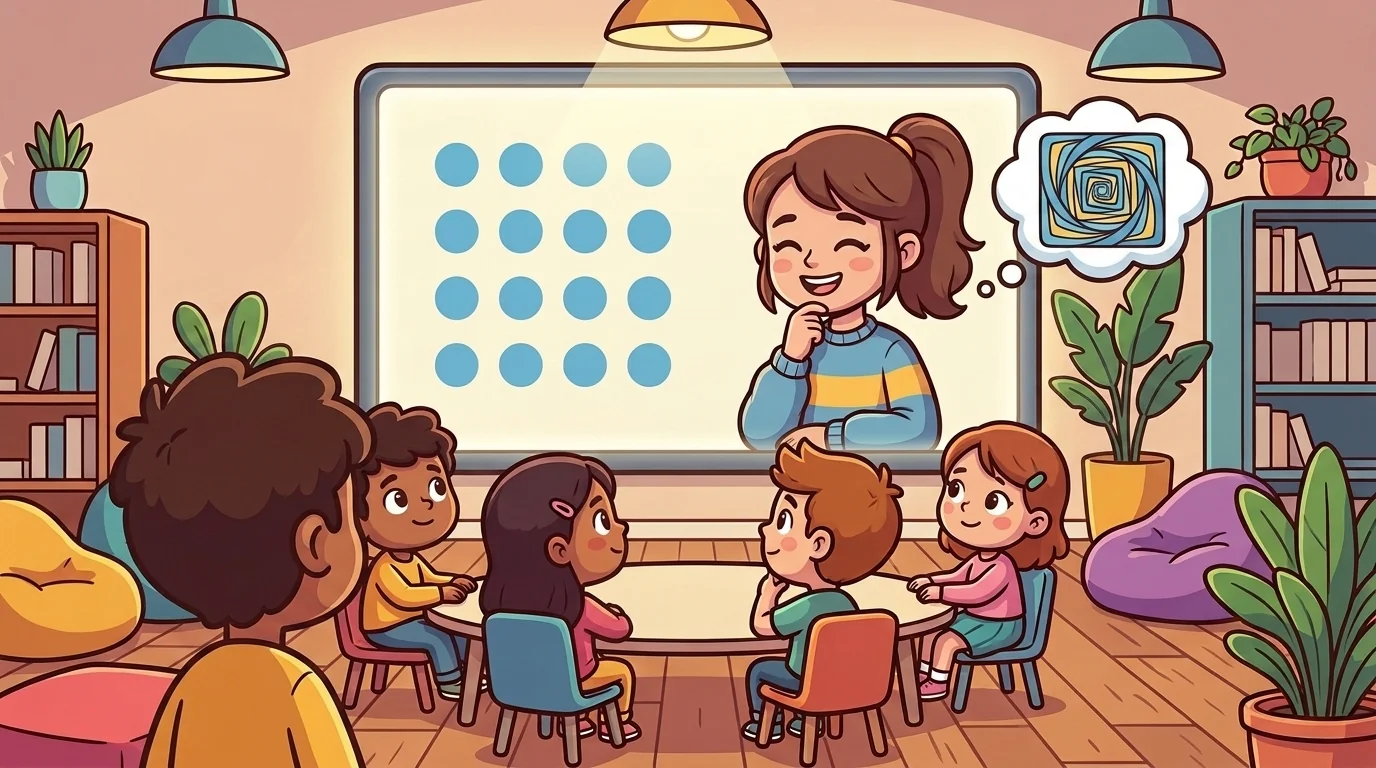
Wendy beamed at them, utterly delighted.
"Do you see what just happened?" she said. "You started out racing and tangled and frustrated. Then you slowed down, noticed what was really there — squares of different sizes — and wondered about them. And the noticing and the wondering led you straight to the pattern. You added them up — sixteen, nine, four, one — and there's your answer: thirty. You didn't power through it. You looked at it, and it opened up."
Lux shook his head. "We were going so fast we didn't even see the bigger squares at first."
"That's what speed costs you," Wendy said gently. "It's not that fast is bad. It's that fast skips the looking. And the looking is where the good stuff hides." She gestured at the grid. "An hour ago this was a chore you wanted to get through. Now it's kind of beautiful, isn't it? Squares inside squares inside squares. That's what wondering does. It turns a thing you have to do into a thing you actually want to look at."
Jess studied the grid with new eyes. "It is kind of beautiful," she admitted.

Later, as the circle wrapped up, Lux stayed behind.
"Can I ask you something?" he said. "Why does the wondering matter? We could've just counted carefully and gotten the answer without all the 'I wonder' stuff."
Wendy thought about it, eyes still on the grid.
"You could have," she agreed. "And you'd have gotten the answer, and felt nothing, and forgotten it by tomorrow. The wondering isn't about getting the answer faster. It's about... actually being there." She smiled. "When I rush, I get answers but the whole thing feels gray and tiring. When I slow down and wonder, even a homework grid becomes something I'm genuinely curious about. The math stops being a wall I have to get over and starts being a thing I get to explore."
She looked up.
"Noticing and wondering is how you fall in love with a problem instead of fighting it," she said. "And problems you love are the ones you actually solve — and the ones you remember."
And as Lux headed home, he found himself, for the first time he could remember, wanting to look more closely at things — not to finish them faster, but just to see what he might notice, and what that noticing might make him wonder.
The MathCircle ensemble
Wendy Wonder is part of MathCircle's distributed-narrative cast. Each character embodies a different curricular primitive; together they teach the full subject.
-

Circle Circe
Meta-host who steps back to let kids talk to each other
-

Echo Edie
Listener-restater; social-fabric weaver
-

Patty Patient
Wait-time character; gentle anti-pressure presence
-

Tortoise Hare
Dual-voice productive-failure surface; embodies the slow-fast tension
-

Tess Try-Small
Specializing — when a problem's too big, try the smallest version first
-

Gemma General
Generalizing — turning a pattern from a few cases into a rule for all of them
-

Hattie Hunch
Conjecturing — daring to guess boldly, then testing the guess honestly
-

Reva Reverse
Working backwards — starting from the goal and reasoning back to the start
-

Cass Check
Sense-checking — asking whether an answer actually makes sense before trusting it