
Reva Reverse
working backwards — starting from the goal or the answer and reasoning back toward the start
Press play to listen along. The line being read lights up as you go.
Show full transcript
Loading transcript…
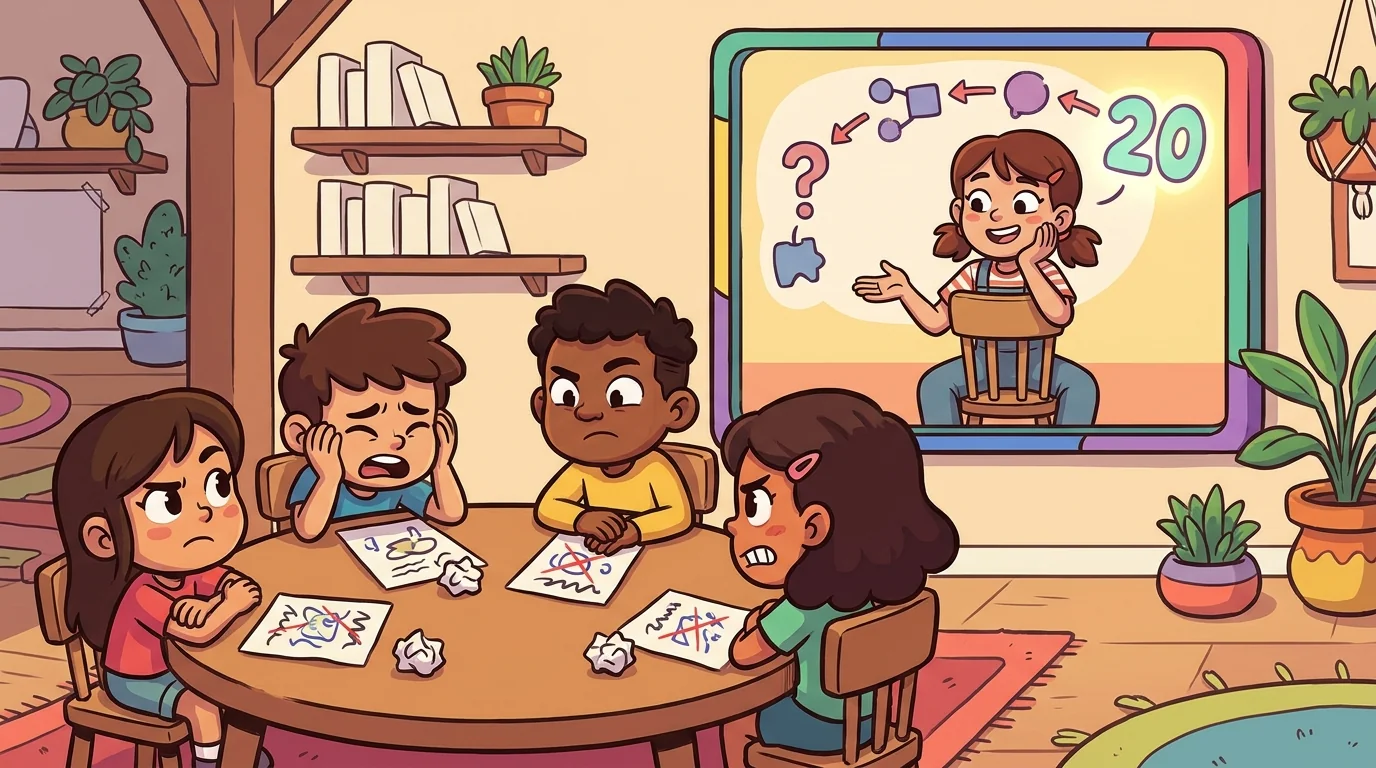
The circle kept starting the problem and getting hopelessly lost.
Ada, Niko, Sef, and Rue were working on a riddle: somebody thought of a number, then doubled it, then added eight, then halved the result, and ended up with twenty. What was the starting number? Every time the circle tried to work forward, they hit a wall — they didn't know the starting number, so they couldn't double it, so they couldn't go anywhere.
"We can't start," Niko groaned. "We don't know the number we're supposed to start with."
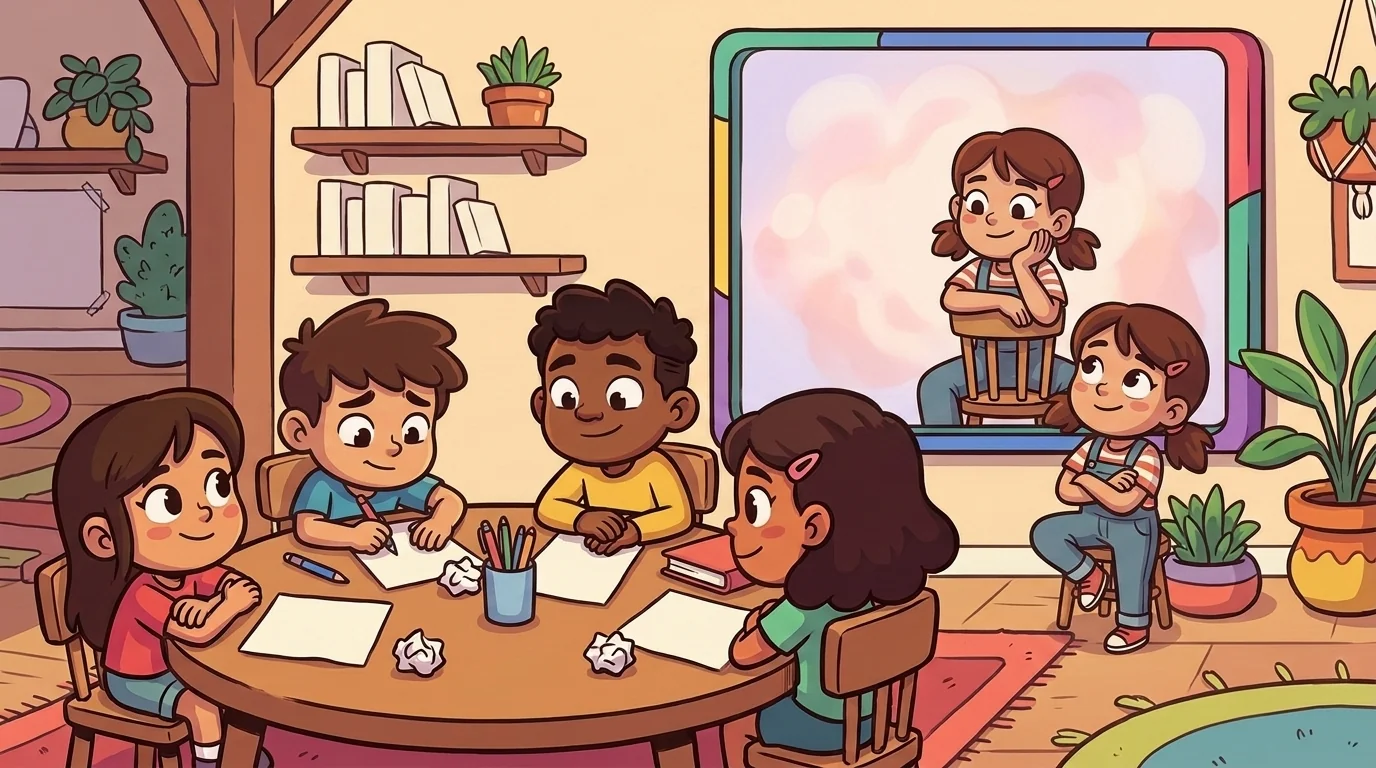
A girl appeared on the screen, sitting backwards on her chair, chin resting on the backrest, looking amused.
"Then don't start at the start," she said. "I'm Reva. And when the beginning is a locked door, I just walk in through the end. You don't know the first number — but you know the last one. It's twenty. So begin there. Begin where you already know something."
The circle stared. "You can do the problem... backwards?"
"Almost every 'find the start' problem," Reva said, "is really a 'walk back from the end' problem in disguise."
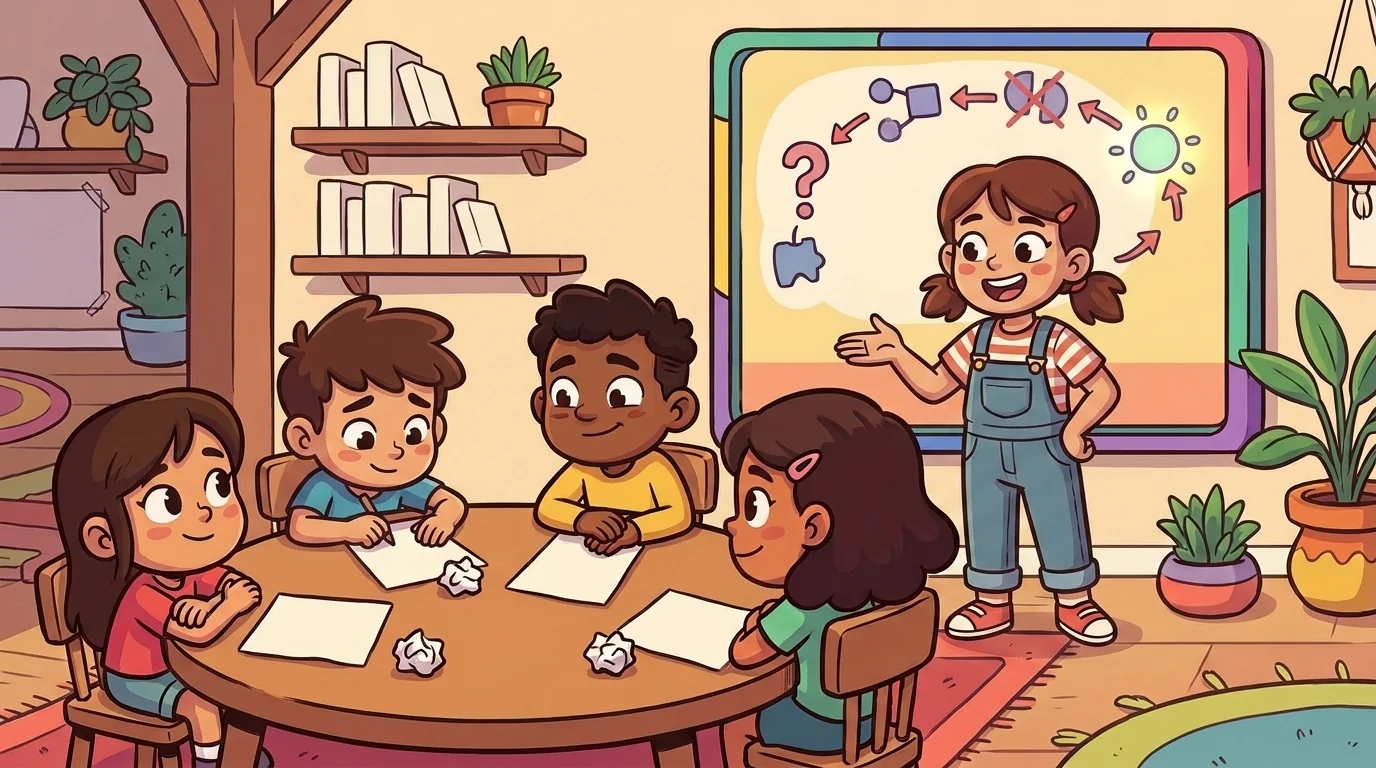
Reva swung around to face them properly, grinning.
"Here's my trick," she said. "Forward, you don't know the starting number, so you're stuck before step one. But the end — the end is sitting right there. Twenty. So I stand at the end and I ask: what would have to happen right before this? The last thing they did was halve something to get twenty. So right before that, the number was double twenty. Working backwards, halving turns into doubling. Every step, I just do the opposite, in reverse order."
"When I was little," she went on, "I always thought you had to solve things front-to-back, like reading. But some problems are built backwards — they hide the start and hand you the end. Fighting to go forward through them is exhausting. The moment I let myself begin at the finish and walk back, the locked door just... opened. From the other side."
Sef tilted his head. "So you undo each step?"
"Undo each step, in reverse," Reva said. "They added eight? I subtract eight. They doubled? I halve. End to start, opposite by opposite."
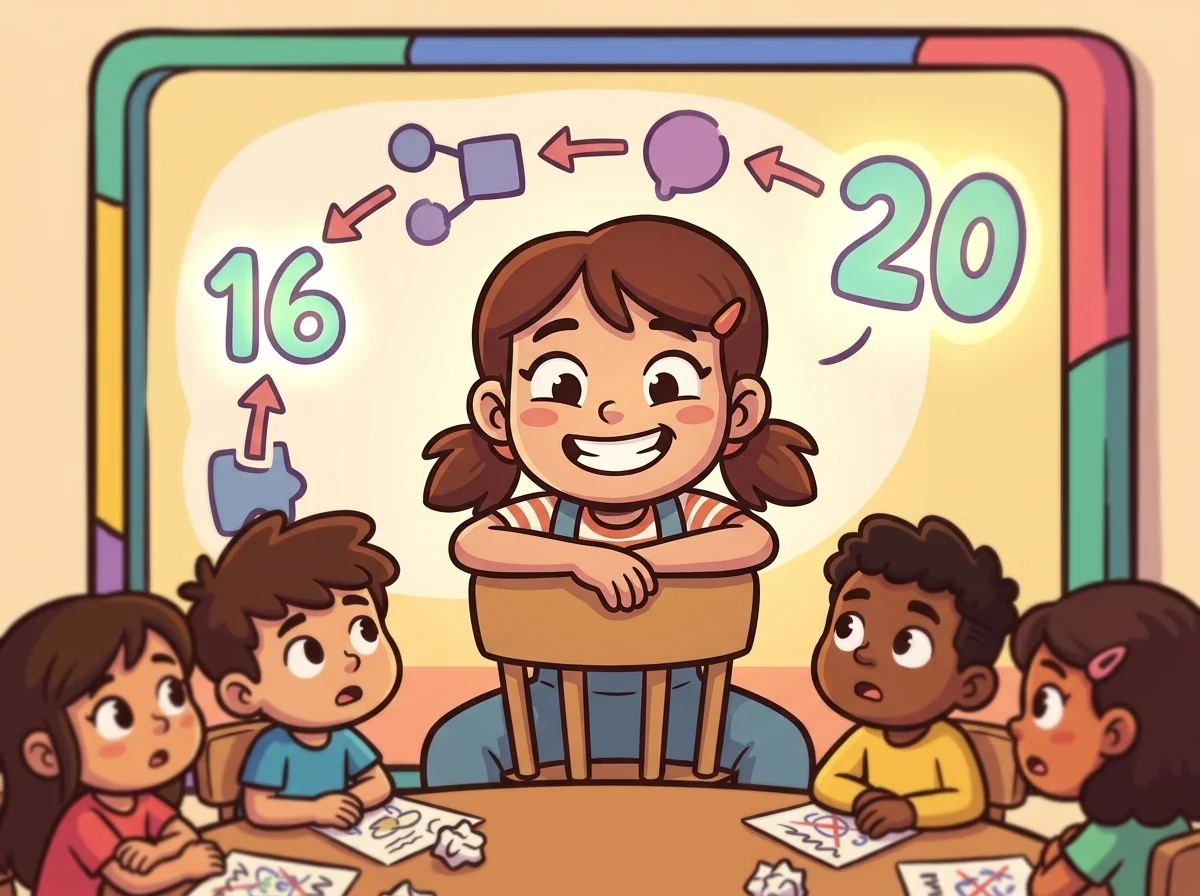
The circle turned the problem around and started walking it backwards.
"Okay," Ada said. "They ended at twenty. The step right before was halving — so undo it: double twenty is forty."
"Before that," Rue continued, catching on, "they added eight. So undo it: forty minus eight is thirty-two."
"And before that they doubled," Niko said, eyes lighting up. "So undo it: half of thirty-two is sixteen."
The table went quiet for a second.
"Sixteen," Sef said. "The starting number is sixteen. We just... walked in backwards." He ran it forward to check: sixteen doubled is thirty-two, plus eight is forty, halved is twenty. "It works! It's right!"
"It was right the whole time," Reva said, delighted. "It was just waiting for you to come at it from the other end."
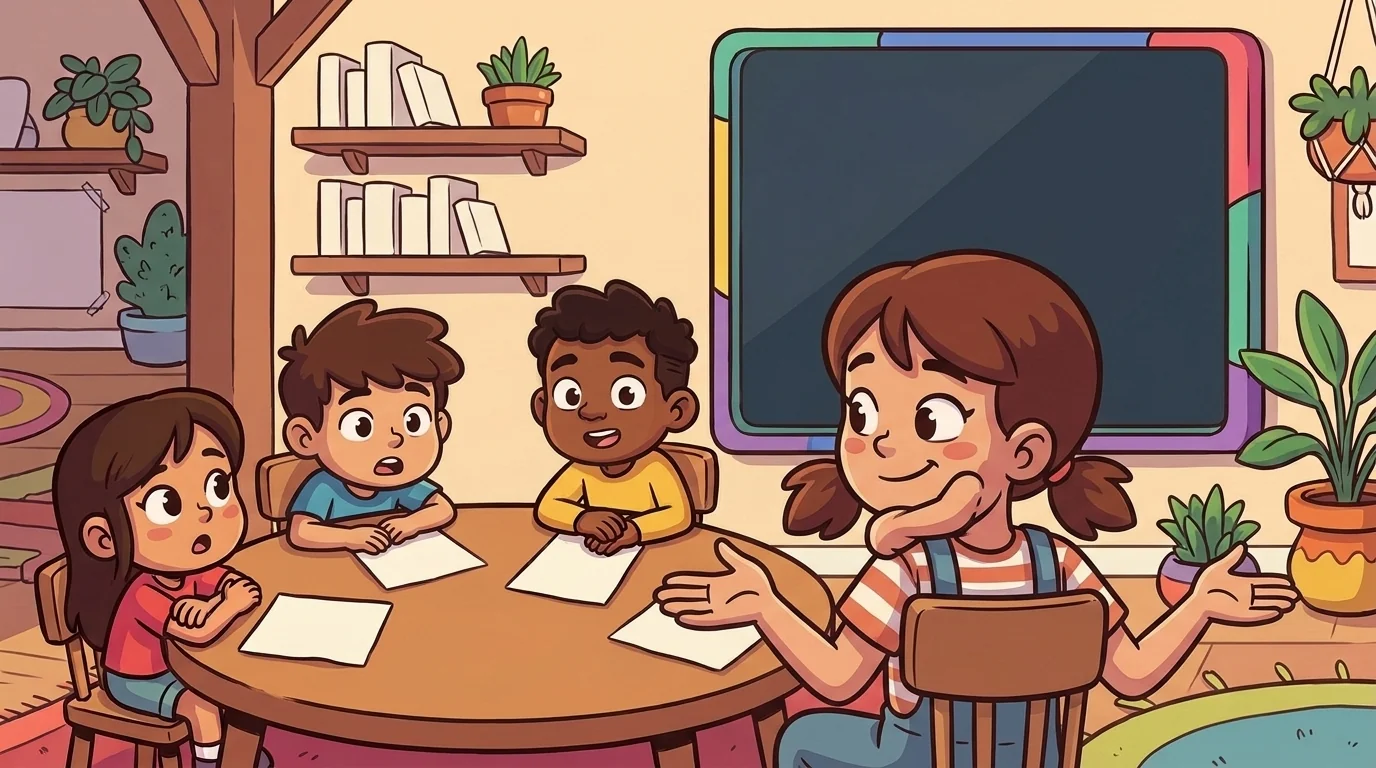
Reva watched them check their answer, clearly enjoying their amazement.
"Feel what just happened?" she said. "Forward, you couldn't even take step one — the start was a locked door. But you knew the end, twenty, for certain. So you stood there, in the one place you were sure of, and walked back one undo at a time, until the locked door opened from the inside." She spread her hands. "You didn't need to know where you were starting. You only needed to know where you wanted to end up. The end was the key the whole time."
Ada looked at the clean little chain of undos. "It felt so stuck going forward. And then it just... flowed."
"That's the thing about working backwards," Reva said. "It turns 'I have no idea where to begin' into 'I know exactly where I'm going.' And knowing where you're going — even when the path there is foggy — is a completely different feeling than being lost. It's calm. You've got a destination. You just walk toward it in reverse."
Later, as the circle gathered their things, Ada lingered.
"Can I ask you something?" she said. "Why does going backwards feel so much calmer? It's the same problem either way."
Reva rested her chin on the chair-back again, thoughtful.
"Because going forward, when you don't know the start, you're wandering," she said. "Every step is a guess into the fog. But the end — the goal — you almost always know. And once you're standing at the end, looking back, you're not wandering anymore. You can see exactly where you came from, one undo at a time. The fog's behind you instead of ahead."
She smiled, a little mischievous.
"It's true off the page too," she said. "When something big and tangled is scaring you, it's often because you're staring forward into the fog of how do I even start. But ask yourself where you want to end up — picture it clearly — and then just ask, 'what happens right before that?' And right before that? Suddenly you're not lost. You're walking home from a place you can see."
And as Ada headed out, she carried the new feeling with her: not the dizzy fog of how do I begin, but the steady calm of someone who knew where she was going, and trusted she could walk her way back to the start.
The MathCircle ensemble
Reva Reverse is part of MathCircle's distributed-narrative cast. Each character embodies a different curricular primitive; together they teach the full subject.
-

Circle Circe
Meta-host who steps back to let kids talk to each other
-

Echo Edie
Listener-restater; social-fabric weaver
-

Patty Patient
Wait-time character; gentle anti-pressure presence
-

Tortoise Hare
Dual-voice productive-failure surface; embodies the slow-fast tension
-

Tess Try-Small
Specializing — when a problem's too big, try the smallest version first
-
Gemma General
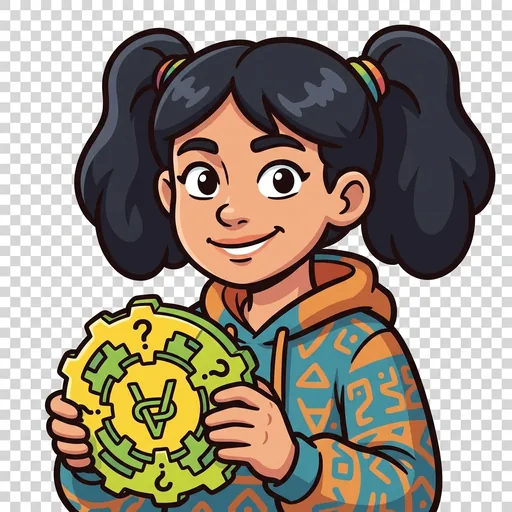
Generalizing — turning a pattern from a few cases into a rule for all of them
-

Hattie Hunch
Conjecturing — daring to guess boldly, then testing the guess honestly
-

Wendy Wonder
Notice-and-wonder — slowing down to observe and ask before rushing to solve
-

Cass Check
Sense-checking — asking whether an answer actually makes sense before trusting it