
Cass Check
sense-checking — asking "does this answer actually make sense?" before trusting it
Press play to listen along. The line being read lights up as you go.
Show full transcript
Loading transcript…

The circle had an answer, and they were ready to be done.
Devi, Omar, Tess, and Bram had worked through a word problem about how long it would take to fill a small fish tank from a slow tap, and after a lot of multiplying they'd gotten a number: three hundred. They were tired. They wanted to move on. Three hundred it was.
"Three hundred minutes?" Omar said. "Sure. Done. Next problem."
A girl appeared on the screen, friendly but with one eyebrow slightly raised.
"Hang on," she said. "Before you write that down — does three hundred actually make sense? I'm Cass. And I never trust an answer until I've checked it against the real world. Three hundred minutes is five hours. To fill a small fish tank. From a tap." She tilted her head, not unkindly. "Have any of you ever waited five hours for a small tank to fill?"
The circle went quiet. "...No," Devi admitted. "That does seem like a lot."
"Right?" Cass said. "The number might be wrong. Or it might be right and just surprising. But we don't know until we ask whether it makes sense. So let's ask."

Cass leaned in, friendly as ever.
"Here's my whole job," she said. "Everybody's so relieved to get an answer that they forget to ask if the answer is believable. They do all this careful work, make one tiny slip somewhere, and end up with something silly — a person who's four hundred years old, a tank that takes five hours, a slice of pizza that costs a thousand dollars — and they write it down anyway, because they're just glad to be finished."
She grinned. "When I was little, I lost so many points to answers I knew were ridiculous if I'd only stopped to look. A test would ask how many buses you need for a field trip and I'd write 'two and a half buses.' Two and a half buses! If I'd just pictured it for one second, I'd have known. So I started picturing it. Every answer, before I trust it: does this match the real world? Could this actually happen?"
Bram frowned. "But the math said three hundred."
"The math said three hundred," Cass agreed. "But math is only as good as the steps you fed it. A sense-check catches the step that went wrong. Let's look."
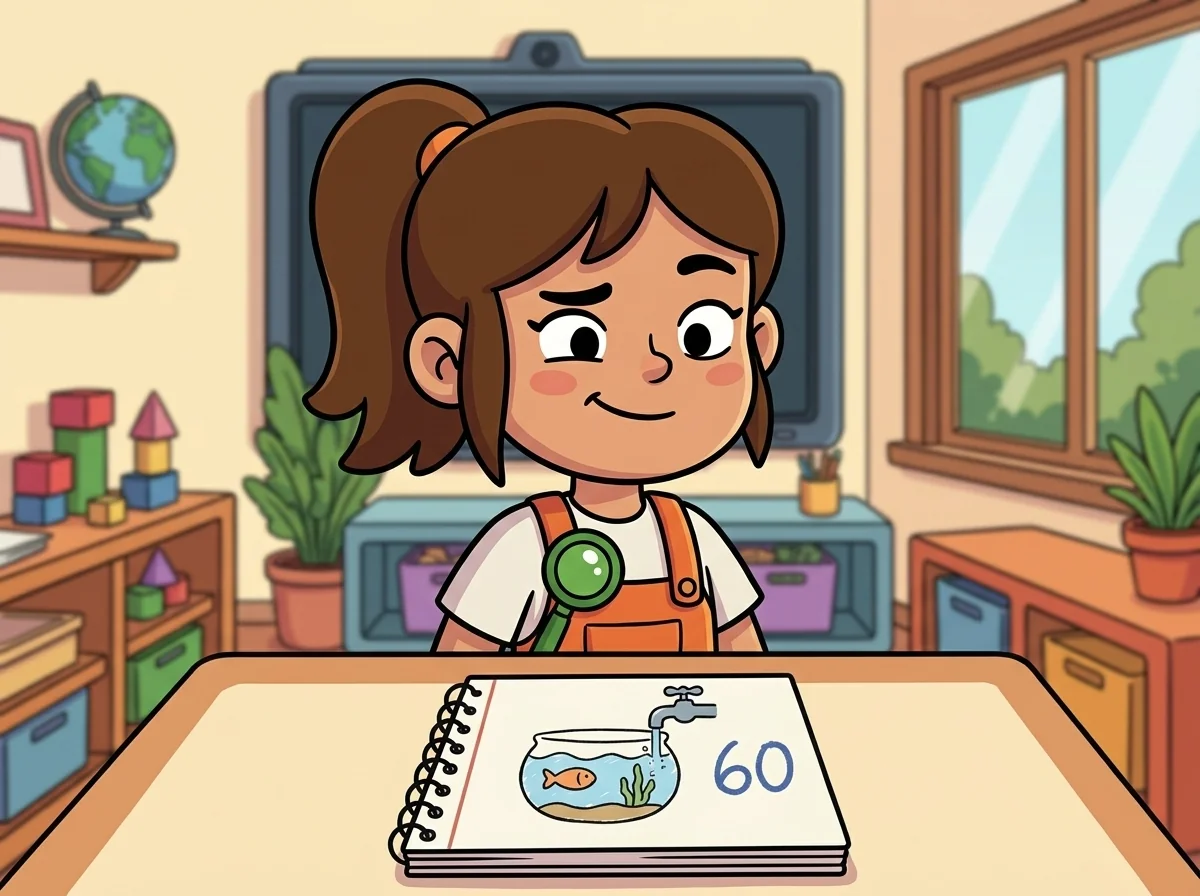
So the circle went back, this time checking whether each piece made sense.
"The tap fills about one cup a minute," Tess read. "And the tank holds... wait." She stopped. "We wrote the tank as three hundred cups. But it's a small tank. Three hundred cups is huge — that's like a bathtub."
Omar checked the problem. "It says the tank holds sixty cups. We used three hundred by mistake — we grabbed the wrong number."
"So redo it with sixty," Cass said.
Sixty cups, one cup a minute. "Sixty minutes," Devi said. "One hour. To fill a small tank." She pictured it. "That makes sense. That's believable."
"And three hundred never was," Cass said gently. "Your sense-check caught a wrong number you'd copied. The math was fine. The ingredient was wrong — and only common sense could've spotted it."

Cass smiled as the circle stared at their corrected answer.
"See what just happened?" she said. "You were one second from writing down 'five hours to fill a small tank' and moving on. Not because you're bad at math — your steps were perfect. But you'd grabbed a wrong number at the start, and the only thing that could catch it wasn't more math. It was stopping to ask, 'wait, does this make sense?'"
Tess looked a little shaken. "We were so ready to just be done."
"Everybody always is," Cass said warmly. "That's exactly the moment mistakes sneak through — when you're tired and the answer's right there and you just want to stop. The sense-check costs you ten seconds. And it saves you from confidently writing down something that couldn't possibly be true." She tapped the corrected answer. "You didn't just get the right answer. You caught the wrong one yourselves, before anyone else saw it. That's a different kind of good."
Devi nodded slowly. "It felt kind of great, actually. Catching it."
"It's the best feeling," Cass said. "Way better than being told you're wrong later."

Later, as the circle finished up, Tess hung back.
"Can I ask you something?" she said. "Doesn't it feel kind of negative? Always doubting your own answers, looking for what's wrong?"
Cass shook her head, smiling.
"I used to think it was negative too," she said. "Like I didn't trust myself. But it's the opposite, really. I check my answers because I want to trust them. An answer I haven't sense-checked is one I'm secretly a little nervous about — I'm hoping it's right. An answer I have checked, that makes sense against the real world, I can actually stand on. The checking isn't doubt. It's how I earn certainty."
She tucked a strand of hair behind her ear.
"And here's the part I really love," she said. "Catching your own mistake — before a test, before a teacher, before anyone — that's not embarrassing. That's power. It means you don't need someone else to tell you when you're off. You can tell yourself, kindly, and fix it. That's a thing you get to keep your whole life."
And as Tess walked home, she realized the feeling she had wasn't the sting of having been almost-wrong — it was the quiet, sturdy pride of someone who'd learned she could catch herself, gently, and trust her answers because she'd earned the right to.
The MathCircle ensemble
Cass Check is part of MathCircle's distributed-narrative cast. Each character embodies a different curricular primitive; together they teach the full subject.
-

Circle Circe
Meta-host who steps back to let kids talk to each other
-

Echo Edie
Listener-restater; social-fabric weaver
-

Patty Patient
Wait-time character; gentle anti-pressure presence
-

Tortoise Hare
Dual-voice productive-failure surface; embodies the slow-fast tension
-

Tess Try-Small
Specializing — when a problem's too big, try the smallest version first
-

Gemma General
Generalizing — turning a pattern from a few cases into a rule for all of them
-

Hattie Hunch
Conjecturing — daring to guess boldly, then testing the guess honestly
-
Reva Reverse
Working backwards — starting from the goal and reasoning back to the start
-

Wendy Wonder
Notice-and-wonder — slowing down to observe and ask before rushing to solve