
Circle and Echo
listening as math — restating what your teammate said before adding your own idea
A story read by Circle and Echo
Press play to listen along. The line being read lights up as you go.
Show full transcript
Loading transcript…
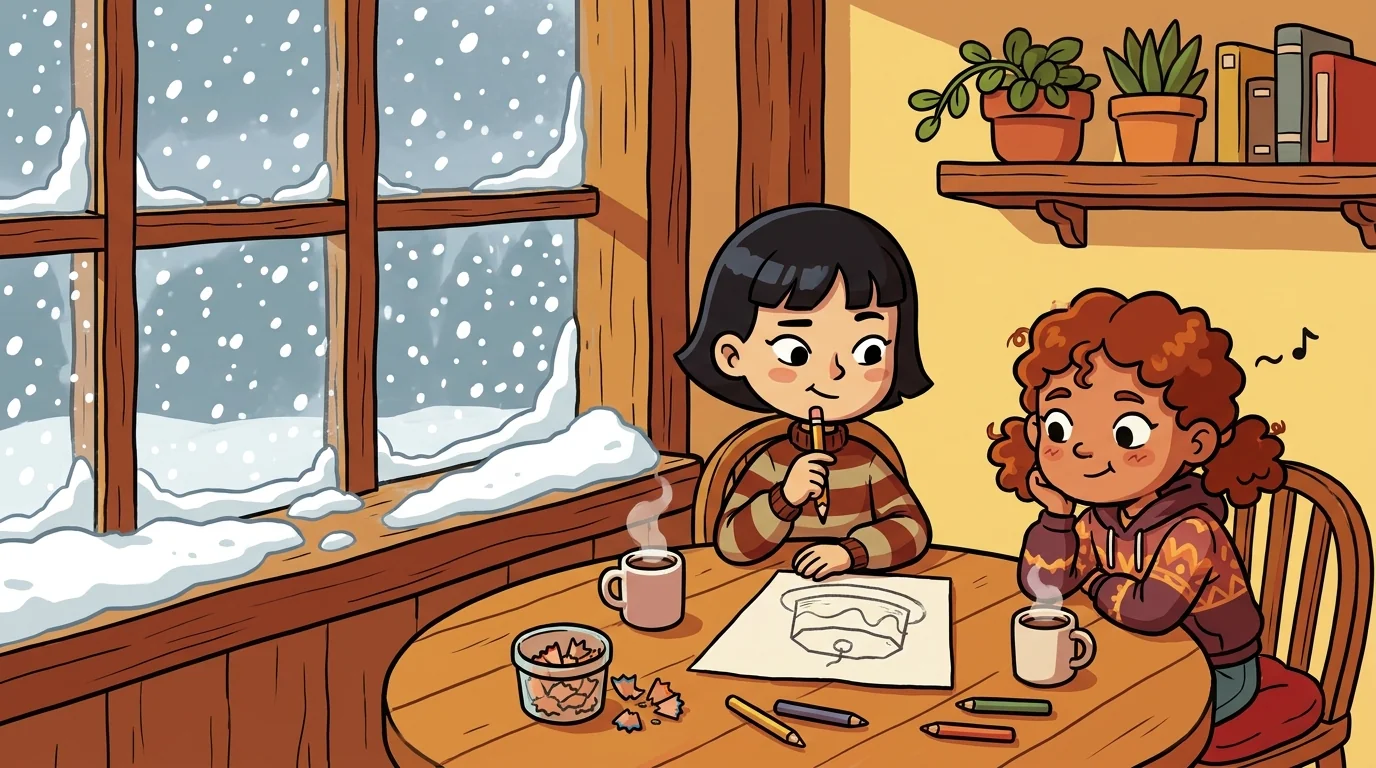
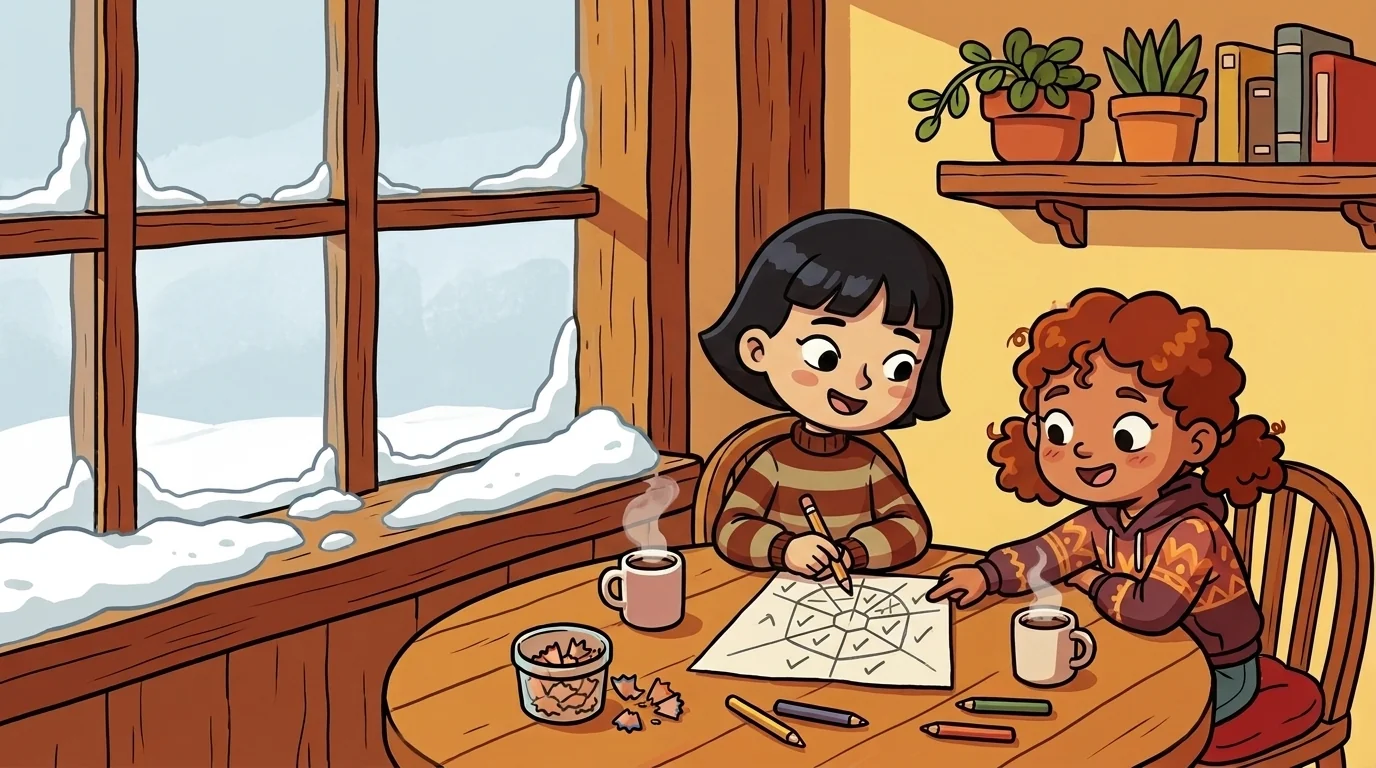
The snow had been falling for almost an hour, and at the round wooden table near the bay window of the math circle's old library room, two friends were trying very hard to feed seven yetis.
The problem in front of them was simple enough to state and impossible enough to solve cleanly that it had occupied them, in companionable silence, for the better part of fifteen minutes. A drawing of a lopsided nonagon — nine-sided, vaguely cake-shaped — sat on the table between them. Above it, in Circle Circe's careful, unhurried handwriting, the conditions: Seven yetis. One cake. If any yeti receives even a crumb more than another, a yodeling contest will commence, and an avalanche will follow.
Circe was the kind of mathematician who liked to begin by understanding what she was looking at. She had drawn the nonagon herself, very carefully, on a fresh sheet of paper. She had a private theory that messy diagrams produced messy thinking, and that one of the small disciplines a person could cultivate, if she wanted to think well, was the discipline of redrawing the problem before attempting it.
Echo Edie, sitting across from her, was a different kind of mathematician. Edie did not redraw things. Edie listened. She had a habit of leaning slightly forward when the other person was speaking, of humming a small, distracted-sounding hum that meant she was concentrating, and of saying — at intervals that struck most people as both irritating and necessary — So what you're saying is...
She said it now.
"So what you're saying is," Edie murmured, although Circe had not yet said anything, "this is a nonagon. Nine sides. For seven yetis. And the yetis are very serious about fairness."
"I have not said any of that out loud," Circe pointed out.
"I am restating your drawing," Edie said.
Circe considered this and decided it was fair.
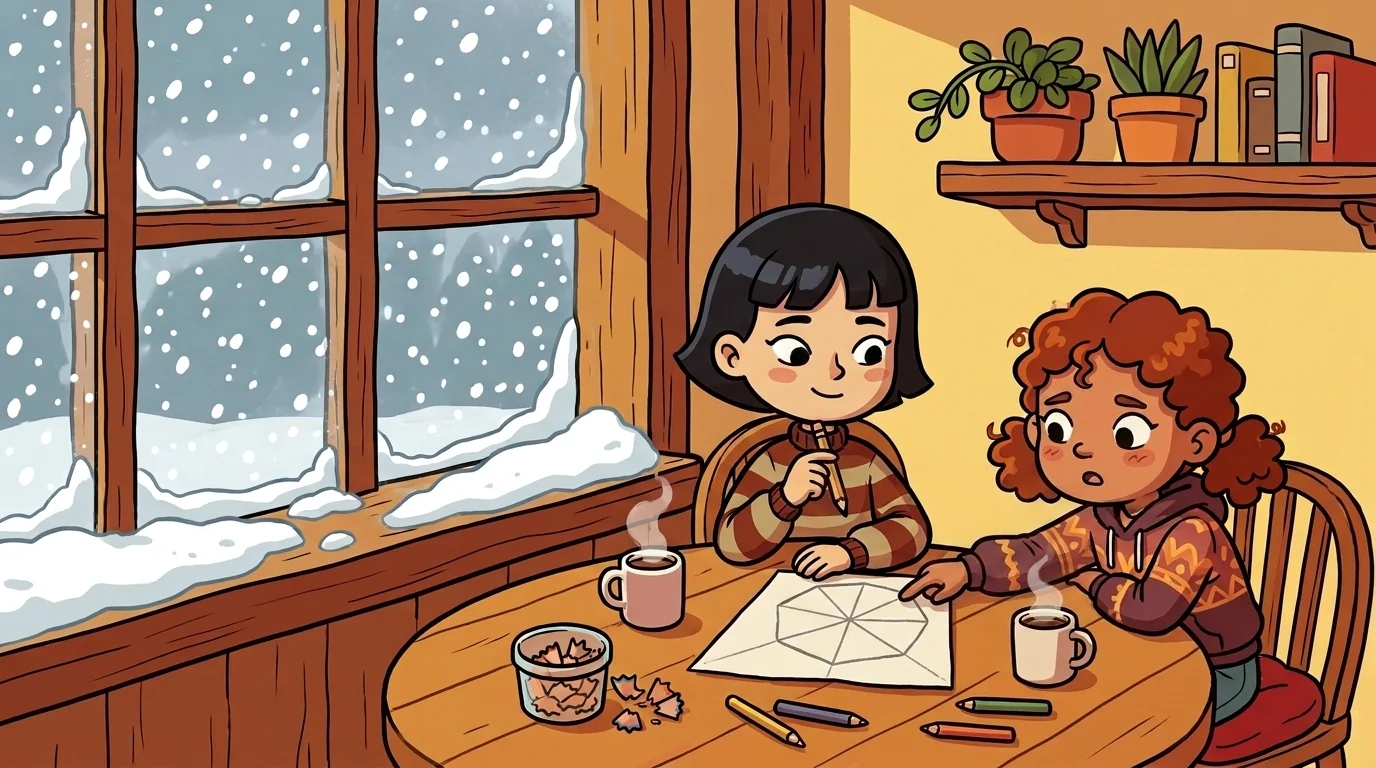
The first thing Circe did, after a moment's quiet, was the natural thing. She drew nine straight lines from the center of the nonagon out to each of the nine corners, like the slices of a pizza, and laid down her pencil with the small satisfaction of a person who has produced a clean idea.
"The simplest cut," she said. "From the center, out to the corners. Nine identical wedges. We give one to each of seven yetis. We have two left."
She looked up at Edie, expecting agreement. Two leftover wedges was not, on the face of it, a disaster. It was a partial solution, and partial solutions were the kind of thing she liked. They had structure. They could be repaired.
But Edie was already humming.
"So what you're saying is," Edie said, slowly, "we slice it like a pizza. Nine clean wedges. Each yeti takes one wedge, which solves the easy part. And the hard part, the part we have to come back to, is the two wedges nobody has eaten yet."
"Yes."
"And the two wedges we have left over each need to be divided into seven exactly equal portions. So that nobody — not the yeti who got their wedge first, not the yeti who only gets a little crumb from the leftover wedges — receives even a crumb more than anyone else."
"Yes."
Edie looked at the drawing for a long time. "I want to say something about that," she said, "but I want to say it carefully, because I don't want you to think I am dismissing your idea. Your idea is the right place to start. I am restating it so I am sure I understand what you're proposing before I try to add to it."
"I am paying attention," Circe said.
"What I want to say is: the moment we start dividing those two leftover wedges into seven equal pieces, the geometry stops being friendly. A wedge is a triangle. Cutting a triangle into seven exactly equal pieces is — geometrically possible, but the kind of possible that takes a ruler and a protractor and a lot of trust."
"That is true."
"So I'm not sure my objection is that your idea is wrong," Edie said. "My objection is that your idea solves the easy part of the problem and pushes the hard part of the problem one step further down the road. Which is a normal thing for an idea to do. It just means we need to ask whether there is a different first move that doesn't push the hard part down the road."
Circe was quiet for several seconds. She was not offended. She was, in a way she had been learning to recognize over the past two years of these afternoons, grateful. There was a thing Edie did, that Circe's own mind did not naturally do, which was to receive an idea fully — completely — and then ask, is this the version of the problem we want to keep solving? Circe's instinct was to refine an idea until it worked. Edie's instinct was to ask whether the idea had pointed them at the right shape of question.
"All right," Circe said. "What if we don't start from the center?"
Edie picked up her own pencil, which was a perfectly ordinary, somewhat blunt pencil that had a small bite mark on the eraser end.
"So what you're saying is," she began — and Circe smiled, because she had begun to find this small ritual genuinely useful — "we should look at a different first move. Something that doesn't leave us with leftover wedges that nobody knows how to share."
"Yes."
"All right." Edie tapped her pencil against the drawing. "We have a nonagon. Nine sides. We have seven yetis. Nine and seven are coprime, which is a polite way of saying they have nothing in common. There's no factor we can pull out to make them play nicely. So instead of starting with the nine, what if we start by giving ourselves a seven?"
She drew, on the same paper, a small but firm pair of lines. Two of the nonagon's nine vertices were now sliced off. The remaining shape — Circe traced it with her eyes — was, in fact, a heptagon. Seven-sided. Seven was the number of yetis.
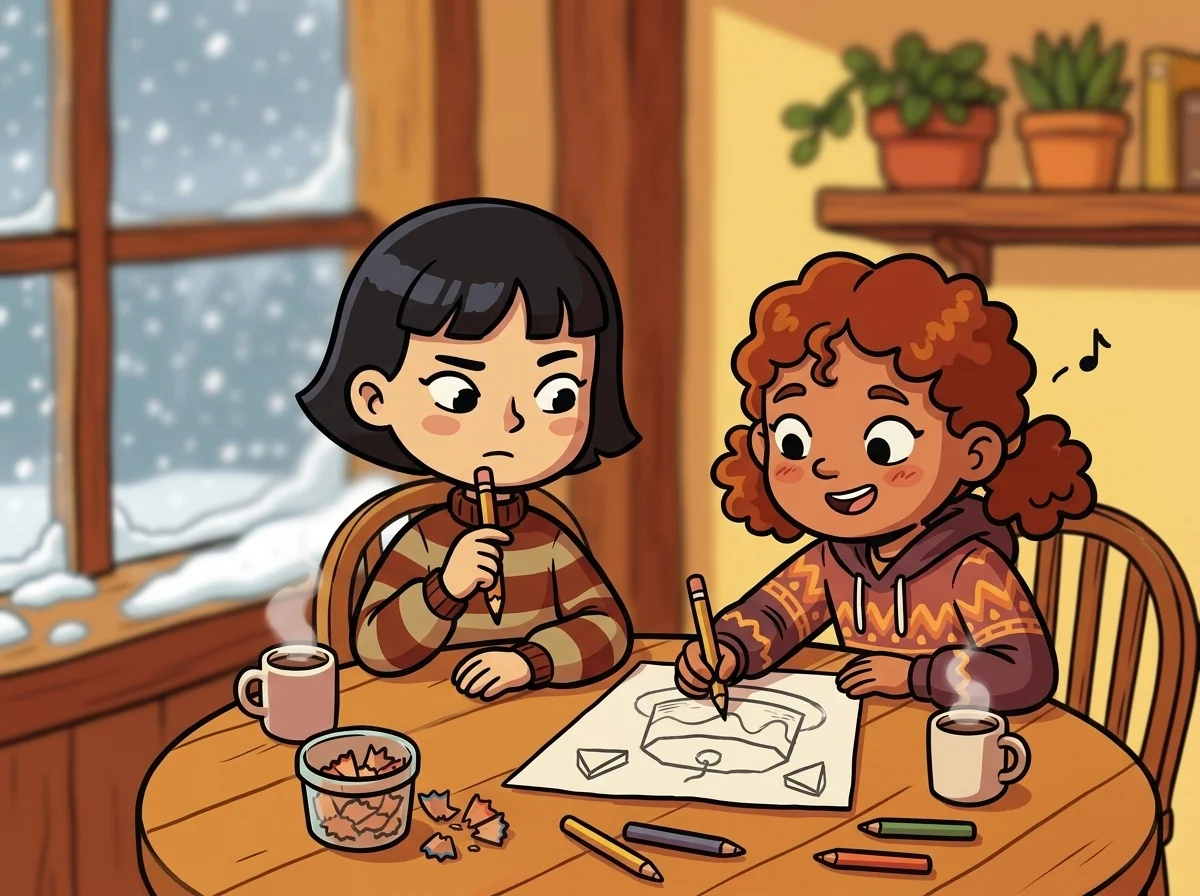
"If we trim two corners off," Edie said, "the inner shape is a heptagon. And a heptagon, sliced from its center, gives us seven equal wedges. Seven yetis, seven wedges, one each. Clean."
Circe looked at the new diagram. It was a beautiful idea. Beautiful in the way Edie's ideas often were — not surgical, but generous. Reshape the problem before you solve it. Circe had once read, in a footnote to a translation of Euler, that the great mathematicians distinguish themselves not by solving the hardest problems but by selecting the right form of those problems.
She was about to say so.
Then she saw the two trimmed corners, sitting in the corner of the drawing like discarded triangle-shaped offcuts, and she felt a small, familiar dissonance.
"Echo," she said quietly. "I want to restate what you just proposed before I add to it. Because you've done me the courtesy of restating my ideas, and I want to do the same."
"All right."
"What you're proposing," Circe said, "is that we change the geometry of the cake itself. We turn it from a nonagon into a heptagon by cutting off two of its corners. Inside the heptagon we make seven clean wedges, one for each yeti, and that solves the hard part of the original problem — the part where nine wedges can't be divided cleanly among seven yetis."
"Yes."
"The thing your idea does not yet solve," Circe said, gently, "is what happens to the two corners we trimmed off."
Edie put her pencil down. "Ah."
"The yetis will know."
"The yetis can smell wasted cake from a mile away."
"They can. So we are now in the same kind of situation as before. Your first move solved the easy part of the problem and pushed a different hard part one step down the road. The hard part is now: how do we divide two triangle-shaped offcuts equally among seven yetis."
"Which is just as hard as dividing two wedge-shaped offcuts among seven yetis."
"Yes."
The two friends sat with this for a moment, looking at each other across the table with the particular companionable resignation of people who have spent enough afternoons together to know that being stuck is a normal stage of the work and not a moral failure.
"All right," Edie said. "I think you're going to tell me that what we actually want is a different kind of move."
"I think what we want," Circe said slowly, "is a move that doesn't generate leftovers. A move where the very act of cutting the cake produces exactly the right number of equal pieces, with no offcuts."
"What you're saying is — instead of starting from the center, or trimming the outside, we look for a third way."
"Yes."
Circe stared at the nonagon for a long time. Edie watched her stare. Circe had a way of looking at things that was not quite the same as looking. She was, Edie had decided some months ago, a person whose face went very still when her mind was working hardest, which was disconcerting if you did not know her and informative if you did.
"What if we draw a smaller nonagon inside the big one," Circe said.
"Restate that for me."
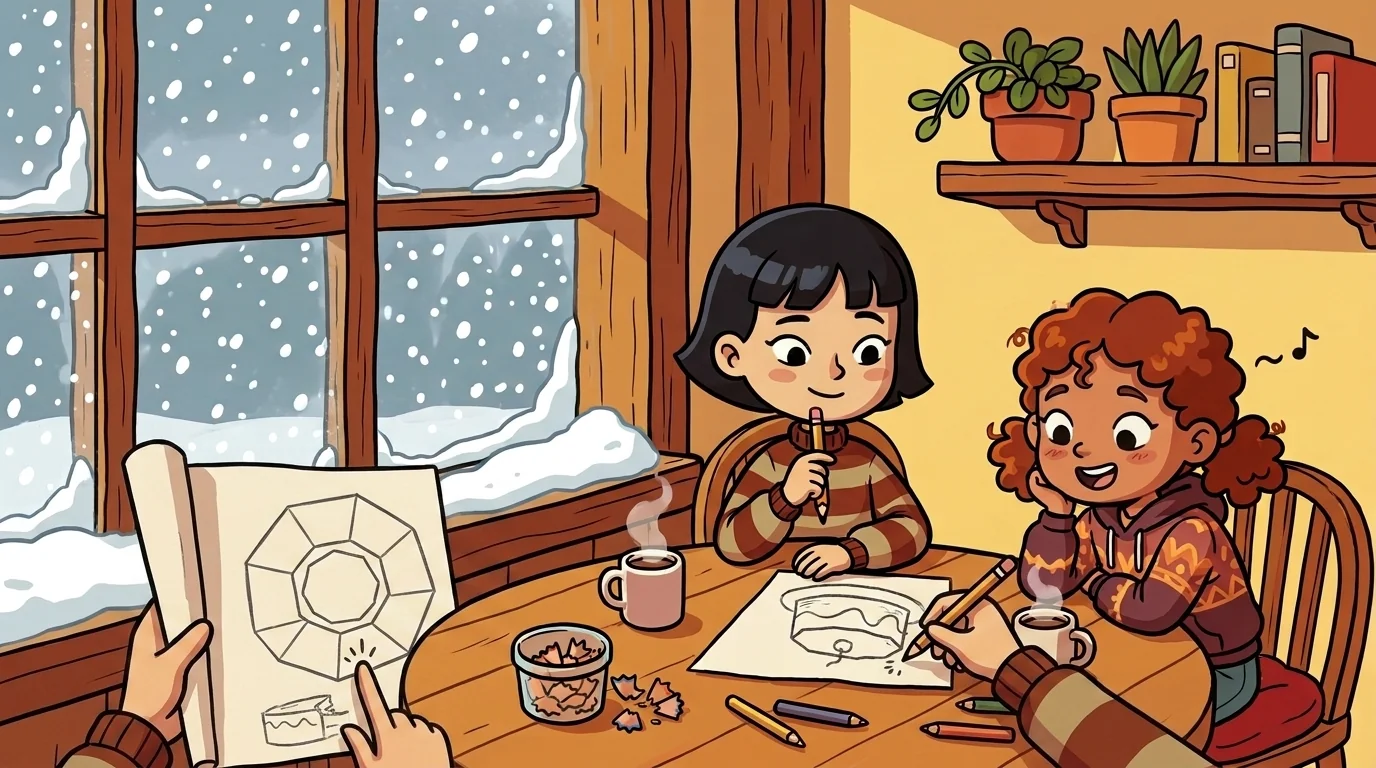
"What if I take the nonagon," Circe said, "and inside it — concentric, with the same nine vertices radiating out to the same nine corners — I draw a smaller nonagon. So the cake is now made of two pieces: a small central nonagon, and around it, a ring made of nine identical trapezoids."
She drew it as she said it. The nine trapezoids ringed the inner nonagon like the petals of a stiff, geometric flower.
Edie hummed. "So what you're saying is — nine identical pieces around the outside, and one small whole nonagon in the middle."
"Yes."
"And we have seven yetis."
"So each yeti receives one trapezoid. That uses seven of the nine outer pieces. We are left with two outer trapezoids and one inner nonagon."
"Which is still leftovers."
"It is. But it is leftovers of a different shape."
Edie's eyes narrowed. She leaned forward over the drawing. "Say that part again."
Circe smiled. "It is leftovers of a different shape. The original leftovers were wedges — triangles converging at a point. The trimmed-corner leftovers were triangles at the corners. Both of those shapes are hard to divide into seven equal pieces. But trapezoids are not hard to divide into equal slices. You cut them into long, parallel strips. And the inner nonagon — a small nine-sided shape — is itself a cake we already know how to attack. Or," Circe paused, "a cake we can hand back to ourselves as a smaller version of the same problem."
Edie sat back, slowly, and put both hands flat on the table.
"Circle," she said.
"Yes."
"That's a recursive solution."
"It is."
"The hard part of the problem is now smaller. It's the same shape as the original problem, but smaller."
"Yes. We have made the nonagon-for-seven-yetis problem into a smaller-nonagon-for-seven-yetis problem, plus two trapezoids that any kid could divide into seven equal strips with a ruler. And the inner nonagon — we can attack it the same way, again, until the leftover cake is small enough to ignore. Or we just divide it into seven strips, since by that point it will be small enough that strip-cutting works fine."
Outside the bay window, the snow had stopped. The afternoon light was low and gold and falling sideways across the wooden table, and the drawing in front of them was a tidy, almost beautiful nest of nested nonagons, ringed with trapezoids, each one indistinguishable from its neighbors.
Edie picked up her pencil one more time. "So what you're saying is," she said, very softly, almost to herself, "good listening — yours, mine — is what made this possible. If I had not restated your first idea, you would have spent the afternoon trying to slice triangles into seven crumb-piles. If you had not restated my second idea, I would have spent the afternoon trying to share two corner-triangles. Each restating slowed us down by maybe thirty seconds. And it saved us, between us, about two hours."
Circle Circe looked at the drawing. The seven yetis were going to eat. The avalanche was not going to happen. The cake was going to be fair.
"Good listening," she said.
"Good echoes," Edie replied.
The MathCircle ensemble
Circle and Echo is part of MathCircle's distributed-narrative cast. Each character embodies a different curricular primitive; together they teach the full subject.
-

Circle Circe
Meta-host who steps back to let kids talk to each other
-

Echo Edie
Listener-restater; social-fabric weaver
-

Patty Patient
Wait-time character; gentle anti-pressure presence
-

Tortoise Hare
Dual-voice productive-failure surface; embodies the slow-fast tension
-

Tess Try-Small
Specializing — when a problem's too big, try the smallest version first
-

Gemma General
Generalizing — turning a pattern from a few cases into a rule for all of them
-

Hattie Hunch
Conjecturing — daring to guess boldly, then testing the guess honestly
-
Reva Reverse
Working backwards — starting from the goal and reasoning back to the start
-

Wendy Wonder
Notice-and-wonder — slowing down to observe and ask before rushing to solve
-

Cass Check
Sense-checking — asking whether an answer actually makes sense before trusting it