
The Layout
BUILDING A PAGE — *a manga page is not five separate drawings. it is establishing shot, panels, transitions, gutters, and sound all arranged to guide one reader's eye through one moment of story.*
Press play to listen along. The line being read lights up as you go.
Show full transcript
Loading transcript…
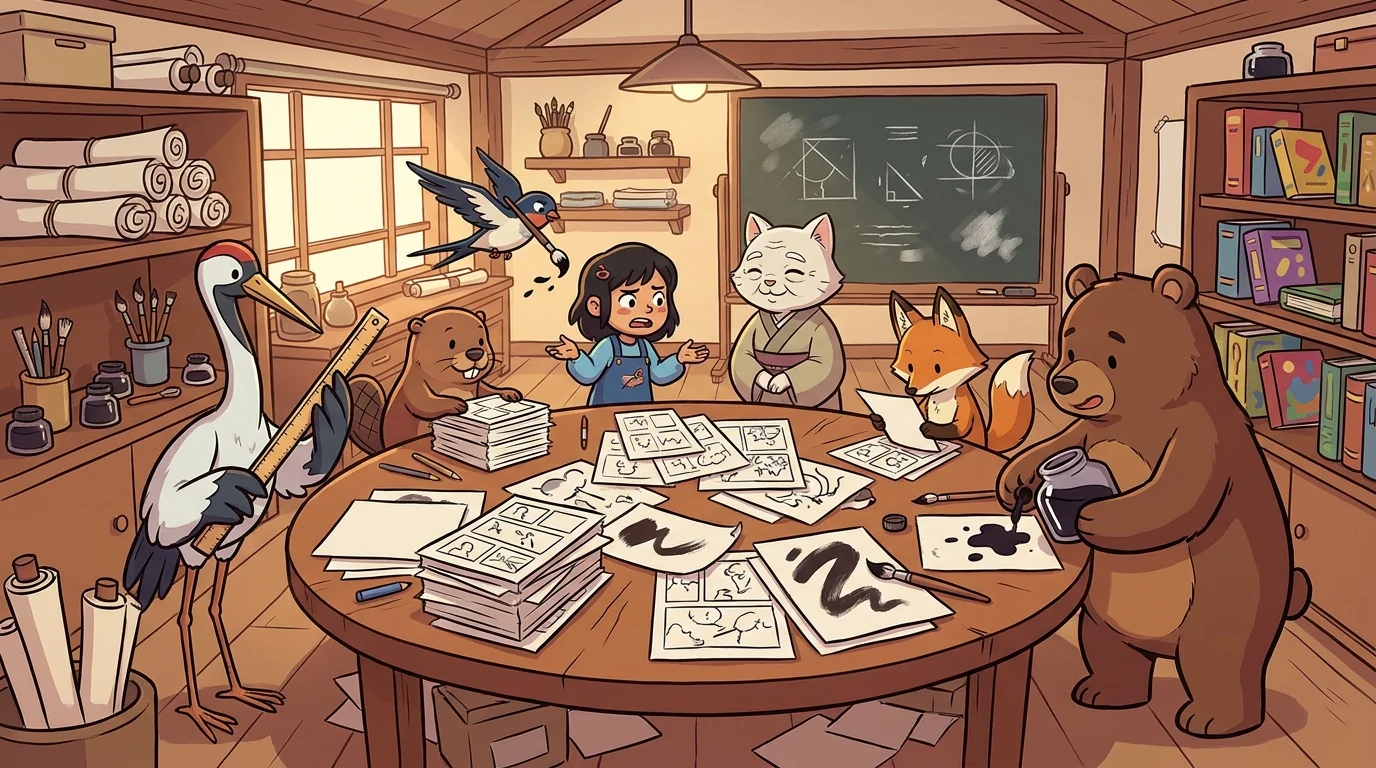
Sumi had drawn every piece of the page, and somehow it still didn't work.
The little apprentice spread her drawings across the big table in the MangaForge studio, where the whole company had gathered. "Look," she said, frustrated. "Here's a wide drawing. Here's some panels. Here's a big sound word. They're all fine on their own. But when I put them on a page together it's just a jumble — your eye doesn't know where to go, and the story doesn't flow. I don't get it. Each drawing is good. Why is the page bad?"
Sensei Sora, the studio's gentle old cat-master, folded her paws and smiled. "Because a page is not a pile of good drawings," she said. "A page is good drawings arranged to guide one reader's eye through one moment of a story. That arranging — that is a craft all its own. And it takes the whole studio, each holding one job, agreeing on where the eye should travel. Let us build it properly. Vista — you always go first."
Around the table, five artists picked up their pens: Vista the tall crane, Panel the neat beaver, Segue the quick swallow, Lapse the quiet fox, and Boom the booming bear. And they began to build.
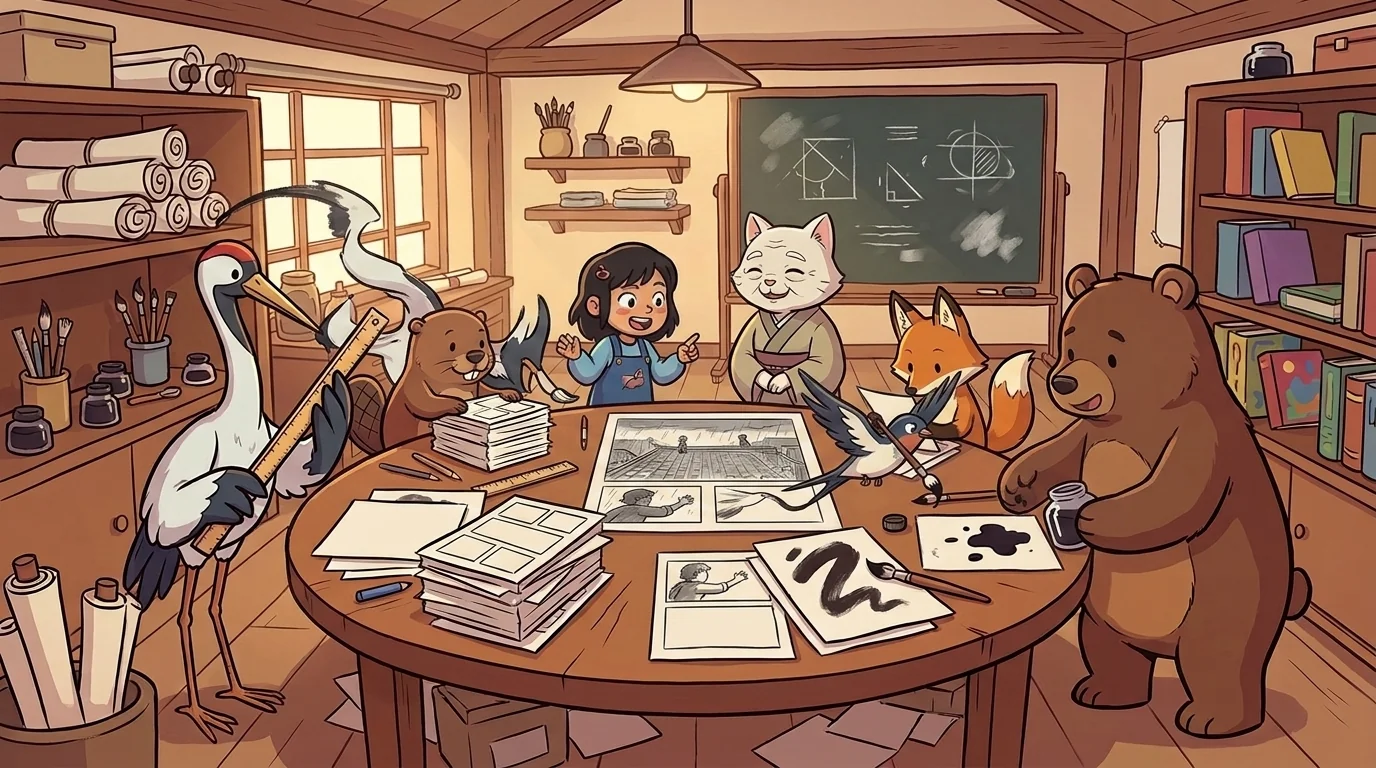
Vista the crane took the top of the page. With a few broad strokes she drew the wide establishing shot — the whole rain-soaked rooftop where the scene would happen, small figures far below. "I go first because the reader needs to know where they are before anything else," she said. "A page that starts close-up is confusing — the reader's lost. My wide shot says: here is the world. here is the stage. Then we can come in close."
Panel the beaver went next, dividing the space below Vista's wide shot into clean frames. "Each of my panels holds exactly one moment," he said, ruling neat borders. "One panel, one beat of story. Too much in a panel and it's crowded; too little and it's empty." But he glanced up at Segue. "The trouble is — panels on their own are just boxes sitting next to each other. They don't connect. That's not my job."
"That's my job," said Segue the swallow, darting in. She looked at how one panel led to the next — the angle, the direction, the way a character's gesture in one panel pointed toward the next. "Transition. I make sure that when your eye leaves one panel, it flows naturally into the right one — not jumping around lost. A good transition, and the reader's eye slides through the panels like water down a gutter." Panel and Segue worked together — the frames and the flow between them, the two of them a pair — and now the boxes weren't boxes anymore. They were a path.

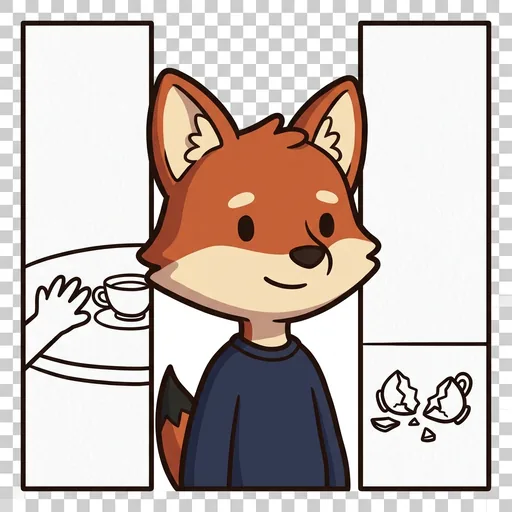
But Lapse the fox was looking at the empty spaces — the white channels between Panel's frames. "You've all been drawing the parts you can see," he said quietly. "I work in the parts you can't." He stepped into the widest gap between two panels. "The gutter. The space between panels where nothing is drawn — and where the reader's own mind fills in what happened. Panel shows the character leaping; the next panel shows them landing. In between, in my empty gutter, the reader's imagination draws the fall. I don't draw anything. I leave room for the reader to. That's not nothing — that's trust."
And then Boom the bear, who had been quiet a suspiciously long time, drew one enormous crackling sound-word across the bottom panel — KA-RAKK! — the lightning splitting the sky. "And I am the opposite of Lapse," he rumbled, delighted. "He's the silence you don't draw. I'm the sound you draw loud. Onomatopoeia — I letter the noise right into the art, so you can see the thunder as much as feel it. My big loud word and his quiet empty gutter—" he grinned at the fox— "we're the two ends of the same page. The hush and the crash. Quiet and Loud." Lapse's empty gutters and Boom's booming word, the two of them a pair, gave the page its whole range — from silence you imagine to sound you can see.
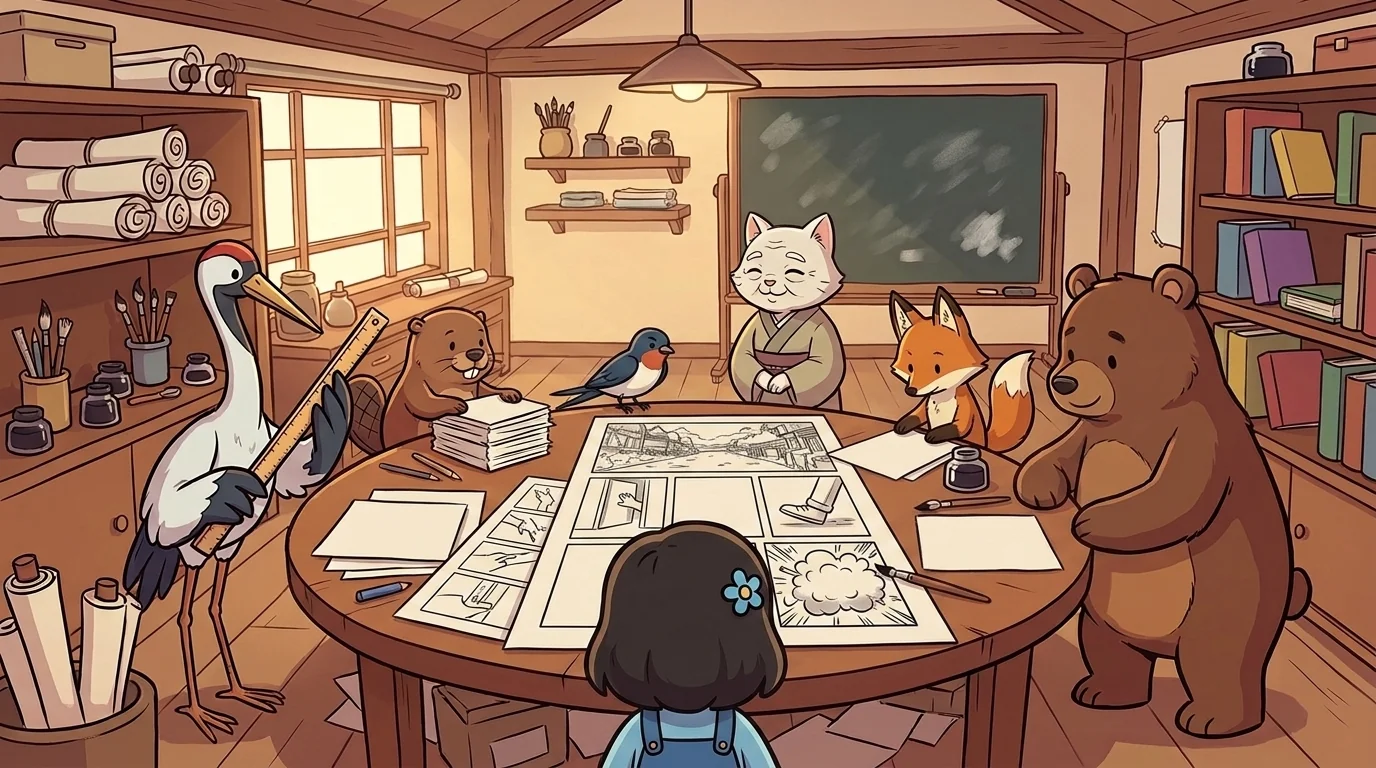
Sensei Sora stepped back and looked at the page they'd built together, and nodded slowly.
It was all there now, and it worked. Vista's wide shot set the stage. Panel's clean frames held each moment. Segue's transitions flowed the eye from one to the next. Lapse's gutters let the reader's mind fill the in-betweens. And Boom's great crackling sound-word landed the final beat. Not one of them had shown off. Each had done one small job — where you are, one moment per box, flow between, room to imagine, sound made visible — and together they'd made something none of them could have made alone: a page, that carried a reader's eye and heart smoothly through one moment of story.
"Oh," Sumi breathed, tracing the path with her paw — down from the wide shot, through the panels, across the gutters, to the thunderclap. "My eye just... goes. It knows exactly where to travel. It flows."
"Because every part is pointing the same way," said Sensei Sora. "That is the layout. Not five good drawings. Five good drawings agreeing — each holding its job, each trusting the others, all guiding one reader's eye through one moment. Manga has done this for a very long time, you know. It is a real and careful art, this arranging. The masters who made it were artists as serious as any painter." She said it warmly, the way she always reminded her students that the tradition they practiced was a peer among the world's arts, never a lesser one.
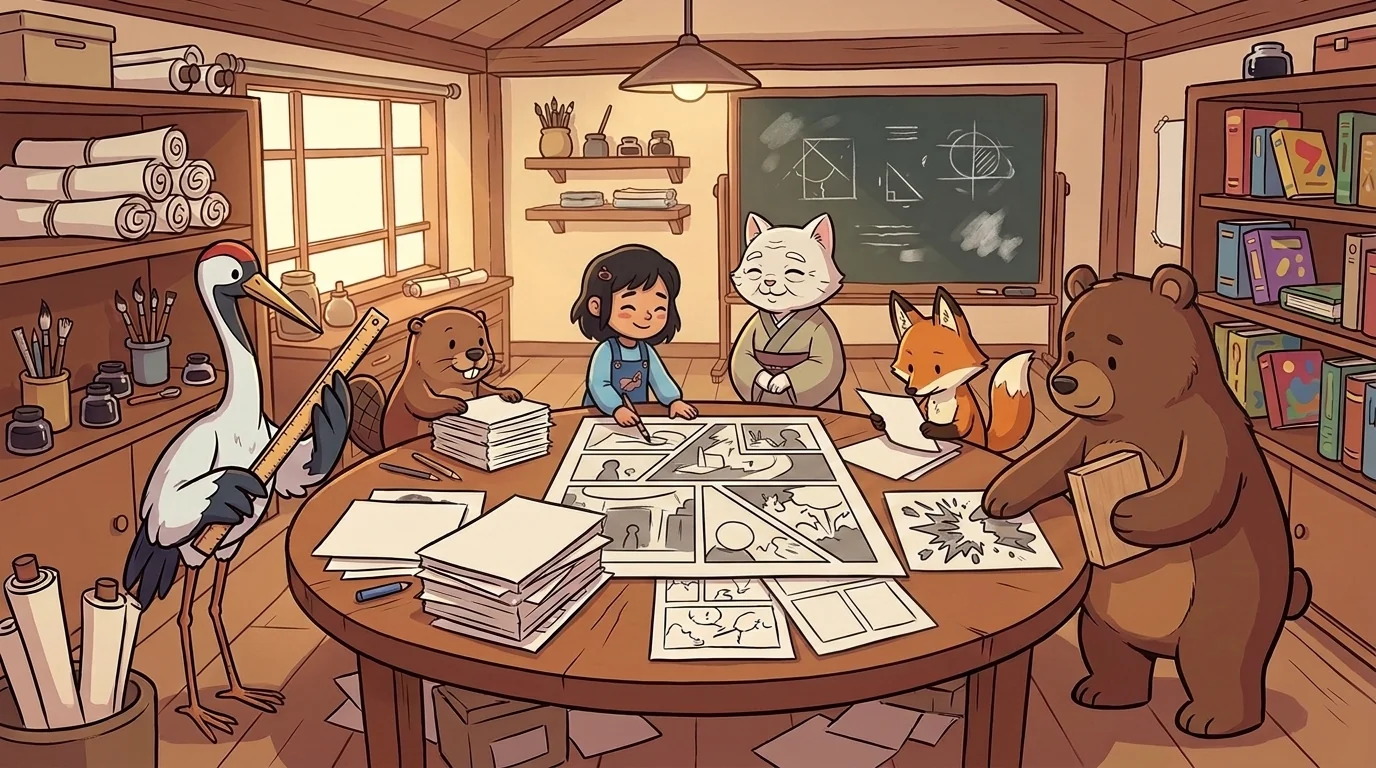
That evening, when the studio lamps burned low, Sumi lingered by the finished page, still tracing its path with one paw.
"I kept thinking my drawings weren't good enough," she admitted. "That's why the page failed. But they were good. I just didn't know they had to work together — that each one only makes sense next to the others."
"That is the whole secret of a page," said Vista, and the five of them gathered around her, and Sensei Sora behind them all. "A page is a team. Vista sets the stage, but her wide shot means nothing without a story to come. Panel holds the moments, but only Segue makes them flow. Lapse leaves the silence, and only Boom makes it crash. Every part needs the others to mean anything. No single drawing carries a page. They carry it together — and then they hand the rest to the reader, whose own mind fills the gutters and finishes the story."
Sumi looked at the page — the stage, the frames, the flow, the silence, the thunder, all pointing the same way — and felt the not-good-enough worry that had knotted her all afternoon loosen into a warm, settled gladness: the quiet joy of watching separate pieces, and separate friends, become one thing that carried a reader along.
"Every part pointing the same way," she said softly. "All of us, and the reader too."
Sensei Sora rested a gentle paw on the apprentice's shoulder, and Sumi felt the last of her worry melt into something calm and proud and glad — the warm belonging of having built one whole thing, together, that would carry a stranger's eye and heart across the page. It was, she thought, the best feeling she knew.
The MangaForge ensemble
The Layout is part of MangaForge's distributed-narrative cast. Each character embodies a different curricular primitive; together they teach the full subject.
-

Panel
The panel — the rectangular frame that contains a single moment of story (the atomic unit of sequential art)
-

Bubble
The speech bubble — the shape-encoded container for dialogue + thought + sound (its outline encodes voice register: thought-cloud / shout-burst / whisper-dotted-line / radio-jag...
-

Sweep
Speed lines / motion lines — the directional line-bursts that convey speed, impact, and energy direction
-

Tone
Screentones — the halftone dot/line patterns laid over an area to convey shadow, mood, and emotional register (the manga-specific shading vocabulary)
-

Splash
The splash page — the full-page or near-full-page impact image that marks a story climax (the moment the page breaks its grid to give one image all the space)
-
Lapse
The gutter — the empty space between two panels where your own mind fills in what happened; closure, the invisible half of comics
-

Segue
The transition — how one panel flows into the next, guiding your eye and your sense of time from moment to moment
-

Vista
The establishing shot — the wide opening panel that shows you where you are before the story zooms in close
-

Jolt
The reaction beat — the panel that catches a character reacting, so a surprise or a feeling truly lands
-

Boom
The sound-effect lettering — onomatopoeia drawn right into the art, so you can see a sound as much as hear it