
Segue
SEGUE — *the panel transition. the KIND of jump from one panel to the next — a tiny moment-to-moment step, a big scene-to-scene leap, or a slow aspect-to-aspect drift — which sets the whole pace of a story.*
Press play to listen along. The line being read lights up as you go.
Show full transcript
Loading transcript…
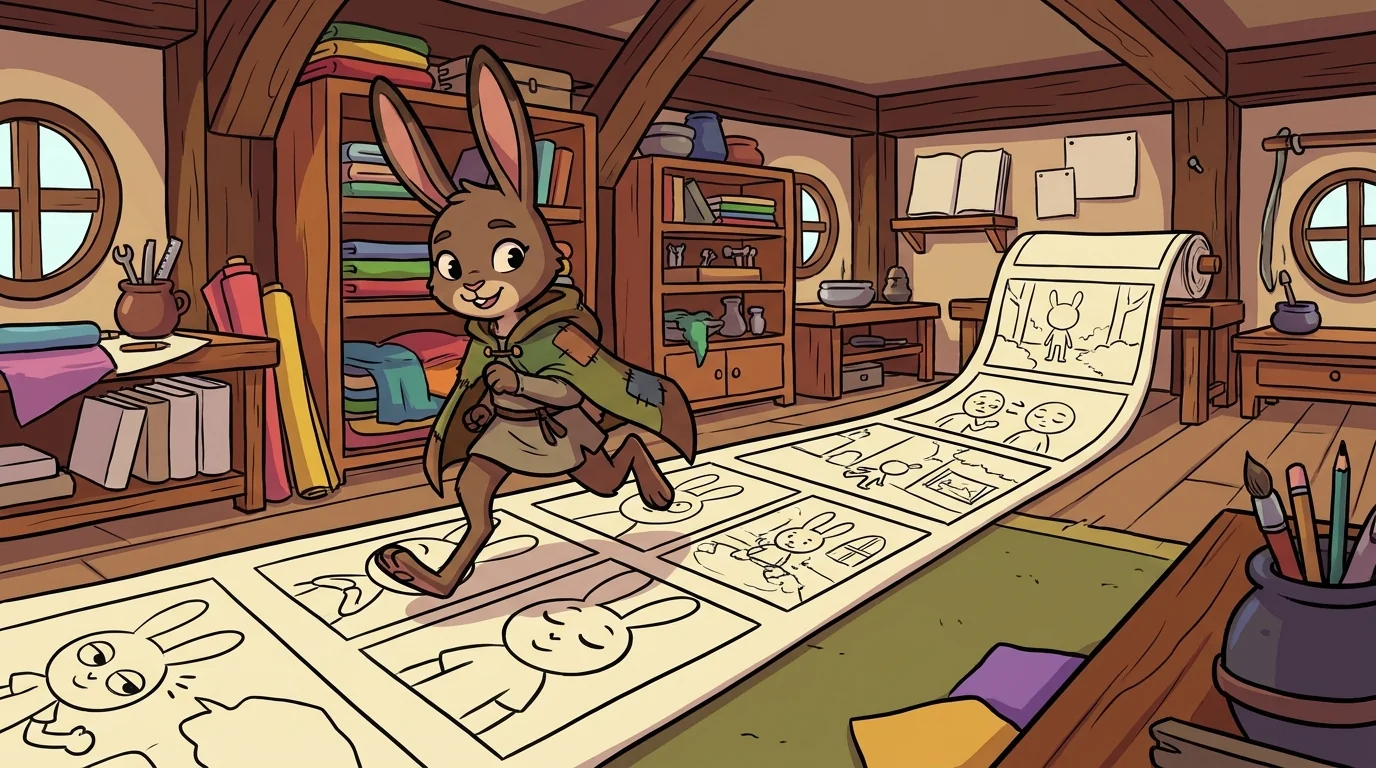
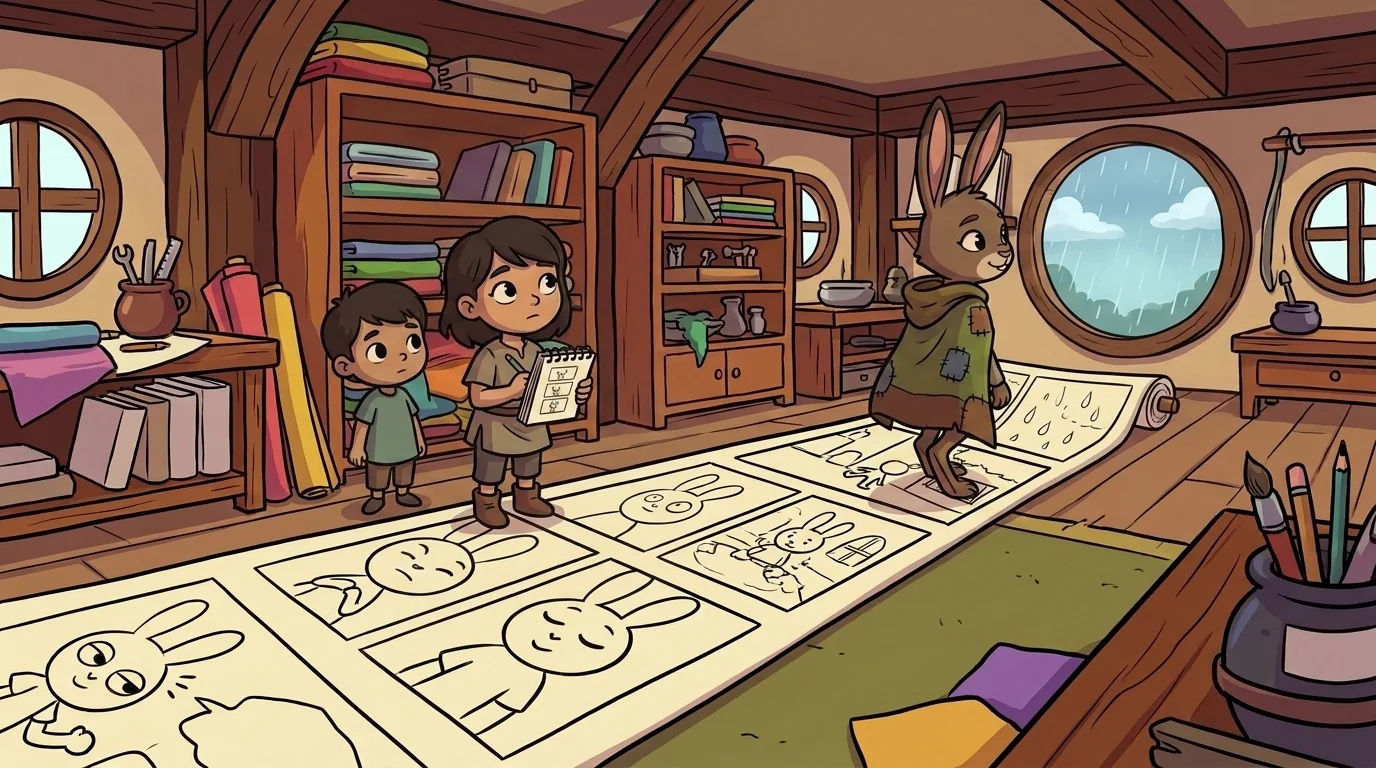
Segue's workshop had a long floor scroll running wall to wall, and she was hopping along it when the apprentices arrived — a slim brown hare-tween in a patched travelling-cloak, pausing at each panel drawn on the scroll, then hopping to the next. Sometimes her hop was tiny, barely a shuffle. Sometimes she took a huge bounding leap clear over a stretch of the scroll. She landed lightly and turned to face them, ears tall.
"You made it! Good. Now watch my feet, not my face." She hopped a small hop between two nearly-identical panels — a character blinking, then the same character with eyes fully closed. "Little hop. What happened between those two panels?"
Sumi thought. "Almost nothing? Just… an eye closing. Like half a second."
"Exactly half a second," Segue said, delighted. "That's a tiny jump. And tiny jumps make time crawl."
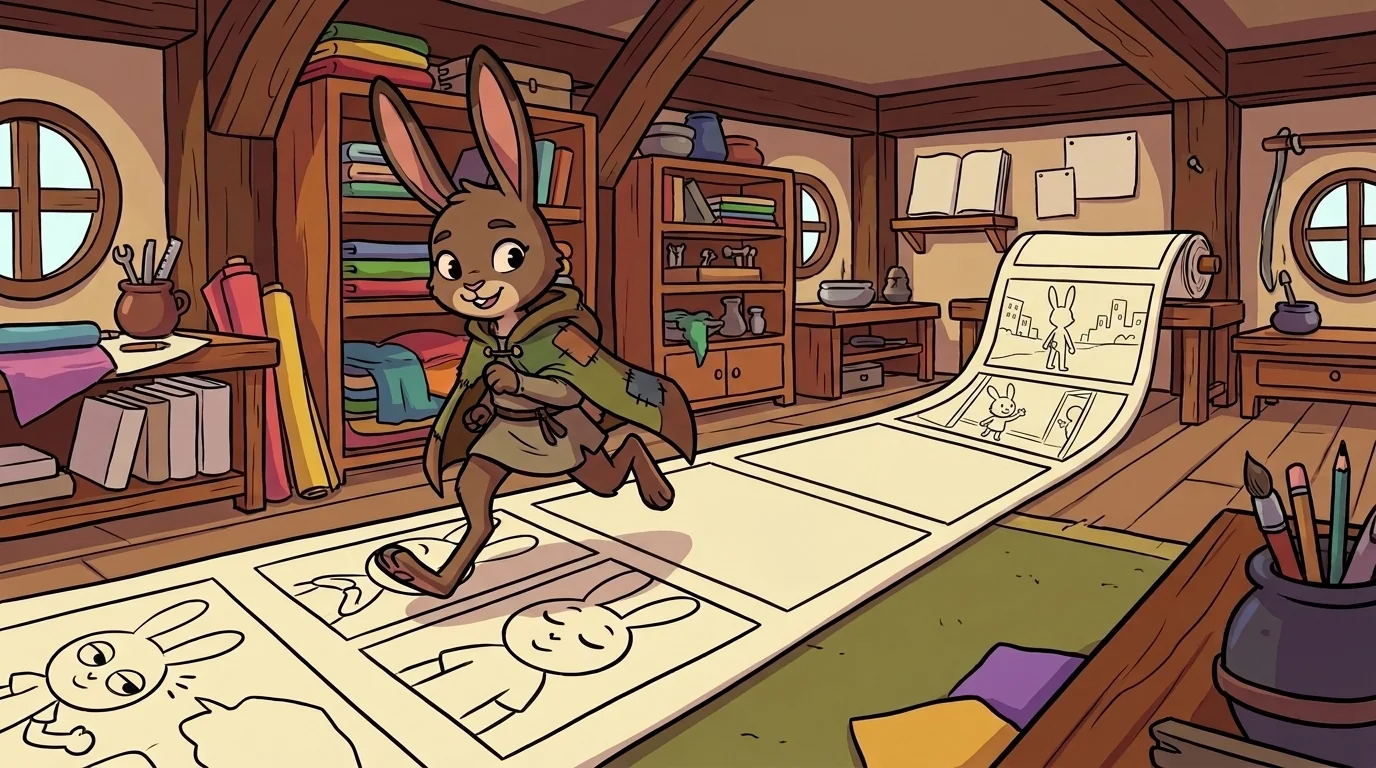
She bounded to the far end of the scroll and landed by two very different panels — a child waving goodbye at a doorway, then the same child, older, arriving at a distant city. "Now — big leap. What happened between these two?"
"Years!" Sumi said. "They grew up. They travelled really far."
"Years, in one jump," Segue agreed. "Same gap on the page. Wildly different jump in time." She hopped back to the middle. "This is my whole craft. It's called the *panel transition — the kind of jump you make from one panel to the next. And the size of the jump controls how time feels*." She counted them on her paw-toes. "A tiny moment-to-moment step — a blink, a breath — makes a moment feel slow and stretched and tense. A big scene-to-scene leap skips across time and space in an instant. And there's a bunch in between: an action-to-action hop that follows a single motion, a subject-to-subject hop that turns to look at someone new."
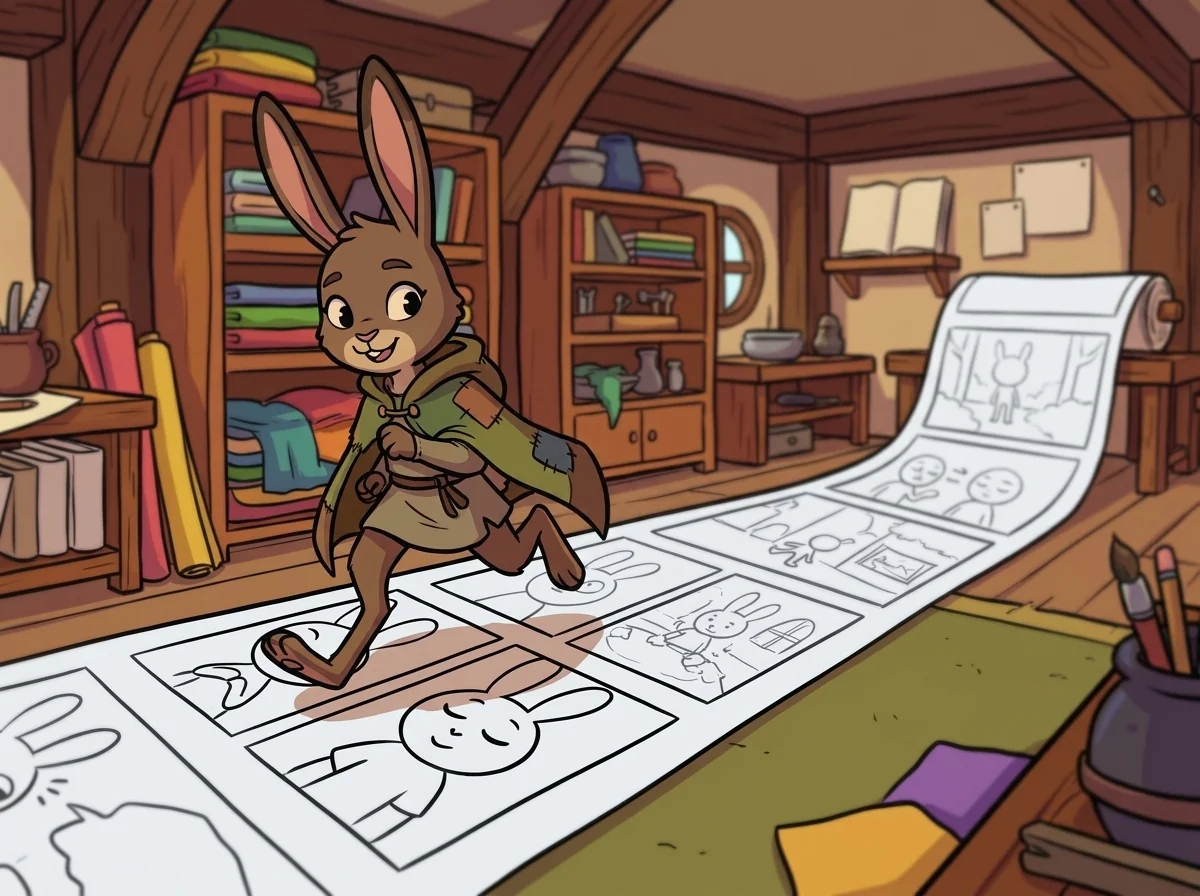
"Try it," she told Sumi, unrolling a blank strip. "Draw me a character catching a ball — but s t r e t c h it out. Little jumps. The ball coming. The hands rising. The fingers opening. The ball an inch away. The catch."
Sumi drew five little panels, each barely different from the last. And when she looked at them in a row, the catch felt enormous — slow and breathless, like the whole world was holding still for it.
"Now the opposite," said Segue. "Two panels. 'Character decides to go on a journey.' 'Character arrives, exhausted, at the mountaintop.' One leap."
Sumi drew the two. The journey vanished into a single jump — and it felt fast, sweeping, epic.
"Same tool," Segue said. "Different size. You just controlled time with nothing but the gap between your drawings. Little jumps to slow a moment down and make it matter. Big jumps to cover ground and keep the story moving. A whole comic is really just a rhythm of these jumps — small, small, small, BIG — like the beat of the story's feet."
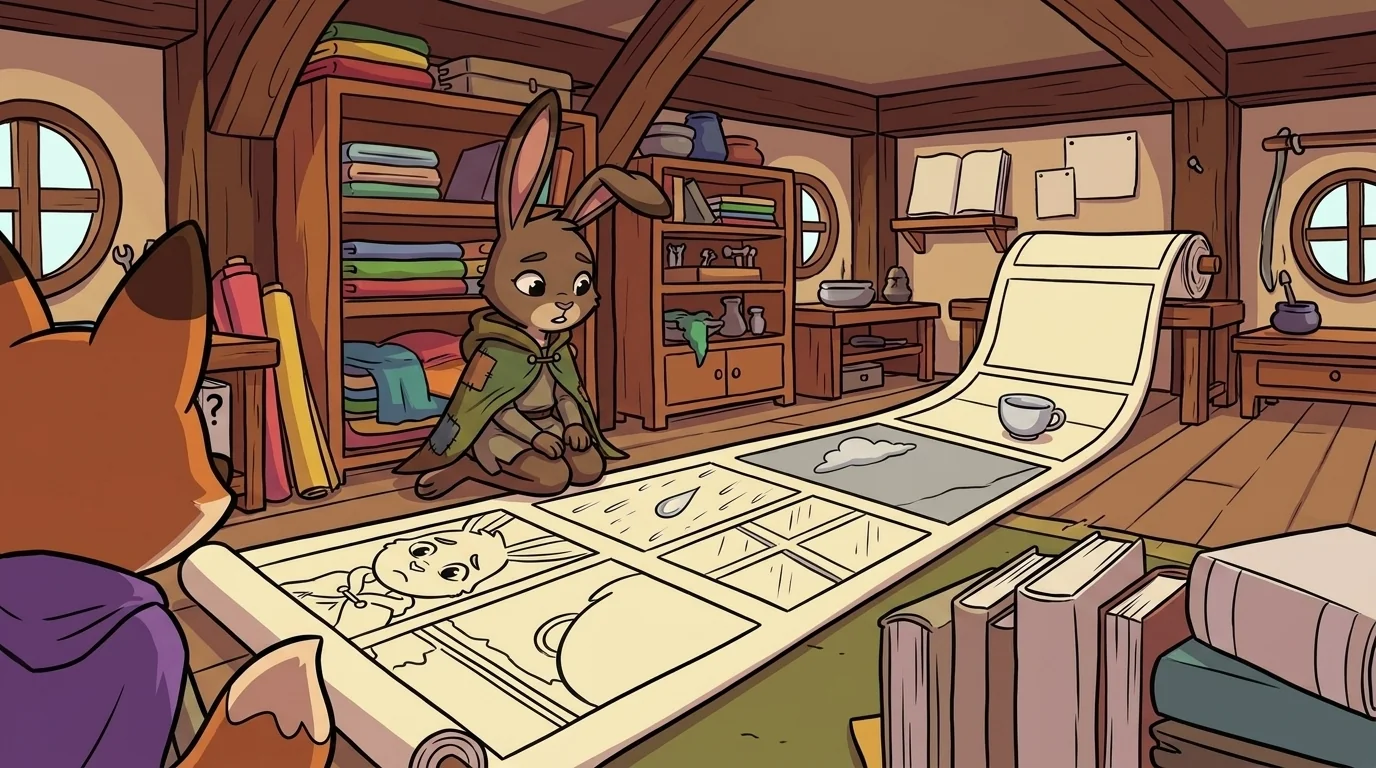
"Now here is the one I love most," Segue said, and she went still for once, sitting back on her haunches. "In a lot of manga, you'll find a transition that Western comics use much less — a slow drift where nothing happens at all. Panel one: a character's face, sad. Panel two: a raindrop on a window. Panel three: an empty grey sky. Panel four: a cold teacup. No action. No plot. Just… mood. Drifting around a feeling."
Sumi frowned. "But nothing's happening."
"Something huge is happening," Segue said gently. "The story is asking you to sit inside a feeling. Those quiet drifting panels give sadness room to be sad. They let a moment breathe." She dipped her ears. "This kind of transition is used with real mastery in the manga tradition, and it's worth learning why it works there, not just copying that it looks cool. Sometimes the most powerful jump between two panels is the one where nothing moves — and everything is felt."
When the lesson wound down, Sumi kept looking at her slow five-panel catch, then at the quiet raindrop drift Segue had sketched. "The slow ones feel bigger," she said slowly. "Even though less is happening. Maybe because less is happening."
Segue's ears came up softly. "That's the whole secret, and you found it yourself," she said. "It's not the busy parts that make a story matter. It's the parts you slow down for. When you take five little panels to draw one catch, you're telling the reader: this — right here — is worth stretching time for." She looked out the window at the real sky. "The world does the same thing, you know. The days rush past in big leaps. But every now and then something makes you take tiny steps — a goodbye, a first snow, a held breath — and time goes slow, and you know that moment counted."
She smiled and gave one small, deliberate hop. "So choose your jumps. Race when you should race. But when a moment matters —" a slow shuffle-step "— take the little steps. Let it breathe. Let it be big."
And Sumi, who had spent her whole life rushing, looked at her slow little panels and felt, for the first time, the quiet power of taking her time.
The MangaForge ensemble
Segue is part of MangaForge's distributed-narrative cast. Each character embodies a different curricular primitive; together they teach the full subject.
-

Panel
The panel — the rectangular frame that contains a single moment of story (the atomic unit of sequential art)
-

Bubble
The speech bubble — the shape-encoded container for dialogue + thought + sound (its outline encodes voice register: thought-cloud / shout-burst / whisper-dotted-line / radio-jag...
-

Sweep
Speed lines / motion lines — the directional line-bursts that convey speed, impact, and energy direction
-

Tone
Screentones — the halftone dot/line patterns laid over an area to convey shadow, mood, and emotional register (the manga-specific shading vocabulary)
-

Splash
The splash page — the full-page or near-full-page impact image that marks a story climax (the moment the page breaks its grid to give one image all the space)
-
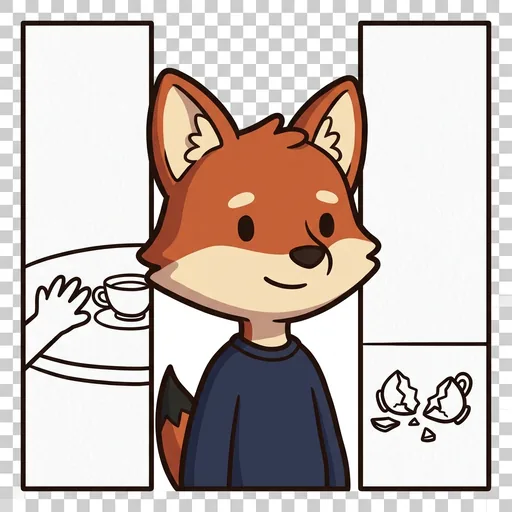
Lapse
The gutter — the empty space between two panels where your own mind fills in what happened; closure, the invisible half of comics
-

Vista
The establishing shot — the wide opening panel that shows you where you are before the story zooms in close
-

Jolt
The reaction beat — the panel that catches a character reacting, so a surprise or a feeling truly lands
-

Boom
The sound-effect lettering — onomatopoeia drawn right into the art, so you can see a sound as much as hear it
-
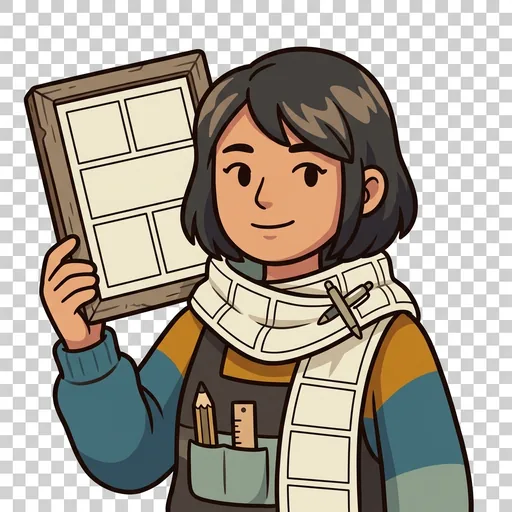
The Layout
The whole page coming together — how the establishing shot, panels, transitions, gutters, and sound-effect lettering arrange to guide one reader eye through one moment of story