Round
CYCLES — *carbon and water move in loops. balance shifts when one loop slows or speeds.*
Press play to listen along. The line being read lights up as you go.
Show full transcript
Loading transcript…
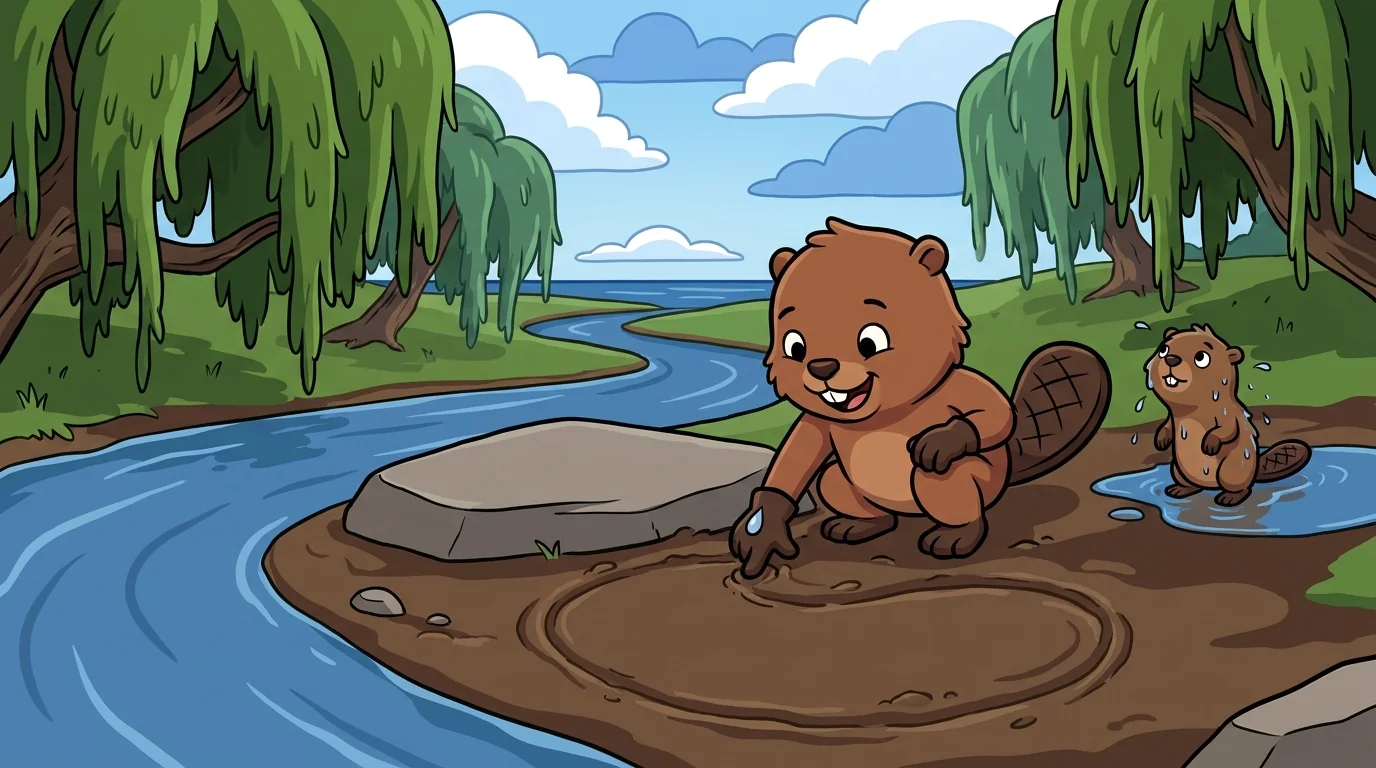
At the bend in the river where the willows leaned over the water, a beaver-tween named Round crouched on a flat rock and traced a slow circle in the mud with one paw.
A raindrop landed on the back of her hand. She grinned and started narrating it, the way some kids narrate a race.
"There you go," she said to the drop. "You were in the ocean once. Then the sun lifted you up into a cloud. The wind carried you here. You fell on me. Now you'll trickle into the river, and the river will carry you all the way back to the ocean, and then — up you go again." She drew the circle a second time, deeper. "Round and round. You've been doing this for about a billion years. You'll do it a billion more."
A younger kit splashed over, dripping. "So where does the water go?"
"That's the trick," Round said. "It doesn't go anywhere. It just moves around the loop." She swept her paw from the river to the sky to the far blue line of the sea and back to the river again. "Ocean, cloud, rain, river, ocean. It's not leaving. It's traveling. Nothing gets used up. It just changes where it is."
The kit stared at the puddle, then at the clouds, then at the puddle. "So this puddle is going to be a cloud."
"This puddle is going to be a cloud," Round agreed, "and someday it'll be river again, and rain again, and it'll fall on some other kid who thinks it's brand new." She tapped the water gently. "Same drops. Same loop. Keeps going."
Round had not always found the loops so calming.
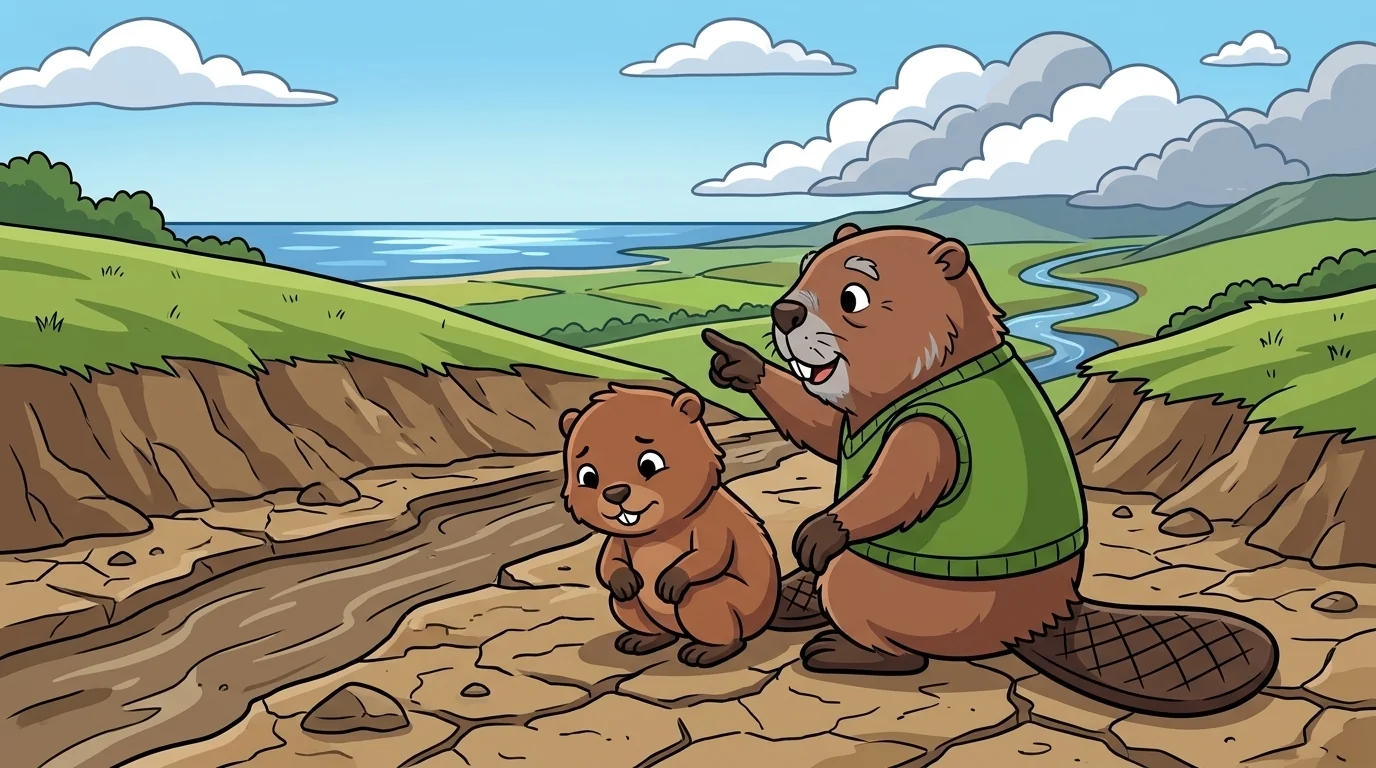
When she was small, a hot summer had dried the little side-stream near her burrow to cracked mud. She'd sat beside it, chest tight, certain the water had simply run out — that it was gone, that something had broken and wouldn't come back. She'd felt it like a stone in her stomach: the world can just lose things, and there's nothing you can do.
Her grandmother, an old broad-tailed beaver who had built dams up and down the valley, came and sat beside her in the mud.
She didn't say don't worry. She said, "You feel like it's ended, don't you? Like it just poured out and vanished."
Round nodded, miserable.
"Come here." Her grandmother led her up the ridge to where they could see the whole valley — the sea flashing far off, clouds stacking over the hills. "Your stream didn't vanish, little one. It went up." She pointed at the clouds. "It's right there, waiting to come down. The loop got slow, not broken. Slow things speed up again. Broken things don't. This one's only slow."
That night it rained. In the morning the side-stream ran clear and full, and the stone in Round's stomach was gone. The dried-up feeling had a new name now — not ended, but waiting to come around. Somehow that made it possible to breathe.
She walked to ClimateQuest at twelve, because a place that studied the whole warming, worrying world ought to understand the kind of thing that only looks like an ending.
Cirrus, the mentor who ran the workshops, met her at the gate. He didn't test her muscles or her dam-building. He asked one question. "What happens to carbon when you burn a log?"
Most kids said it's gone. Round didn't.
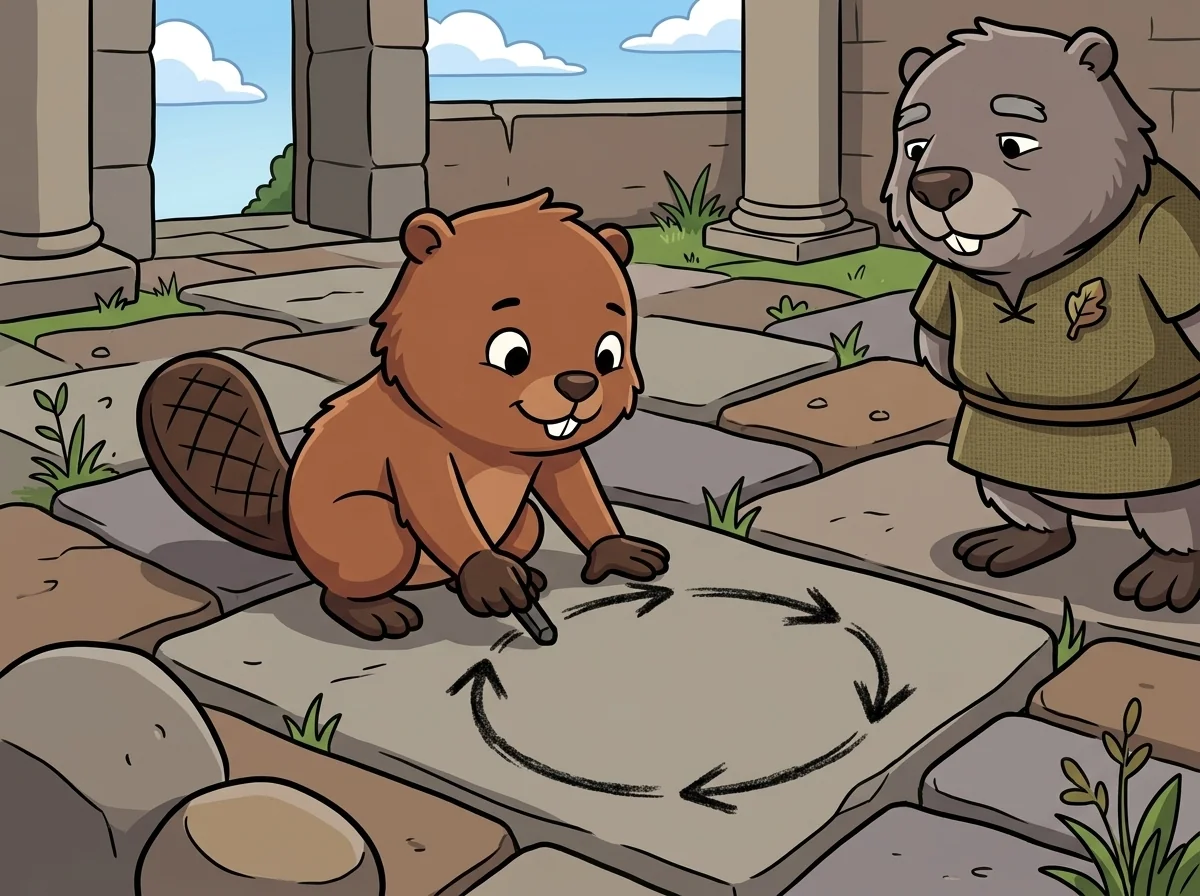
She picked up a stick of charcoal and drew on the courtyard stones — a wide loop with arrows. "The carbon in the log came from the air," she said, tracing. "A tree pulled it out of the sky to grow. Burn the log and the carbon goes right back up to the sky. Then another tree pulls it down again to grow." She followed the loop all the way around. "It's not destroyed. It moved. Sky, tree, soil, sky. Round and round — for a billion years."
Cirrus looked at the loop on the stones for a long moment. "You are appointed," he said.
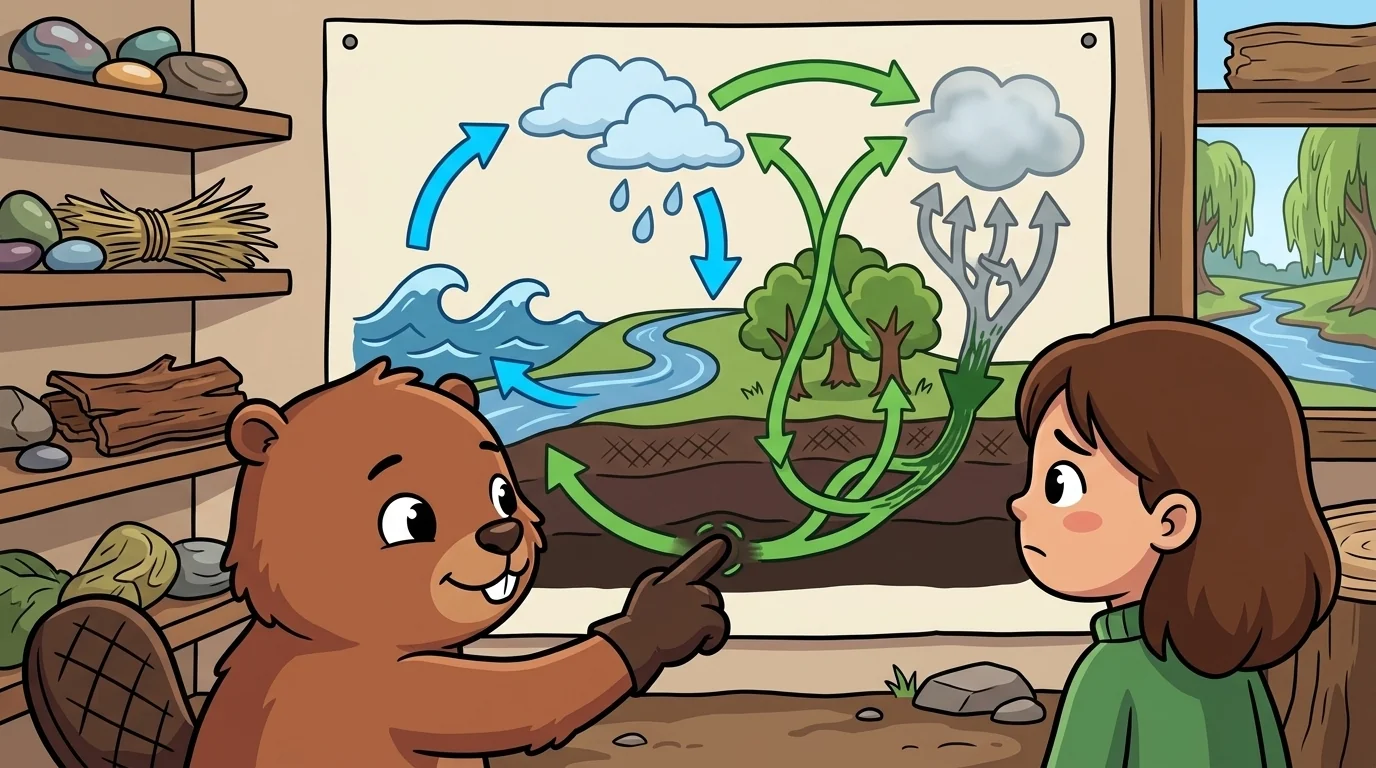
Round's workshop had one big flow-diagram on the wall — blue arrows for water, green for carbon, every arrow curving back to where it started.
A girl came in one afternoon with her shoulders up around her ears. She'd read something scary about the sky filling with carbon, and she looked like she was holding her breath. "Everyone says the carbon's ruining everything," she said. "Like it's poison we dumped and now it's just — there. Forever."
Round knew that held-breath look. She'd felt it in the mud by the dry stream.
"Put your finger here," she said, and pressed the girl's finger to the diagram, on the deep-underground arrow. "This is where a lot of carbon was resting — locked in the ground for millions of years, real slow loop. When we dig it up and burn it, we move it up to the sky fast." She slid the finger up the arrow to the sky. "So the sky-part of the loop got bigger. That's the trouble. Not poison. Not forever. Just a loop that's carrying too much, too fast."
"But it's stuck up there now," the girl said.
"Is it?" Round tapped the green arrows coming down from the sky — into forests, into the sea. "Every tree is still pulling carbon down. Every ocean is still soaking it in. The loop never stopped working. It's just behind. So we help it catch up — plant more trees, burn less from underground, let the sea and soil do their slow steady thing." She traced the whole circle once more, gently. "It isn't broken. It's out of balance. And out-of-balance is the kind of thing you can fix."
The girl let out a long breath. Her shoulders came down. "So it's not an ending."
"It's not an ending," Round said. "It's a loop we're learning to shape."
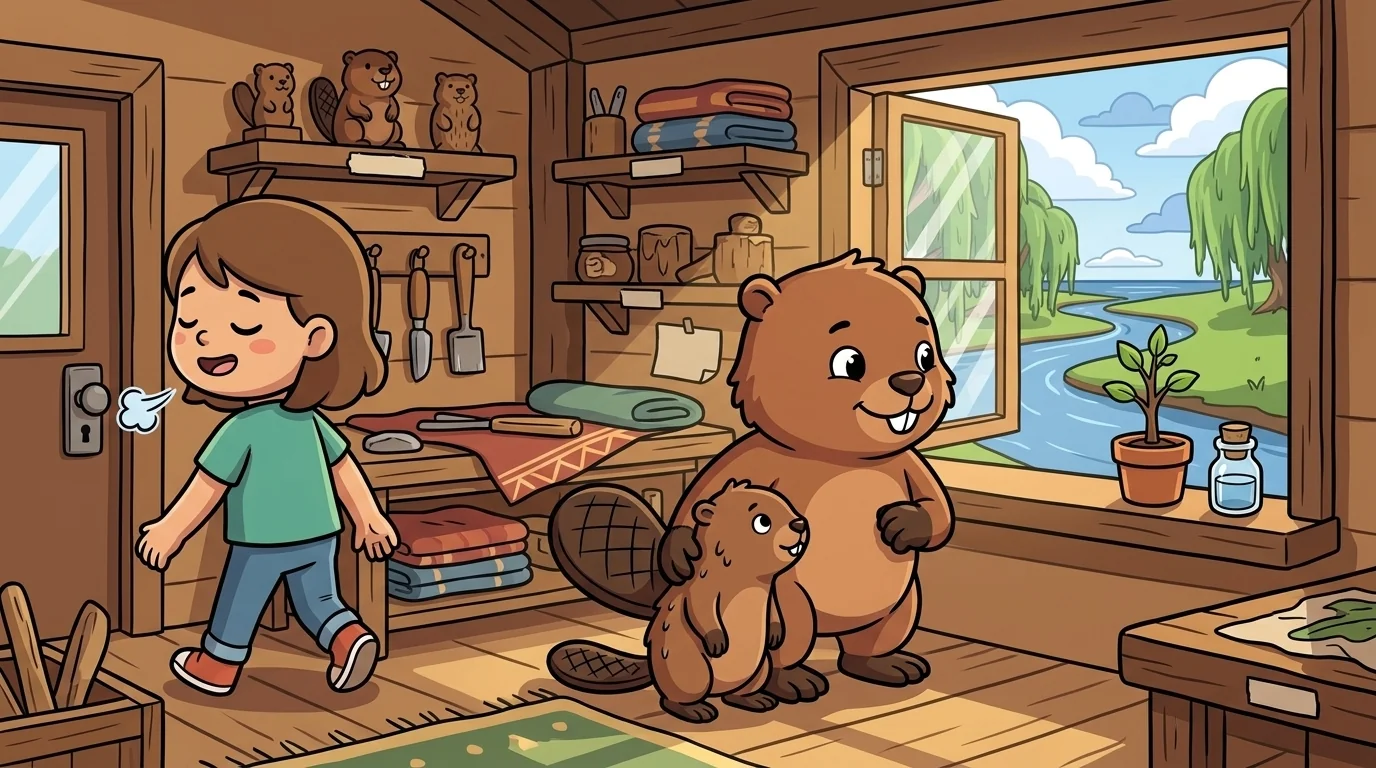
Later, when the workshop had emptied, the girl came back with one quieter question.
"When it feels really big and scary," she said, "and you can't see the loop working — how do you keep believing it's still going around?"
Round thought about the dry stream. About the stone in her stomach and her grandmother's paw on her shoulder and the rain that came in the morning.
"You remember that the loops are older than all of us," she said, "and slower than a scared feeling. When something looks like it just poured out and vanished, mostly it went up, or under, or around — waiting to come back. Your job isn't to carry the whole sky. It's to help the loop along, a little, where you're standing. Plant the tree. Save the drop. Let the slow things do their work." She looked out the window toward the river bend where she'd grown up. "That's not despair. That's the opposite."
The girl nodded, and Round watched the held breath go out of her for good — the same way, years ago, the stone had lifted out of her own stomach by a dried-up stream that turned out to be only waiting for rain.
She didn't say the last part out loud, but she felt it, round and warm and steady as the loops themselves: the scariest-looking endings are usually just the slow parts of a circle. Nothing you love is truly gone. It's coming back around.
The ClimateQuest ensemble
Round is part of ClimateQuest's distributed-narrative cast. Each character embodies a different curricular primitive; together they teach the full subject.
-

Haze
Atmosphere (air, gases, the sky as a thin layer)
-

Squall
Weather events (vs. climate — short-term variability)
-

Blanket
Greenhouse effect (insulating gases)
-

Stitch
Collective action / policy / repair
-

Glint
Ice-albedo feedback (bright ice reflects, dark water absorbs — a warming loop)
-

Fathom
Ocean heat + carbon sink (thermal inertia — the sea stores and slows change)
-

Cusp
Tipping points (thresholds where small change flips a system all at once)