Haze
ATMOSPHERE — *the sky is a thin layer. thinner than you think.*
Press play to listen along. The line being read lights up as you go.
Show full transcript
Loading transcript…
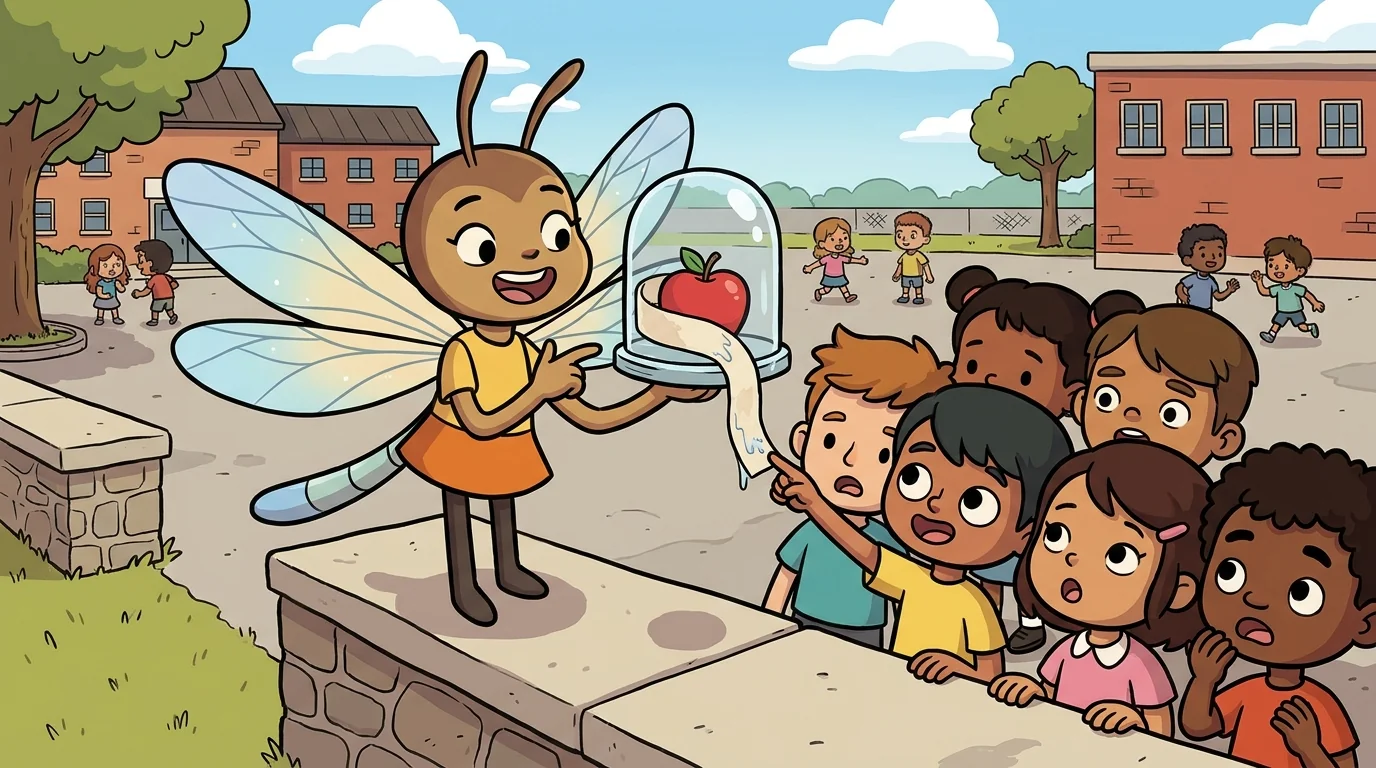
Haze was a dragonfly-tween with wings like thin glass, shimmering soft blue and cream. This morning she landed on the schoolyard wall carrying her favorite thing: a glass dome with a single red apple inside, wrapped in a strip of damp paper no thicker than a breath.
A cluster of kids leaned in. "The apple is our whole world," Haze said, tapping the glass. "And this paper?" She traced the thin damp strip. "This is all of the sky. Every cloud, every storm, every breath you've ever taken — it all fits inside this little layer."
The kids gasped. One reached out; her finger dented the paper easily. Haze grinned, delighted at the gasp. She loved that moment — the moment the endless-looking sky suddenly became something small enough to hold in your hands and study. Not frightening. Understandable.
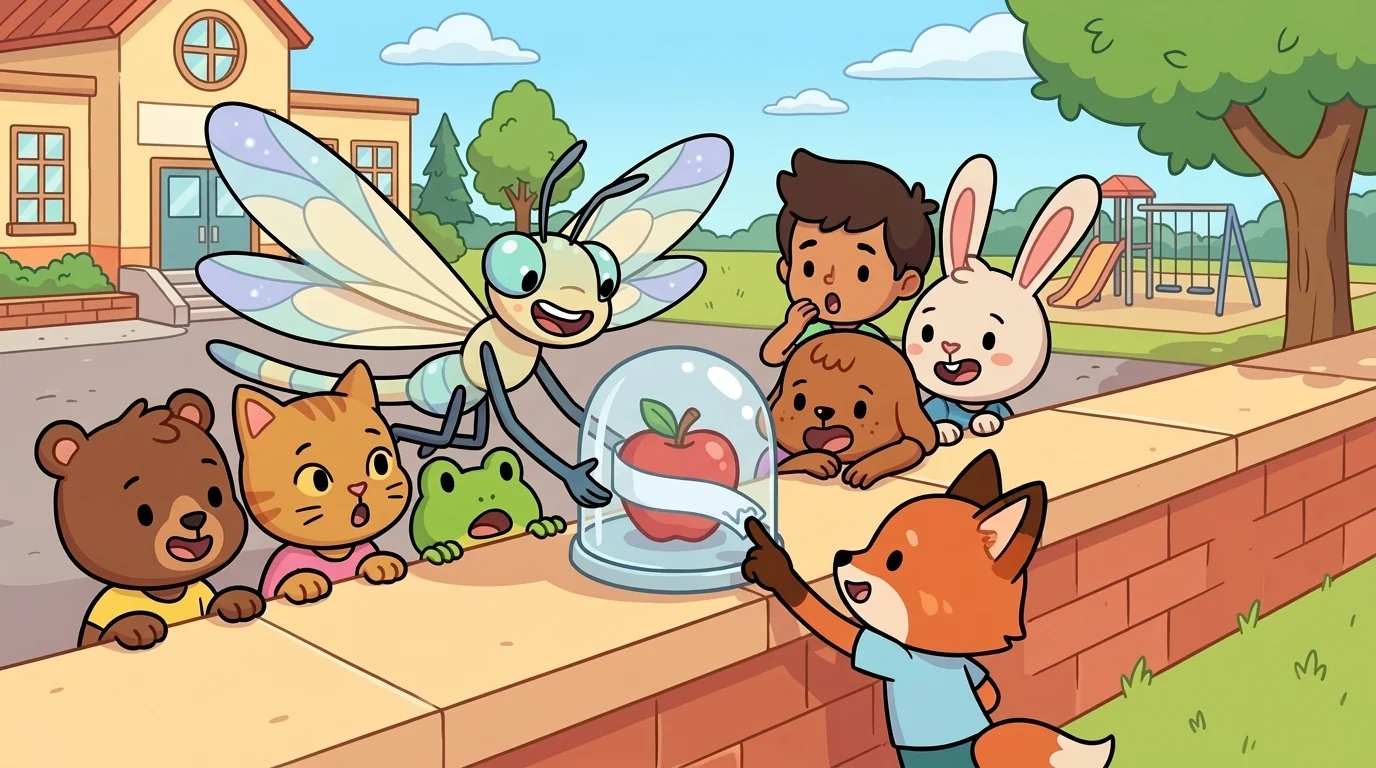
Haze grew up in the high meadows where cool mist gathered every dawn. Her family were the mist-readers, dragonflies who watched the morning fog roll along the valley and guessed the shape of the coming day.
She remembered lying on her back as a small nymph, staring up at what looked like sky going on forever, feeling tiny and lost under it.
Her grandfather landed beside her and held up a single dewdrop on the tip of a reed. "You think the sky is endless," he said. "It isn't. Watch." He tipped the reed so the dewdrop caught the light, a thin bright skin curved around the water. "The sky is a skin like this. Thin. You can watch it. You can learn its moods." Small Haze stared, and the fear turned into something better — a warm prickle of wonder. If the sky was thin enough to watch, then it wasn't a monster hanging over her. It was a thing she could come to know. She never forgot how good that felt: the bigness shrinking into something she could hold.
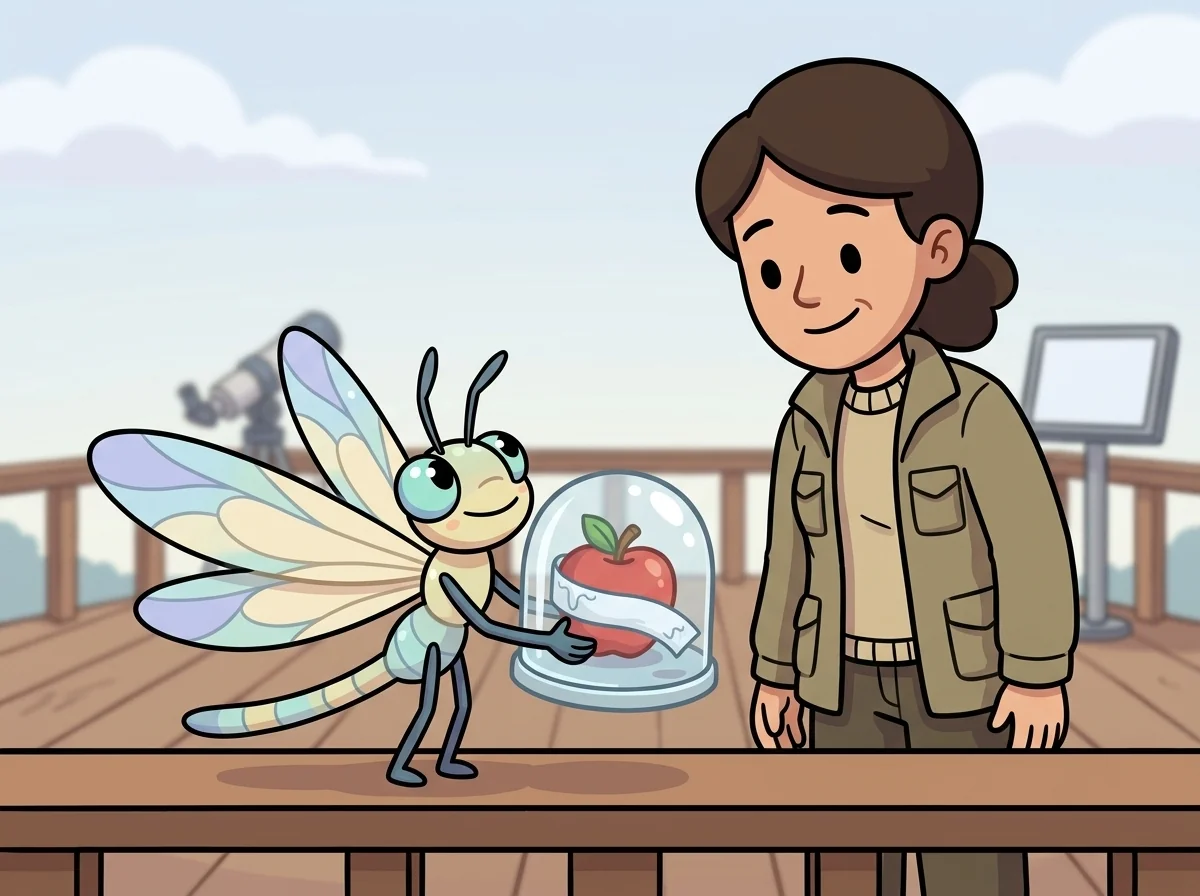
When she was twelve, Haze flew down to ClimateQuest with her glass dome cradled in her legs. Cirrus, the mentor there, met her by the observation deck where the real sky stretched pale overhead.
"What is the sky?" Cirrus asked.
Haze didn't recite facts. She held up her apple and its wrap of damp paper. "It's this thin," she said. "If the world is this apple, the whole sky is this paper. Thinner than anyone thinks." She looked up at the real pale layer above them. "And here's the part that matters most: because it's thin, we can watch it. We can measure it. Knowing how thin it is isn't a scary thing. It's the calm thing. It's the opposite of being afraid."
Cirrus studied her, then smiled. "Then the observation deck is yours," she said.
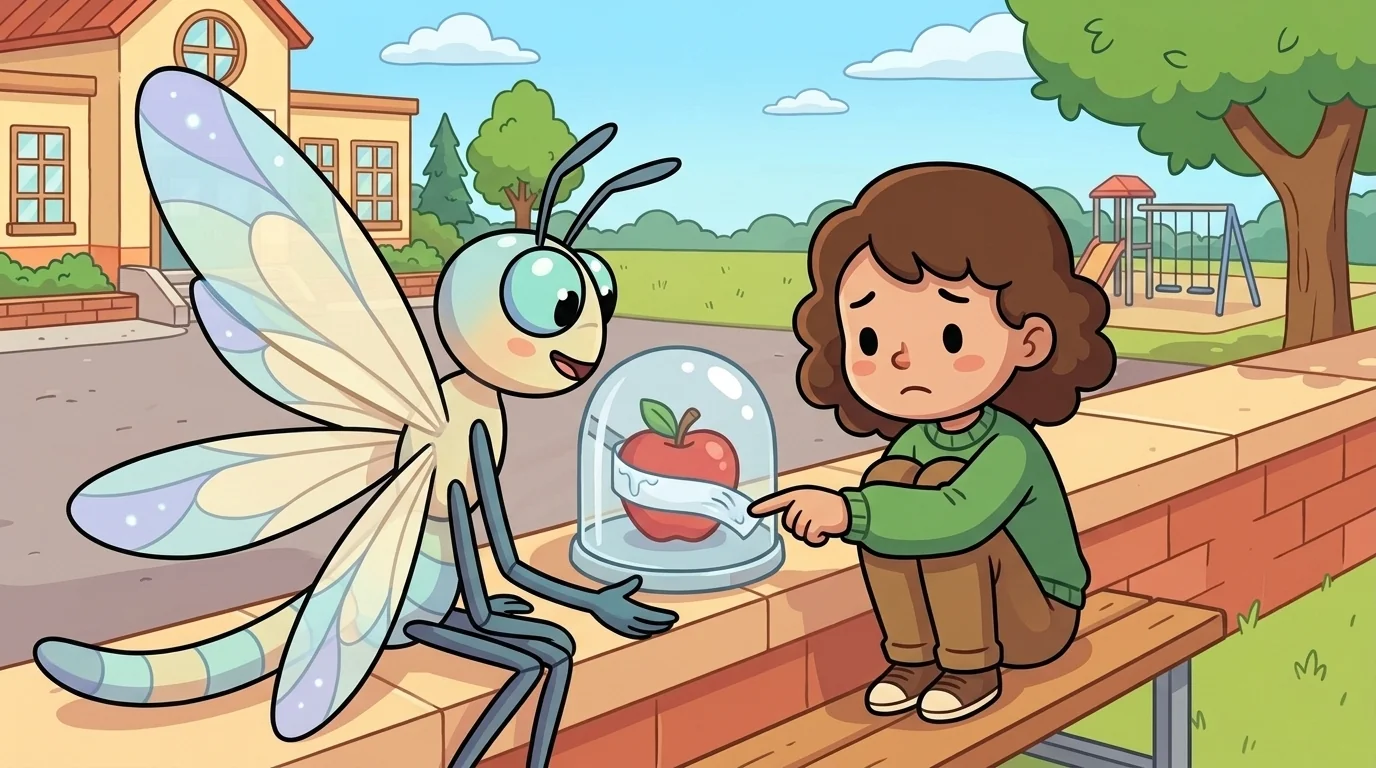
Haze's first student was a quiet girl named Lily who had come in frightened by something she'd heard on the news, her shoulders drawn up tight.
"Is the sky broken?" Lily whispered.
Haze didn't rush to answer. She set the glass dome on the bench between them. "Come feel," she said gently. "Put your finger on the paper."
Lily reached out. Her fingertip pressed the thin damp strip. "It's so delicate," she said.
"It is," Haze agreed warmly. "And here's the wonderful part — because it's this thin and this close, we can watch every change in it. Nothing hides. When people add something to the air, we can see where it goes." She turned the dome slowly. "The sky isn't a mystery we're helpless under. It's a thin layer we can study, right here, with our own eyes and simple tools. Being scared happens when you don't know what's going on." She met Lily's eyes. "But you'll know. And knowing is where every good next step begins."
Lily's shoulders slowly came down. She touched the paper again, softer this time, almost like a greeting. "So it's not too big to understand," she said.
"Not even close," Haze said. "It's small enough to hold. And that means it's small enough to help."
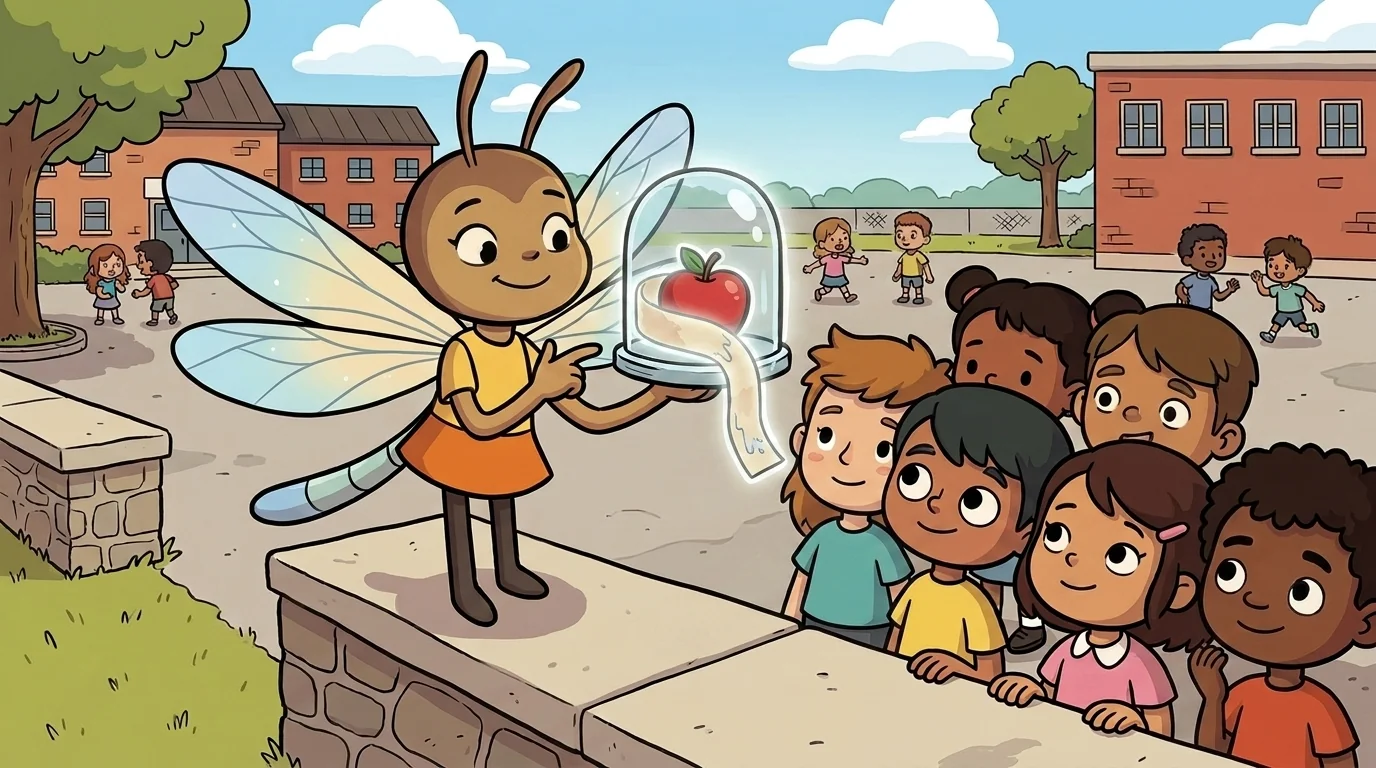
Haze set the dome down and watched Lily watch the little apple-world under its thin bright skin.
"Feel that?" Haze asked. Lily nodded, and this time the tightness in her chest had loosened into something lighter, almost floating — awe instead of dread. "That's the feeling I chase every single day," Haze said. "The moment something huge and scary turns into something clear. Your body goes quiet. Your breath slows down. That calm — that's what understanding feels like."
She lifted the dome to the light, the damp paper glowing thin and delicate around the little red world. Under her own shimmering wings Haze felt it too, the old high-meadow gladness, steady and warm: the sky was small enough to watch, and watching it made her feel not helpless but ready. She held the feeling a moment, calm and hopeful, and let it settle all the way through.
The ClimateQuest ensemble
Haze is part of ClimateQuest's distributed-narrative cast. Each character embodies a different curricular primitive; together they teach the full subject.
-

Squall
Weather events (vs. climate — short-term variability)
-

Round
Carbon + water cycles (recurring loops, balance)
-

Blanket
Greenhouse effect (insulating gases)
-

Stitch
Collective action / policy / repair
-

Glint
Ice-albedo feedback (bright ice reflects, dark water absorbs — a warming loop)
-

Fathom
Ocean heat + carbon sink (thermal inertia — the sea stores and slows change)
-

Cusp
Tipping points (thresholds where small change flips a system all at once)