
Odds and Flipside
the complement rule — the chance a thing happens plus the chance it doesn't always add to 1 (a whole). P(A) + P(not A) = 1. When counting the thing directly is hard, count the opposite instead and subtract from 1 — the "at least one" shortcut.
Press play to listen along. The line being read lights up as you go.
Show full transcript
Loading transcript…
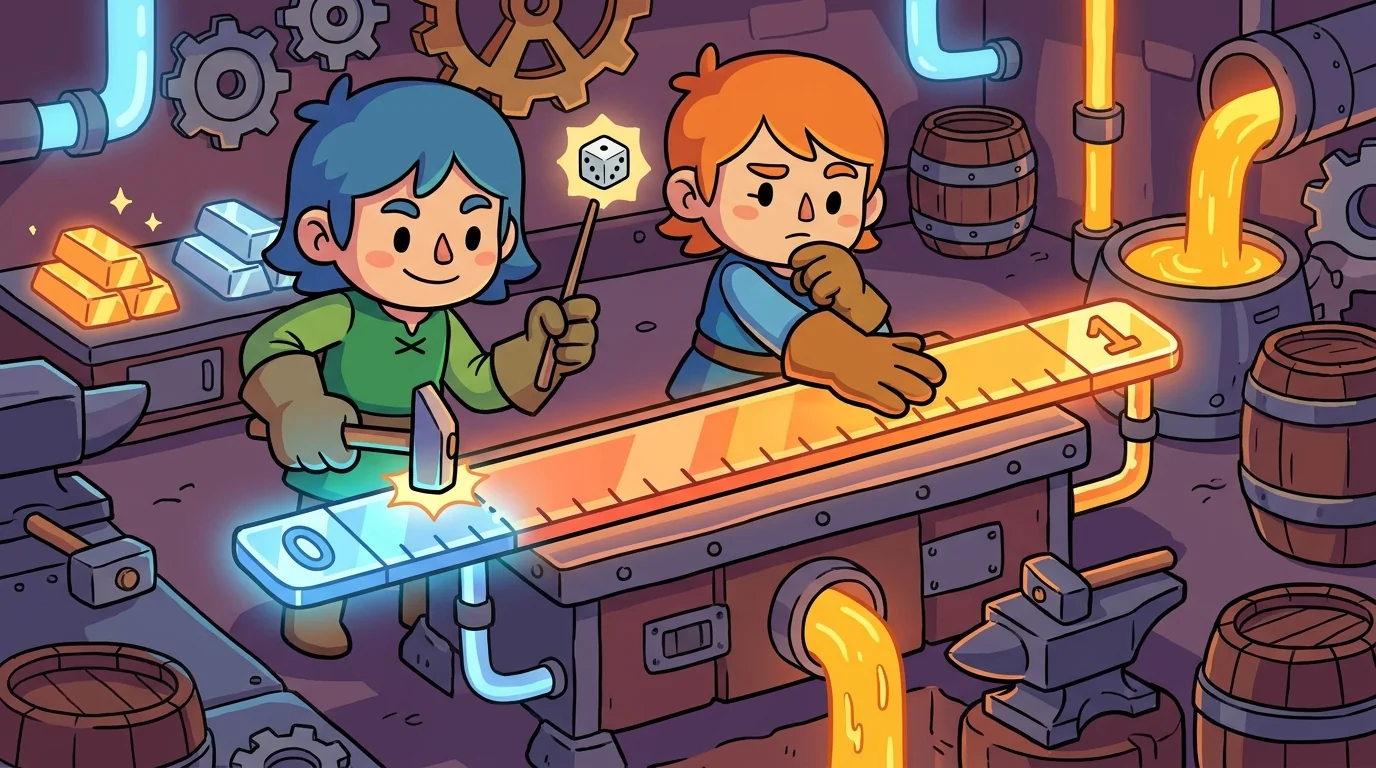
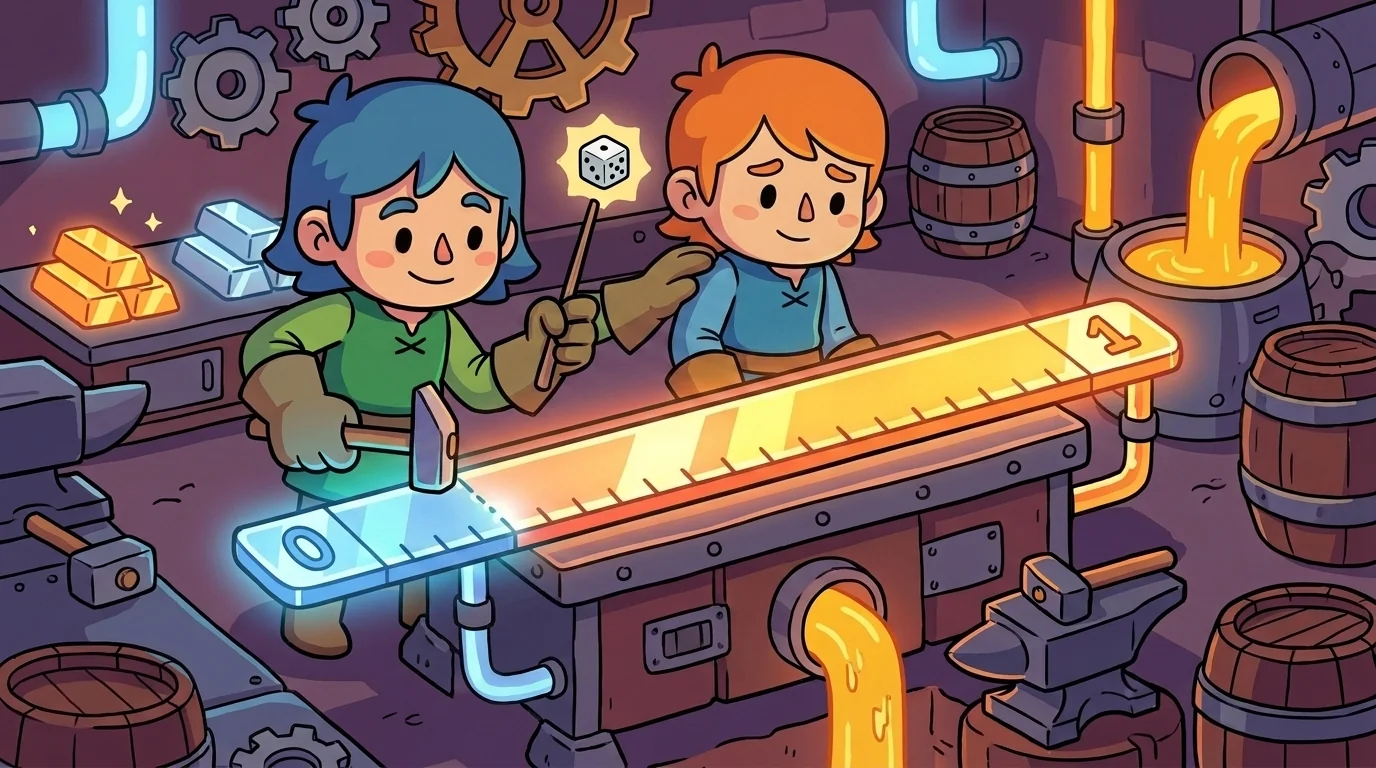
In the chance-forge stood a long glowing bar, painted from 0 at one end to 1 at the other — the whole line of everything that could possibly happen. Odds stood proudly at it, a pointer in hand.
"Watch," said Odds, tapping the bar. "Somebody's about to roll a die. What's the chance they roll a six?" They slid their pointer to a spot near the low end. "One face out of six. Right about... there. That's the odds. I read the chance a thing happens. Clean, direct, done."
Behind them, quietly, Flipside was looking at the rest of the bar — all the space Odds hadn't pointed to. "And I," said Flipside, "read what's left. If the six sits there, then not-a-six is all of this." They swept a hand across the long remaining stretch. "Five faces out of six. Everything that isn't the thing."
Odds glanced back. "You always do that. You always look at the other side."
"Somebody has to," Flipside said mildly. "Besides — look." They pointed at the whole bar, end to end. "Your little piece and my big piece. Together we cover the entire line. No gaps. Every single time."
"Huh," said Odds, seeing it. "They add up to the whole thing."
"They add up to one," said Flipside. "They always do."
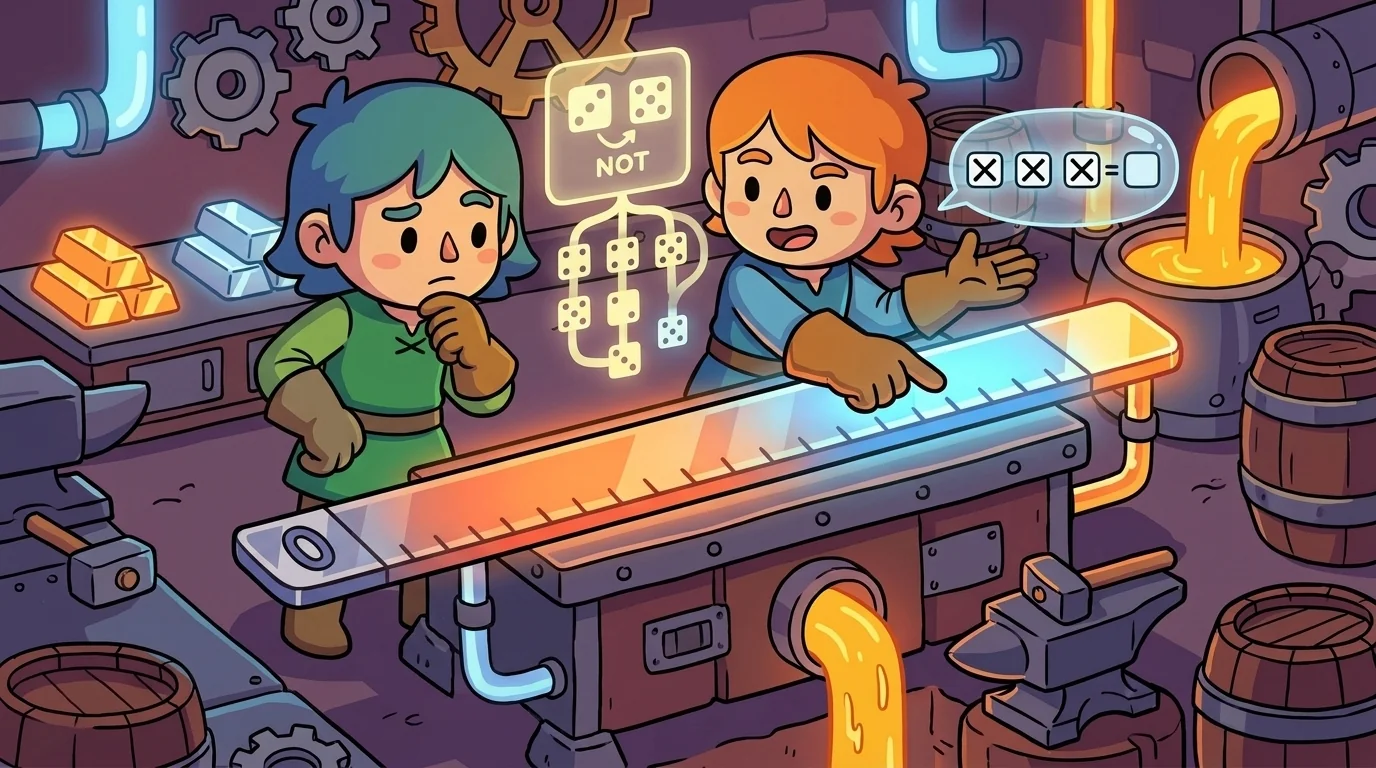
Flipside liked to admit, when the forge was quiet, that they hadn't always felt proud of their job.
"For the longest time," Flipside said, "I thought I was the leftover one. Odds got to name the exciting thing — will it rain, will they win, will the six come up — and I just... counted whatever was left over. The scraps. The 'not-that.'" They shrugged. "It felt small. Like being the second half of somebody else's sentence."
Odds set down their pointer, listening.
"And then," Flipside went on, "a gambler asked a question Odds couldn't easily answer. 'Roll a die four times — what's the chance you get at least one six?' And Odds started counting: one six, or two sixes, or a six then a not-six then a six — so many ways, all tangled up."
"It was a nightmare," Odds admitted.
"So I turned it around," said Flipside, brightening. "I asked the opposite. What's the chance of no sixes at all? That's easy — just not-six, four times in a row. Count that, subtract from one, and there's your answer." They smiled. "That was the day I stopped feeling like the leftover. The opposite isn't the scrap. Sometimes the opposite is the only door that opens."
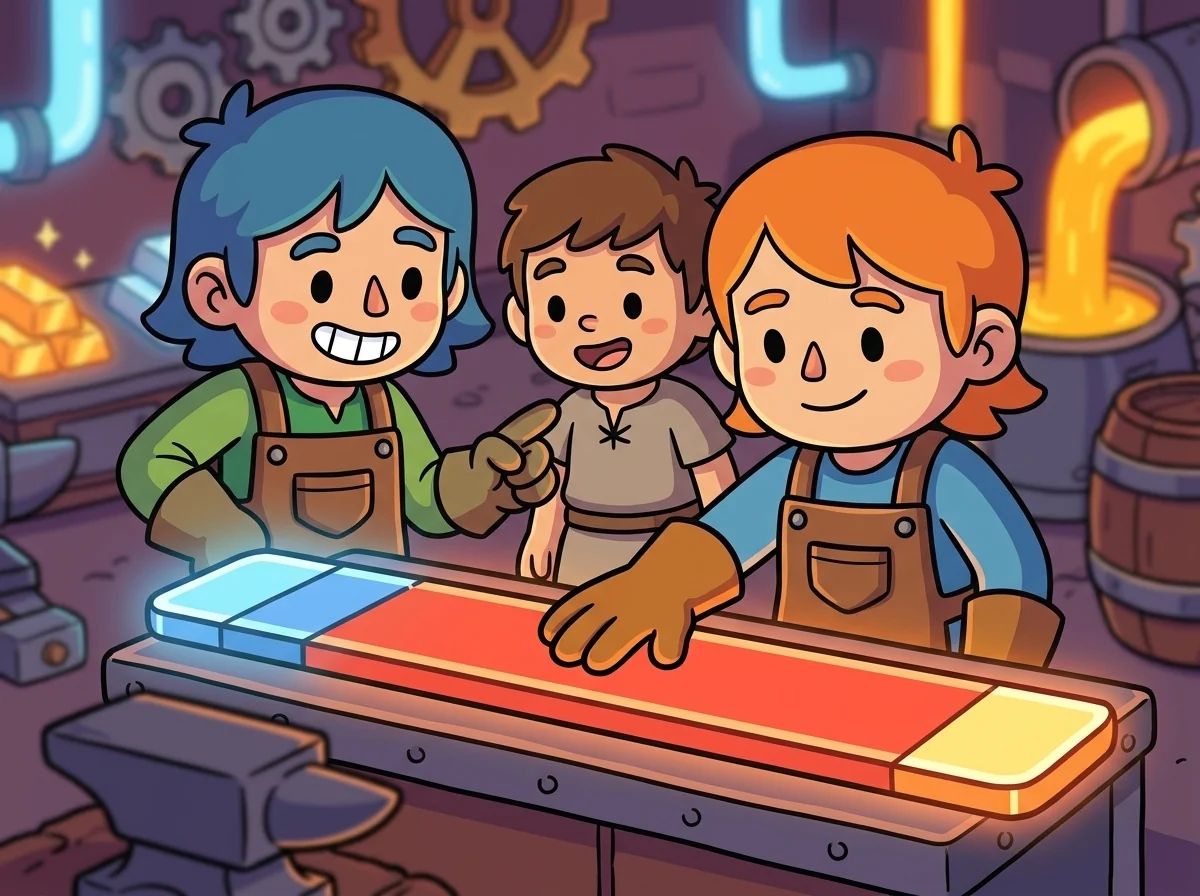
A young apprentice came with a real problem, looking worried. "There's a spinner. It lands on red a lot — lots of little red slices, all different sizes, scattered everywhere. Somebody asked me the chance it lands on red. I'd have to add up every red slice. There are dozens."
Odds winced. "That's a lot of adding. And if you miss one—"
"Then don't count the red," said Flipside gently. "Count the not-red. How many slices aren't red?"
The apprentice blinked. "Just... three. Three blue ones."
"Three," said Flipside. "Add up those three. That's the chance of not-red. Now—"
"Subtract from one!" the apprentice said, eyes going wide. "Because red and not-red fill the whole spinner! One minus the three blue slices is all the red — without counting a single red slice!"
"There it is," said Odds, grinning at Flipside. "You made the hard question easy by flipping it over."
"That's the whole trick," said Flipside. "When the front door is jammed, try the back."
The apprentice was still turning it over. "But how do I know they add to one? How do I know there's no gap?"
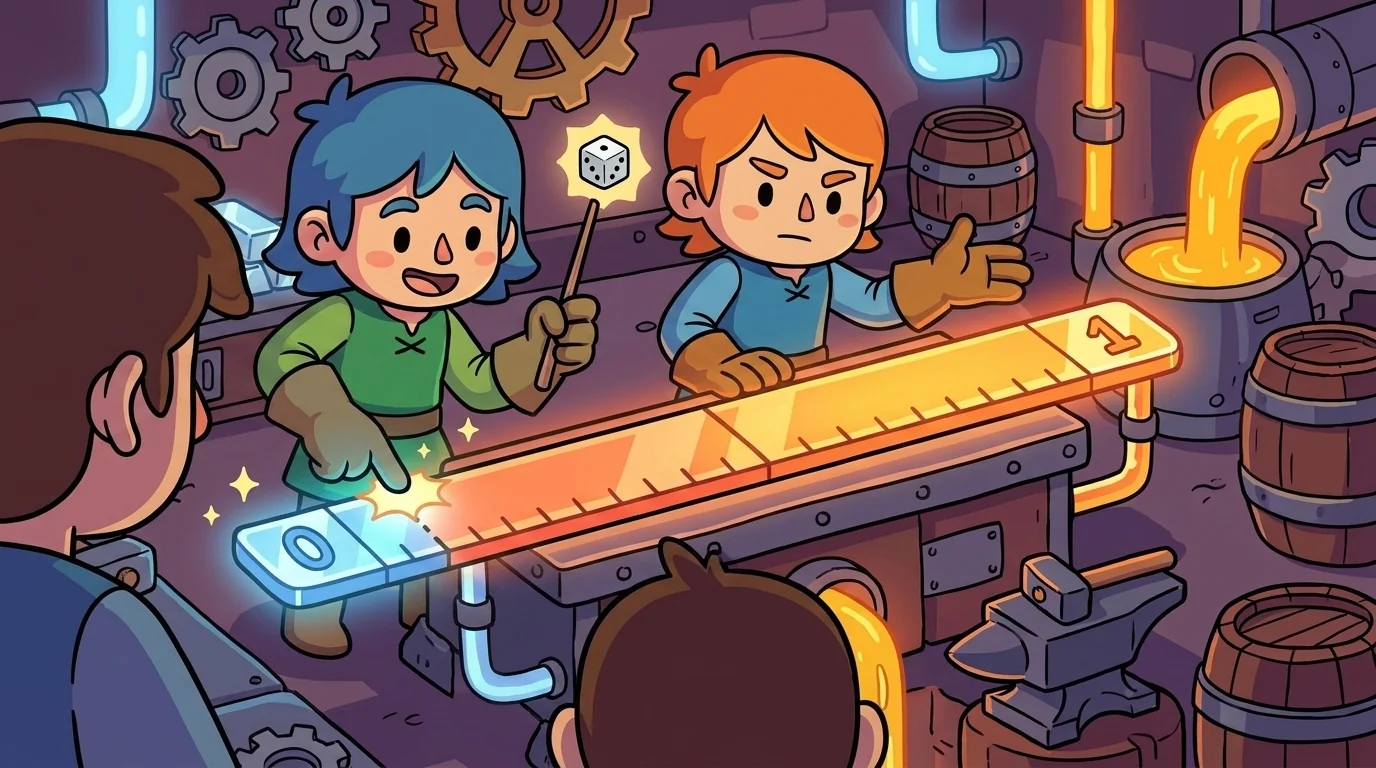
Odds and Flipside stepped to the glowing bar together.
"Because there's no third option," Odds said. "A thing either happens, or it doesn't. There's no in-between, no secret door." They pointed to their piece. "Happens."
"Doesn't happen," said Flipside, pointing to the rest.
"And between us," they said together, "we've named every possibility. The whole line, 0 to 1, completely covered. So our two chances have to add to the whole. To one."
The apprentice looked at the bar — Odds' piece and Flipside's piece meeting perfectly in the middle with no seam, no gap, no leftover sliver. "One of you is the chance," they said slowly, "and one of you is everything else. And there's nothing outside the two of you."
"Nothing," said Odds.
"Nothing at all," said Flipside, and for once they didn't sound small about it.
When the apprentice had gone, Odds and Flipside stood a while at the quiet, glowing bar.
"I never used to notice how much I need you," Odds said. "I get to point at the exciting thing. But half the time — more than half — it's you who actually cracks the problem. The 'at least one.' The jammed front door. The spinner." They bumped Flipside's shoulder. "You're not the leftover. You're the other half of every answer I've got."
Flipside was quiet, looking at the whole line — their big piece and Odds' small one, together making one complete, unbroken thing. And something in them that had felt like a scrap for so long finally settled and went warm, the quiet, steadying gladness of understanding at last that they were never the leftover of the story — they were the half that made it whole, and always had been.
"Together we're one," Flipside said softly.
"Together we're one," Odds agreed, and the bar glowed steady and full between them.
The ChanceForge ensemble
Odds and Flipside is part of ChanceForge's distributed-narrative cast. Each character embodies a different curricular primitive; together they teach the full subject.
-

Tally the Counter-of-Outcomes
Data collection + frequency counting (the foundational "what happened, how often?" move)
-

Display the Picture-Maker
Graphs and visual displays (bar charts, histograms, dot plots, line graphs — turning numbers into pictures)
-

Center the Middle-Finder
Central tendency — mean, median, mode (the "what's typical?" question)
-

Sample the Estimator
Sampling, sampling distributions, inference from sample to population
-

Tree the Compound-Brancher
Compound events and probability trees — multiplication rule for independent events, addition for disjoint, conditional dependencies
-

Odds the Likelihood-Reader
Basic probability — placing a chance on the 0-to-1 scale from impossible to certain
-
Scatter the Spread-Reader
Spread and variability — how far apart the data is (range), not just the middle
-

Flipside the Other-Outcome-Counter
The complement rule — find the chance it doesn't happen and subtract from 1
-
Clew the Clue-Follower
Conditional probability — how chances change once you learn a new fact
-
Evens the Long-Run-Settler
Expected value and the long run — results settle toward the average over many tries