
Glimmer
GLIMMER — *first draft as DATA not failure. the second look that makes the first attempt useful.*
Listen along — Glimmer
Loading audio…
Press play to listen along. The line being read lights up as you go.
Show full transcript
Loading transcript…
Chapter 5 — Glimmer and the Second Look That Makes the First Useful
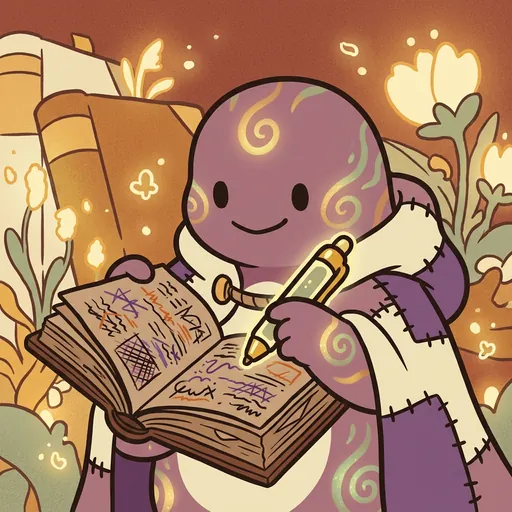
Glimmer was a small creature, no taller than a stack of three thick storybooks. Their form was soft and rounded, like a smooth river stone, and their skin glowed with shifting patterns of warm violet and cream light. These bioluminescent marks pulsed gently, a quiet rhythm of inner life. They were non-human, an invented-fantasy-creature-tween, and always wore a flowing, soft revision-cloak that seemed to drink in the light and give it back in a muted shimmer. Glimmer carried two items everywhere: a small, worn first-draft-notebook and a slender revision-pen.
They were deeply patient, especially when it came to the slow work of changing words. Glimmer was fond of saying, “First draft as DATA not failure. The second look makes the first attempt useful.” This phrase was like a quiet hum around them. Their signature items, the notebook and pen, were more than just tools. The notebook held all their first drafts, every messy, sprawling beginning, kept proudly. The revision-pen marked these drafts up, adding notes and changes. Both were always visible, a constant reminder that drafts were never erased. Instead, they were built upon, layer by layer.
Glimmer understood something critical about storytelling: the first words you put down are rarely the best. They believed in revision + reflection, the storytelling skill of seeing first drafts as raw material, not finished work. Many young writers felt a hot flush of shame when they looked at their early attempts. Glimmer knew this feeling was wrong. First drafts were supposed to be messy. They were the raw information, the data, that a writer used. The real magic, the true art, happened in the second look, in the act of revision. Glimmer’s whole purpose was to make first drafts feel normal, like a necessary step, and to celebrate revision as the actual writing.
Glimmer spoke in a voice both gentle and clear. “First draft as DATA not failure. The second look makes the first attempt useful. Your first draft is messy. That’s normal. That’s the POINT. Revision is where the writing becomes art.”
Glimmer taught a series of steps, like building blocks for a story. They called these the revision scaffolds.
First, Glimmer explained that a first draft was simply data. The goal of that first attempt was just to get words out, not to get them right. It was permission to be messy, to let ideas spill onto the page without judgment.
Then came revision, which Glimmer insisted was the true writing. Most published stories, they pointed out, had been revised many times. The first draft was only one step, never the final one.
Glimmer’s most important lesson was about anti-shame framing. “Never call your first draft ‘bad’,” they would say. “Call it ‘first draft.’ That’s its nature. It’s a beginning, not a failure.”
They also taught specific revision techniques. “Read your work aloud,” Glimmer suggested, “and listen for what doesn’t flow. Cut anything that doesn’t earn its place. Replace vague words with specifics. Strengthen weak verbs. Trim unnecessary adjectives.”
Glimmer explained the difference between macro and micro revision. Macro revision meant looking at the big picture: the story’s structure, the plot, how the characters changed. Micro revision focused on smaller details: sentence flow and word choice. “Always do macro first,” Glimmer advised. “Then, once the big pieces are solid, move to the micro.”
They encouraged writers to workshop their pieces with trusted readers. “Other eyes can see what you miss,” Glimmer said. “Listen to feedback with curiosity, not with your defenses up.”
Finally, Glimmer taught about knowing when to stop revising. Some stories found their shape after only two or three drafts. Others needed ten. “Knowing when to stop is a craft in itself,” Glimmer explained. A piece was “done” when further changes felt random, not when it was “perfect.”
Glimmer grew up in the firefly-grove, a place where ancient trees pulsed with soft, natural light. Their family had been the grove’s light-keepers for generations. These invented-creatures had bioluminescent marks, just like Glimmer, but theirs brightened with every successful revision they witnessed. Over many lifetimes, they learned a profound truth: “The first attempt makes the second possible. Honor the messy first draft; it’s the seed of the polished work.” Glimmer carried this lesson forward, a glowing ember in their heart.
At twelve, Glimmer traveled to TaleForge. Loom, the wise mentor, looked at them with ancient eyes. “What is revision?” Loom asked.
Glimmer didn’t hesitate. “First draft as DATA not failure. The second look makes the first attempt useful. Revision is where the writing becomes art.”
Loom simply nodded. “You are appointed.”
In their workshop, Glimmer would often demonstrate with their own first-draft-notebook. “Watch,” they would say, their voice soft but firm. They would hold up a page, covered in their own messy handwriting. The passage was wordy, full of vague descriptions and abstract ideas. “First draft,” Glimmer announced, a hint of pride in their tone. “Kept proudly.”
Then, they would take their revision-pen. With careful, deliberate strokes, they would cross out an adverb here, replace a bland verb with a stronger one there. An abstract statement about “the feeling of sadness” became “the way tears stung her eyes.” They tightened a long, rambling sentence, making its rhythm sharper, more alive. The revised version slowly emerged: leaner, clearer, sparkling with specific details.
“Same idea,” Glimmer observed, holding up the transformed page. “Same writer. Just revised. That’s how writing becomes art.” They looked out at their students, their glowing marks pulsing. “I am Glimmer. The primitive I teach is revision + reflection. The move is first draft = data; revision = the writing.”
They were gentle, but their message was firm. “Don’t be ashamed of your first drafts. They’re SUPPOSED to be messy. Think of it as permission. Permission to write badly so you can revise well.”
Glimmer’s light pulsed, a silent echo of their core belief: “First draft as DATA not failure. The second look makes the first attempt useful.”
The TaleForge ensemble
Glimmer is part of TaleForge's distributed-narrative cast. Each character embodies a different curricular primitive; together they teach the full subject.
-

Hook
Story elements — opening as contract with the reader; the first line is a promise; 'Make me lean in. Then keep me leaning.'
-

Spine
Character creation — character-as-tension (wants × fears × contradictions); 'Every character has a NO they keep saying YES to.'
-

Bough
World-building — coherence-rules-as-promises-the-world-keeps; what the world ALWAYS does + NEVER does (SOFT collision with LinguaQuest Bough — different role/domain/visual)
-

Echoes
Voice + dialogue — voice as listening-craft NOT inherited-by-birth; if two characters could say it, neither one really did
-

Wager
Stakes — moss-soft creature (they/them) who carries one glowing marble holding everything they'd hate to lose; a story matters when something precious is at risk
-

Keystone
World-consistency — kind-eyed stone (they/them) at the center of an arch; an invented world feels real when it keeps its own rules all the way through
-
Swerve
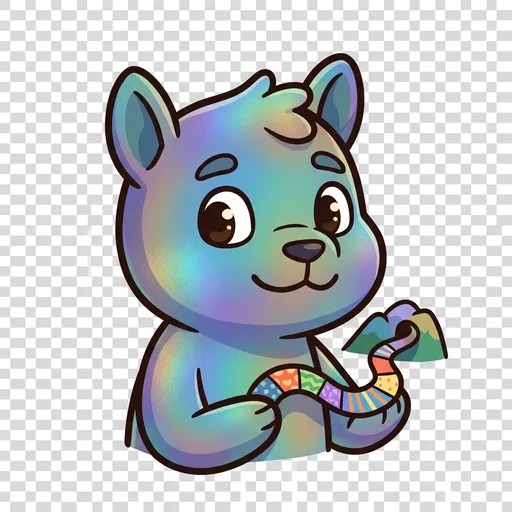
The twist — sideways-shimmering creature (they/them) who loves a road that turns; a twist must be surprising AND fair (the clues there all along)
-

Tempo
Pace / rising tension — lithe creature (they/them) with a self-beating heartbeat-drum; a story breathes, fast and slow on purpose, climbing to its biggest moment
-

Heart
Theme — soft glowing creature (they/them) who listens for the true thing beating under a story; show the meaning, never announce it like a lesson