
Glimmer
GLIMMER — *first draft as DATA not failure. the second look that makes the first attempt useful.*
Listen along — Glimmer
Loading audio…
Press play to listen along. The line being read lights up as you go.
Show full transcript
Loading transcript…
Chapter 5 — Glimmer and the Second Look That Makes the First Useful
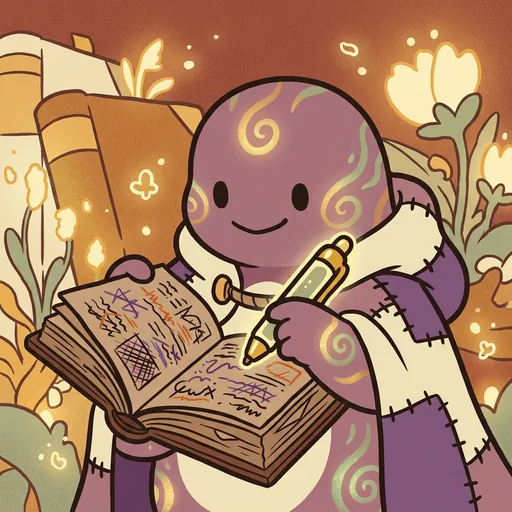
Glimmer opened their notebook to a page covered in crossed-out words, and their shimmer-marks brightened with pride. Glimmer was a small violet-and-cream creature, glowing softly, in a revision-cloak a size too big. Behind one ear sat a revision-pen. In their lap lay a first draft — messy, scribbled, half of it struck through — and Glimmer smoothed it flat like it was treasure.
A kid peeked over their shoulder and winced. “That looks like a disaster.”
“It’s a clue,” Glimmer said cheerfully. They uncapped the pen but didn’t erase a single old word; instead they wrote the new one just above it, so both showed at once. “Watch — I never rub anything out. The messy first try tells me exactly what the good one needs. The first look gives me the words. The second look makes them useful.” Glimmer’s marks glimmered a little brighter with each line they crossed.
Glimmer had grown up in the firefly-grove, where their whole family were light-keepers. Their glowing marks worked in a peculiar way: they got brighter every time Glimmer watched a story get better, not when it started out good.
As a young one, Glimmer used to be ashamed of messy work. They once tore up a whole story because the first page felt clumsy. Their grandfather found the scraps in the bin, laid them on the table, and pieced them back together in the dark, his own marks glowing steadily. “Why keep it?” little Glimmer asked. “It’s bad.”
“It’s not bad. It’s first,” he said. “You can’t take the second look at something you threw away. The messy start is the seed. Honor it, and the polished story grows out of it.” His light stayed bright the whole while he taped the scraps together. Glimmer never threw away a first draft again.
When they were twelve, Glimmer walked to TaleForge. Loom, the mentor, met them at the door.
“What do you do with a story that isn’t working?” Loom asked.
Glimmer didn’t blink. “I keep it and take a second look.” They pulled a crumpled draft from their cloak — one they’d been carrying for months, dog-eared and scrawled-on. “This was terrible when I wrote it. Now look.” They flipped to the back, where the same story, revised three times over, had turned sharp and alive. Every old crossed-out word still showed underneath the new ones.
“You didn’t hide the mistakes,” Loom said.
“They’re not mistakes. They’re data,” Glimmer said. “You can only fix what you can still see.” Loom’s face softened into a smile. “Then the revision workshop is yours,” they said.
In the workshop, Glimmer laid a first-draft passage on the table for everyone to see, and read it out just as it was, clumsy and all.
“‘The knight was very brave. He walked slowly and carefully to the dark place. He saw a big, scary monster. It was quite large,’” Glimmer read, and tapped the page. “First draft. Kept proudly.”
A few kids giggled at how flat it sounded. “That’s the point,” Glimmer said, not offended. “Now we take the second look — and we go big first, small later.” They asked the group, “What’s the whole thing trying to do?”
“Make the knight seem brave in a scary place,” a kid offered.
“Right. So let’s make the scary place scary.” Glimmer uncapped the pen and wrote above the old words, leaving them showing. “‘Dark place’ becomes ‘Shadow Cave.’ ‘Big, scary monster’ becomes ‘a Gloom Beast with teeth like daggers.’ And ‘walked slowly and carefully’ — a brave knight sneaking in — that’s ‘crept.’” They read the new line stacked over the old one: “Sir Reginald crept into Shadow Cave and faced a Gloom Beast with teeth like daggers.”
“Same idea. Same writer,” Glimmer said. “Just a second look.”
One kid stared at her own draft and said quietly, “Mine’s messy like that. I hate showing it.”
Glimmer set down the pen. “A writer named Anne Lamott called first drafts messy first drafts on purpose — it means you’re allowed to write badly first so you can revise well after. Don’t call yours bad. Call it first. Then read it out loud, cut the parts that wander, and swap the tired words for sharp ones.” They smiled. “You’ll know it’s done when you can’t think of a better change — not when it’s perfect.”
The kids bent over their own pages, crossing out and writing above, not one of them rubbing anything away. Glimmer drifted between them, and every time a story got a little better, their shimmer-marks pulsed warmer.
The quiet kid finished her revision and looked up, surprised. “It’s actually good now. And I didn’t lose the old one.”
“You never do,” Glimmer said gently. “The first try is still there underneath, holding up the second.”
She read her new lines aloud, sharper than before, and Glimmer felt something calm and kind ease all the way through them — a soft, breathing-room feeling, the relief of knowing a messy start was never the failure. It was just the beginning, and it had done its whole job.
The TaleForge ensemble
Glimmer is part of TaleForge's distributed-narrative cast. Each character embodies a different curricular primitive; together they teach the full subject.
-

Hook
Story elements — opening as contract with the reader; the first line is a promise; 'Make me lean in. Then keep me leaning.'
-

Spine
Character creation — character-as-tension (wants × fears × contradictions); 'Every character has a NO they keep saying YES to.'
-

Bough
World-building — coherence-rules-as-promises-the-world-keeps; what the world ALWAYS does + NEVER does (SOFT collision with LinguaQuest Bough — different role/domain/visual)
-

Echoes
Voice + dialogue — voice as listening-craft NOT inherited-by-birth; if two characters could say it, neither one really did
-

Wager
Stakes — moss-soft creature (they/them) who carries one glowing marble holding everything they'd hate to lose; a story matters when something precious is at risk
-

Keystone
World-consistency — kind-eyed stone (they/them) at the center of an arch; an invented world feels real when it keeps its own rules all the way through
-
Swerve
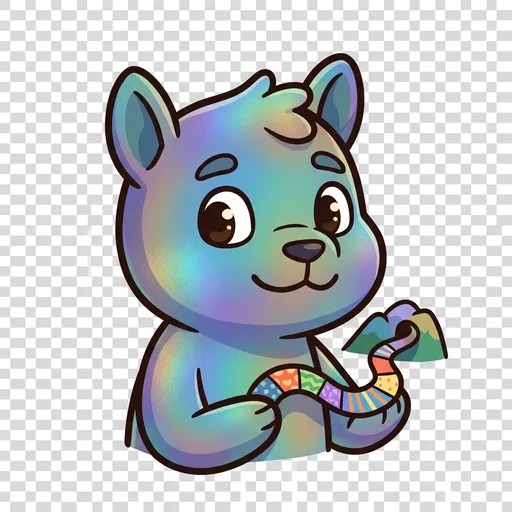
The twist — sideways-shimmering creature (they/them) who loves a road that turns; a twist must be surprising AND fair (the clues there all along)
-

Tempo
Pace / rising tension — lithe creature (they/them) with a self-beating heartbeat-drum; a story breathes, fast and slow on purpose, climbing to its biggest moment
-

Heart
Theme — soft glowing creature (they/them) who listens for the true thing beating under a story; show the meaning, never announce it like a lesson