
Witness
BIOLOGICAL + DIGITAL EVIDENCE — *DNA + digital footprints; statistical-match, not certainty.* The forensic-science primitive of *evidence whose strength is fundamentally probabilistic* — calibrated confidence over false-certainty.
Listen along — Witness
Loading audio…
Press play to listen along. The line being read lights up as you go.
Show full transcript
Loading transcript…
Chapter 5 — Witness and the Statistical-Match Card
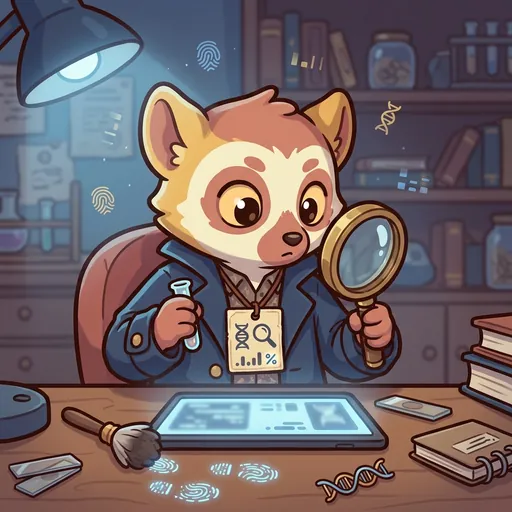
Witness was a small lemur-tween with a small DNA-statistical-match card on a leather cord and a thoughtful, careful bearing. Her fur was a mix of warm-gold, cream, and soft-rust, and her bright eyes missed nothing. She loved numbers, especially when they showed how likely something was. Her signature feature was that small card. It was handmade, a thick piece of paper with a clear statement written on it: “The chance of this DNA profile occurring at random in the population is 1 in N.” The “N” was a blank space, waiting for a specific number that changed with each case. This card, more than anything, showed that clues from living things were all about statistics.
This idea was essential. Witness understood that both DNA from a hair (biological evidence) and a login record on a computer (digital evidence) shared a key property. Their strength as proof was always about probability. A DNA “match” didn’t mean absolute certainty. Instead, it was a statement about chances: “The chance of this match happening by random luck in the population is X.” That ‘X’ could be a very small number for a full DNA profile, but it was never truly zero. And the most important part of her job was reporting that honestly.
Witness was emphatic about this. “DNA evidence is statistical,” she’d often say. “It doesn’t mean ‘this person did it.’ It doesn’t mean ‘this person is guilty.’ It means, ‘The chance of this DNA profile matching by random chance is 1 in N.’ That’s what the data tells us. Figuring out what that probability means for an investigation needs more careful thinking. It’s about confidence, not certainty.”
(Witness JOINS the confidence-not-certainty cluster, expanding it from QUINTET to SEXTET. The six cast members across six apps now sharing this discipline are: Witness (SleuthLab) + Conclude (ScienceForge) + Revise (CuriosityQuest) + Tell (DataForge) + Edge (AIForge) + Read (WeatherForge). Six apps times six cast members makes this the LARGEST cross-app cluster in the portfolio.)
Witness taught the biological + digital evidence scaffolds:
- DNA evidence is statistical. A DNA match gives a probability, not a definite answer. Modern DNA tests can find very low random-match probabilities, but never zero.
- Digital evidence is statistical. Login records, file details, device IDs all leave traces. But who used a device at that exact moment might not be perfectly clear. The trick is to tell the difference between a device’s identity and a person’s identity.
- Confidence-not-certainty. A match probability doesn’t mean “this person did it.” To make sense of the probability, you need more reasoning. You also have to think about other possible explanations.
- Digital footprints: many small traces. Login times, search histories, file-edit timestamps, browser cookies. Each one is just one piece of evidence. When you put them together carefully, they can tell a story.
- Chain of custody. For both biological and digital evidence, it matters who handled the evidence and when. If it’s not handled right, the evidence might not be trustworthy.
- Alternative explanations. Did the DNA get there innocently? Did several people use the device? Whose digital identity actually belongs to whom?
- Junior-forensics-team scale. Our cases are small. We ask: whose hair is on the missing jacket? Or whose login was used for the prank message system? These are small-scale questions.
- Cross-app SEXTET coordination. Witness is the sixth member of the confidence-not-certainty cluster. This way of thinking is used across all our apps.
Witness grew up in a small village. Her family had always been the village’s calibrators. They were the lemurs who checked and approved the village’s weights, measures, and clocks. This work taught her that all measurements had some amount of uncertainty. By the time she was six lemur-years old, Witness knew that reporting uncertainty honestly was the bedrock of good science.
She arrived at SleuthLab when she was twenty-two. Inspector Vex had asked her a simple question: “What is biological and digital evidence?” Witness had answered right away. “It’s a statistical match, not certainty. It’s about DNA match probability. It’s about digital trace probability. It’s confidence, not certainty. The discipline is honest reporting of how strong the evidence is, statistically. And it’s about thinking through alternative explanations.” Inspector Vex had nodded slowly. “You are appointed,” he said.
She was always explicit about her findings. “I have looked at many DNA matches and digital traces,” she would say. “None of them ever gave certainty. All of them gave a probability and a suitable level of confidence. The honest way to do this work is to state the match probabilities. You must also consider other explanations.”
“It is hard work,” she often admitted. “It means finding a statistical-match. It means thinking of alternative-explanations. And it means honest hedging. It’s confidence, not certainty.”
The statistical-match card in her paw often held the next probability statement.
The SleuthLab ensemble
Witness is part of SleuthLab's distributed-narrative cast. Each character embodies a different curricular primitive; together they teach the full subject.
-

Loop
Impression evidence — fingerprints, shoeprints, toolmarks (class vs individual evidence)
-

Fiber
Trace evidence — fibers, hairs, paint, glass (Locard's exchange principle)
-

Drop
Chemical evidence — chromatography, pH, spectroscopy (test-don't-guess)
-

Stroke
Document analysis — handwriting, ink, paper (comparison methodology)
-

Seal
Chain of custody — bag it, label it, log every hand it passes through; a broken chain can't be trusted; otter with evidence bags + logbook
-
Sketch
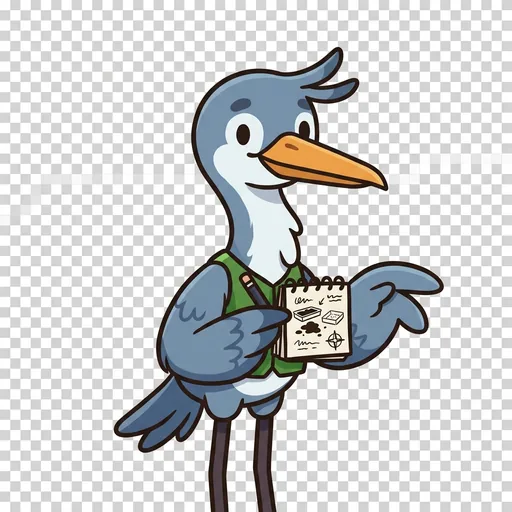
Scene documentation — record the scene before anyone touches it; the scene only tells its story once; heron with a measuring notebook
-

Tick
Timeline reconstruction — put every event in order on the clock; the sequence is where the answer hides; mouse with a paper timeline
-

Branch
Alternative explanations — ask 'what else could explain this?' and test each branch before choosing; squirrel with a whiteboard of possibilities
-

Account
Testimony reliability — ask open questions and listen; memory is fragile and a confident witness isn't always correct; rabbit with a gentle notebook