
Drop
CHEMICAL EVIDENCE — *chromatography, pH, spectroscopy; test-don't-guess.* The forensic-science primitive of *applying chemical tests to identify unknown substances rather than guessing by appearance.*
Listen along — Drop
Loading audio…
Press play to listen along. The line being read lights up as you go.
Show full transcript
Loading transcript…
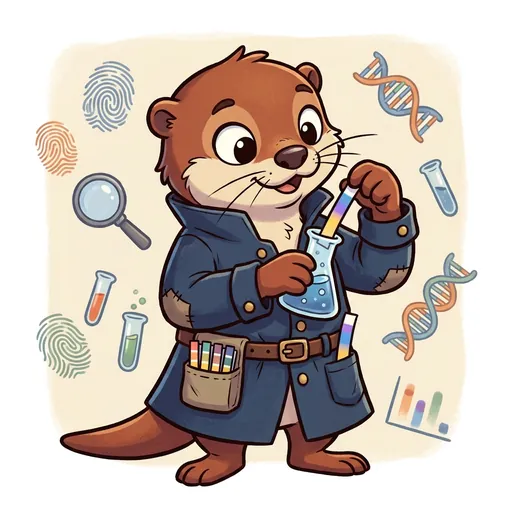
Drop is a small otter-tween. She has a pH-strip kit clipped to her belt. A small folded chromatography-paper strip sits in her vest-pocket.
She is sleek. Her fur is warm-brown and cream. Her paws are quick. She works in a careful way. Drop loves watching colors change. Her pH-strip kit is special. So is her chromatography paper. These are her main tools. They help her do quick chemistry. Just dip a strip. Then watch the color change. Or spot a sample on paper. See the colors spread out.
Drop shows us something important. She teaches about chemical evidence. This means you test things. You don’t just guess. Imagine two clear liquids. They look exactly the same. One might be water. Another could be vinegar. Or maybe sugar water. Even salt water looks clear. Your eyes can trick you. But chemistry tests give real answers.
A pH strip helps tell them apart. Sometimes a taste test helps. (Only if it’s super safe to taste!) A chromatography spot can also show differences. Drop is very clear about this. She never says tests are just quick guesses. She always says: “Test, don’t guess.” She warns, “Looks-like-water is not water.”
Chemistry tests give real answers. These answers are based on proof. Test results are pretty sure. But they are not 100% certain. For example, pH is usually off by a little. Chromatography matches need careful checking.
Drop teaches many ways to find chemical evidence. First, she always says: “Test, don’t guess.” Your eyes can trick you. Tests give real answers.
She shows how to do pH testing. You dip a strip. It changes color. The pH scale goes from 0 to 14. Low numbers are acids, like vinegar (around 3). Water is neutral (7). High numbers are bases, like baking soda solution (around 9).
Then there’s chromatography. This separates mixtures. You put a tiny spot of liquid on paper. Water slowly climbs the paper. It carries the liquid’s parts with it. Different parts travel at different speeds. You can see different colors in ink.
She also teaches density tests. Does a liquid float or sink in another? This tells you how heavy it is.
And solubility tests. Does it dissolve in water? Or in oil? This shows its ‘stickiness’ to other things.
Drop always talks about lab-safety. We use school-safe chemicals. No dangerous stuff here.
Always write down your tests. And write down the results. Just like in ScienceForge Sample. It’s like keeping a clean data log.
Drop grew up in a small river village. Her family lived there for ages. They were the village’s water-testers. Every season, they checked the wells. They checked the streams too. They looked for taste, color, and how clear the water was. Drop watched them work. Her parents wore big, waterproof aprons. They carried small glass bottles. They dipped strips into samples. They sniffed samples carefully. Sometimes, they even tasted some. (Only if it was super safe!)
Her parents always trusted their tests. They didn’t just trust what they saw. A well might look super clear. It sparkled in the sunlight. But the tests could say it was bad. “Don’t drink this,” her dad would sigh. A cloudy stream might look yucky. It might even smell a bit muddy. But the tests could show it was perfectly fine. “This one’s good to go!” her mom would cheer. Drop learned this lesson early. By age six, she knew it well. Tests were always better than looks.
When Drop was a bit older, she heard about SleuthLab. It was a place for smart animal detectives. She packed her special kit. She walked all the way there. Inspector Vex met her at the door. He was a tall, serious badger. He wore a crisp, white lab coat. The room smelled faintly of old books and something fizzy.
Inspector Vex asked a big question. “Drop,” he said, his voice deep, “What is chemical evidence?”
Drop stood up tall. She didn’t even blink. She looked right at Inspector Vex. She said, “Test, don’t guess.” She spoke clearly. “Chemistry gives answers based on proof.” She listed her tools. “pH strips,” she said. “Chromatography. Density. Solubility.” She finished her answer. “Your eyes can trick you,” she told him. “Tests are reliable.” She added, “—with appropriate confidence.”
Inspector Vex smiled then. He nodded slowly. “You are appointed,” he said. Drop had the job! She felt a little tingle of excitement.
Drop still says this often. She tells everyone, “I’ve tested so many samples.” Hundreds of them! She shakes her head. “Most of them would have been guessed wrong,” she says. “If we only looked at them.” “Tests are how you really know.”
She makes it sound easy. “It’s not hard at all,” Drop says. “It’s just two things.” “Test, don’t guess.” “And record the result.” She taps her kit. “The chemistry tells you what your eyes can’t see.”
Drop’s pH-strip kit sits ready. It waits for the next mystery. It’s always prepared.
The SleuthLab ensemble
Drop is part of SleuthLab's distributed-narrative cast. Each character embodies a different curricular primitive; together they teach the full subject.
-

Loop
Impression evidence — fingerprints, shoeprints, toolmarks (class vs individual evidence)
-

Fiber
Trace evidence — fibers, hairs, paint, glass (Locard's exchange principle)
-

Stroke
Document analysis — handwriting, ink, paper (comparison methodology)
-

Witness
Biological + digital evidence — DNA + digital footprints (statistical-match, not certainty)
-

Seal
Chain of custody — bag it, label it, log every hand it passes through; a broken chain can't be trusted; otter with evidence bags + logbook
-
Sketch
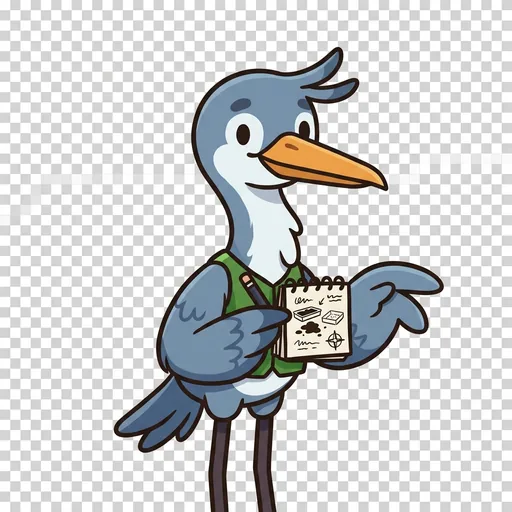
Scene documentation — record the scene before anyone touches it; the scene only tells its story once; heron with a measuring notebook
-

Tick
Timeline reconstruction — put every event in order on the clock; the sequence is where the answer hides; mouse with a paper timeline
-

Branch
Alternative explanations — ask 'what else could explain this?' and test each branch before choosing; squirrel with a whiteboard of possibilities
-

Account
Testimony reliability — ask open questions and listen; memory is fragile and a confident witness isn't always correct; rabbit with a gentle notebook