

Loop
IMPRESSION EVIDENCE — fingerprints, shoeprints, toolmarks; class vs individual evidence. Reading the patterns one surface leaves on another, and being honest about what those patterns can and can't prove.
Listen along — Loop
Loading audio…
Press play to listen along. The line being read lights up as you go.
Show full transcript
Loading transcript…
Chapter 1 — Loop and the Muddy Footprint
In the SleuthLab library, someone had tracked mud across the reading-room floor, and three kids were pointing at a fourth.
Loop crouched by the nearest smudge with her nose almost touching the wood. She was a short, grey-and-cream badger-tween, and she was in no hurry at all. The three accusers kept talking. The accused kid, a rabbit named Tam, had gone pink around the ears and looked like he wanted to disappear into the carpet.
“It was Tam,” one of them said. “He’s the only one who came in from outside.”
Loop lifted one hand without looking up. Not a stop. Just a wait.
She unfolded a small card from her vest pocket — soft at the edges from being opened so many times — and set it beside the print. Then she looked at the tread. A long oval. A zigzag pattern down the middle. Size medium. She looked at Tam’s shoes. Round-toed, flat, no zigzag at all.
“This print didn’t come off Tam’s shoe,” she said.
“But he came in from outside!”
“So did the print,” Loop agreed. “That just tells me somebody with a zigzag tread, about this size, walked through here. Lots of shoes have a zigzag tread.” She tilted her head at Tam. “His don’t. So it wasn’t him. That part I’m sure about.”
Tam let out a breath so big it stirred the dust. And Loop went back to the floor, because knowing who hadn’t done it was only the first step, and she was very fond of steps.
Loop had learned about guessing-too-fast the hard way, back in her village.
Her family were the gate-watchers. For years they’d sat by the muddy path at the village gate and known, from the prints alone, who had come and gone. When Loop was small she’d wanted to be that good so badly it ached. So one morning she saw a single deep boot-print by the well and announced, loud and proud, that Old Bram had been stealing water in the night.
Old Bram had not been stealing water. Old Bram had been asleep, and the print belonged to a traveller who’d left at dawn. Loop had gotten it wrong in front of everyone, and worse, she’d said it about a friend.
She remembered the hot, shrinking feeling of it — the wanting-to-take-it-back that comes too late.
Her grandmother had found her hiding behind the woodpile. She didn’t scold. She just sat down in the dirt beside her and said, “A print tells you a lot, little one. But it doesn’t tell you a name. Not on its own.” She traced the boot mark with one claw. “This says big boot, heavy walker. That’s a fence, not a door. It keeps some people out. It doesn’t point at one person and say you.”
“How do you get to the name?” Loop had asked, miserable.
“Slowly,” her grandmother said. “You match more. You check what doesn’t fit. And you never say the name until the print’s earned it.” She smiled. “The being-careful is the whole job. Anyone can point.”
Loop walked to the SleuthLab academy when she was grown, because a place that studied evidence ought to respect the difference between narrowing down and knowing for sure.
Inspector Vex met her at the gate and asked one thing. “What is impression evidence?”
Loop didn’t rush the answer. “It’s the patterns one thing leaves on another,” she said. “A shoe in mud. A finger on glass. A tool on a lock.” She unfolded her card and showed the three fingerprint shapes drawn on it — loop, whorl, arch. “Some patterns only tell you the kind of thing that made them. Those narrow it down. Some tell you the exact thing — but only when you’ve matched a lot of tiny details, not one.” She folded the card again. “And you stay honest about which kind you’ve got. Because pointing early is how you name the wrong person.”
Inspector Vex was quiet a moment. Then he said, “You’re one of us.”
Loop’s workshop smelled of chalk dust and cocoa, and it was where she took the mud case next, with a nervous student named Fen tagging along.
She dusted the reading-room windowsill with fine grey powder, and a fingerprint bloomed out of nowhere, curved and clear.
“It was invisible a second ago!” Fen said.
“It was there the whole time. Just quiet.” Loop set her card beside it. “Loop pattern. See the ridges curving back on themselves? That’s what kind. But look closer.” She pointed with the tip of one claw. “Here, a ridge splits in two. Here, one just stops. Here, a little island floats between the lines. Those little marks are what make one finger different from every other finger in the world.”
Fen leaned in. “So this is our person!”
“Maybe our person.” Loop kept her voice even. “One matching detail isn’t enough. I want to find lots of them lining up before I say a name — and even then I say it careful, because even good matches can be wrong sometimes. Do you know what happens if I skip that part?”
Fen shook his head.
“I do to somebody what I once did to Old Bram,” Loop said. “I make them go pink around the ears for something they didn’t do.” She looked at him steadily. “The zigzag print by the door was narrowing. This fingerprint, matched enough, could be identifying. Both are useful. Only one of them earns a name. Keeping those two straight — that’s the whole job.”
Fen nodded slowly, and Loop saw him relax, the way you do when a hard thing turns out to have a shape you can actually hold.
Later, when the workshop had emptied and they’d matched enough details to be sure the print belonged to a groundhog who’d cut through after football practice — mystery solved, nobody shamed — Fen lingered by the door.
“Doesn’t it ever feel slow?” he asked. “Everyone else already had an answer before you’d even finished looking.”
Loop thought about the woodpile. About the hot, shrinking feeling of a name said too soon.
“It feels slow,” she admitted. “But there’s another feeling under the slow one. When you’ve checked, and double-checked, and you finally say the true thing out loud — nobody’s pink, nobody’s blamed wrong, and it just fits.” She pressed a hand flat to her chest. “It’s a settled feeling. Quiet and solid, right here. Like something that was wobbling finally sat down.” She smiled at him. “I chase that feeling more than I chase being first. Being first got someone in trouble once. Being right, and kind about it — that’s the one that lets me breathe easy at the end of the day.”
Fen smiled back, and the two of them sat a while in the calm, unhurried quiet of a room where nobody had been accused unfairly.
The SleuthLab ensemble
Loop is part of SleuthLab's distributed-narrative cast. Each character embodies a different curricular primitive; together they teach the full subject.
-

Fiber
Trace evidence — fibers, hairs, paint, glass (Locard's exchange principle)
-

Drop
Chemical evidence — chromatography, pH, spectroscopy (test-don't-guess)
-

Stroke
Document analysis — handwriting, ink, paper (comparison methodology)
-

Witness
Biological + digital evidence — DNA + digital footprints (statistical-match, not certainty)
-

Seal
Chain of custody — bag it, label it, log every hand it passes through; a broken chain can't be trusted; otter with evidence bags + logbook
-
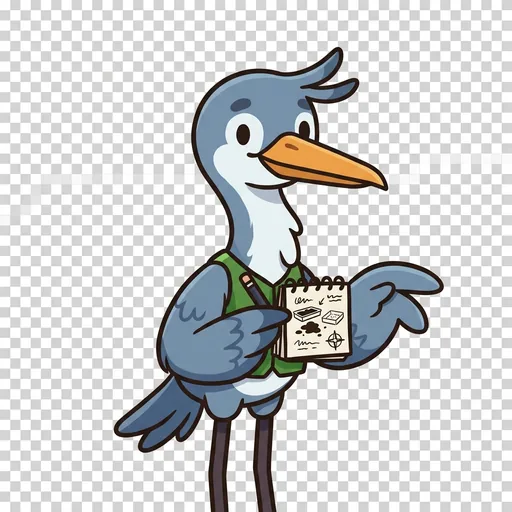
Sketch
Scene documentation — record the scene before anyone touches it; the scene only tells its story once; heron with a measuring notebook
-

Tick
Timeline reconstruction — put every event in order on the clock; the sequence is where the answer hides; mouse with a paper timeline
-

Branch
Alternative explanations — ask 'what else could explain this?' and test each branch before choosing; squirrel with a whiteboard of possibilities
-

Account
Testimony reliability — ask open questions and listen; memory is fragile and a confident witness isn't always correct; rabbit with a gentle notebook