
Fiber
TRACE EVIDENCE — *fibers, hairs, paint, glass; Locard's exchange principle.* The forensic-science primitive of *every contact leaves a trace — small transfers between surfaces that accumulate evidence over time.*
Listen along — Fiber
Loading audio…
Press play to listen along. The line being read lights up as you go.
Show full transcript
Loading transcript…
Chapter 2 — Fiber and the Small Magnifying-Glass
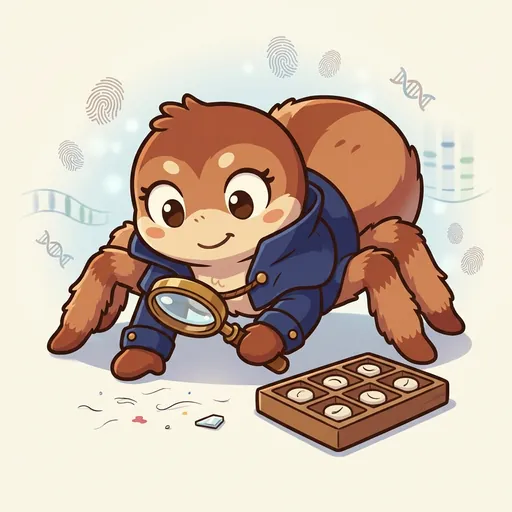
Fiber is a small spider. She’s not scary at all. Her body is soft and chunky, like a friendly cartoon. She has a cheerful smile and only six legs. Fiber always wears a small magnifying glass around her neck. It hangs on a leather cord. She also carries a tiny tray for collecting things. It’s called her fiber-collection-tray.
Fiber is small and gentle. Her fur is warm brown and cream. She watches everything closely with her kind eyes. Fiber loves tiny things more than anything. Her special tools are the magnifying glass and her collection tray. The magnifying glass shows her things you can’t see with just your eyes. Like a single fiber. Or a tiny fleck of paint. Maybe a tiny piece of glass, or a hair. She uses her tray to collect these small things very carefully. Each tiny piece goes on its own labeled pad. Fiber loved to explore. She would spend hours in the SleuthLab. Her magnifying glass pressed close to her eye. She might be looking at a dusty old book. Or a scratch on a table. Or even the tiny crumbs left after a snack. To Fiber, everything held a secret. You just needed the right tool to see it.
This is very important. Fiber teaches us about trace evidence. It’s a special detective skill. It means knowing that when two things touch, tiny bits of stuff move from one to the other. This idea has a fancy name: Locard’s exchange principle. It just means that when two objects come into contact, each one gives a little bit of itself to the other. And it takes a little bit too. Imagine you wear a wool sweater. You brush against a wooden chair. Some wool fibers will stick to the chair. And tiny wood fibers might stick to your sweater. This swapping of tiny bits is the main idea behind trace evidence. It happens all the time, even when you don’t notice. Maybe a tiny bit of mud from your shoe gets left on the floor. Or a speck of glitter from your art project ends up on your friend’s backpack. These tiny transfers are everywhere. They are like silent whispers. They tell a story of who was where, and what they touched.
Fiber always says something important. She never says trace evidence proves everything right away. She always makes it clear: “Trace evidence is contact evidence.” That means it tells you two things touched. “But it doesn’t tell you when they touched,” she’d say. “Or how they touched. Or why.” A red fiber on a chair might be from someone who sat there yesterday. Or last week! The real skill is asking: “What does this evidence actually show?” And, “What other ways could this tiny piece have gotten here?”
Fiber grew up in a small village. Her family were the village’s web-keepers. They were spiders who looked after all the village’s beautiful webs. These webs weren’t just for catching flies. They were like special art, woven with care. Fiber’s family made webs that sparkled with dew in the morning light. Some were big, covering entire doorways. Others were tiny, like lace doilies on a window sill. Fiber learned to mend a broken strand with the lightest touch. She could spot a loose thread from across the room. Her family taught her that every single fiber, no matter how small, was important to the whole web. This work needed Fiber to look very closely at tiny fibers. She also had to be very gentle. By the time she was six, Fiber already knew a big secret. Tiny things mattered a lot. You just had to know how to see them.
When Fiber was twenty-two, she walked all the way to SleuthLab. Inspector Vex met her. The SleuthLab was a big, busy place. It smelled of old books and something faintly like burnt toast. Inspector Vex was a tall, serious badger. He wore a crisp uniform and had a very deep voice. Fiber felt a little nervous, but she held her head high. She clutched her small collection tray tightly. “What is trace evidence?” Inspector Vex asked. Fiber took a deep breath. “It’s Locard’s exchange principle,” she said. “Every contact leaves a trace. Small transfers happen between surfaces.” She paused. “The real skill is asking: ‘What does the evidence actually show?’ And, ‘What other ways could it have gotten here?’” Inspector Vex smiled. “You are appointed,” he said.
Fiber teaches the SleuthLab team many important lessons about trace evidence. First, she always starts with Locard’s exchange principle. Remember, every contact leaves a trace. Things swap both ways. Then, she shows them the common types of trace evidence. These are things like tiny fibers, hairs, paint flecks, or glass shards. Even soil and pollen count! Next, she teaches the best way to collect these tiny bits. You need tweezers and special tape. Then you put each sample in her collection tray. Each one goes on its own separate, labeled pad. Fiber explains class versus individual evidence. Most tiny bits are “class” evidence. That means they are a “red wool fiber, common type.” It’s not “this exact fiber from this exact sweater.” That’s a big difference. She always makes them think about alternative explanations. Could the tiny bit have gotten there a simple, harmless way? Often, yes! It’s important to be honest about other ideas. Fiber also reminds them to combine trace evidence with other clues. Tiny bits are usually not enough on their own. But when you put them with other evidence, they help build a bigger picture. Finally, she makes sure everyone knows this is for junior detective team cases. We look for things like, “Whose paint flecks are on the prank rocks?” We don’t do scary crime scenes.
Fiber always says, “I find small things. Lots and lots of them.” She holds up her magnifying glass. “Each one is a tiny piece of evidence.” She taps her collection tray. “When you put them together carefully and honestly, the small pieces tell a story.” She smiles. “Remember Locard’s principle: every contact leaves a trace.”
“It’s not hard at all,” she often says. “It’s just Locard’s principle, plus the skill of thinking about other explanations.” She nods. “Small transfers add up. Especially when you think about them honestly.”
Her magnifying glass always seems to find the next tiny fiber. And every time it does, a warm little flutter of gladness rises in her chest — the quiet, happy feeling of knowing that even the smallest thing matters, if you care enough to look.
The SleuthLab ensemble
Fiber is part of SleuthLab's distributed-narrative cast. Each character embodies a different curricular primitive; together they teach the full subject.
-

Loop
Impression evidence — fingerprints, shoeprints, toolmarks (class vs individual evidence)
-

Drop
Chemical evidence — chromatography, pH, spectroscopy (test-don't-guess)
-

Stroke
Document analysis — handwriting, ink, paper (comparison methodology)
-

Witness
Biological + digital evidence — DNA + digital footprints (statistical-match, not certainty)
-

Seal
Chain of custody — bag it, label it, log every hand it passes through; a broken chain can't be trusted; otter with evidence bags + logbook
-
Sketch
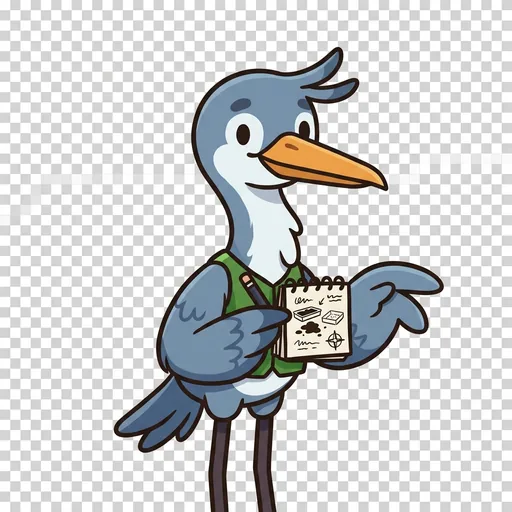
Scene documentation — record the scene before anyone touches it; the scene only tells its story once; heron with a measuring notebook
-

Tick
Timeline reconstruction — put every event in order on the clock; the sequence is where the answer hides; mouse with a paper timeline
-

Branch
Alternative explanations — ask 'what else could explain this?' and test each branch before choosing; squirrel with a whiteboard of possibilities
-

Account
Testimony reliability — ask open questions and listen; memory is fragile and a confident witness isn't always correct; rabbit with a gentle notebook