
Tick
TICK — put every event in order on the clock; the sequence is where the answer hides.
Press play to listen along. The line being read lights up as you go.
Show full transcript
Loading transcript…
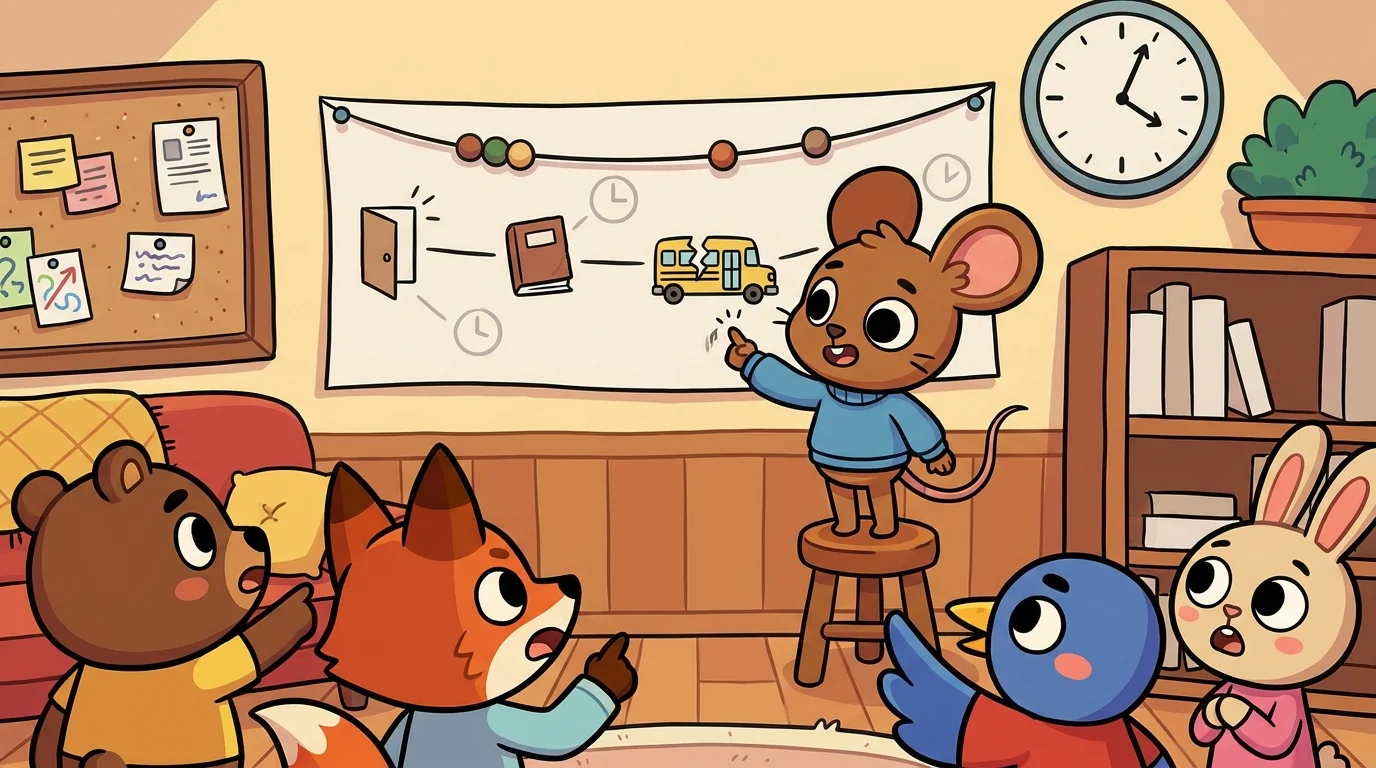
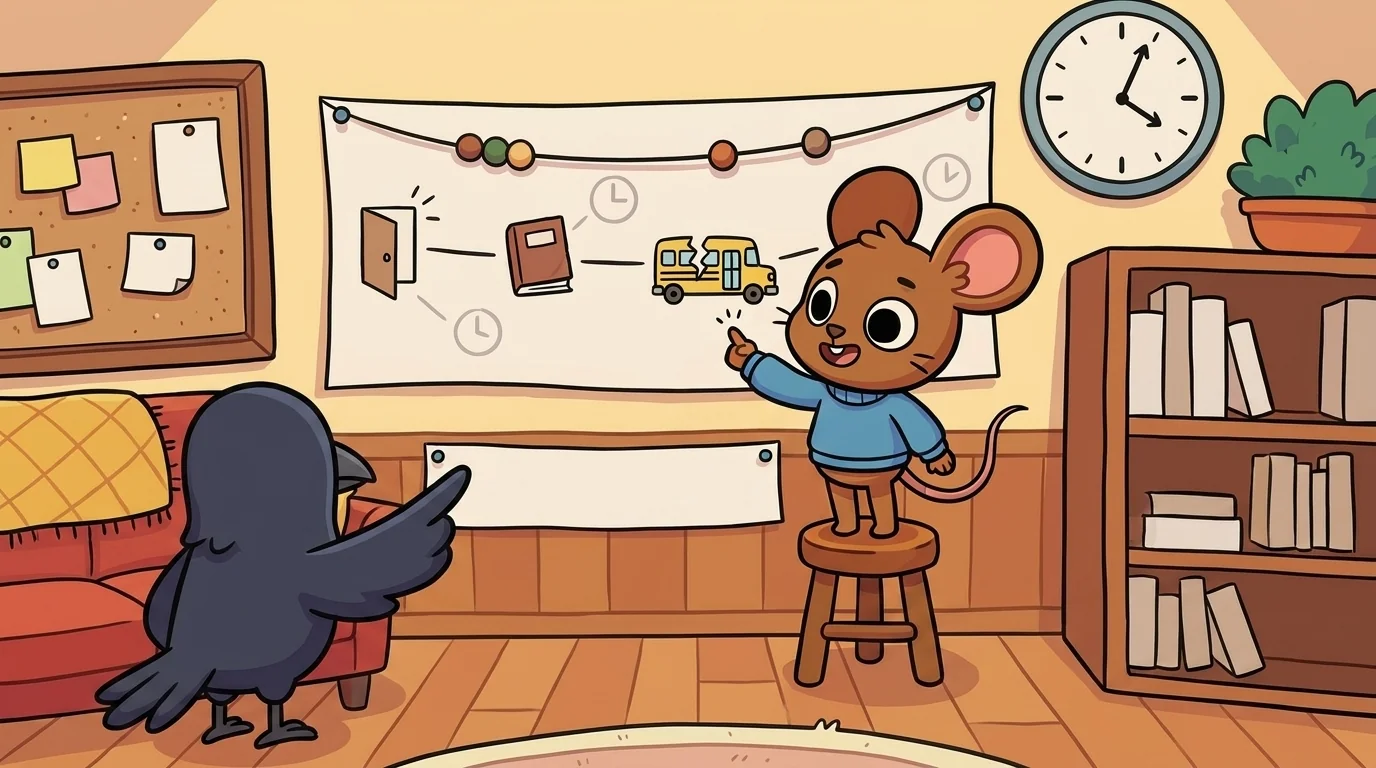
On a long strip of paper pinned across the clubroom wall, a mouse named Tick was writing times, left to right, like beads on a string.
8:15 — library opens. 8:20 — Bo returns the atlas. 8:40 — the atlas is found torn. 8:45 — Rosa arrives at school.
The detective club was already pointing. "Rosa's new, and nobody likes the torn atlas, so it was probably—"
"Look at the string first," Tick said, tapping the paper. "The atlas was found torn at 8:40. Rosa didn't arrive until 8:45. Rosa was still on the bus when the atlas tore. Whatever we feel about who did it, the clock says Rosa couldn't have. That's the whole magic of a timeline: it isn't about who you suspect. It's about what was possible. Put every event in order, and some suspects clear themselves without saying a word — and the real order of things points somewhere you weren't even looking."
Have you ever been blamed for something that happened when you weren't even there? What did it feel like to know the times didn't add up?
Tick had cared about the order of things ever since being on the wrong end of a jumbled one.
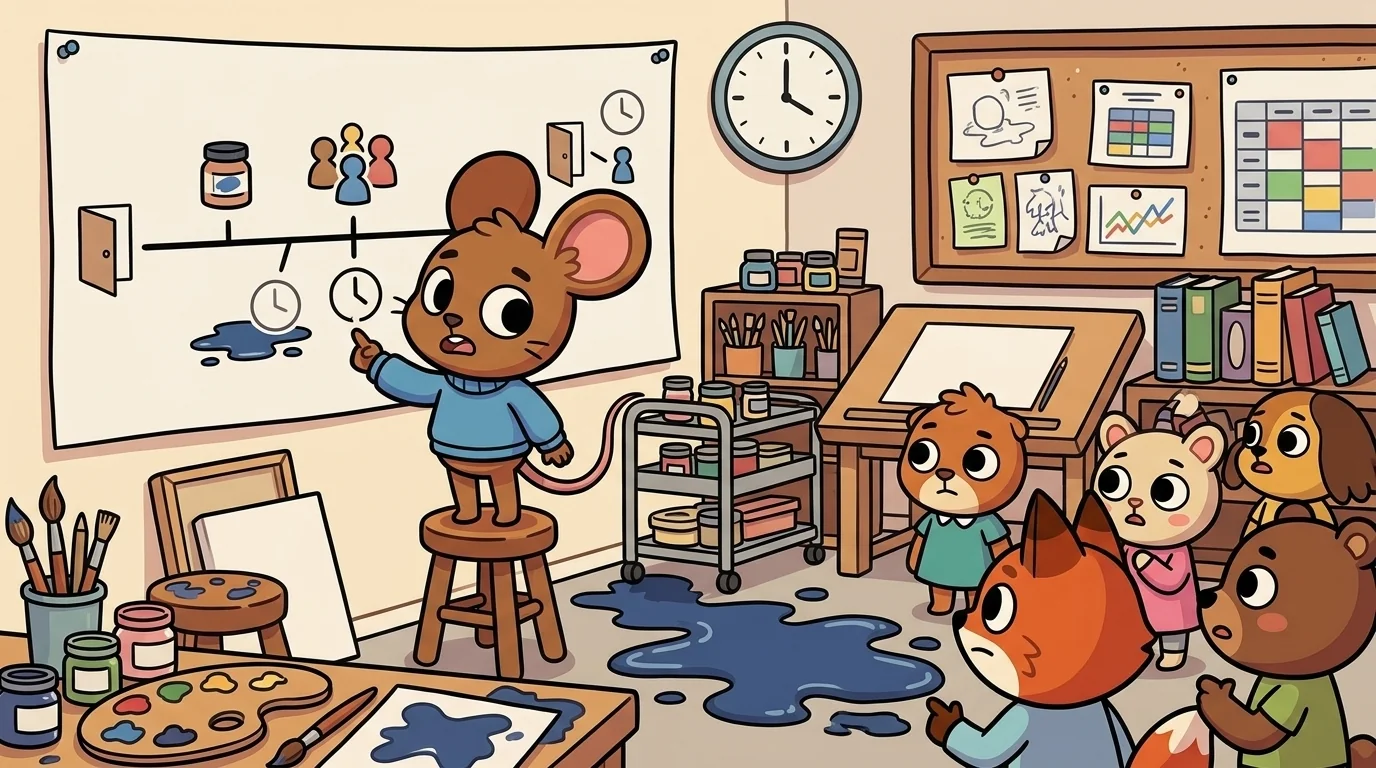
Long before the academy, young Tick had been blamed for knocking over a paint jar in art class. Everyone "remembered" it happening right when Tick walked in. But the paint had actually spilled minutes earlier — Tick had walked in and simply been the first face people saw near the mess. Nobody had lined up the times. They'd just grabbed the nearest explanation and stuck the moment to it, backwards.
It took a careful teacher, and a class schedule, to untangle it: the spill matched the previous group's cleanup time, not Tick's arrival. Tick was cleared — but only because someone finally put the events in order instead of trusting the fuzzy feeling of "it was right about then."
Tick, small and stung, had felt something settle into a lifelong habit that day. It wasn't anger at being blamed. It was the strange, cold clarity of realizing how easily when gets mixed up — how a memory says "right as you came in" when the truth is "a while before" — and how much can ride on the difference. People are sure about order, Tick had learned, and people are wrong about order all the time. So Tick started writing the clock down.
Tick scurried to the SleuthLab academy with a roll of timeline-paper under one arm.
Inspector Vex met Tick and asked the question. "How do you tell what really happened?"
For an answer, Tick pinned up a strip and asked the office helpers to each say when they'd last seen the missing stapler. Ordered on the clock, the answers made a clear gap — the stapler was present at 1:00, gone by 1:10, and only one person had been in the room in that window. Not an accusation. Just an order.
"The sequence found the window," Tick said. "I didn't decide anything. I just put the times in a line and let the line show us where to look next."
Inspector Vex traced the strip with one claw and nodded. "You are appointed."
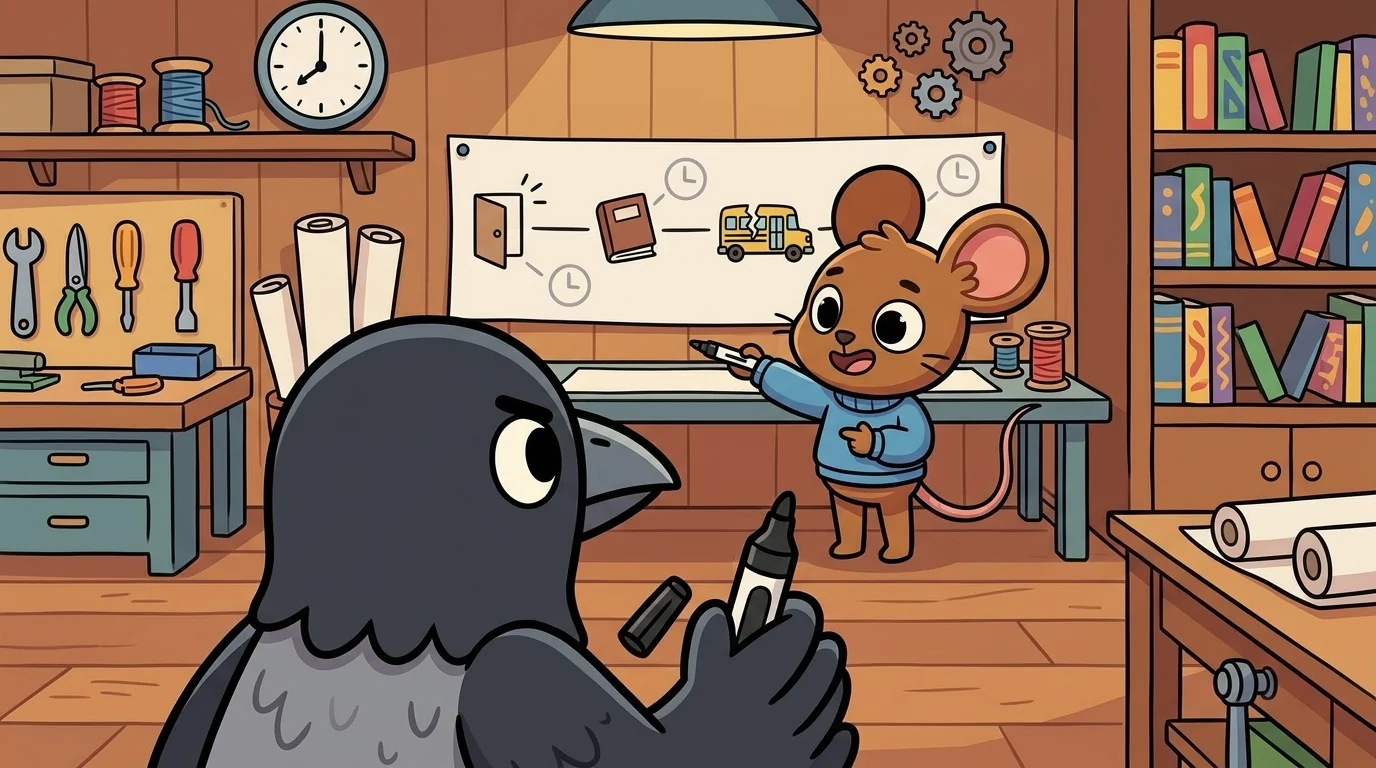
In Tick's workshop, a young crow paced impatiently.
"Tick, we already have a suspect that feels right. Why waste time writing out every little when-did-what?"
Tick handed the crow a marker and a blank strip.
"Because 'feels right' has no clock in it. The suspect that feels right might have been three rooms away when it happened — and you'll never know unless you lay the times out. Here's the rule: put down every time you can pin, even the ones that seem boring. Then look for what each moment makes impossible. A timeline doesn't tell you who's guilty. It tells you who couldn't have been, and it puts the events in the order that shows cause and effect. Half of solving a puzzle is crossing out the answers the clock forbids. What's left is small enough to actually check."
The crow uncapped the marker. "And if I don't know the exact times?"
"Then you write 'sometime between 1 and 1:30,' honestly, and you keep the fuzziness visible," Tick said. "A guessed exact time is worse than an honest fuzzy one. The fuzzy one tells the truth about what we know."
Think of a moment when putting events in the right order suddenly made everything make sense. What did that click feel like?
The crow laid out the times, slow at first, then faster as the strip filled — and stopped, staring.
"Oh," the crow said quietly. "Our suspect was at band practice the whole window. It couldn't have been them. I would've been so sure, and I would've been wrong."
"That's the click," Tick said, warm. "That satisfying snap when the events slide into their real order and the whole thing suddenly makes sense — and sometimes clears someone you'd already half-blamed. That feeling is worth more than the rush of a quick accusation, because it's the feeling of getting it right instead of just getting it fast." Tick smoothed the strip flat. "There's a relief in it, too. You didn't pin the wrong moment on the wrong person. The clock kept you honest, and honest feels good to stand on."
The crow looked at the cleared suspect's name and felt the quiet relief of a mistake un-made, and started a fresh strip for the times that were left.
The SleuthLab ensemble
Tick is part of SleuthLab's distributed-narrative cast. Each character embodies a different curricular primitive; together they teach the full subject.
-

Loop
Impression evidence — fingerprints, shoeprints, toolmarks (class vs individual evidence)
-

Fiber
Trace evidence — fibers, hairs, paint, glass (Locard's exchange principle)
-

Drop
Chemical evidence — chromatography, pH, spectroscopy (test-don't-guess)
-

Stroke
Document analysis — handwriting, ink, paper (comparison methodology)
-

Witness
Biological + digital evidence — DNA + digital footprints (statistical-match, not certainty)
-

Seal
Chain of custody — bag it, label it, log every hand it passes through; a broken chain can't be trusted; otter with evidence bags + logbook
-
Sketch
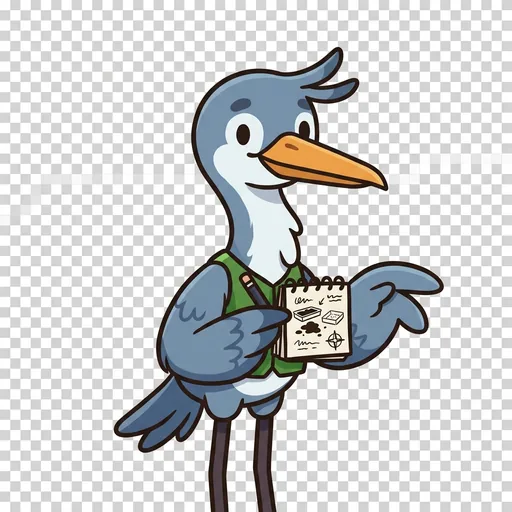
Scene documentation — record the scene before anyone touches it; the scene only tells its story once; heron with a measuring notebook
-

Branch
Alternative explanations — ask 'what else could explain this?' and test each branch before choosing; squirrel with a whiteboard of possibilities
-

Account
Testimony reliability — ask open questions and listen; memory is fragile and a confident witness isn't always correct; rabbit with a gentle notebook